
债市

Search documents
国泰海通|固收:基金费率新规落地如何影响债市
国泰海通证券研究· 2026-01-04 13:14
Core Viewpoint - The new regulations on sales fees for publicly offered securities investment funds will take effect on January 1, 2026, with specific exemptions for redemption fees on certain bond and index funds, which is expected to stabilize the bond market and reduce redemption pressure on bond funds [1][2]. Group 1: Regulatory Changes - The revised regulations provide exemptions for redemption fees for individual investors holding index and bond funds for more than 7 days, and for institutional investors holding bond funds for more than 30 days [1]. - The transition period for existing funds that do not comply with the new regulations is set at 12 months, which is more lenient compared to the previous draft [1]. Group 2: Market Impact - The new rules are expected to alleviate the passive redemption pressure on bond funds, thereby supporting the bond market [1]. - If the central bank resumes the buying and selling of government bonds, it could further stabilize the long-term bonds, leading to a gradual decline in deposit rates [1]. Group 3: Fund Types and Performance - The stability of the liability side for bond funds is expected to benefit medium to high-grade, medium to long-term credit bonds and perpetual bonds, with flexible trading funds being the main buyers [2]. - Short-term bond funds may see reduced liquidity advantages as the exemption threshold for institutional investors has increased from 7 days to 30 days, potentially shifting funds towards money market funds or bond fund ETFs [2]. - Bond ETFs are projected to grow significantly, with net asset value expected to exceed 800 billion yuan by 2025, reflecting a year-on-year increase of over 370% [2]. Group 4: Fee Structure Changes - The new fee structure allows for a maximum subscription fee of 0.8% for actively managed equity funds and 0.5% for other mixed funds, while bond funds can charge up to 0.5% [3]. - Redemption fees for investors holding funds for less than 7 days will be no less than 1.5% of the redemption amount, while those holding for 7 to 30 days will incur a fee of at least 1% [3].


债市日报:12月30日
Xin Hua Cai Jing· 2025-12-30 08:06
Group 1 - The bond market is experiencing a "short weak long strong" trend, with mixed performance in government bond futures and a majority of interbank bond yields declining, although short-term yields slightly rebounded in the afternoon [1][2] - The central bank conducted a net injection of 253.2 billion yuan in the open market, with significant increases in funding rates observed [1][4] - Institutions suggest that the bond market is likely to remain in a slightly weak oscillating pattern, with steepening pressure on the yield curve, and recommend gradual allocation at high points [1][5] Group 2 - In the North American market, U.S. Treasury yields collectively fell, with the 2-year yield down by 2.45 basis points to 3.450% and the 10-year yield down by 1.95 basis points to 4.108% [3] - In the Eurozone, yields on 10-year government bonds also decreased, with French bonds down by 3.6 basis points to 3.523% and German bonds down by 3.2 basis points to 2.827% [3] - The market sentiment is fragile, with adjustments in the bond market driven by trading factors and supply-demand concerns, leading to expectations of a weak oscillating trend in the first quarter of the following year [5][6] Group 3 - The central bank's recent operations included a fixed-rate reverse repurchase agreement of 312.5 billion yuan at an interest rate of 1.40%, with a total net injection of 253.2 billion yuan after accounting for maturing reverse repos [4] - The Shibor rates for short-term products mostly increased, with the overnight rate down by 0.1 basis points to 1.247%, while the 14-day rate rose by 21.9 basis points to 1.869%, marking a new high since April 2025 [4] - Institutions predict that fiscal policy will be more proactive in 2026, with continued expansion in spending directed towards new infrastructure, technological innovation, and basic public services to stimulate consumption [5]
内外宽松预期支撑债市,经济现实弱修复,30年国债ETF(511090)红盘微扬
Sou Hu Cai Jing· 2025-12-30 02:33
Group 1 - The 30-year Treasury ETF (511090) has seen a slight increase of 0.02% as of December 30, 2025, with a trading volume of 5.66 billion yuan and a turnover rate of 2.23% [1] - The average daily trading volume of the 30-year Treasury ETF over the past year is reported at 83.89 billion yuan, indicating strong market activity [1] - The latest scale of the 30-year Treasury ETF has reached 25.346 billion yuan, reflecting its growing significance in the market [1] Group 2 - The Central Political Bureau meeting emphasized the need to activate existing policies and expand domestic demand, suggesting a more proactive fiscal policy and moderately loose monetary policy to create a supportive environment for the bond market [1] - The expectation of a rate cut by the Federal Reserve and the potential for domestic reserve requirement ratio (RRR) cuts and interest rate reductions are likely to enhance support for the bond market [1] - According to Shenwan Hongyuan, the current economic fundamentals are in a state of strong expectations but weak reality, which may provide support for the bond market despite low actual performance [2] Group 3 - The 30-year Treasury ETF closely tracks the China Bond 30-Year Treasury Index, which consists of publicly issued 30-year government bonds, serving as a benchmark for investment in this category [2]
固收-1月债市展望
2025-12-29 15:50
Summary of Key Points from the Conference Call Industry Overview - The conference call primarily discusses the bond market outlook for early 2026, focusing on government bonds and credit bonds, with specific attention to the impact of monetary policy and market dynamics on these instruments [1][3][9]. Core Insights and Arguments - **Monetary Policy and Market Sentiment**: The expectation for monetary policy easing is limited, with concerns about increased government bond supply, particularly from Shandong province, which is set to issue nearly 100 billion in a single day [1][2]. - **Interest Rate Projections**: The forecast for the 10-year government bond yield is between 1.75% and 1.85%, while the 30-year yield is expected to be around 2.3% [1][3][9]. - **Social Financing Growth**: A slight increase in social financing growth is anticipated, projected to rise by 0.1%, but overall, significant upward movement is not expected [1][4]. - **Inflation Expectations**: The impact of rising prices of small and precious metals on the Producer Price Index (PPI) is expected to be limited due to their low weight in the PPI calculation. The CPI is projected to reach 1.5% year-on-year in February 2026, influenced by seasonal factors and technical issues [1][5]. - **Market Stability**: The central bank is expected to maintain market stability through liquidity easing and purchasing operations, with large banks and insurance companies actively participating in the market [1][7][8]. Investment Strategy - **Focus on Space Selection**: The current investment strategy should prioritize space selection over timing, given the stability of interest rate ceilings [1][8]. - **Credit Bond Recommendations**: The most secure investments are expected to be in three-year perpetual bonds, followed by AA- to AA+ rated city investment bonds, and then five-year perpetual bonds and two-year general credit bonds [1][10]. - **Convertible Bonds**: There is a notable demand for convertible bonds at the beginning of the year, although the current low holding levels of insurance and pension funds may affect this trend [1][11]. Additional Insights - **Market Dynamics**: The bond market is expected to experience fluctuations, but significant declines are not anticipated. The market consensus suggests that the peak for the 10-year government bond yield will be around 2.0% [1][9]. - **Sector Performance**: In the convertible bond market, sectors such as AI and robotics are performing well, while previous strong sectors like non-ferrous metals are adjusting [1][14]. - **New Issuances**: There has been an increase in the issuance of new bonds, particularly in the technology sector, with promising opportunities expected in January 2026 [1][15]. Conclusion - The bond market outlook for early 2026 suggests a stable yet cautious environment, with specific strategies recommended for navigating the anticipated fluctuations and opportunities in various sectors. The focus remains on maintaining a balanced approach to investment, considering both the macroeconomic indicators and sector-specific trends.
超长债调整到位?部分基金上周涨超1%,年后债市节奏可能“前弱后强”
Mei Ri Jing Ji Xin Wen· 2025-12-29 10:13
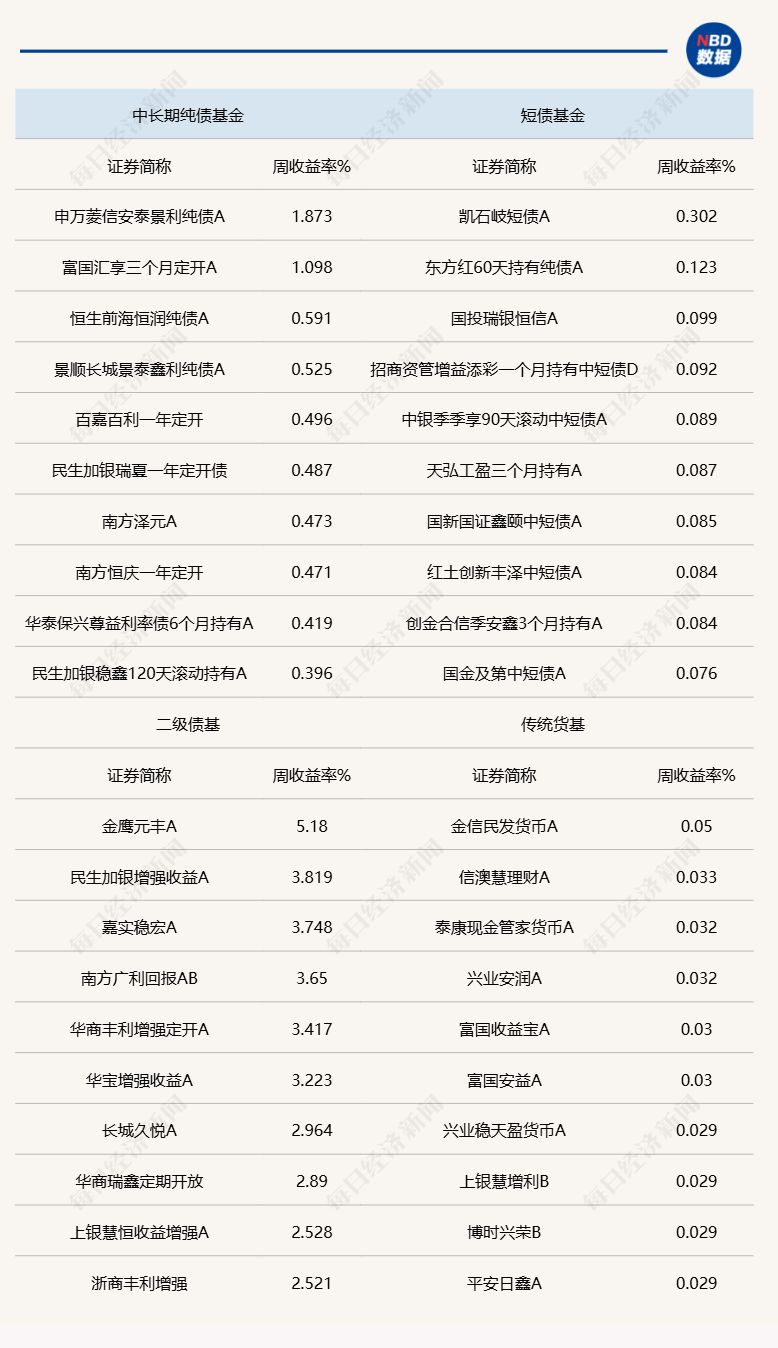
临近年末,市场资金面波动明显,上周有明显的收紧迹象,但债券收益率整体震荡下行,其中短端收益率下行 幅度更大,债市情绪有所回暖。部分纯债基金单周业绩达到1%以上。 有分析指出,本轮带动债券收益率调整的关键是超长债,但随着调整的进行,当前已处在较为中性的水平,影 响债市的因素有望从多方因素影响转向以政策影响为主。 债市收益率震荡下行 纯债基金头部业绩高 当前,国债期货市场呈现震荡略多态势,主要受年末资金面宽松、降息预期支撑及经济基本面偏弱影响。而在 上周(12月22日至28日),债市收益率震荡下行,纯债基金头部业绩高。 市场方面,随着年末的临近,上周资金价格有所上涨,跨元旦的R014涨至1.8%以上,月内的资金价格也有小 幅抬升。尽管资金价格在年末有所波动,但这种季节性的波动很正常,甚至与往年相比,今年的波动幅度也较 小。 诺安基金观察回购成交数据后发现,当前银行及货基融出余额在较高水平,且银行融出的占比高,说明银行间 资金还是很充裕且平稳的,跨年后资金价格大概率会回落至正常水平。 节奏可能"前弱后强" 债券方面,尽管本周资金有所收紧,权益市场表现也较好,但债券收益率整体震荡下行,其中短端收益率下行 幅度更大,债 ...
建信期货国债日报-20251229
Jian Xin Qi Huo· 2025-12-29 00:53
行业 国债日报 日期 2025 年 12 月 29 日 研究员:何卓乔(宏观贵金属) 18665641296 hezhuoqiao@ccb.ccbfutures.com 期货从业资格号:F3008762 研究员:黄雯昕(国债集运) 021-60635739 huangwenxin@ccb.ccbfutures.com 期货从业资格号:F3051589 研究员:聂嘉怡(股指) 021-60635735 niejiayi@ccb.ccbfutures.com 期货从业资格号:F03124070 宏观金融团队 请阅读正文后的声明 #summary# 每日报告 | | | 表1:国债期货12月25日交易数据汇总 | | | | | | | | | --- | --- | --- | --- | --- | --- | --- | --- | --- | --- | | 合约 | 前结算价 | 开盘价 | 收盘价 | 结算价 | 涨跌 | 涨跌幅 (%) | 成交量 | 持仓量 | 仓差 | | TL2603 | 112.780 | 112.910 | 112.510 | 112.560 | -0.270 | -0.2 ...
固定收益定期:汇率升值如何影响债市?
GOLDEN SUN SECURITIES· 2025-12-28 11:20
Report Industry Investment Rating No relevant content provided. Core View of the Report - Exchange rate appreciation has limited impact on the bond market, mainly affecting certificates of deposit. As funds remain loose and institutional indicator pressure eases after the New Year, the bond market is expected to continue its repair from short - to long - term. The 10 - year Treasury bond is expected to hit a new low in the first quarter or the first half of next year [4][17]. Summary by Related Aspects Bond Market Performance This Week - The bond market continued to fluctuate and slightly recover this week, with the short - end still stronger than the long - end. The yields of 10 - year and 30 - year Treasury bonds changed slightly by 0.7bps and - 0.2bps to 1.84% and 2.22% respectively compared with last week. The yields of 3 - year and 5 - year AAA - secondary capital bonds rose slightly by 1.4bps and 1bps. The 1 - year Treasury bond yield dropped significantly by 6.8bps to 1.29%, and the 1 - year AAA certificate of deposit remained basically flat at 1.64% [1][7]. Impact of Exchange Rate Appreciation on the Bond Market Impact on Foreign Investment in Bonds - Exchange rate appreciation mainly has a negative impact on certificates of deposit, but the impact is in the second half and is expected to gradually subside after the first quarter of next year. Due to the continuous inversion of Chinese and foreign interest rates and the impact of forward exchange rates, the correlation between foreign investment in Treasury bonds and policy - financial bonds and interest rates has significantly decreased in recent years. During the recent exchange rate appreciation, foreign investors did not increase their allocation of government bonds. The scale of foreign holdings of Treasury bonds and policy - financial bonds decreased from 2.92 trillion yuan in April to 2.75 trillion yuan in November. Foreign investment in domestic bonds has mainly been reflected in certificates of deposit in recent years. As the RMB exchange rate appreciates, the forward premium of the exchange rate has decreased, and foreign investors have continued to withdraw from certificates of deposit. The scale of foreign - held certificates of deposit decreased from 1.30 trillion yuan in April to 0.69 trillion yuan in November. If the current downward trend continues, the impact on certificates of deposit will gradually decrease [1][7]. Impact on Corporate Settlement and Sale of Foreign Exchange - Exchange rate appreciation changes corporate willingness to settle and sell foreign exchange, leading to an increase in net settlement volume, which in turn increases money creation and has a certain impact on funds. However, the impact is not large due to the limited scale. Exchange rate appreciation increases the settlement ratio of export enterprises and reduces the sale ratio of import enterprises, leading to an increase in the settlement - sale surplus. The 6 - month moving average of the settlement - sale surplus has increased from about $10 billion last year to $47.7 billion currently. Commercial bank settlement generates a similar money - creation function, increasing the demand for RMB funds and impacting liquidity. But the scale is limited. Assuming a monthly settlement - sale surplus of $50 billion, it corresponds to about 350 billion yuan in RMB, consuming about 40 billion yuan of base money [2][8]. Impact on Monetary Policy - China's monetary policy is mainly domestic - oriented, and the impact of exchange rate appreciation may be limited. The central bank is expected to maintain a loose monetary environment. Given the weak financing demand, loose liquidity is expected to continue. Even if the financing demand increases seasonally at the end of the year or the demand for foreign exchange settlement increases, the central bank may increase capital injection through various means, including reserve requirement ratio cuts, to maintain a generally loose capital environment [3][12]. Outlook for the Bond Market - With the continuous loosening of funds and the alleviation of institutional indicator pressure after the New Year, there is room for further decline in the yields of certificates of deposit and short - term credit bonds. The yield of 1 - year AAA certificates of deposit is expected to fall to around 1.5%. The decline in short - term yields will enhance the relative value of long - term bonds. The issuance duration of government bonds may shorten. Banks' indicator pressure may ease around the end of the year, and the relatively high long - term bond yields will increase the allocation value for institutions such as insurance companies. As trading institutions reduce their positions, short - selling pressure will decrease, and both short - term and long - term bonds are expected to have investment opportunities [4][17].
央行货币政策委员会召开2025年第四季度例会,资金面结构有所分化,债市震荡盘整
Dong Fang Jin Cheng· 2025-12-25 11:00
Report Summary 1. Report Industry Investment Rating No information about the industry investment rating is provided in the report. 2. Core Viewpoints - On December 24, 2025, the demand for cross - year funds increased, leading to a structural differentiation in the capital market. The bond market fluctuated and consolidated, while the convertible bond market's major indices rose collectively, with most individual convertible bonds posting gains. Yields of U.S. Treasuries across various tenors generally declined, and the 10 - year government bond yields of major European economies showed divergent trends [1]. 3. Summary by Directory 3.1 Bond Market News - **Domestic News** - The 4th quarter (111th in total) regular meeting of the Central Bank's Monetary Policy Committee in 2025 was held on December 18. It proposed to leverage the integrated effect of incremental and existing policies, maintain ample liquidity, and keep the RMB exchange rate basically stable at a reasonable and balanced level [3]. - On December 24, the central bank announced a 400 - billion - yuan MLF operation on December 25, with a net injection of 100 billion yuan after considering the maturity of 300 billion yuan of MLF this month [4]. - Multiple departments jointly issued the "Opinions on Financial Support for Accelerating the Construction of the New Western Land - Sea Corridor", proposing 21 key measures to support its high - quality development [4]. - The National Development and Reform Commission and the Ministry of Commerce released the "Catalogue of Industries Encouraged for Foreign Investment (2025 Edition)", with a total of 1679 items, a net increase of 205 items compared to the 2022 edition [5]. - Beijing optimized and adjusted housing purchase restriction policies on December 24, reducing the social security or tax payment requirements and allowing multi - child families to buy an additional property within the 5th Ring Road [6]. - **International News** - On December 24, the U.S. Department of Labor reported that the number of initial jobless claims for the week ending December 20 fell to 214,000, while the number of continuing jobless claims for the week ending December 13 was 1.923 million. Consumer confidence has declined for five consecutive months [7]. - **Commodities** - On December 24, international crude oil and natural gas futures prices declined. WTI February crude futures fell 0.05% to $58.35 per barrel, Brent February crude futures fell 0.22% to $62.24 per barrel, COMEX gold futures fell 0.01% to $4,505.40 per ounce, and NYMEX natural gas prices fell 3.69% to $4.249 per ounce [8][9]. 3.2 Capital Market - **Open Market Operations** - On December 24, the central bank conducted a 26 - billion - yuan 7 - day reverse repurchase operation, with a net withdrawal of 20.8 billion yuan due to the maturity of 46.8 billion yuan of reverse repurchases [11]. - **Funding Rates** - On December 24, due to the increasing cross - year demand from institutions, the capital market showed a structural differentiation. DR001 dropped 0.69bp to 1.262%, and DR007 dropped 3.05bp to 1.380% [12]. 3.3 Bond Market Dynamics - **Interest - Bearing Bonds** - **Spot Bond Yield Trends** - On December 24, affected by multiple rumors such as the central bank's reserve requirement ratio cut and bond purchases, the bond market fluctuated and consolidated. As of 20:00, the yield of the 10 - year Treasury bond active bond 250016 remained unchanged at 1.8350%, and the yield of the 10 - year CDB bond active bond 250215 dropped 0.05bp to 1.8975% [14]. - **Bond Tendering** - Information on the tendering of 25 Discount Treasury Bond 82, 25 Discount Treasury Bond 81, and 25 Coupon Treasury Bond 25 is provided, including their terms, issuance scales, winning yields, and other data [15]. - **Credit Bonds** - **Secondary Market Transaction Anomalies** - On December 24, the trading price of one industrial bond, "22 Vanke 04", deviated by more than 10%, rising more than 18% [15]. - **Credit Bond Events** - Various companies announced events such as debt defaults, debt restructurings, asset sales, and equity transfers. For example, Sunac China completed its comprehensive overseas debt restructuring, and Wanda's credit ratings were downgraded [17]. - **Convertible Bonds** - **Equity and Convertible Bond Indices** - On December 24, the three major A - share stock indices rose collectively, and the convertible bond market also increased. The CSI Convertible Bond Index, Shanghai Stock Exchange Convertible Bond Index, and Shenzhen Stock Exchange Convertible Bond Index rose 0.71%, 0.75%, and 0.62% respectively [17]. - **Convertible Bond Tracking** - On December 25, Jin 05 Convertible Bond started its online subscription, and on December 24, Tianneng Convertible Bond announced that it was about to trigger the condition for a downward revision of the conversion price [23]. - **Overseas Bond Markets** - **U.S. Bond Market** - On December 24, yields of U.S. Treasuries across various tenors generally declined. The 2 - year U.S. Treasury yield dropped 1bp to 3.47%, and the 10 - year U.S. Treasury yield dropped 3bp to 4.15%. The yield spreads between 2 - year and 10 - year, and 5 - year and 30 - year U.S. Treasuries both narrowed by 2bp [20][21]. - **European Bond Market** - On December 24, the 10 - year government bond yields of major European economies showed divergent trends. France's 10 - year government bond yield rose 1bp, Spain's dropped 1bp, and the UK's remained unchanged [24]. - **Daily Price Changes of Chinese - Issued U.S. Dollar Bonds** - As of the close on December 24, price change information of various Chinese - issued U.S. dollar bonds is provided, including the daily and monthly changes in yields and prices of bonds issued by companies such as Longfor Group and Wanda [26].
中加基金权益周报|资金面维持平稳,债市继续转暖
Xin Lang Cai Jing· 2025-12-25 08:55
Market Overview and Analysis - The issuance scale of government bonds, local government bonds, and policy financial bonds in the primary market last week was 296 billion, 40 billion, and 40.1 billion respectively, with net financing amounts of -47.3 billion, 28.1 billion, and 40.1 billion [1][6] - Financial bonds (excluding policy financial bonds) totaled an issuance scale of 135.6 billion, with a net financing amount of 25 billion. Non-financial credit bonds had an issuance scale of 251.1 billion, with a net financing amount of 56.7 billion. No new convertible bonds were issued [1][6] Secondary Market Review - The sentiment in the bond market continues to recover, with short- to medium-term interest rates performing well. Key influencing factors include central bank open market operations, expectations of interest rate cuts, and institutional behavior in bond allocation [2][7] - The central bank restarted the 14-day reverse repurchase agreement, signaling support for the year-end funding situation. The final R001 and R007 rates increased by 0.4 basis points and 0.7 basis points respectively compared to the previous week [2][7] Policy and Fundamentals - November economic data fell short of expectations, with weak performance in investment and consumption. High-frequency data indicates a weak production sector towards year-end, a downturn in real estate demand, a rebound in exports, and a mixed price trend with food prices diverging and most production material prices strengthening [3][8] Overseas Market - The U.S. non-farm payroll data for November showed resilience, but the Consumer Price Index (CPI) weakened beyond expectations. The 10-year U.S. Treasury bond closed at 4.16%, down 3 basis points from the previous week [4][9] Equity Market - The A-share index experienced significant fluctuations last week, with the Wind All A index slightly down by 0.15%. There was structural differentiation, with retail trade and basic chemicals leading gains, while electronics and power equipment lagged. The market lacked major sector opportunities, with average daily trading volume decreasing to 1.76 trillion, down 192.5 billion from the previous week. As of December 18, 2025, the total financing balance for All A was 24,825.32 billion, a decrease of 7.597 billion from December 11 [5][10] Bond Market Strategy Outlook - The bond market remains in a volatile state. The central bank's willingness to cut reserve requirements or interest rates in the short term is limited, focusing instead on facilitating the monetary transmission mechanism. The downward space for bond yields is yet to be opened, while the upward space remains constrained. The adjustment of long-term interest rates at year-end is primarily driven by sell-off operations to balance duration risk in a volatile market. The current yield spread for 10-30 year government bonds has risen to 40 basis points, approaching a risk balance point. However, the bond market is expected to trend towards a stronger stance as year-end approaches, with continued allocation from banks and insurance companies. The convertible bond index is also experiencing fluctuations, with a shift from "extraordinary" to "normal" settings in important meetings. Liquidity and institutional behavior remain key indicators, with a focus on risk-reward ratios in the convertible bond market [11]
债市主导逻辑切换:机构行为如何影响市场走向?
2025-12-25 02:43
Summary of Key Points from Conference Call Industry Overview - The conference call discusses the bond market dynamics and the roles of various financial institutions, particularly focusing on the behavior of banks, insurance companies, and brokerages in the context of regulatory changes and market conditions [1][2][3]. Key Insights and Arguments 1. Role of State-Owned Banks - State-owned banks are expected to play a more prominent role as primary dealers in the bond market by 2026, enhancing their trading attributes and increasing their bond purchasing volume starting from Q2 2025 [2][10]. - However, the overall capacity of banks to absorb long-term interest rate bonds may weaken due to regulatory constraints and a shift towards more liquid liabilities [2][10]. 2. Insurance Sector Dynamics - The implementation of IFRS 9 and IFRS 17 accounting standards in 2026 is anticipated to increase the demand for medium to long-term interest rate bonds from insurance companies [4][10]. - Despite a slowdown in premium income growth, insurance companies are expected to become significant holders and price setters for long-term bonds, although they will adopt a more cautious approach to timing their investments [4][10]. 3. Public Fund Trends - The size of pure bond funds is projected to decrease in 2025, influenced by new fee regulations and a challenging market environment, leading to a rise in the proportion of mixed funds [5][11]. - Traditional preferences for perpetual bonds may face pressure due to the overall weak market performance [6][11]. 4. Wealth Management Products - Wealth management products are expected to transition into a net asset value era, focusing on stable returns while managing volatility [7]. - These products will likely increase allocations to fixed-income assets and short-term securities to stabilize net asset values and meet liquidity needs [7]. 5. Brokerage Firms' Position - Brokerages, while holding a relatively small amount of bonds (approximately 4 trillion), are active traders and significant price setters in the market [8][9]. - Their pricing power in long-term interest rate bonds may strengthen in a volatile market but could weaken in a downward trending market [9][12]. Additional Important Insights - The competition for pricing power between brokerages and insurance companies is dynamic and influenced by market conditions, with both parties adjusting strategies based on market trends [12]. - The anticipated increase in the scale of wealth management products and their focus on short-term credit bonds and interbank certificates is expected to benefit these asset classes [11]. This summary encapsulates the critical points discussed in the conference call, highlighting the evolving roles of various financial institutions in the bond market and the implications of regulatory changes and market conditions.