
全球经济增长

Search documents
财政部副部长廖岷出席二十国集团财政和央行副手会议
Zheng Quan Shi Bao Wang· 2025-12-17 04:25
人民财讯12月17日电,2026年二十国集团(G20)主席国美国在华盛顿举行其接任主席国后的首次G20财 政和央行副手会议。会议围绕2026年G20财金渠道工作安排以及G20财金渠道重点议题和工作计划进行 了讨论。财政部副部长廖岷出席会议并发言。 廖岷表示,当前全球经济增长动能不足,各方应更好发挥G20财金渠道作用,加强宏观政策协调,共同 营造开放、包容、非歧视的国际经济合作环境。中方坚定支持多边主义,期待与各方共同努力推进2026 年G20财金渠道合作进程,为促进全球经济强劲、可持续、平衡、包容性增长贡献力量。中方呼吁遵循 市场化原则,多渠道动员资源帮助更多债务国改善债务可持续性并提高可持续发展能力。 ...
交大高金朱宁:经济学家视角下AI时代的范式思维转变 | MEET2026
量子位· 2025-12-13 02:00
Core Viewpoints - The concept of scarcity has changed after the emergence of AI, prompting a need for deeper consideration on how to make better choices in the face of this new reality [6][11] - As AI begins to replace human decision-making, competition may arise between humans and algorithms, as well as among algorithms themselves [6][22] Economic Implications - Economics has historically focused on technological progress and its impact on economic principles and human welfare, with fundamental concepts like "what is human?" and "what is production?" undergoing significant changes in the AI era [8][11] - The traditional view of scarcity, which included time, computational power, and creativity, is being challenged as AI can now perform tasks that previously required significant human effort [11][12] - AI is expected to contribute to global economic growth by 0.5% to 0.7% annually over the next decade, although this may not be sufficient to support high valuations in tech markets [14][24][25] Industry Impact - The nature of work is changing, with both white-collar and blue-collar jobs facing potential replacement by AI, blurring the lines between these categories [31] - Knowledge-intensive industries, previously thought to be safe from AI disruption, are also at risk as AI capabilities evolve [33] - Companies are encouraged to focus on how to leverage AI technology to enhance productivity and efficiency rather than seeking industries that are immune to AI [33] Global Considerations - There is a significant disparity in access to AI capabilities between high-income and low-income countries, which may exacerbate global wealth distribution issues [28][29] - The shift towards AI-driven trade will lead to new regulatory and governance challenges, particularly regarding accountability in cross-border transactions [30]


这篇高影响力Nature论文,发表一年多后,撤稿了
生物世界· 2025-12-10 10:00
撰文丨王聪 编辑丨王多鱼 排版丨水成文 近日, Nature 期刊撤回了一篇仅发表了一年多的高影响力论文。 这篇论文题为: The economic commitment of climate change (气候变化的经济代价) ,来自德国 波 茨坦气 候影响研究所,于 2024 年 4 月 17 日发表于 Nature 期刊。 该论文 探讨了气温和降水等气候变化如何影响全球经济增长,该论文一经发表就受到广泛关注,仅一年多 时间,论文访问量就超过了 310000 次 ,谷歌学术显示,该论文被引用次数高达 441 次 。 关于气候变化对全世界造成的宏观经济损害的预测,通常只考虑长期时间尺度上的年平均温度和国家级温 度的影响。在这项研究中,研究团队利用过去 40 年间全世界 1600 多个地区的近期实证研究结果,来预测 温度和降水对次国家级地区造成的损害。 该研究显示,即便从现在开始大幅削减二氧化碳排放,由于气候变化,世界经济到 2050 年仍将面临 19% 的收入损失,也就是每年损失高达 38 万亿美元,这些损失主要源于气温上升,以及 降雨量和气温波动的 变化,如果 将风暴、野火等极端天气因素考虑在内,经济损 ...
建信期货贵金属日评-20251209
Jian Xin Qi Huo· 2025-12-09 02:32
行业 贵金属日评 日期 2025 年 12 月 9 日 宏观金融团队 研究员:何卓乔(宏观贵金属) 021-60635739 hezhuoqiao@ccb.ccbfutures.com 期货从业资格号:F3008762 研究员:黄雯昕(国债集运) 021-60635739 huangwenxin@ccb.ccbfutures.com 期货从业资格号:F3051589 研究员:聂嘉怡(股指) 021-60635735 niejiayi@ccb.ccbfutures.com 期货从业资格号:F03124070 请阅读正文后的声明 每日报告 一、贵金属行情及展望 日内行情: 美联储降息预期打压美元指数并推高贵金属的流动性溢价,与此同时市场继 续关注新任美联储主席提名人选对美联储货币政策倾向的潜在影响,短期内金价 易涨难跌,关注本周三美联储议息会议对 2026 年货币政策的指引;全球经济增长 前景改善,使得工业属性较强的银铂钯在广期所上市铂钯品种的情况下持续偏强 运行,但上周银铂钯价格初现松动迹象,建议投资者留意银铂钯价格短期飙升后 调整风险的释放。中短期内多空因素交织,我们判断伦敦黄金需要在 3880-4380 美 ...
格林大华王骏:全球经济增长面临多重挑战,抓住长周期趋势进行资产配置能提升投资胜率
Qi Huo Ri Bao· 2025-12-06 23:57
Group 1: Key Events Impacting the Futures Market - The series "Futures Discussion - 2025 Futures Industry Review" aims to provide insights into the 2025 futures market and its key events, with a focus on macro to micro analysis and future planning for 2026 [2] - A significant event in 2025 was the global tariff war initiated by Trump in early April, which led to the largest price drop for many commodities throughout the year, providing purchasing opportunities for physical enterprises [2] Group 2: Global Economic Growth Challenges - According to IMF and OECD forecasts, global economic growth is expected to slow to around 3.1% in 2025, marking the lowest level in five years, with developed economies struggling while emerging markets, particularly in the Asia-Pacific region, contribute 60% of global growth [3] - The economic policies of different regions are diverging, with the US, Europe, and the UK entering a rate-cutting cycle, while Japan plans to raise rates, and countries like Turkey and Argentina are increasing rates due to high inflation [3] - China's economy shows resilience with a GDP growth of 5.2% in the first three quarters, but a continuous PMI index below the threshold indicates weak consumer demand, suggesting potential stimulus measures in 2026 [3] Group 3: Geopolitical Conflicts and Commodity Price Volatility - Geopolitical conflicts in various regions in 2025 have led to significant volatility in commodity prices, increased supply chain costs, and heightened market risk aversion [4] - The situation in the Middle East has affected container shipping rates, oil, and gold prices, while the Russia-Ukraine conflict has caused energy price fluctuations and disruptions in grain transport, raising food prices [4] Group 4: Development Opportunities from the 14th Five-Year Plan - The "14th Five-Year Plan" emphasizes high-quality development and technological self-reliance, which will have a profound impact on the futures market by enhancing the underlying market for futures [5] - New infrastructure and industrial development are expected to boost demand for raw materials like steel and non-ferrous metals, while technological advancements will drive demand for new materials such as lithium carbonate and platinum [5] Group 5: AI Demand and Energy Transition - In 2025, global investments in AI data centers and chip industries reached $2.9 trillion, with new AI-driven demands promoting green energy development and altering energy consumption structures [6] - The share of green energy in traditional energy provinces has reached 50%, leading to increased demand for silver, aluminum, copper, and polysilicon [6] - The traditional pig cycle has shortened from around 40 months to 15-20 months due to enhanced breeding scale, necessitating attention to breeding stock and production efficiency [6] Group 6: Futures Tools Supporting the Real Economy - The performance of the non-ferrous metals sector in 2025 was notably influenced by the tariff war, which provided hedging opportunities for companies to lock in low raw material prices [7] - The focus on AI development is shifting from investment to application scenarios, which will become a new direction for capital market growth in 2026 [7] - Understanding long-term economic cycles can enhance asset allocation strategies, making it easier for traders and companies to navigate investment decisions [7]

10张图,看彭博对全球2026年经济增长预期
Xin Lang Cai Jing· 2025-12-05 12:56
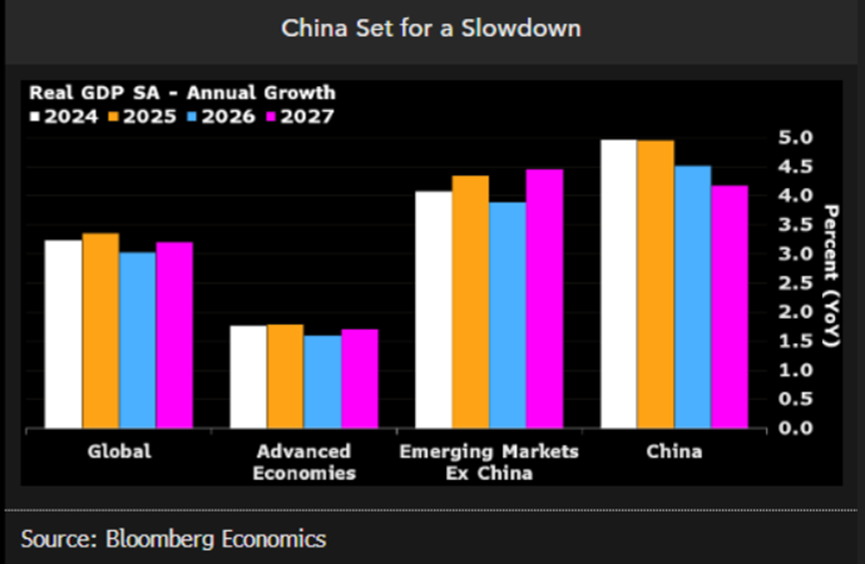
(来源:十五的投资笔记) 1、全球经济2026年预计增长3%。 预计美联储将在 2026 年降息 100 个基点。中国央行将维持适度宽松的政策取向;英国央行也将开启降息。由于通胀已接近 目标,但欧洲央行的宽松周期可能未结束。而日本央行则走向相反方向 —— 不过考虑到政治阻力与增长轨迹的不确定性, 其政策调整会较为谨慎。 4、增长与通胀不会阻碍美联储降息 美国 2026 年 GDP 增速预计将从今年的 1.8% 升至 2.3%,这得益于货币政策宽松,以及大规模资本支出激励、减税、放松 监管带来的红利。随着不确定性消退、新贸易协议有望落地,投资环境将趋于强劲——而 AI 是核心驱动力之一。预计美联 2025 年,尽管全球经济遭遇关税冲击与巨大的政策不确定性,但表现却意外强劲 —— 发达经济体与新兴经济体均展现出 韧性。展望未来,2026 年全球经济增速或将从今年的 3.4% 回落至 3%。中国经济放缓但仍高于全球整体。 2、关税推高美国通胀,拉低其它地区通胀 对美国而言,关税上调正在推高进口成本。对全球其他多数国家来说,经济增长放缓、商品寻求美国以外市场的冲击,大 概率会成为主导因素,进而压低通胀。这很大程度上取 ...
经合组织:维持今明两年全球经济增长预期 AI热潮与贸易风险并存
Yang Shi Wang· 2025-12-03 06:09
经合组织发布的报告预计,今明两年全球经济增速分别为3.2%和2.9%,与今年9月预测一致。报告 指出,三方面因素共同支撑全球需求。一是扩张性宏观政策,二是市场对新技术的积极预期,三是人工 智能带动贸易和投资增长。但报告同时发出警告,认为全球经济风险正在累积。具体包括:贸易保护主 义升级可能严重损害全球供应链和产出,人工智能领域资产高估(值)可能突然回调,各国财政脆弱性 可能阻碍经济增长。 报告还提及美国经济面临的风险,如需求承压、通胀顽固、就业市场疲软及巨额赤字。数据显示, 美国涉及加征关税的进口商品总值较非征税进口商品明显下降,说明关税正抑制美国国内需求,预计贸 易量将继续承压。由于就业市场降温、关税抬高消费价格,美国家庭消费增长将继续放缓,通胀可能更 加持久,从而减少降息空间。报告预测,美国经济增速将由2024年的2.8%降至今年的2.0%,明年进一 步放缓至1.7%。 央视网消息:经济合作与发展组织2日发布最新经济展望报告。报告指出,今年全球经济韧性超出 预期,但仍面临贸易壁垒、人工智能泡沫和财政脆弱性等风险。 报告还认为,美国关税对全球经济的影响正逐步显现,并传导至支出、企业成本以及消费价格。经 合组 ...
联合国报告:明年世界经济活动或保持“低迷”
Jin Shi Shu Ju· 2025-12-03 02:17
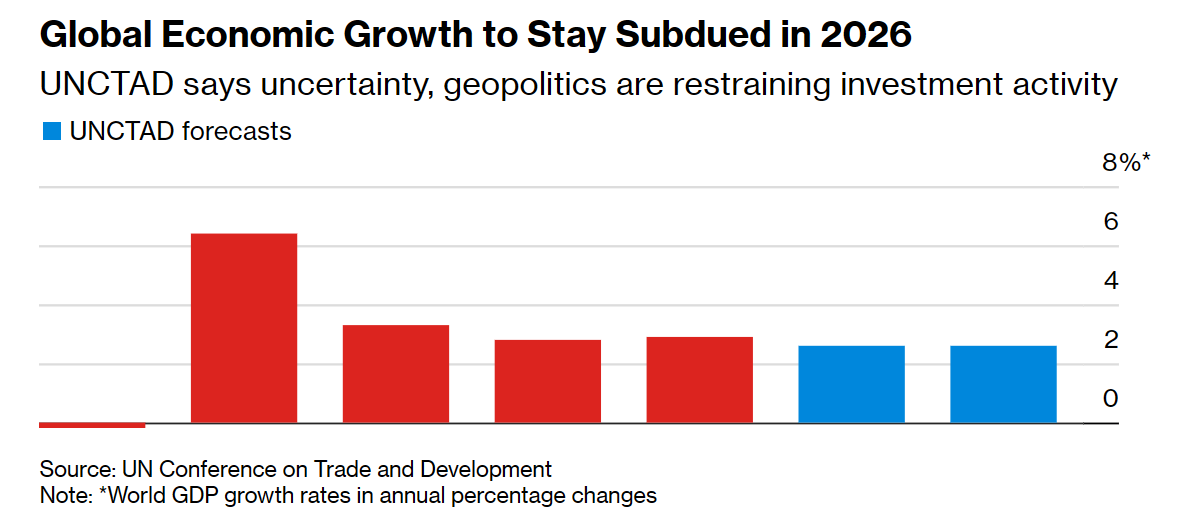
Core Insights - The UNCTAD report predicts a "sluggish" global economic activity in 2024, influenced by trade uncertainties and geopolitical tensions [1][3] - Global economic growth is expected to slow to 2.6% this year, maintaining this rate until 2026, which is 0.4 percentage points lower than the pre-pandemic average [1][3] Economic Risks - The report highlights risks in the economic and financial markets, particularly due to unpredictable tariff policies under the Trump administration [3] - Developing economies remain vulnerable to exchange rate fluctuations and punitive tariffs imposed by the US on their exports [3] Global Economic Disparities - There is a concerning gap among "Global South" economies, which account for over 40% of global GDP, half of foreign direct investment flows, and approximately 45% of goods trade, yet remain marginalized in global equity and bond markets [3] Trade and Financial Interdependence - Approximately 72% of global trade is governed by WTO's most-favored-nation rules, while 90% of international trade relies on a concentrated global financial system [3][4] - The interdependence in the short term helps avoid disruptions and signals policy adjustments, as seen in the market reactions following Trump's tariff announcements [4] Currency Dynamics - The report discusses the imbalance between the rules-based global trade matrix and the centralized global financial system, emphasizing the dominance of the US dollar [5] - Despite a decline in the dollar's share of international reserves, no suitable challenger has emerged to replace it, indicating a trend towards de-dollarization without a viable alternative currency [5]
联合国报告:金融波动可能危及全球贸易 使全球经济“濒临危机”
Yang Shi Xin Wen Ke Hu Duan· 2025-12-02 19:11
Group 1 - The core viewpoint of the report is that global economic growth is expected to slow down to 2.6% in 2025, down from 2.9% in 2024, highlighting the significant impact of financial markets on global trade [1] - The report emphasizes that over 90% of global trade relies on bank financing, indicating a deep dependence on financial channels that tightly connect trade and the global financial environment [1] - Changes in interest rates in major financial centers or fluctuations in investor sentiment can significantly affect global trade volumes, underscoring the interconnectedness of finance and trade [1] Group 2 - Developing economies face increasing pressures due to limited roles in global financial markets, leading to higher financing costs and vulnerability to capital flow volatility [2] - The report points out that geopolitical dynamics and policy shifts are reshaping globalization, necessitating adjustments in the financial system to better serve the needs of the real economy [2] - Climate-related financial risks are becoming more pronounced, further constraining the fiscal and investment space required for sustaining growth in developing economies [2]
经合组织上调全球经济增长展望
Xin Lang Cai Jing· 2025-12-02 15:45
责任编辑:张俊 SF065 责任编辑:张俊 SF065 尽管面临关税阻力,经合组织(OECD)表示AI投资和政策支持使经济增长保持韧性,并上调了对美国 和欧元区2025年的预测。 尽管面临关税阻力,经合组织(OECD)表示AI投资和政策支持使经济增长保持韧性,并上调了对美国 和欧元区2025年的预测。 ...