经济复苏

Search documents
顺周期板块后续表现或仍值得期待
British Securities· 2026-01-29 01:55
英大证券研究所证券研究报告 2026 年 1 月 29 日 顺周期板块后续表现或仍值得期待 总量视角 【A 股大势研判】 当前大宗商品的轮动行情契合"避险资产、工业需求、能源传导、民生终端" 的路径。2025 年至今,贵金属率先开启牛市,成为周期行情的先行者;随后工业 金属接棒,铜价创下历史新高,碳酸锂上演 V 型反转,背后是新能源、AI 算力等 新兴产业的刚性需求与供给端约束的共振。如今有色板块的上涨,正是这一轮动 逻辑的中期演绎,而按照传导顺序,能源化工与煤炭或将承接行情扩散。 在全球流动性宽松预期下,随着反内卷政策持续推进,国内稳增长政策持续 发力,经济供需格局有望改善,复苏预期强化,直接利好对经济敏感的板块,后 续经济数据(如 PPI)若持续改善,将验证复苏逻辑,驱动顺周期板块上行。可 逢低关注稀土、化工、煤炭、有色金属、基建、地产等板块,周期板块后续表现 或仍值得期待。 分析师:惠祥凤 执业证书编号:S0990513100001 电话:0755-83007028 请务必阅读最后一页的免责条款 1 金 点 策 略 晨 报 邮箱:huixf@ydzq.sgcc.com.cn 周三晨报提醒,依托上证 50 ...
周期投资的“左邻右舍”:揭秘有色与石化的联动规律!
Sou Hu Cai Jing· 2026-01-29 00:51
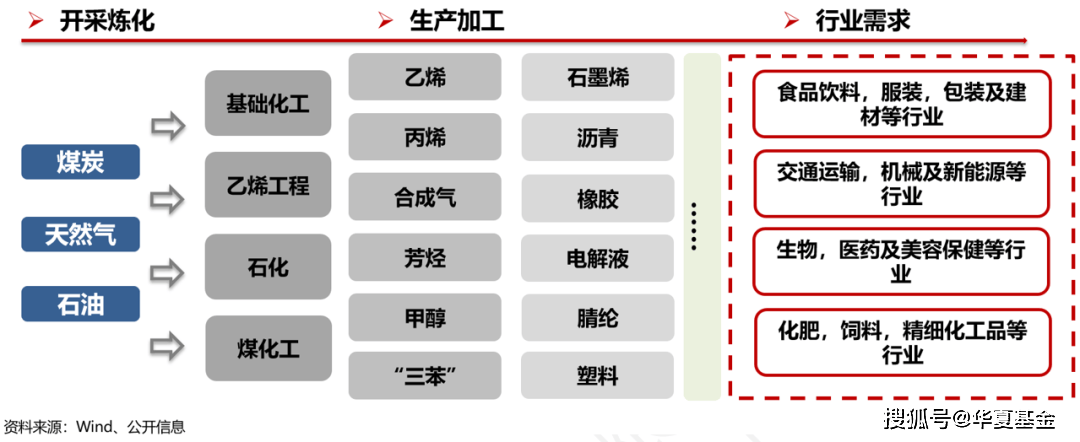
Core Viewpoint - The relationship between non-ferrous metals and petrochemicals is significant, as both belong to the cyclical sector, and their market movements are interconnected [1][4]. Group 1: Industry Relationship - Non-ferrous metals focus on extracting metals from ores, while petrochemicals convert crude oil into various products, indicating a close relationship in the industrial chain [1]. - Non-ferrous metals are considered the "vanguard" of cyclical sectors, reacting quickly to changes in global monetary policy and economic recovery expectations, while petrochemicals tend to respond more slowly [3][4]. Group 2: Market Dynamics - The non-ferrous metal sector is sensitive to commodity prices, with major stocks like Zijin Mining and Luoyang Molybdenum directly linked to prices of copper and gold [3]. - The petrochemical sector is more complex, with its performance influenced by both international oil prices and domestic supply-demand dynamics in chemical products [4]. Group 3: Economic Recovery Cycle - A typical economic recovery cycle begins with liquidity easing, boosting gold-related companies, followed by increased demand for industrial metals like copper, which then leads to higher demand for petrochemical products [9]. - The market often views the stock performance of non-ferrous metal companies as a precursor to future demand for petrochemical products [9]. Group 4: Future Outlook for Petrochemicals - As of 2026, there is speculation that the petrochemical sector may experience a turnaround, with oil prices stabilizing around $55-$60 per barrel, indicating a potential bottoming out of the cycle [10]. - Policies aimed at controlling new refining capacity and eliminating outdated production are expected to enhance the market position of leading petrochemical companies [10]. - Demand for high-end chemical materials is anticipated to grow, driven by traditional industries and emerging sectors like new energy and AI, suggesting a shift from a purely cyclical to a growth-oriented perspective for the petrochemical industry [10].

外部环境扰动南亚中小国家经济
Jing Ji Ri Bao· 2026-01-28 21:58
Economic Overview - Bangladesh and Nepal are set to hold elections in February and March 2026, respectively, with economic growth reforms being a primary focus for the new governments [1] - Sri Lanka is experiencing a mild economic recovery, but continues to face internal and external pressures [1] Bangladesh Economic Insights - Bangladesh's GDP growth rate is projected to reach 4.6% for the fiscal year 2025-2026, an increase of 0.9 percentage points from the previous fiscal year [1] - If structural reforms are effectively implemented by the new government, GDP growth could accelerate to 6.1% in the fiscal year 2026-2027 [1] - Exports are expected to reach $48 billion in fiscal year 2025, following two years of decline, but will face challenges in fiscal year 2026 due to global demand fluctuations and the effectiveness of government reforms [1] - Inflation decreased from 11% in August 2024 to 8% in December 2025, with the central bank targeting a reduction to 7% for fiscal year 2026 [1] Foreign Exchange Reserves - As of December 2025, Bangladesh's foreign exchange reserves increased to $32.57 billion, a 30% rise from $25 billion in August 2024, sufficient to cover three months of import payments [2] - Continued growth in remittances and exports, along with effective financial reforms, could stabilize foreign exchange reserves in fiscal year 2026 [2] Challenges Facing Bangladesh - Export pressures are evident due to weak global demand and increased tariffs from the U.S., leading to a 2.19% year-on-year decline in exports from July to December 2025 [3] - The banking sector is under strain, with non-performing loan rates exceeding 20% and reaching a historical peak of nearly 36% [3] - Government debt exceeds 20% of GDP, with projections indicating a potential rise above 40% if the local currency depreciates by 10% [3] Nepal Economic Insights - Nepal's GDP growth is expected to decline to 2.1% for the fiscal year 2025-2026 due to political instability and social unrest [4] - If the elections in March 2026 proceed smoothly, growth could rebound to 4.7% in the following fiscal year [4] - The tourism sector, a key economic pillar, has been severely impacted by recent unrest, affecting consumer and investor confidence [4] Inflation and Fiscal Situation in Nepal - Inflation is projected to remain below 3% in fiscal year 2026, which is below the central bank's target [4] - Increased government spending in preparation for the elections may lead to a wider fiscal deficit, but current debt levels remain manageable at around 45% of GDP [5] Sri Lanka Economic Insights - After a strong recovery in 2024, Sri Lanka's GDP growth rate fell to 3.5% in 2025, with a cautious outlook for 2026, projected at 3.1% [6] - Inflation has been controlled, with core inflation dropping from over 50% in September 2022 to 2.7% in December 2025, providing the central bank with more policy space [6] - Export growth for Sri Lanka is expected to decline to around 3.8% in 2026 due to global economic slowdowns and reliance on a narrow export base [7] Debt and Financial Management in Sri Lanka - Government debt reached 96% of GDP by the end of 2025, with significant repayment obligations ahead [7] - The IMF has committed $2.9 billion in loans, with ongoing negotiations for debt restructuring with various bilateral creditors [7] - A national productivity plan aims to shift the economy towards a productivity-driven, export-oriented growth model from 2024 to 2029 [8]
经济复苏动能稳步增强 沪锌期货或保持高位震荡
Jin Tou Wang· 2026-01-28 06:00
五矿期货指出,锌矿显性库存边际累库,锌精矿TC止跌企稳。锌冶利润小幅修复,国内锌锭社会库存 去库放缓。沪伦比值修复后,元素外流状况好转,国内锌产业维持偏弱。1月23日夜间公布的美国PMI 数据小幅低于预期,双宽政策仍未表现在经济数据上,短期多头情绪暂退。但海外天然气价格暴涨,引 发市场对欧洲冶炼企业成本的担忧,伦锌价格抬升。叠加当前锌铜比、锌铝比均处绝对低位,锌价当前 仍在跟随板块补涨宏观属性的过程中。 中财期货分析称,宏观方面,美国经济数据呈现增长韧性、需求疲软与通胀黏性的分化格局,美联储降 息预期显著下修。国内宏观呈现政策协同加码与经济数据持续向好的共振格局,经济复苏动能稳步增 强。产业来看,外盘LME暂停锌品牌交割行为,主要为品牌注册正常到期,补交手续后可以重新交 割。需求端,终端需求持续疲软态势未改,初加工企业开工或将于下周开始陆续放假。库存端,外盘库 存回归至10w关口,内外比价有所回归。下周来看,预计锌价整体呈中性震荡。 铜冠金源期货表示,国内延续供需双弱,下游部分企业月底开始放假,需求边际减弱,但近期部分炼厂 检修,缓解库存回升节奏。短期锌价走势受美元走弱及成本端支撑,预期保持高位震荡。 1月2 ...
金融期货早班车-20260128
Zhao Shang Qi Huo· 2026-01-28 02:01
金融期货早班车 招商期货有限公司 金融研究 2026年1月28日 星期三 | | 市场表现:1 月 日,A 股四大股指全线上涨,其中上证指数上涨 0.18%,报收 点;深成指 27 4139.9 | | | --- | --- | --- | | | 上涨 0.09%,报收 14329.91 点;创业板指上涨 0.71%,报收 3342.6 点;科创 50 指数上涨 1.51%, | | | | 报收 1555.98 点。市场成交 29,215 亿元,较前日减少 3,592 亿元。行业板块方面,电子(+2.27%), | | | | 通信(+2.15%),国防军工(+1.65%)涨幅居前;煤炭(-2.27%),农林牧渔(-1.95%),钢铁(-1.34%)跌幅 | | | | 居前。从市场强弱看,IC>IM>IH>IF,个股涨/平/跌数分别为 1,928/91/3,450。沪深两市,机构、主 | | | | 力、大户、散户全天资金分别净流入-174、-241、13、401 亿元,分别变动+323、+19、-307、-35 | | | 股指期货 | 亿元。 | | | | 基差:IM、IC、IF、IH 次月合约 ...
波黑工业产值持续下滑,经济复苏面临多重挑战
Shang Wu Bu Wang Zhan· 2026-01-27 15:41
波黑《独立报》1月26日报道。欧盟委员会最新发布的扩大进程国家经济进展报告显示,波黑工业产值 已连续13个季度下跌。这一持续下滑趋势始于上届大选之后,即国家层面新联盟组建前夕。 报告指出,波黑实际GDP增长率从0.7%降至0.5%,表明经济疲软态势长期持续。从生产侧看,去年第 三季度同比增长的主要动力仍来自贸易、公共行政部门以及医疗教育、信息通信等行业。同时,出口增 长明显放缓:去年第三季度出口增幅降至1.4%,而第一、第二季度分别为2.4%和3.5%。2025年前三季 度实际生产总增长率为2%,低于2024年同期的2.8%。 就业方面,注册就业增长持续放缓,第三季度同比微降0.1%。制造业就业人数同比下降1.6%,农业下 降3.6%,矿业下降约1%。 工资增长呈现不同态势:2025年第三季度名义工资同比增速加快至14.6%,10月放缓至13.7%。经通胀 调整后,第三季度实际工资同比上涨10.2%,涨幅居地区前列。但分析指出,这主要源于住宿餐饮、贸 易、制造业和建筑业的涨薪——其背后是人口持续外流导致的劳动力短缺。 经济账户赤字略有改善,从第二季度占GDP的3.3%收窄至第三季度的3.1%。商品贸易平衡因出 ...
国泰海通|策略:进入复苏的盈利周期——2025年报业绩预告前瞻
国泰海通证券研究· 2026-01-27 14:03
报告导读: 25Q4 新经济增长中枢抬升,景气线索扩散。 AI 与出海继续推动新兴科技景 气中枢抬升,而顺周期板块多数受益供给受限与下游需求转型带来的涨价,重视电子 / 出 海制造 / 保险等盈利预期上修的低拥挤滞涨板块。 新经济景气中枢上移,盈利改善范围扩散。 2025 年四季度经济转型加快,尽管新旧经济景气分化的结构延续,但新经济景气中枢明显上移,并由 AI 向出 海、资源品、服务消费等更多领域扩散。新兴科技产业链呈现出供需两旺的特征,内部细分涨价赛道明显增多。结合宏观数据,我们提示把握四季度盈利增长 的四个结构特征: 1 )新兴经济仍是四季度业绩主要高增领域。科技服务业等第三产业用电量在 25Q4 高增,并带动全社会用电增速在 9 月后明显上行,这 与工业增加值下行趋势背离明显,新经济主导并拉动经济复苏; 2 )中下游制造盈利占比提升。通胀整体改善且新经济成本传导顺畅, CPI-PPI 剪刀差扩 张, PPI 内部中下游价格更强,工业企业利润向 TMT 、装备制造与有色化工等行业集中; 3 )大中盘业绩增长弹性更大。 PMI 改善,且结构上大型企业景 气占优趋势延续,企业生产经营预期与订单分项改善明显; ...

智库报告:经济复苏处于早期阶段,仍需激发内生动力
Nan Fang Du Shi Bao· 2026-01-27 08:15
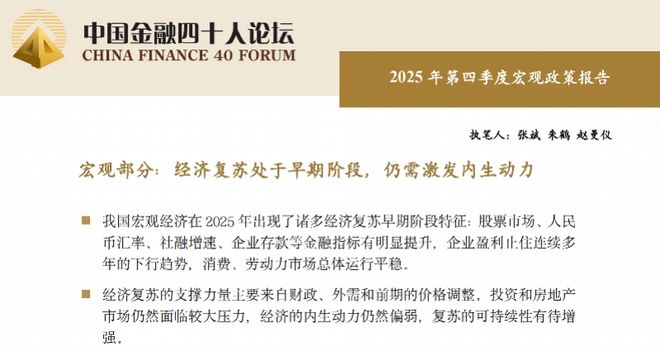
Group 1 - The core viewpoint of the report is that China's economic recovery is in its early stages and requires stimulation of internal momentum [1] Group 2 - In 2025, China's macroeconomic indicators show characteristics of early-stage recovery, with significant improvements in financial markets compared to 2024, including a nearly 30% increase in the CSI 300 index and a 5% appreciation of the RMB against the USD [3] - The growth rate of social financing stock increased from 8.0% at the end of 2024 to 8.3% at the end of 2025, indicating stronger support for purchasing power [3] Group 3 - Corporate cash flow has improved, and the downward trend in corporate profits has been curbed, with non-financial corporate bank deposits rising from -2.2% in January 2025 to 3.6% by November 2025 [4] - The report anticipates that the profit levels for 2025 may improve compared to 2024, despite a slight decline in asset return rates for listed companies [4] Group 4 - The total retail sales of consumer goods in 2025 are expected to grow by 3.7%, slightly better than the 3.5% growth in 2024, indicating stable consumption [4] Group 5 - The report highlights that the current economic recovery is heavily reliant on fiscal borrowing and external demand, with insufficient internal growth momentum, particularly in private sector investment and consumer willingness to purchase homes [4] Group 6 - Looking ahead to 2026, the report suggests that with sufficient counter-cyclical policy support, China's economy could achieve a real GDP growth rate of around 5.0% and a nominal GDP growth rate of approximately 4.5% [5] - The external environment for China's economy is expected to marginally improve due to stable growth in major developed economies and a potential stabilization in China-US trade relations [5] - Continued positive fiscal policies and moderately loose monetary policies are anticipated to support economic growth in 2026, coinciding with the start of the 14th Five-Year Plan [5]
揭秘商品周期轮动密码:从贵金属-有色-化工-农产品,现在是到哪个阶段了?
对冲研投· 2026-01-27 07:49
Core Viewpoint - The article discusses the cyclical nature of commodity markets, highlighting the sequential rotation of different commodities as indicators of economic phases. It emphasizes that the current market signals suggest the beginning of a new commodity cycle, characterized by differentiation and rotation rather than a broad-based rally [1][13]. Group 1: Commodity Phases - The first phase of a commodity bull market typically features precious metals like gold and silver, which shine during economic uncertainty or stagflation, as seen since March 2024 with gold prices reaching $4000 per ounce [2][3]. - The second phase involves industrial metals, such as copper, which signal economic recovery as demand for raw materials increases when economic stimulus measures take effect. This phase began in November 2025 with rising copper prices [3][4]. - The third phase is marked by a surge in energy and chemical products, driven by overheating economies where demand for oil and related products spikes, often accompanied by inflationary pressures [4][5]. - The final phase sees agricultural products gaining traction, as their demand remains relatively stable regardless of economic conditions, often influenced by production costs and weather conditions [5][6]. Group 2: Current Market Analysis - Current market conditions indicate that gold has reached a historical high, signaling strong global demand for safe-haven assets and concerns about the traditional monetary system, marking a clear first phase signal [10]. - The strong performance of industrial metals suggests that market participants are pricing in expectations of economic recovery, with significant investments flowing into this sector [10][11]. - Energy and chemical products are still in a relatively low position, indicating that the global economy has not yet reached a stage of full operational capacity, suggesting that the third phase is still developing [10][11]. - Agricultural products are influenced more by specific supply and demand factors rather than broad economic trends, indicating that they are not yet in a position to lead the cycle [11][12]. Group 3: Macro Indicators - The dollar's decline since 2025 is noted as a favorable backdrop for commodity price increases, as historically, a weakening dollar correlates with rising commodity prices [12]. - The Baltic Dry Index (BDI) has shown signs of recovery since February 2025, which typically precedes a broader rise in commodity prices by 1-3 months, indicating increased global trade activity [12]. Group 4: Investment Strategy - The article suggests that the current market environment presents structural opportunities, particularly in precious metals and select industrial metals, which have clear investment logic supported by macro indicators [13][14]. - Energy and chemical sectors require patience as their comprehensive market movements depend on confirming signals of economic overheating, while agricultural investments should focus on specific supply narratives rather than broader trends [14].

张斌:以货币政策激发扩大内需的内生动力
Sou Hu Cai Jing· 2026-01-27 05:04
Core Viewpoint - The Chinese economy is in the early stages of recovery in 2025, with 2026 being a crucial year for sustaining this recovery through effective counter-cyclical policies, particularly in monetary policy [2][3]. Economic Indicators - In 2025, various financial indicators such as the stock market, RMB exchange rate, social financing growth, and corporate deposits showed significant improvement, indicating early signs of economic recovery [3]. - Corporate profits have halted a multi-year decline, and overall consumption and labor market conditions are stable [3]. Factors Driving Recovery - The recovery is primarily driven by three factors: 1. Support from counter-cyclical policies, especially increased government borrowing and spending [3]. 2. Successful navigation of the tariff war initiated by the U.S., which helped maintain export momentum [3]. 3. Price adjustments over previous years have provided support for market rebounds [3]. Weaknesses in Recovery - The foundation of the economic recovery is fragile, heavily reliant on fiscal borrowing and external demand, with insufficient internal growth drivers [3]. - Weak investment willingness from private enterprises and low consumer confidence in housing and spending are significant concerns [3]. Private Investment Concerns - From 2010 to 2021, the average return on assets for listed companies was 6.7%, while the average yield on 10-year government bonds was 3.4%, resulting in a consistent spread of 3.3% [4]. - However, from 2022 to 2025, the average return on assets dropped to 2.7%, and the yield on government bonds fell to 2.4%, narrowing the spread to only 0.3%, which negatively impacts private investment enthusiasm [4]. - The average growth rate of private fixed asset investment fell from 14.4% (2010-2021) to -1.2% (2022-2025) [4]. Housing Market Dynamics - The report indicates that the cost of buying a home has become less favorable compared to renting, with mortgage rates averaging 3.9% and second-hand home price growth at -4.8% from 2022 to 2025, leading to a buying cost of 8.7% [5]. - This unfavorable comparison has exerted downward pressure on housing prices [5]. Impact of Interest Rates - Interest rates significantly influence housing prices, with even minor reductions in rates having substantial effects on price increases [6]. - The decline in private investment has weakened overall spending growth, leading to slower income growth for residents, which adversely affects consumption [6]. Policy Recommendations - The report suggests maintaining necessary government borrowing and spending while emphasizing the importance of loose monetary policy in expanding domestic demand [7]. - Monetary policy should aim to improve expectations and optimize the budget constraints and incentives for both corporate investment and consumer spending [7]. - Achieving these changes requires a decisive stance from the central bank on inflation targets and a significant reduction in policy interest rates [7].