
经济衰退

Search documents
降息倒计时,黄金博弈加剧!
Jin Tou Wang· 2025-12-09 10:51
Group 1: Gold Market - Gold prices are currently fluctuating around $4209, with a slight decline of 0.2% to close at $4190.48 [1] - The market is experiencing a high-level consolidation, indicating mixed expectations regarding the pace of interest rate cuts [16] Group 2: Australian Central Bank - The Reserve Bank of Australia (RBA) decided to maintain the key policy rate at 3.6%, marking the third consecutive meeting without a rate cut [2][5] - Analysts from Goldman Sachs, UBS, and Barrenjoey have shifted their outlook, suggesting that the RBA is more likely to raise rates rather than cut them further [5] Group 3: US Federal Reserve - Traders are increasingly betting on a third consecutive rate cut by the Federal Reserve, with a probability of 89.6% for a 25 basis point cut in the upcoming meeting [6][8] - Two potential scenarios for the Fed's December meeting are identified: a dovish cut to support a weak labor market or a hawkish cut with a strong forward guidance [8] Group 4: Indian Rupee and Central Bank Intervention - The Indian central bank is intervening in the market to stabilize the rupee, which has depreciated significantly, with foreign currency assets decreasing by approximately $38 billion since June [10] - Ongoing trade negotiations between the US and India are seen as a critical factor for the future trajectory of the Indian rupee [10] Group 5: Market Sentiment and Predictions - Concerns are raised by Wall Street analysts regarding the sustainability of recent gains in the US stock market, with suggestions to underweight major tech stocks due to changing profit growth trends [11] - Notable figures like Ray Dalio have warned of an uncertain global economic outlook, reiterating concerns about market bubbles [10][11]


福利金与平均工资挂钩,税收占GDP比重创新高,德国微调养老金,市场担心增税
Huan Qiu Shi Bao· 2025-12-07 23:11
Group 1 - The German pension reform plan has been passed by the Bundestag, which includes a slight increase in pensions for retirees, directly affecting 21 million retirees and all contributors to the pension system [1][2] - The plan ensures that the pension level (ratio of average pension to average wage) will not fall below 48% until at least 2031, extending a previously set "stop-loss line" that was due to expire [1][2] - The passage of the pension reform is expected to result in an additional expenditure of €233 billion for the federal budget by 2040, amidst an existing fiscal gap of approximately €170 billion [2][3] Group 2 - Experts warn that the costly pension plan may lead to higher taxes, with predictions that tax increases will be necessary to cover mid-term losses [3] - The German economy is facing a structural decline in industrial output, with a forecasted decrease of 2% this year, marking the fourth consecutive year of decline [4] - Factors contributing to the industrial crisis include weak domestic demand, high energy prices, and increased non-wage labor costs, with companies responding to the crisis through layoffs [4]
黄金白银技术分析:美联储政策转向信号打开上行空间
Sou Hu Cai Jing· 2025-12-06 10:42
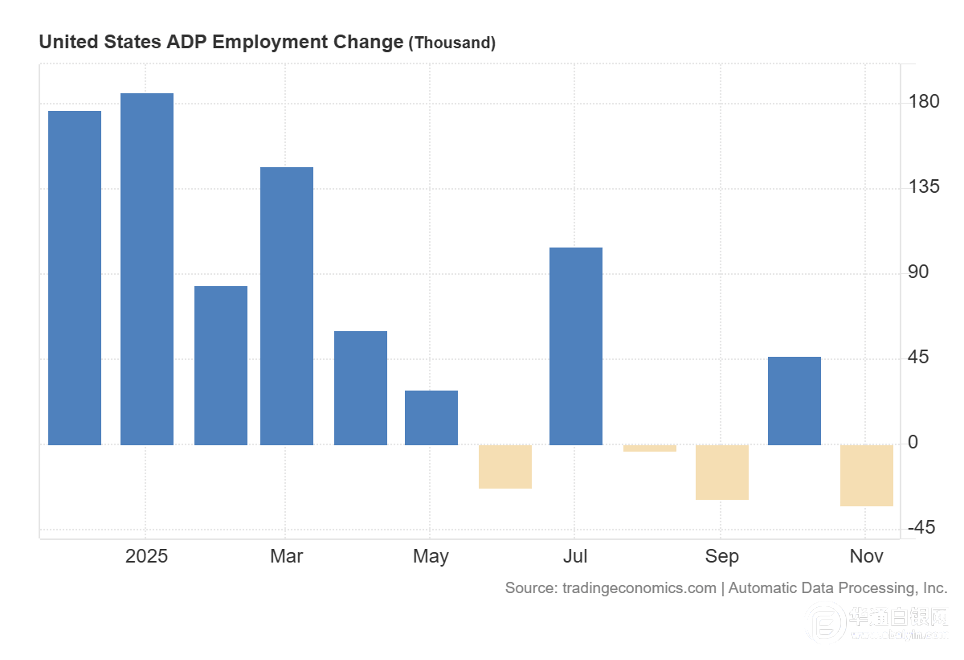
【华通白银网12月05日讯】随着市场对不断变化的经济状况做出反应,黄金和白银受到越来越多的关注。在政策预期继续演变的同时, 避险需求正在增强。 就业数据预示美联储政策转向,黄金白银上涨 疲弱的ADP就业报告支撑了黄金和白银价格的积极前景。下图显示,11月份美国经济失去了3.2万个就业岗位,这是自2020年8月以来首次 出现3个月平均就业岗位下降。 就业疲软和关税压力的结合加剧了人们对经济衰退的担忧。因此,对黄金和白银等避险资产的需求仍然很高。 此外,市场普遍预期美联储将在12月10日降息25个基点。目前美联储降息概率已飙升至89%,且美国13周短期国债收益率已跌破当前联 邦基金利率目标水平。较低的利率削弱了美元,降低了持有无息资产的机会成本。这重新激起了人们购买黄金和白银的兴趣。 尽管就业数据疲弱,但经济的一些领域依然坚挺。下图显示,ISM服务业PMI上升至52.6%。 失业主要集中在小企业,这些企业继续面临关税和其他经济因素的压力。假期期间增加的压力进一步影响了许多这样的企业。 此外,金融环境依然宽松,芝加哥联储指数为-0.522。然而,这些恢复力的迹象可能只会推迟进一步的宽松,而不是阻止它。由于投资者 预 ...
背叛高市早苗?日本经济再现负增长,各界组团请求访华“续命”
Sou Hu Cai Jing· 2025-12-03 11:44
Group 1 - Japan's economy experienced a significant contraction, with real GDP falling at an annualized rate of 1.8% in Q3 2025, marking a return to negative growth for the first time since Q1 2024 [1] - The economic downturn is attributed to a combination of external demand shrinkage and weak domestic demand, exacerbated by ineffective policies and diplomatic failures [3][20] - The U.S. has raised tariffs on Japanese imports from 2%-3% to 15%, severely impacting key industries like automotive, which has a profit margin of only 7%-8% [5][9] Group 2 - The decline in the automotive sector has a domino effect on related industries such as electronics and steel, leading to a broader economic downturn [7] - Personal consumption, which constitutes a significant portion of Japan's economy, only increased by 0.1% in Q3, with growth slowing considerably compared to Q2 [9] - Structural issues, including labor shortages due to an aging population and declining birth rates, are contributing to long-term domestic demand weakness [11] Group 3 - The Japanese government has proposed a massive economic stimulus plan worth 21.3 trillion yen, but it is unlikely to alleviate market concerns due to the current inflationary environment [13][14] - The focus on military spending, with defense expenditures rising to 2% of GDP, diverts resources away from addressing pressing economic issues and undermines growth potential [16][18] - Japan's diplomatic tensions with neighboring countries, particularly China, have created uncertainty in trade relations, which could further harm the economy [22][24] Group 4 - The historical success of Japan's post-war economy was largely due to a focus on economic development over military expansion and maintaining good relations with neighboring countries [26] - The current trajectory of military buildup and diplomatic provocations is seen as a misdirection that fails to address underlying economic challenges [27][29] - A sustainable recovery for Japan's economy will require confronting structural issues such as industry layout, demographic changes, and debt burdens rather than relying on military spending and aggressive foreign policy [29]

【环球财经】德国工业联合会:德经济正经历“自由落体式下滑”
Xin Hua She· 2025-12-03 08:08
德国已连续两年陷入经济衰退,联邦政府预计今年经济增幅仅为约0.2%。今年5月上台的总理默茨承诺 重振德国,包括通过大规模公共支出,加大国防和基础设施投入。默茨政府表示,经济复苏需要时间, 已实施减税等改革措施,但企业批评改革速度仍显不足。 (文章来源:新华社) 报告显示,今年德国工业产出预计下降2%,为连续第四年下滑。莱宾格指出,这一趋势已超出周期性 波动范围,反映工业发展陷入结构性困境。今年第三季度工业产出环比下降0.9%,同比下降1.2%,为 连续第九个季度萎缩,较2018年峰值明显回落。 新华财经柏林12月3日电(记者李函林)德国工业联合会2日发布最新工业报告,大幅下调德国今年工业 生产预期,指出德国经济正面临二战后最严重的危机。德国工业联合会主席彼得·莱宾格表示,德国工 业正经历"自由落体式"下滑,需要以竞争力和增长为优先的政策调整。 ...
山东招金梁永慧:黄金牛市没有结束,预计年底前将是一个震荡行情,长期应该是持续的稳步上涨
Sou Hu Cai Jing· 2025-11-27 03:54
Core Viewpoint - The long-term bull market for gold is not over, but a correction is expected in the short to medium term due to rapid price increases in 2025, leading to a forecast of a volatile market until the end of the year, followed by steady long-term growth [2][12]. Long-term Factors - Gold prices are influenced by long-term factors such as currency devaluation, global debt, and geopolitical issues, which are expected to have a lasting impact [7][8]. - The trend of de-dollarization is ongoing, with many countries increasing their gold reserves to support their currencies, which is likely to continue for over three years [8][12]. - Global debt and credit are expanding, particularly U.S. debt, with some countries selling U.S. bonds to buy gold, providing long-term support for gold prices [8][12]. - Historical inflation trends suggest that inflation may rise significantly after 2025, potentially leading to a substantial increase in gold prices [9][12]. - The global economy is entering a recession, which is expected to last for over a decade, further supporting gold as a safe-haven asset [9][10]. Medium-term Factors - The ongoing divergence in global monetary policies is expected to maintain a loose monetary environment, providing support for gold prices over the next three years [10][12]. - The uncertainty surrounding global economic recovery and the current economic cycle suggests that demand for gold as a safe asset will continue to rise [10][12]. Short-term Factors - The probability of interest rate cuts by the Federal Reserve is decreasing, which has led to a recent decline in gold prices, but the overall outlook remains bullish for the end of the year [10][12]. - Ongoing trade negotiations, particularly between the U.S. and China, have created short-term pressures on gold prices [11][12]. - Recent price movements indicate that gold is currently experiencing a downward adjustment, with key support levels identified at $3,900 and $3,520 [11][12]. Investment Recommendations - Investors and the general public are advised to consider allocating 5% to 30% of their asset portfolio to physical gold or gold ETFs, reflecting a long-term optimistic view on gold [6][13].

【环球财经】美国11月消费者信心指数显著走低
Xin Hua Cai Jing· 2025-11-26 05:27
(文章来源:新华财经) 调查还显示,在10月回升后,消费者对家庭当前和未来财务状况的预期在11月份走低。在金融市场遭遇 短暂抛售和对美国经济衰退的担忧之下,消费者对当前家庭财务状况的评估降至与2024年8月低点接近 的水平。消费者还在抑制今后半年服务支出计划,几乎涉及每个服务类别。 消费者在调查中提交的评论信息显示,物价与通胀、关税与贸易、政治等继续是影响经济的主要因素, 提到联邦政府"停摆"的次数增多。与10月份相比,消费者评论的基调整体上变得更为负面。 新华财经纽约11月25日电 美国研究机构世界大型企业研究会25日发布的初步调查数据显示,受联邦政 府"停摆"等因素影响,美国11月消费者信心指数从10月修订后的95.5显著降至88.7,为今年4月以来的最 低水平。 在该指数的组成部分中,消费者对当前商业和就业市场条件的评估指数下降4.3点,至126.9点。反映短 期收入前景、商业和就业市场环境的消费者预期指数则下降8.6点,至63.2点。该预期指数已经连续10个 月低于80这一通常显示将出现经济衰退的临界点。 世界大型企业研究会首席经济学家达纳·彼得森(Dana M Peterson)表示,在经过几个月的 ...
美国11月消费者信心指数显著走低
Xin Hua She· 2025-11-26 02:54
另外,美国商务部当天发布数据显示,美国9月零售额环比上升0.2%,低于市场预期的0.4%,较8月数 据显著下滑。美国富国银行高级经济学家蒂姆·昆兰表示,随着就业市场持续放缓和价格上涨压缩消费 能力,美国家庭支出持续放缓。 世界大型企业研究会首席经济学家达娜·彼得森表示,在经过几个月的盘整后,消费者信心在11月大幅 下挫。消费者信心指数的5个成分指数显示疲软或走弱。 (文章来源:新华社) 新华社纽约11月25日电(记者刘亚南)美国研究机构世界大型企业研究会25日发布的初步调查数据显 示,受联邦政府"停摆"等因素影响,美国11月消费者信心指数从10月修订后的95.5显著降至88.7,为今 年4月以来的最低水平。 调查还显示,在10月回升后,消费者对家庭当前和未来财务状况的预期在11月走低。在金融市场遭遇短 暂抛售和对美国经济衰退的担忧之下,消费者对当前家庭财务状况的评估降至与2024年8月低点接近的 水平。 在该指数的组成部分中,消费者对当前商业和就业市场条件的评估指数下降4.3,至126.9。反映短期收 入前景、商业和就业市场环境的消费者预期指数则下降8.6,至63.2。该预期指数已连续10个月低于80这 一通 ...
新力量NewForce总第4910期
First Shanghai Securities· 2025-11-25 08:13
Group 1: Pinduoduo (PDD) Analysis - Pinduoduo's Q3 revenue reached RMB 108.276 billion, a year-on-year increase of 9%, aligning with market expectations[8] - Online marketing services revenue was RMB 53.348 billion, up 8% YoY, while transaction services revenue was RMB 54.929 billion, up 10% YoY, indicating a deepening commercial model[8] - The company maintained a net profit of RMB 29.328 billion, a 17% increase YoY, with a net profit margin of 27.1%[8] - Target price for Pinduoduo is set at USD 148.90, reflecting a 31% upside potential from the current price of USD 113.24[11] Group 2: Xiaomi Group (1810) Analysis - Xiaomi's Q3 smartphone revenue was RMB 45.97 billion, a decline of 3.1% YoY, with global smartphone shipments at 43.3 million units, a 0.5% increase YoY[16] - The automotive business achieved revenue of RMB 29.01 billion, with a gross margin of 25.5%, marking the first quarterly profit of RMB 700 million[18] - Xiaomi's IoT revenue increased by 5.6% YoY to RMB 27.6 billion, with a gross margin of 23.9%[17] - Target price for Xiaomi is set at HKD 50.20, indicating a potential upside of 31.83% from the current price of HKD 38.08[22]

11.9万就业虚高,失业率破4.4%,美联储陷降息两难
Sou Hu Cai Jing· 2025-11-24 14:13
朋友们,今天带你们吃一口热乎乎的经济大瓜!谁能想到,一份来自美国的数据报告,竟然比悬疑大片还刺激,直接把全球资本市场搅得风起云涌! 这份就业报告,原本该在秋天就和大家见面,结果硬生生拖到了初冬才"压轴登场"。这感觉,就像你都已经穿上羽绒服了,才收到夏天网购的短袖——数据 早就和现实脱节啦! 乍一看,11.9万的新增就业岗位,简直闪亮到晃眼,把市场预期甩开几条街。可离奇的是,美债价格却像坐上窜天猴一样往上冲,十年期收益率直接掉到 4.11%。这波操作的精髓在哪?表面是经济利好的烟花,实际上却是市场在疯狂下注:美联储马上要拧开降息的水龙头了! 数据里头的门道可深了。新增岗位看着热闹,可懂行的人都知道,这里头多半是兼职和零工在撑场子。你想想,一个人为了生活拼三份工,统计表上就华丽 变身成三个就业岗位——这哪是经济腾飞,分明是打工人的辛酸加倍! 其实美国经济早就陷入了一个"三明治困局"。最上层是越滚越大的债务雪球,光利息支出就比军费还烧钱。中间是日益撕裂的贫富差距,普通人的钱包越来 越瘪。最下层是那些曾经风光无限的科技概念,如今也开始显露疲态。 真正让华尔街精英们坐不住的,是那个偷偷摸摸涨到4.4%的失业率。别看只涨 ...
