地缘政治风险

Search documents
光大期货0126热点追踪:伊朗局势趋紧,燃料油再度大涨
Xin Lang Cai Jing· 2026-01-26 09:06
热点栏目 自选股 数据中心 行情中心 资金流向 模拟交易 客户端 周一,燃料油跳空高开高走,日内最大达涨幅超5%,相关能化品一并走强。美国总统特朗普22日表 示,一支"庞大舰队"正在前往中东地区海域。美国福克斯新闻网此前报道,随着与伊朗紧张关系升级, 美国正在向中东地区增派兵力,其中包括至少一艘航空母舰,同时将在该地区部署更多的导弹防御系 统。据参考消息网援引路透社1月23日报道,一名伊朗高级官员23日说,伊朗将把任何袭击都当作"针对 我们的全面战争"对待。作为全球高硫燃料油主要出口地,中东局势升温再次引发市场供应端的担忧情 绪,燃料油价格随之大涨,短期继续关注伊朗局势进展。 基本面来看,供应方面,哈萨克斯坦部分油田由于电力分配系统出现问题后暂停生产,预计时间持续1- 2周,这将减少通过里海管道联盟的原油出口。需求方面,IEA最新月报将全球原油石油需求上调了19.4 万桶/日至93万桶/日,预计2026年全年全球原油市场过剩量约为370万桶/日,供应过剩程度略有收窄。 国内炼厂需求方面,我国1月高硫燃料油进口量预计在80万吨,同比下降28万吨。当前市场缺乏单边趋 势的强劲驱动,供应充足和高库存的现实,限制了油 ...


大摩:金价未见顶 下半年牛市情境可见5,700美元
智通财经网· 2026-01-26 08:27
智通财经APP获悉,摩根士丹利发布研报称,黄金价格已超越该行对下半年每盎司4,750美元的预测, 然而该行认为金价尚未见顶,主要受地缘政治风险、央行释放的积极信号及ETF买盘支撑。该行特别提 出看涨情境下的目标价:下半年每盎司5,700美元。白银价格动能强劲,上海市场的现货溢价凸显供应 紧张。 大摩表示,看涨黄金情境正在发酵,美元指数走弱、实物需求稳健及地缘政治风险居高不下,该行认为 金涨势尚未结束。该行强调对2026年下半年的牛市情境目标为每盎司5,700美元,意味着较当前水平仍 有14%上行空间。 白银正以每盎司100美元的历史高点交易,其贵金属属性主导走势。在经历数年供应短缺后,强劲的 ETF需求正吸纳有限的库存。上海白银价格(实物交割合约比例较高)相对于芝加哥商品交易所呈现大幅 溢价,反映实物供应持续紧绷。尽管太阳能需求可能已见顶,或导致下半年银价走弱,但目前其他驱动 因素仍占主导地位。 大摩指出,波兰央行正转向以绝对吨位数作为黄金储备目标,而非占总储备比例,显示其对价格敏感度 降低。联储局今年的降息预期应能持续支持贵金属ETF买盘。上海白银现货价格飙升,表明供应紧缩局 面可能延续。 ...
【白银期货收评】沪银日内上涨12.78% 市场地缘担忧情绪再起
Jin Tou Wang· 2026-01-26 07:59
Group 1 - The silver futures market is experiencing significant price increases, with the Shanghai silver futures closing at 27,207 yuan per kilogram, reflecting a daily increase of 12.78% and a trading volume of 965,900 contracts [1] - The spot price of silver in Shanghai is quoted at 27,610 yuan per kilogram, indicating a premium of 403 yuan per kilogram over the futures price [1] - Geopolitical tensions are rising due to U.S. military movements towards Iran, contributing to increased volatility and higher silver prices, with the domestic sentiment improving [4] Group 2 - The U.S. Treasury has taken initial steps to intervene in the foreign exchange market, indicating potential shifts in monetary policy [2] - The U.S. has announced new sanctions against entities and oil tankers related to Iran, with military readiness heightened in the region [3] - The U.S. is pressuring Bolivia to expel suspected Iranian spies and is considering similar actions in Chile, Peru, and Panama, reflecting a broader strategy to counter Iranian influence [3]
地缘风险升温,铂钯双双大涨
Hua Lian Qi Huo· 2026-01-26 07:51
1. Report Industry Investment Rating - No information provided in the report. 2. Core Viewpoints of the Report - Platinum and palladium prices are still affected by the overall sentiment of the precious metals sector and geopolitical risks in the short term. Geopolitical risks remain high, driving up precious metals prices, and platinum and palladium fluctuate with the sector [8][9]. - Fundamentally, the global platinum market has been in short supply for two consecutive years. The supply of platinum is shrinking, industrial demand is rising, and low prices have stabilized jewelry and investment demand, highlighting the supply - demand contradiction. The supply - demand gap of platinum is expected to continue in the next few years, so the long - term fundamentals of platinum are optimistic [9]. - For palladium, automotive demand dominates. Due to the surge in the penetration rate of new energy vehicles in China, the growth of palladium demand is suppressed, and it is difficult to see improvement in the short term. Therefore, the fundamental support for palladium is limited, and its trend is affected by platinum linkage and the macro - environment [9]. - Overall, the industrial demand for platinum and palladium is concentrated in fuel - vehicle exhaust catalysts, and the fundamental support is insufficient. Their trends are mainly driven by the overall sector sentiment, and recently by safe - haven demand. They are expected to maintain high volatility and wide - range fluctuations. It is recommended to go long on platinum PT2606 and palladium PD2606 with light positions [9]. 3. Summary According to Relevant Catalogs 3.1 Weekly Views and Strategies 3.1.1 Weekly Views - **Price Trends**: Last Friday, there were fluctuations in the platinum and palladium markets. The sharp rise in the spot price of platinum in the external market drove the prices of domestic platinum and palladium to gap up on Friday. Platinum was relatively strong, with the platinum main contract closing at 685.9 yuan, up 10.39%; the palladium main contract closed at 497.95 yuan, up 3.98%. The spot price of external platinum reached a record high of 2704.3 at the early morning of Saturday. The weekly gains of domestic platinum and palladium were 12.4% and 6.1% respectively [8]. - **Macroeconomic Situation**: The number of initial jobless claims in the US in the week of January 17 was 200,000, lower than the expected 209,000. The number of continued jobless claims dropped to 1.85 million last week, lower than the expected 1.89 million, the lowest level since November, indicating a warming labor market. The final quarter - on - quarter growth rate of the US GDP in the third quarter was 4.4%, the fastest in two years, showing robust growth. In November, the overall PCE price index in the US increased by 2.8% year - on - year and 0.2% month - on - month, in line with expectations; the core PCE price index also increased by 2.8% year - on - year and 0.2% month - on - month, in line with expectations, indicating a mitigation of inflation risks. The market is focusing on the upcoming announcement of the new Fed Chairman, which may affect market expectations for the future interest - rate path of the Fed [8]. - **News**: The sharp rise in precious metals last week was mainly due to the intensification of geopolitical risks, which led to funds flowing into safe - haven assets. The US President's announcement of tariffs on eight European countries and Europe's strong response of selling US Treasuries, along with the deterioration of the situation in Greenland, initially increased geopolitical risks. Although the US President later cancelled the tariffs and gave up the idea of seizing the island by force, the tense relations between Europe and the US and the uncertain situation in Iran still stimulated the market's demand for safe - haven asset allocation [8]. - **Fundamentals**: In 2026, platinum and palladium are expected to show significant differences. The supply of platinum is continuously restricted, with South Africa accounting for over 70% of global production. Its demand structure is diverse, with automotive exhaust catalysts accounting for only about 40%, and the rest coming from investment, jewelry, and industrial fields. Against the background of rising platinum prices, investment demand has increased significantly. At the same time, emerging fields such as the hydrogen - energy industry and commercial spaceflight have opened up long - term growth prospects, and the supply - demand gap of platinum is expected to widen in 2026. The terminal demand for palladium is highly dependent on automotive exhaust catalysts, accounting for over 80%. Suppressed by the accelerating penetration of new energy vehicles and the substitution trend of platinum, the growth of palladium demand lacks imagination. Although there is still a short - term supply gap, it is expected to narrow significantly in 2026, with relatively limited fundamental support [8]. 3.1.2 Strategies - It is recommended to go long on platinum PT2606 and palladium PD2606 with light positions [9]. 3.2 Spot and Futures Markets - The report provides multiple sets of charts, including the trends of NYMEX platinum and palladium futures, London platinum and palladium spot prices, Guangzhou Futures Exchange platinum and palladium futures, and the Shanghai Gold Exchange platinum price [12][16][20][24]. 3.3 US Economy - The report presents charts of US GDP, PMI, new non - farm employment numbers, and the unemployment rate, which can be used to analyze the overall situation of the US economy [30][31]. 3.4 Inflation - The report provides charts of US CPI/PCE and core CPI/PCE to show the inflation situation in the US [36][39]. 3.5 Interest Rates - The report shows charts of US Treasury yields (including short - term and medium - to - long - term) and real interest rates, which can be used to analyze the interest - rate situation in the US [42][45][46]. 3.6 Fundamentals - **Platinum**: The report provides a global platinum supply - demand balance sheet from 2013 to 2026f, showing the supply from various regions (such as South Africa, Zimbabwe, North America, Russia), different types of demand (automotive, jewelry, IT, etc.), and the supply - demand gap and inventory changes in different years [51]. - **Palladium**: The report provides a global palladium supply - demand balance sheet from 2009 to 2025, showing the supply from different regions (South Africa, Russia, North America, etc.), different types of demand (automotive, chemical, dental and biomedical, etc.), and the supply - demand gap in different years [52]. 3.7 Futures Positioning - The report provides charts of the external platinum and palladium futures positionings, including non - commercial net long positions and total positions [53]. 3.8 Passenger Car Sales - The report provides charts of China's passenger - car market retail and wholesale data, including the number of vehicles sold and year - on - year changes [60]. 3.9 US Dollar Index and Exchange Rates - The report provides charts of the US dollar index and various exchange - rate pairs, including the US dollar against the Chinese yuan, the euro, the Japanese yen, the British pound, and the Canadian dollar [66][69][72][74]. 3.10 Platinum - Palladium Price Difference between Domestic and Foreign Markets - The report provides charts of the spot price trends of domestic and foreign platinum and the price difference between them [83]. 3.11 Platinum - Palladium Price Ratio - The report provides a chart of the platinum - palladium price ratio, including the ratios in NYMEX and LPPM [90].
山东墨龙一度涨超7% 中东局势依然紧张 美国天然气期货狂飙
Zhi Tong Cai Jing· 2026-01-26 07:37
消息面上,据新华社报道,美国总统特朗普于1月22日在"空军一号"上宣布,美国正调集重兵前往伊 朗,多艘军舰已向该区域行进。这一表态引发国际市场对中东局势的深度担忧。此外,受侵袭美国大部 分地区的冬季风暴影响,美国天然气价格25日大幅飙升,期货价格自2022年以来首次突破每百万英热单 位6美元关口。 华泰期货认为,短期中东局势依然紧张,美国持续在中东地区布兵,对伊朗的打击可能箭在弦上,伊朗 不同于委内,由于其地缘位置的重要性,可能波及周边重要产油国以及霍尔木兹海峡,因此油价对伊朗 局势的敏感性远大于委内瑞拉。 山东墨龙(002490)(00568)一度涨超7%,截至发稿,涨5.13%,报4.3港元,成交额2.85亿港元。 ...

机构策略师:“TACO交易”悖论或放大下一轮市场危机
Ge Long Hui A P P· 2026-01-26 07:36
格隆汇1月26日|BCA Research全球投资策略团队副总裁Miroslav Aradski表示,如果采用滚动高点的方 法,即从最近一次市场高位而非按日历周期计算跌幅,标普500指数已连续185天未出现10%的回撤。这 一时长本身并不意味着回调迫在眉睫,但长期的平静容易滋生自满情绪。即便市场似乎对政治言辞越来 越"脱敏",地缘政治依然是一个高度不可预测的风险。Aradski指出,"TACO交易"的核心存在一个深刻 的悖论,即市场基于政策威胁终将被收回的假设而选择忽略它们,"在缺乏市场约束的情况下,特朗普 反而拥有更大的空间去推进可能具有破坏性的政策。这意味着,当下一次危机到来时,规模可能会超过 上一次。" ...
1.26黄金冲高100美金 硬上5100关口
Sou Hu Cai Jing· 2026-01-26 07:26
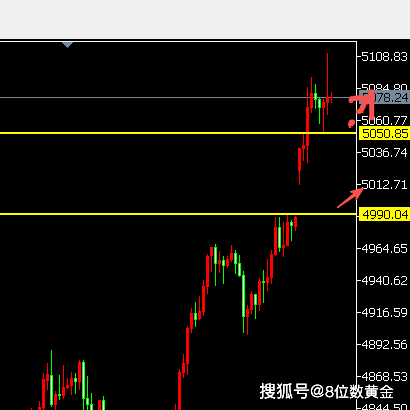
今天的走势 周五一路走高,加速冲到4990。 黄金上周高开暴走,多头不改,连续闯关,单边抛物线涨达400美金后。今天又是高开,继续冲顶新 高,生吃5100,继续挺进新高。 上周主要因素: 面临5000,没有丝毫停留,直接高开了。 冲高力度很大,最高触达5093后回落。 短期内冲的太猛,回踩5050后。 又是大力回升,一度涨破了5100的关口。 上方继续涨,新高,看向5150的区域。 当然了,下方再调整需求,可再探5050的位置。 不过,谨防大的调整,下方可回踩看向5000的关口。 黄金连涨2个月后,本月又进入了单边涨势。一路火光带闪电,直接抛物线走势,而且这两周明显进入 了加速阶段,上冲,不猜顶。当然了,谨防大的技术性调整出现,下方大的调整,可看向4700-4750的 区域。 操作方面,黄金继续冲高,强势不改,关注5000和5050做多的机会。此外,黄金强势之下,空单避让。 一方面,格陵兰纠纷继续打乱地缘格局,特朗普一手直接掀翻了固有的秩序,把情绪推升到了高位,而 且方言对欧关税,又是一波冲击。再加上,美继续加码对伊的军事,中东火药库继续牵动全球,推升黄 金不断走高。 另外一方面,日元地震,直接剧烈动荡不安, ...
黄金白银:2026年1月26日申万期货品种策略日报-20260126
Shen Yin Wan Guo Qi Huo· 2026-01-26 07:21
| | | | 2026年1月26日申万期货品种策略目报-黄金自银 | | | | | --- | --- | --- | --- | --- | --- | --- | | | | | 甲银万国期货研究所 陈梦赟(从业资格号:F03147376;交易咨询号:Z0022753) | | | | | | | | chenmy@sywggh.com.cn | 021-50585911 | | | | | | 沪金2606 | 沪金2604 | 沪银2606 | 沪银2604 | | | | 昨日收盘价 | 1118.38 | 1115. 640 | 24930 | 24965 | | | | 前日收盘价 | 1090.38 | 1087. 580 | 23297 | 23339 | | | 期货 | 涨跌 | 28. 00 | 28. 060 | 1633 | 1626 | | | 市场 | 涨跌幅 | 2.57% | 2.58% | 7.01% | 6.97% | | | | 持仓量 | 80602 | 206580 | 160299 | 316349 | | | | 成交量 | 51175 | 288050 ...
“双万亿巨头”股价今日创新高
Xin Lang Cai Jing· 2026-01-26 07:21
Group 1 - The A-share market saw a significant rise in resource and energy leading stocks, with Zijin Mining and China National Offshore Oil Corporation (CNOOC) reaching historical highs, both surpassing a market capitalization of 1 trillion yuan [1] - Major companies such as Shandong Gold, Zhongjin Gold, China Uranium Industry, and Weichai Power also experienced notable increases, indicating strong performance in the precious metals and oil and gas sectors [1] - The spot gold price broke the $5,000 per ounce mark for the first time on January 26, setting a new historical record [1] Group 2 - Experts indicated that the surge in gold prices is driven by multiple factors, including central bank gold purchases, expectations of interest rate cuts by the Federal Reserve, geopolitical risks, and trends towards de-dollarization [1] - Continuous gold buying by central banks is highlighted as a crucial fundamental factor supporting gold prices [1] - On January 25, U.S. natural gas futures prices exceeded $6 per million British thermal units, reaching the highest level since 2022, influenced by energy supply tightness due to a winter storm [1]


站稳5000美元!黄金牛途全速前进,地缘风险+货币贬值点燃市场
Sou Hu Cai Jing· 2026-01-26 07:08
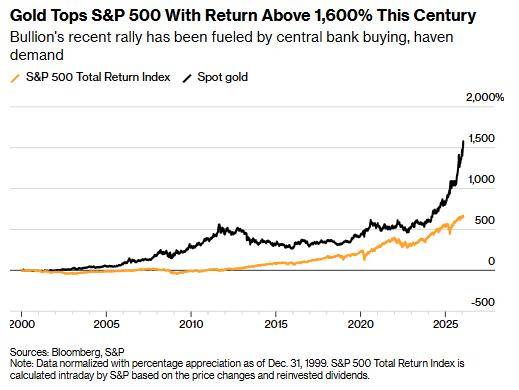
智通财经获悉,国际金价首次站上每盎司5000美元关口,涨势依然迅猛。这一轮凌厉的上涨,背后源于 美国总统特朗普的外交格局重塑,以及投资者大举撤离主权债券和各国货币的市场行为。 受美元走弱进一步提振黄金需求的影响,现货黄金涨幅一度扩大至2.1%,价格逼近每盎司5100美元。 过去六个交易日,美元指数累计跌幅近2%;市场猜测美国或协助日本提振日元汇率,这一消息叠加对美 联储独立性的担忧、以及特朗普政策的反复性,进一步加剧了美元的弱势。白银价格同样创下历史新 高,突破每盎司109美元,实现三连涨。 截至发稿,现货黄金报每盎司5078.20美元,涨幅1.9%;白银报每盎司107.72美元,涨幅4.6%。铂金价创 历史新高,钯金价同样走高。美元现货指数继上周下跌1.6%后,周一再跌0.4%。 上周末,特朗普发出威胁,称若加拿大与中国达成贸易协议,美国将对加拿大所有对美出口商品加征 100%关税,加美双边紧张局势进一步升级。与此同时,美国国内的政治不确定性仍居高不下:参议院 民主党领袖查克・舒默明确表示,除非共和党取消国土安全部的相关拨款,否则将否决大规模支出法 案,这一表态也加大了美国政府部分停摆的风险。 过去两年,黄 ...