智能驾驶

Search documents
德赛西威20251225
2025-12-26 02:12
Summary of Desay SV's Conference Call Company Overview - **Company**: Desay SV - **Industry**: Automotive Technology and Smart Driving Solutions Key Points and Arguments Financial Performance and Projections - Desay SV expects a stable long-term gross margin around 20%, benefiting from increased penetration of traditional joint venture brands in smart driving and premium revenue from overseas operations [2][3] - The company’s contract manufacturing business currently accounts for 10% to 15% of total revenue, with expectations that this proportion will not significantly increase in the long term due to rising contributions from traditional brands' smart driving systems [3] Market Dynamics and Product Development - The cockpit sector has potential for increased per-vehicle value, driven by the demand for higher performance chips as L3 autonomous driving progresses [2][6] - Desay SV anticipates new customers in the smart driving sector primarily from traditional brands and sub-brands that did not launch this year, with a shift towards higher-margin projects expected [7] - The company is collaborating closely with domestic autonomous driving chip manufacturers, maintaining the ability to transition from OV platforms to others [9] Overseas Market Strategy - As of Q3, overseas revenue accounted for 7.5%, with expectations of remaining below 10% for the year. The goal is to increase this to 20% by 2030, starting with mass production of integrated cockpit solutions in Q4 next year [8] Supply Chain and Cost Management - Desay SV has a strong supply chain management capability, particularly in procurement and logistics, providing a significant cost advantage over competitors [11] - The company is addressing rising material costs, especially memory prices, by negotiating cost-sharing with clients and ensuring stable supply for automakers [4] Product Innovation and Competitive Edge - The company’s autonomous vehicles adhere to automotive-grade standards and are fully self-developed, which enhances reliability and quality, allowing Desay SV to capture market share without engaging in price wars [10] - The introduction of L3 autonomous driving standards is expected to significantly enhance vehicle value and increase the demand for high-performance chips [6][12] Customer Structure and Market Trends - The customer base is becoming more diversified, with revenue from any single customer now below 20%. The company expects stable demand from core clients despite competitive pressures [13] - Future market demand is anticipated to be influenced by tax incentives and trade-in policies, with core customers maintaining a strong demand for autonomous configurations [15][16] Research and Development - A decrease in R&D expenses in Q3 is viewed as a temporary phenomenon, with plans to maintain a stable R&D investment ratio to support ongoing innovation [15] Additional Important Insights - Desay SV is exploring opportunities in the instant retail market and potential collaborations in the Robotaxi sector, which is expected to yield higher margins compared to traditional passenger vehicles [12] - The company is positioned to benefit from the growing Robotaxi market, which has a significantly higher value than traditional vehicles, contributing to improved gross margins [12]
智驾险仍徘徊“兜底服务”阶段
Jing Ji Wang· 2025-12-26 02:02
Core Viewpoint - The evolution of intelligent driving technology is leading to a revolution in transportation, with the recent approval of China's first L3-level vehicle licenses marking a significant step towards the commercialization of L3-level autonomous driving [1] Group 1: Intelligent Driving Technology and Market Developments - The L3-level "conditional automation" mode introduces "human-machine transfer" of driving responsibility, shifting focus to system reliability, algorithm decision-making, and sensor performance [1] - The emergence of "intelligent driving insurance" products in the market is primarily a safety net provided by automakers or intelligent driving solution suppliers, rather than genuine insurance products [2][3] - Companies like Xiaopeng Motors have launched intelligent driving insurance plans, with costs around 239 yuan per year, which require customers to purchase additional insurance from partnered companies [2] Group 2: Insurance Industry's Role and Challenges - Insurance companies play a crucial role in the design and risk control of these insurance products, but most current "intelligent driving insurance" offerings are essentially value-added services rather than independent insurance products [3] - The lack of access to critical driving data held by automakers complicates the ability of insurance companies to develop genuine intelligent driving insurance products [5] - The complexity of liability in "human-machine co-driving" scenarios presents challenges for insurance companies, as existing traffic safety regulations are based on human drivers [5] Group 3: Future Directions and Regulatory Environment - To realize intelligent driving insurance, collaboration across various sectors is necessary, including regulatory frameworks, data governance, and industry cooperation [6] - Policies encouraging the insurance industry to adapt to the impacts of intelligent driving are being developed, with a focus on evolving risk assessment and pricing models [6][7] - Experts emphasize the need for clear definitions and regulations regarding intelligent driving insurance to avoid overlaps with existing insurance products and ensure data transparency [7]

“人机共驾”再次进阶 智驾险仍徘徊“兜底服务”阶段
Zhong Guo Zheng Quan Bao· 2025-12-26 02:01
Core Insights - The evolution of intelligent driving technology is leading to a revolution in transportation, with the recent approval of China's first L3-level vehicle licenses marking a significant step towards the commercialization of L3-level autonomous driving [1] - The L3-level "conditional automation" introduces a shift in driving responsibility from human to machine, raising concerns about system reliability, algorithm decision-making, and sensor performance [1] - The emergence of "intelligent driving insurance" products has been noted, but these are primarily safety nets provided by automakers rather than true insurance products [1][2] Group 1: Intelligent Driving Insurance Landscape - Since 2025, there has been a notable increase in insurance products related to assisted and intelligent driving, with companies like Xiaopeng Motors offering "intelligent driving insurance" for an annual fee of 239 yuan [2] - Many of these insurance products require customers to first purchase traditional insurance before accessing additional coverage for intelligent driving scenarios, indicating a trend towards bundled services [2][3] - Current "intelligent driving insurance" products are largely backed by automakers rather than traditional insurance companies, often serving as value-added services rather than independent insurance offerings [3] Group 2: Challenges in Insurance Development - The lack of access to critical driving data held by automakers poses a significant challenge for insurance companies in developing true intelligent driving insurance products [5] - The complexity of responsibility in "human-machine co-driving" scenarios complicates the establishment of clear liability standards, as traditional insurance models are based on human drivers [5][6] - The need for high-quality, standardized data for accurate risk assessment is emphasized, with current data being monopolized by automakers, making it difficult for insurers to evaluate risks effectively [4][5] Group 3: Regulatory and Collaborative Efforts - There is a call for collaborative efforts among insurers, automakers, and technology companies to create a new ecosystem that addresses regulatory frameworks, data governance, and industry cooperation [6][7] - Recent policy signals indicate a push for the insurance industry to adapt to the impacts of intelligent driving, with a focus on evolving risk assessment and pricing models [6][7] - Experts suggest the establishment of a national data-sharing platform and the need for regulatory frameworks to clarify liability in intelligent driving scenarios [6][7]
承泰科技递表港交所 国泰君安国际为独家保荐人
Zheng Quan Shi Bao Wang· 2025-12-26 00:20
Core Viewpoint - Chengtai Technology has submitted an application for a mainboard listing on the Hong Kong Stock Exchange, with Guotai Junan International as its sole sponsor [1] Group 1: Company Overview - The company specializes in the design, research and development, manufacturing, and commercialization of millimeter-wave radar products [1] - Chengtai Technology operates production bases in Shenzhen and Suzhou [1] - The company employs a "business three-ring" model, focusing on high-quality hardware, agile software, and rapid delivery to provide OEM customers with high-quality and quickly deployable intelligent driving products and services [1] Group 2: Product Offerings - Chengtai Technology has developed multiple generations of millimeter-wave radar product matrices that support intelligent driving needs from L0 to L2+, including competitive 5th generation 4D radar and 5.5th generation high-resolution 4D radar products [1] - The company has established partnerships with over 20 automotive industry clients, including several leading Chinese OEMs, and its high-resolution products have been adopted by major clients [1] - Chengtai Technology is currently in discussions with leading European automotive brands [1] Group 3: Competitive Advantages - The company demonstrates significant advantages in delivery efficiency, with an average product delivery cycle for customized software ranging from 6 to 9 months, which is considerably lower than the industry average of 12 to 24 months [1] - Some collaborative projects can even be delivered within one month [1]
“人机共驾”再次进阶智驾险仍徘徊“兜底服务”阶段
Zhong Guo Zheng Quan Bao· 2025-12-25 21:11
Core Viewpoint - The evolution of intelligent driving technology is leading to a revolution in transportation, with the recent approval of China's first L3-level vehicle licenses marking a significant step towards the commercialization of L3-level autonomous driving [1] Group 1: Development of Intelligent Driving Insurance - Since 2025, there has been a notable increase in insurance products related to assisted and intelligent driving, with companies like Hongmeng Zhixing, Zhuoyu Technology, GAC Group, Xiaopeng Motors, and Xiaomi Motors launching intelligent driving protection plans [1] - Xiaopeng Motors offers a "smart driving insurance" for 239 yuan per year, which provides compensation if an accident occurs during the use of intelligent driving features [2] - Many of the current "intelligent driving insurance" products are essentially value-added services or liability agreements provided by car manufacturers rather than independent insurance products [3] Group 2: Challenges in Intelligent Driving Insurance - The core data necessary for accurate risk assessment in intelligent driving insurance is largely monopolized by car manufacturers, making it difficult for insurance companies to access critical information [4] - The complexity of responsibility in "human-machine co-driving" scenarios poses significant challenges for insurance companies, as current traffic safety regulations are based on human drivers and do not clearly define liability in these new contexts [5] - Experts suggest that to effectively implement intelligent driving insurance, there needs to be collaboration across various sectors, including regulatory frameworks, data governance, and industry cooperation [6] Group 3: Future Directions and Regulatory Environment - Regulatory bodies are exploring the impact of intelligent driving on insurance operations and are encouraging the insurance industry to adapt to new risks associated with autonomous vehicles [5][7] - There is a call for the establishment of a national data-sharing platform and for car manufacturers to open up anonymized data to facilitate the development of risk assessment systems [6] - Some large insurance companies are already conducting tests and preparing intelligent insurance products specifically for L3-level and above intelligent connected vehicles [7]
“人机共驾”再次进阶 智驾险仍徘徊“兜底服务”阶段
Zhong Guo Zheng Quan Bao· 2025-12-25 21:09
Core Insights - The evolution of intelligent driving technology is leading to a revolution in transportation, with the recent approval of China's first L3-level vehicle licenses marking a significant step towards the commercialization of L3-level autonomous driving [1] - The L3-level "conditional automation" introduces a shift in driving responsibility from human to machine, raising concerns about system reliability, algorithm decision-making, and sensor performance [1] - The current market offerings labeled as "intelligent driving insurance" are primarily safety net solutions provided by automakers or intelligent driving solution suppliers, rather than genuine insurance products [1][2] Group 1: Market Developments - Since 2025, there has been a notable increase in insurance products related to assisted and intelligent driving, with companies like Xiaopeng Motors and GAC Group launching their own intelligent driving protection plans [2] - Xiaopeng Motors offers a "smart driving insurance" for 239 yuan per year, which provides compensation for accidents caused during the use of their intelligent driving features [2] - Other new energy vehicle manufacturers are also collaborating with insurance companies to provide supplementary coverage tailored to intelligent driving scenarios, often embedded as value-added services in the car purchase experience [2] Group 2: Insurance Industry Challenges - The design and risk control of these insurance products heavily rely on insurance companies, which are currently not offering true intelligent driving insurance to individual consumers [3][5] - The core data necessary for accurate risk assessment is largely monopolized by automakers, making it difficult for insurance companies to access critical information needed for pricing and claims [4][5] - The complexity of liability in human-machine driving scenarios poses significant challenges, as existing traffic safety regulations are based on human drivers, and the transition to L3-level automation complicates responsibility allocation [5][6] Group 3: Future Directions - To effectively implement intelligent driving insurance, collaboration across various sectors is essential, including regulatory frameworks, data governance, and industry cooperation [7] - Recent policy signals indicate a push for the insurance industry to adapt to the impacts of intelligent driving, with a focus on evolving risk assessment and pricing models [7][8] - Experts emphasize the need for clear definitions and regulations surrounding intelligent driving insurance, including liability recognition and data security, to ensure transparency and protect consumer rights [8]
“人机共驾”再进阶,保险如何跟进?
Zhong Guo Zheng Quan Bao· 2025-12-25 14:57
Group 1 - The Ministry of Industry and Information Technology has officially announced the first batch of L3-level vehicle access permits in China, marking a significant step towards the commercialization of L3-level autonomous driving [1] - The L3-level "conditionally automated driving" mode introduces a "human-machine transfer" of driving responsibility, shifting the focus of risk to system reliability, algorithm decision-making, and sensor performance [1] - New insurance demands are emerging around intelligent driving, but existing regulations and traditional insurance models are not yet equipped to address these needs [4][5] Group 2 - Several companies, including Zhaoyu Technology, GAC Group, Xiaopeng Motors, and Xiaomi Motors, have launched intelligent driving insurance plans, with Xiaopeng offering a "smart driving insurance" for 239 yuan per year [2] - Current intelligent driving insurance products are often not independently underwritten by insurance companies but are instead backed by car manufacturers, making them more of a value-added service than a regulated insurance product [2] - The insurance industry has yet to open intelligent driving insurance to individual consumers, focusing primarily on new energy vehicle insurance [2][4] Group 3 - The development of intelligent driving insurance faces challenges such as responsibility determination and data deficiencies, as current traffic safety regulations are based on human drivers [4][5] - Experts suggest that collaboration among various stakeholders, including regulatory frameworks, data governance, and industry cooperation, is essential for the successful establishment of intelligent driving insurance [5][6] - The Financial Regulatory Bureau and the Ministry of Industry and Information Technology have called for a comprehensive study on the long-term impacts of intelligent driving and rapid vehicle iteration on the insurance industry [6]
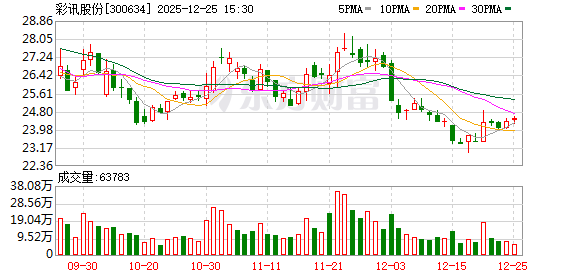
彩讯股份:公司为知名汽车企业提供智能驾驶的算力支持,主要是帮助客户建设智能驾驶智算中心
Mei Ri Jing Ji Xin Wen· 2025-12-25 11:53
Group 1 - The core viewpoint of the articles highlights that CaiXun Co., Ltd. is providing computing power support for intelligent driving to well-known automotive enterprises, focusing on building intelligent driving computing centers and enhancing the capabilities of autonomous driving models [1][3] - The company emphasizes that its collaboration with clients strictly adheres to commercial confidentiality agreements, and specific technical details will be disclosed officially by the clients [1] - The recent issuance of the first batch of L3-level autonomous driving vehicle special license plates in Beijing marks a significant milestone in the transition of autonomous vehicles from testing to mass production, indicating the start of the L3 autonomous driving era [3] Group 2 - CaiXun Co., Ltd. has developed the Rich AICloud computing platform, which features advanced infrastructure deployment, intelligent networking, and resource optimization capabilities, currently providing computing support for intelligent driving to domestic well-known automotive companies [3] - The inquiry from investors regarding whether the automotive enterprise has achieved L3-level intelligent driving indicates the growing interest and potential of the autonomous driving sector [3]

2025 EDGE AWARDS 年度汽车科技榜单正式揭晓
Tai Mei Ti A P P· 2025-12-25 11:31
Core Insights - The automotive industry is shifting focus from mere electrification to a comprehensive system capability centered around "intelligence" [2][3] - The 2025 EDGE AWARDS emphasizes "implementation capability" as a core criterion, recognizing smart automotive products and technologies that have been validated in real user scenarios [3][4] Industry Trends - The competition in the automotive sector has entered a new phase, with rapid technological iterations and a shift in user focus from short-term concept chasing to long-term stability and experience [3][4] - Key areas of innovation include advanced intelligent driving, smart cockpit experiences, and the integration of hardware and software for overall vehicle intelligence [3][4] Award Categories - The awards are categorized into four main directions: Best Intelligent Driving, Best Intelligent Cockpit, Best Intelligent Model, and Innovative Dark Horse Product [4] - Evaluation criteria include technological maturity, scene coverage, user experience, and industry demonstration significance [4] Best Intelligent Driving - The award recognizes models or technologies with leading algorithm capabilities and real-world performance in intelligent driving [5][7] - Notable winners include: - Horizon's Journey series chips for enabling large-scale production of advanced intelligent driving [7] - Huawei's Kunlun ADS for its scalable and replicable industrial system [8] - Momenta for its data-driven approach and international expansion [9] Best Intelligent Cockpit - This category highlights innovative user experiences and the deep application of AI in cockpit technology [10][11] - Key models include: - The ZunJie S800, which integrates intelligent driving and cockpit capabilities for a refined user experience [11] - The Li Auto i6, focusing on reliable daily capabilities for family users [12] Innovative Dark Horse Products - This category celebrates products that achieve success through atypical paths, emphasizing innovation in design, technology, or business models [16] - Notable mentions include: - The Equation Leopard Ti7, which achieved significant sales shortly after launch [17] - The Galaxy V900, a flagship MPV with unique seating configurations and advanced energy management [18] - The Deep Blue L06, featuring advanced suspension technology for enhanced driving comfort [19] Market Impact - The launch of the Leap Lafa5 and the LeDao L90 signifies a trend towards high-quality, high-configuration electric vehicles, addressing market pain points and achieving rapid sales [20][22] - The LeDao L90 has set a record for the fastest delivery of large electric SUVs, indicating a strong market demand for this segment [22]
汽车夹层玻璃中间膜市场展望:增长趋势、驱动因素与未来机遇(附主要厂商介绍)
QYResearch· 2025-12-25 10:07
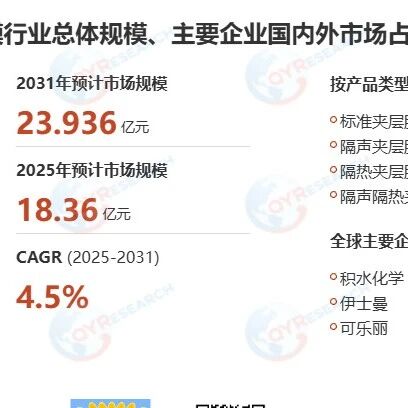
汽车夹层玻璃中间膜,是夹在两层或多层玻璃之间的一层有机聚合物材料。它经过高温高压工艺处理,与玻璃永久粘合,是夹层玻璃发挥安全、隔 音、隔热等功能的核心组件。 汽车夹层玻璃中间膜全球市场总体规模 根据 QYResearch 最新调研报告显示,预计 2 03 2 年全球 汽车夹层玻璃中间膜 市场规模将达到 3.66 亿美元,未来几年年复合增长率 CAGR 为 4.5% 汽车夹层玻璃中间膜的主要生产商 | 总部 | / 国家 | 企业名称 | 业务介绍 | | --- | --- | --- | --- | | 日本 | | 积水化学 | 积水化学工业株式会社是一家综合性化学品与高性能材料公司, | | | | | 主要业务涵盖功能性树脂、泡沫材料、工程塑料、医疗器械、建 | | | | | 筑材料及环保产品等的研发、生产与销售,产品广泛应用于汽 | | | | | 车、电子、电器、医疗、建筑与包装等行业。公司以创新材料和 | | | | | 系统解决方案为核心,为客户提供高附加值产品与技术支持,致 | | | | | 力于可持续发展和高效资源利用。 | | 美国 | | 伊士曼 | 伊士曼化工公司是一家全球性专注 ...