宏观经济治理

Search documents
央行:做好逆周期和跨周期调节 提升宏观经济治理效能
Sou Hu Cai Jing· 2025-11-11 09:23
Core Viewpoint - The People's Bank of China emphasizes a balanced approach to monetary policy, focusing on steady progress while adhering to the new development philosophy and advancing financial reform and openness [1] Group 1: Monetary Policy Strategy - The central bank will maintain a stable and progressive work guideline, fully implementing the new development concept [1] - There is a commitment to deepen financial reform and enhance high-level openness in the financial sector [1] - The goal is to construct a robust monetary policy system and a comprehensive macro-prudential management framework [1] Group 2: Economic Balance - The central bank aims to balance short-term and long-term goals, growth support and risk prevention, as well as internal and external equilibrium [1] - There is a focus on reinforcing the consistency of macro policy orientation [1] - The central bank will enhance counter-cyclical and cross-cyclical adjustments to improve macroeconomic governance effectiveness [1] Group 3: Economic Stability - The objectives include sustaining growth, stabilizing employment, and maintaining expectations [1]
深化新时代做好经济工作的规律性认识
Jing Ji Ri Bao· 2025-11-11 00:10
Core Insights - The article emphasizes the significance of Xi Jinping's economic thought as a guiding framework for China's economic development, highlighting its historical achievements and transformative changes since the 18th National Congress of the Communist Party of China [1][10]. Group 1: Centralized Leadership - The necessity of maintaining the Party's centralized leadership over economic work is a key original contribution of Xi Jinping's economic thought, ensuring that the economy develops in the correct direction [3][4]. - The central economic work meetings have consistently reinforced this principle, emphasizing the Party's authoritative role during critical historical moments [3][4]. Group 2: High-Quality Development - Xi Jinping's assertion that China's economy has transitioned from a phase of rapid growth to one of high-quality development is a pivotal recognition, shaping economic policies and macroeconomic adjustments [4][5]. - Subsequent meetings have reiterated the importance of high-quality development as the primary task for economic construction, linking it to the broader goals of modernization and sustainable growth [4][5]. Group 3: People-Centric Development - The principle of development for the people is a fundamental aspect of Xi Jinping's economic thought, emphasizing the need to prioritize people's interests in economic decision-making [5][6]. - This approach has been integrated into various strategic frameworks, ensuring that economic policies align with the needs and aspirations of the populace [5][6]. Group 4: Macroeconomic Governance - The introduction of supply-side structural reforms marks a significant advancement in macroeconomic governance, moving beyond traditional demand management approaches [6][7]. - The emphasis on balancing total supply and demand, along with proactive policy adjustments, reflects a mature approach to economic governance [6][7]. Group 5: Reform and Opening-Up - The recognition that deepening reform and opening-up is essential for enhancing economic vitality is a critical aspect of Xi Jinping's economic thought [7][8]. - This includes addressing systemic barriers to development and leveraging institutional advantages to foster collective strength in overcoming challenges [7][8]. Group 6: Development and Security - The increasing importance of balancing development and security in the face of global uncertainties is highlighted, with a focus on risk awareness and proactive measures to safeguard economic stability [8][9]. - The interaction between high-quality development and high-level security is emphasized as essential for sustainable progress [8][9]. Group 7: Methodological Insights - A problem-oriented approach to economic strategy, emphasizing stability and progress, is a key methodological insight from Xi Jinping's economic thought [9][10]. - The integration of systematic thinking and coordinated efforts in policy implementation is crucial for achieving economic objectives [9][10].
年均增长5.5% 中国成为全球发展“稳定器”
Ren Min Wang· 2025-11-10 03:07
Economic Growth and Contribution - During the first four years of the "14th Five-Year Plan," China's economy achieved an average annual growth of 5.5%, contributing approximately 30% to global economic growth, establishing itself as a "stabilizer" for global development [1] - China's economic scale is projected to cross four significant thresholds: 110 trillion, 120 trillion, 130 trillion, and 140 trillion yuan, with per capita GDP expected to rise from 73,000 yuan at the end of the "13th Five-Year Plan" to 96,000 yuan in 2024, potentially surpassing 100,000 yuan this year [1] Innovation and Industrial Upgrading - In the field of innovation, significant breakthroughs have been made, with domestic AI models and emerging technologies gaining attention, driving the industry towards mid-to-high-end transformation, and high-tech manufacturing value added expected to grow by 42% compared to the end of the "13th Five-Year Plan" [2] - The green development initiative has resulted in China contributing to one-fourth of the world's new greening area, with a clean power system where one-third of electricity comes from renewable sources, and a cumulative reduction of 11.6% in energy consumption per unit of GDP over four years [2] Social Welfare and Security - China has established the world's largest education, social security, and healthcare systems, with significant improvements in key indicators such as life expectancy, which has reached 79 years, with an expected increase of one year during the "15th Five-Year Plan" [2] - The foundations for food, energy, industry, and national defense security have been further solidified, enhancing the ability to respond to various risks and challenges [2] Macroeconomic Policy and Governance - The economic operation has faced challenges, including external pressures and weak domestic demand, prompting effective macroeconomic regulation and optimization of economic structure [3] - A more proactive fiscal policy is proposed for 2025, with an increase in the deficit ratio to 4%, and a moderately loose monetary policy to maintain reasonable liquidity [3] - The macroeconomic policy emphasizes the combination of short-term and long-term goals, demand and supply management, and cross-cycle and counter-cyclical adjustments, enhancing the effectiveness of macroeconomic governance [3] Future Prospects - China's economic foundation is stable, with multiple advantages, including the socialist system, large market size, complete industrial system, and rich talent resources, which are expected to support rapid economic growth and long-term social stability in the next five years [4]
21社论丨提升宏观经济治理效能,激活内生发展动力
21世纪经济报道· 2025-10-31 00:09
Group 1 - The article emphasizes the importance of enhancing the macroeconomic governance system and improving its effectiveness, which is crucial for building a high-level socialist market economy [1] - It highlights the need for strategic guidance and policy coordination to ensure consistency in macroeconomic policies, addressing the complexity and interconnectivity of current economic challenges [1][2] - The article discusses the implementation of proactive fiscal policies that focus not only on expanding fiscal spending but also on improving spending efficiency and sustainability [2] Group 2 - The article outlines the establishment of a long-term government debt management mechanism that aims to manage existing debt while preventing the expansion of hidden debts [3] - It stresses the importance of building a financial powerhouse, with a focus on developing various types of finance such as technology finance, green finance, and digital finance to support national strategic needs [3][4] - The article mentions the transformation of the capital market from being primarily financing-oriented to a platform that coordinates investment and financing, enhancing its attractiveness for long-term capital [4]

提升宏观经济治理效能,激活内生发展动力
2 1 Shi Ji Jing Ji Bao Dao· 2025-10-30 23:14
Core Viewpoint - The article discusses the recent release of the "Suggestions" by the Central Committee of the Communist Party of China regarding the 15th Five-Year Plan, emphasizing the need for a more systematic and effective macroeconomic governance framework to support high-quality economic development. Group 1: Macroeconomic Governance - The "Suggestions" highlight the importance of enhancing macroeconomic governance efficiency and establishing a high-level socialist market economy system [1] - The focus is on optimizing the policy framework and execution mechanisms to support an economy driven by domestic demand, consumption, and endogenous growth [1] Group 2: Policy Coordination - There is a call for stronger strategic guidance and policy coordination to ensure consistency in macroeconomic policy orientation [2] - The need to break down departmental barriers and promote a unified policy approach is emphasized to achieve synergistic effects [2] Group 3: Fiscal Policy - The implementation of proactive fiscal policies will not only involve expanding fiscal spending but also improving spending efficiency and sustainability [2] - The establishment of a budget allocation mechanism centered on policy performance and project necessity is crucial for optimizing fiscal resource allocation [2] Group 4: Debt Management - The "Suggestions" propose accelerating the establishment of a long-term government debt management mechanism to address existing debt and prevent hidden debt expansion [3] - A comprehensive lifecycle management system for debt financing, budget constraints, risk warnings, and emergency responses is recommended [3] Group 5: Financial Sector Development - There is an emphasis on building a strong financial nation, with a focus on developing technology finance, green finance, inclusive finance, pension finance, and digital finance [3] - The financial system is expected to lead and shape future industries through innovative financial products and risk pricing mechanisms [3] Group 6: Capital Market Transformation - The capital market is transitioning from a financing-led model to a platform that coordinates investment and financing [4] - Systematic reforms are aimed at enhancing the quality of listed companies and improving shareholder return mechanisms to attract long-term capital [4] Group 7: Economic Development Model - The overall strategy aims to strengthen the coordination of fiscal and monetary policies while leveraging various policy tools to promote an economy driven by domestic demand and consumption [4]
坚持有效市场和有为政府相结合——六论学习贯彻党的二十届四中全会精神
Xin Hua Wang· 2025-10-30 00:48
Core Viewpoint - The 20th Central Committee emphasizes the importance of combining an effective market with a proactive government to enhance economic and social development during the 14th Five-Year Plan period [1][2]. Group 1: Market and Government Relationship - The core issue in maintaining the direction of socialist market economy reform is to manage the relationship between government and market, ensuring that the market plays a decisive role in resource allocation while the government effectively addresses market failures [2][4]. - The government should reduce direct intervention in microeconomic activities and allow the market to regulate economic activities where it can be effective, thereby maximizing resource allocation efficiency [3][4]. Group 2: Economic System and Governance - A unified, open, competitive, and orderly market system is essential for high-quality economic development, which requires the improvement of the socialist basic economic system [2][5]. - Effective macroeconomic governance and scientific regulation are necessary to leverage the advantages of the socialist market economy, necessitating a clear government governance system that adheres to the rule of law [4][5]. Group 3: Policy Implementation and Market Vitality - The Central Committee's recommendations for the 15th Five-Year Plan include measures to stimulate the vitality of various business entities and enhance the efficiency of macroeconomic governance [5]. - Continuous improvement of the market-oriented allocation system and the removal of barriers to market entry are crucial for promoting efficient resource allocation and unleashing development potential [3][5].
申兵:加快完善要素市场化配置体制机制
Jing Ji Ri Bao· 2025-10-30 00:08
Core Viewpoint - The article emphasizes the importance of improving the market-oriented allocation of factors as an inherent requirement for building a high-standard market system and accelerating the improvement of the socialist market economy system [1][4]. Group 1: Achievements in Factor Market Reform - During the "14th Five-Year Plan" period, significant progress has been made in the reform of factor market allocation, with an increasingly improved institutional framework [2]. - The institutional framework for market-oriented allocation of factors has been established, focusing on five key areas: land, labor, capital, technology, and data [2]. - Specific policy measures have been proposed to enhance the role of data as a factor, including 20 policy initiatives related to data property rights, circulation, revenue distribution, and governance [2][3]. Group 2: Accelerated Progress in Factor Market Allocation - The nationwide unified secondary market for construction land use rights is continuously improving, and the reform of rural collective operating construction land is progressing steadily [3]. - The reform of the household registration system is deepening, allowing more agricultural migrants to settle in urban areas, thereby enhancing the role of the labor market in talent mobility [3]. - The government has approved comprehensive reform pilot programs in ten regions to further demonstrate and accumulate experience in factor market allocation [3]. Group 3: Importance of Efficient Resource Allocation - The "15th Five-Year Plan" period is crucial for achieving socialist modernization, necessitating a robust factor guarantee system to support economic quality and reasonable growth [4]. - The article highlights the need to enhance the efficiency of factor allocation to adapt to the changing internal and external environments, emphasizing the importance of a market-oriented system [4][5]. - Improving the market-oriented allocation of factors is essential for leveraging China's large-scale market advantages and enhancing economic resilience against external shocks [4]. Group 4: Breaking Down Barriers to Factor Mobility - The article calls for deeper economic system reforms to eliminate barriers to the free flow and efficient allocation of factors, focusing on traditional factors like land, labor, and capital [7]. - It emphasizes the need to innovate land supply methods and optimize urban land use to meet the requirements of modern industrial development [7]. - For new factors like technology and data, it is crucial to improve pricing and trading mechanisms to facilitate efficient conversion and application of technological achievements [7][8]. Group 5: Enhancing Overall Efficiency of Factor Allocation - The article suggests promoting innovative configurations of production factors and optimizing their combinations to reduce costs associated with technological innovation and green transformation [8]. - It advocates for the integration of various factors such as talent, capital, technology, and data to foster new industries and business models [8]. - The use of big data and artificial intelligence is recommended to build evaluation systems and improve assessment standards for the effectiveness of factor market reform pilot programs [8].
清华大学中国经济思想与实践研究院首席研究员刘培林:收放得当发挥更大实效
Jing Ji Ri Bao· 2025-10-29 22:08
Core Viewpoint - The combination of an effective market and an active government is a crucial principle for China's economic and social development during the "14th Five-Year Plan" period [1] Group 1: Government and Market Relationship - The relationship between government and market is central to building a high-level socialist market economy [1] - Development planning serves as a manifestation of the combination of the "visible hand" and the "invisible hand" in macroeconomic governance [1] Group 2: Role of Development Planning - For a late-developing country like China, economic growth and structural changes occur relatively quickly, making development planning essential for guiding the catch-up process and mitigating risks [1] - Development planning aids business entities in assessing internal and external development environments, serving as a critical reference for production, operations, and investment decisions [1] Group 3: Effective Use of Government's Role - The government must strike a balance in its "visible hand" approach, particularly in the context of building a unified national market [1] - The government can enhance its role by providing basic public services, promoting the urbanization of migrant populations, and creating a fair market environment [1] - The government should appropriately regulate where necessary and allow more freedom where applicable to maximize effectiveness [1]
基本实现社会主义现代化夯实基础全面发力:\十五五规划建议\解读
Huafu Securities· 2025-10-29 12:30
Group 1: Economic Development Strategy - The "15th Five-Year Plan" emphasizes building a modern industrial system as the material and technical foundation for Chinese-style modernization[2] - The plan aims to optimize traditional industries while fostering emerging and future industries, focusing on high-level technological self-reliance[3] - It highlights the need for breakthroughs in key core technologies in areas such as integrated circuits and advanced materials to enhance national innovation capabilities[3] Group 2: Consumption and Investment - The plan proposes actions to boost consumption and effective investment, addressing the impact of real estate market adjustments on durable goods consumption[4] - It suggests enhancing residents' consumption capacity and removing unreasonable restrictions on consumption in sectors like automobiles and housing[4] - The government aims to maintain reasonable investment growth and improve investment efficiency by optimizing investment structures and clarifying investment directions[4] Group 3: Macro Policy Implementation - The plan calls for a moderately loose monetary policy and the resumption of government bond trading in the open market[4] - It emphasizes the need for coordinated fiscal and monetary policies to enhance macroeconomic governance effectiveness[4] - The central bank will implement a one-time personal credit relief policy in early 2026 to alleviate residents' debt burdens and stabilize the real estate market[4] Group 4: Risk Considerations - There are risks associated with the expansion of fiscal policy and the extent of monetary policy easing not meeting expectations[5]
罗志恒:“十五五”规划建议的十二大看点
Sou Hu Cai Jing· 2025-10-29 04:05
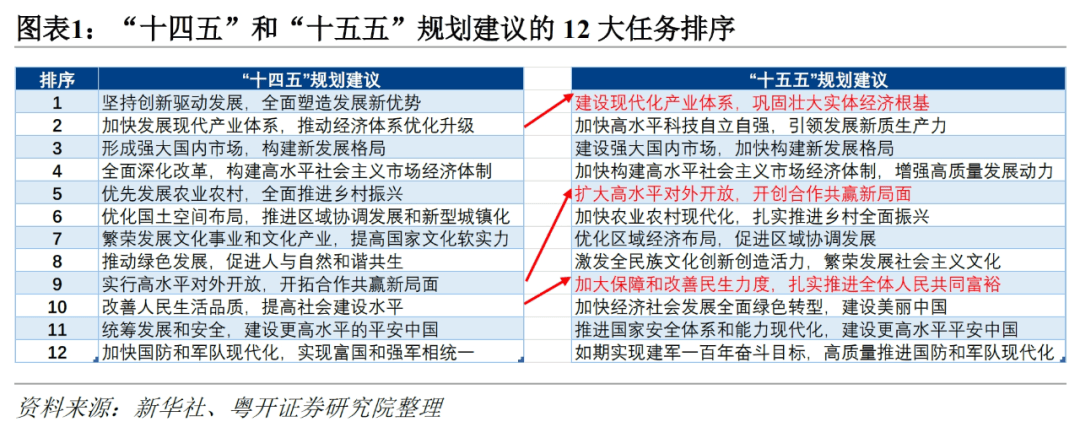
Core Insights - The "15th Five-Year Plan" emphasizes quality development, technological self-reliance, and the importance of domestic consumption, particularly in the context of changing external circumstances and US-China competition [1][2][5] - The plan outlines 12 major tasks categorized into optimizing supply, expanding demand, and ensuring security, aiming for a higher level of supply-demand circulation [1][5] Comparison with Previous Plans - The assessment of future risks and uncertainties is more pronounced in the "15th Five-Year Plan," shifting from a focus on strategic opportunities to a dual emphasis on opportunities and risks [2] - The development goals have expanded from six to seven areas, highlighting quality development, technological self-reliance, and increased international influence [2][6] Task Prioritization - The "15th Five-Year Plan" prioritizes the modernization of the industrial system and places technological innovation second, reflecting the current international emphasis on openness [3][6] - The plan includes a clear structure with three main sections: achievements from the previous five years, specific tasks, and the role of party leadership [5][6] Economic and Social Development Goals - The plan sets seven key development goals, including significant improvements in quality development, technological self-reliance, and social welfare [16][17] - The nominal GDP growth target is set at an average of 5% per year, with a focus on increasing the resident consumption rate from 40% to 43% [17][18] Industrial and Technological Development - The plan emphasizes the construction of a modern industrial system as the foundation for economic development, with a focus on maintaining a reasonable proportion of manufacturing [21][23] - It highlights the importance of technological self-reliance and innovation, particularly in key sectors such as integrated circuits and advanced materials [28][29] Domestic Demand and Consumption - The plan stresses the need to expand domestic demand and enhance consumption, aiming to create a robust domestic market to counter external uncertainties [30][31] - It outlines strategies to increase disposable income and improve consumer confidence, alongside optimizing the supply structure to meet evolving consumer needs [30][31][33] Macro-Economic Governance - The plan calls for improvements in macro-economic governance, emphasizing the need for coordinated fiscal and monetary policies to support sustainable growth [34][35] - It advocates for a shift from traditional fiscal policies to a more proactive approach that enhances the efficiency of existing assets and promotes strategic investments [38][39]