
美国劳动力市场

Search documents
新加坡华侨投资基金管理有限公司:美国经济放缓与就业疲软,古尔斯比呼吁审慎降息
Sou Hu Cai Jing· 2025-09-25 09:24
Group 1 - Chicago Fed President Goolsbee emphasizes a cautious approach to interest rate cuts due to weakening economic growth and a soft labor market [1][3] - The recent decision to lower the benchmark interest rate to a range of 4% to 4.25% was supported, but future adjustments will depend on economic data [1][3] - Goolsbee describes the current economic environment as shrouded in "stagflation fog," indicating that any rate cuts should be gradual to avoid new economic volatility [3][4] Group 2 - Concerns exist regarding the potential for tariffs implemented since April to push prices higher, complicating policy decisions [4] - The neutral interest rate, defined as neither suppressing nor stimulating the economy, is estimated at around 3.1%, suggesting about a 1% room for further rate cuts [4] - The Fed may consider two more rate cuts this year, one in each of the remaining quarters [4] Group 3 - Labor market signals are critical indicators, with a current unemployment rate of 4.3% remaining historically low despite a slowdown in hiring [6] - The Chicago Fed has launched a new labor monitoring system to better capture employment market changes, integrating eleven types of high-frequency data [6] - If the economy continues to move towards inflation targets, further rate cuts may be possible, but each step will require solid economic progress [6]


美股与黄金同创新高,这意味着什么?
Hua Er Jie Jian Wen· 2025-09-23 01:32
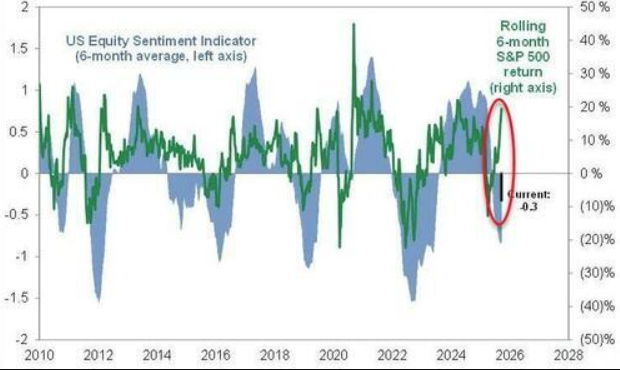
Group 1 - Nvidia's significant investment in OpenAI has reignited the AI boom, leading to record highs in the three major U.S. stock indices and the Philadelphia Semiconductor Index, reflecting heightened market sentiment [1] - Risk assets and safe-haven assets have both reached historical highs, raising questions among investors about whether the market has achieved "perfect pricing" and if it has fully reflected all positive factors, potentially limiting future gains [3] - Deutsche Bank's report suggests that the market is far from "perfect pricing," indicating that concerns about future risks provide potential upside for the market [3][4] Group 2 - The report outlines five key reasons why the market is not "perfectly priced," starting with the historical high in gold prices, which signals market fear rather than extreme optimism [4] - Current U.S. inflation expectations remain elevated, with the 2-year inflation swap rate at 2.92%, indicating that inflation pressures are priced in, which limits the Federal Reserve's ability to cut rates [7][5] - Ongoing tariff concerns persist, with potential for additional tariffs on pharmaceuticals, semiconductors, and critical minerals, reflecting unresolved risks in the market [8][9] Group 3 - The U.S. labor market shows signs of concern, with non-farm payroll growth averaging only 64,000 over the past six months, the lowest in the current economic cycle, and an unemployment rate of 4.3%, the highest since late 2021 [9] - There is a widespread expectation among investors for further interest rate cuts by major central banks, particularly the Federal Reserve, which reflects concerns about potential economic slowdown rather than strong economic signals [10]

【招银研究|海外宏观】降息如期重启,未来分歧加剧——美联储议息会议点评(2025年9月)
招商银行研究· 2025-09-18 09:48
Core Viewpoint - The Federal Reserve's recent interest rate cut of 25 basis points to a target range of 4.00-4.25% reflects a preventive approach to manage risks in the economy, highlighting concerns over the labor market while maintaining a cautious stance on future economic conditions [1][4]. Economic Analysis - The current economic landscape shows a coexistence of strong economic growth and weak employment, with GDP growth forecasted to improve slightly by 0.2 percentage points compared to previous predictions, while unemployment rates are expected to rise [4]. - Powell described a "peculiar balance" in the labor market, where reduced labor supply due to immigration policies contrasts with weakened demand due to economic slowdown, contributing to the decision for the rate cut [5]. Political Influence - Political factors are increasingly impacting the Federal Reserve's independence, as evidenced by attempts from the Trump administration to influence Fed appointments, which poses a potential threat to its credibility and policy effectiveness [6]. Interest Rate Policy - There is significant divergence among Federal Reserve officials regarding future rate cuts, with the median forecast for rate cuts increasing from two to three times this year, indicating a growing split in opinions on monetary policy direction [7]. - The dot plot indicates a downward adjustment in future rate projections for 2026 and 2027, reflecting a cautious approach to economic data dependency [7]. Forward Guidance - The Federal Reserve is expected to continue its rate-cutting trajectory, with predictions of two additional 25 basis point cuts in October and December, aiming to reach a neutral rate of 3.25%-3.50% next year [8]. - The yield curve is anticipated to steepen due to market expectations of rate cuts and concerns over the Fed's independence, with potential for further steepening of 15-20 basis points [8]. Market Implications - Gold remains a favorable investment as central bank buying trends continue, and the renewed rate-cutting cycle supports its price, although investors are advised to adopt a dollar-cost averaging strategy due to high valuations [9]. - U.S. equities are expected to continue a moderate upward trend, driven by strong corporate earnings rather than valuation increases, with a balanced investment strategy recommended [9].

鲍威尔:经过修订的就业数据意味着,美国劳动力市场不再那么稳固
Hua Er Jie Jian Wen· 2025-09-17 18:42
Core Viewpoint - The revised employment data indicates that the U.S. labor market is no longer as robust as previously thought [1] Group 1 - The adjustments in employment figures suggest a weakening in the stability of the labor market [1]
五矿期货贵金属日报-20250915
Wu Kuang Qi Huo· 2025-09-15 02:56
1. Report Industry Investment Rating - No relevant information provided in the content 2. Core View of the Report - The US labor market has significantly weakened, with the overall non - farm employment revised down by 911,000 from April 2024 to March 2025, much higher than market expectations. The initial jobless claims in the week of September 6, 2025, also exceeded expectations. The inflation data shows that the US August PPI was significantly lower than expected, while the CPI was in line with or slightly higher than expectations. The market has increased the pricing of the Fed's interest rate cut. Silver prices will significantly benefit in the interest - rate cut cycle. It is recommended to buy on dips, with the reference operating range of the main Shanghai Gold futures contract at 816 - 860 yuan/gram and the main Shanghai Silver futures contract at 9710 - 10800 yuan/kilogram [2][3] 3. Summary by Related Catalogs 3.1 Market Quotes - **Gold**: Shanghai Gold rose 0.39% to 834.00 yuan/gram, COMEX gold fell 0.25% to 3677.00 dollars/ounce. The London Gold rose 0.59% to 3651.10 dollars/ounce, and the Au(T + D) rose 0.51% to 830.34 yuan/gram. The SPDR Gold ETF holdings decreased by 0.32% to 974.80 tons [2][4] - **Silver**: Shanghai Silver rose 1.22% to 10051.00 yuan/kilogram, COMEX silver fell 0.47% to 42.63 dollars/ounce. The London Silver rose 2.88% to 42.26 dollars/ounce, and the Ag(T + D) rose 2.68% to 10034.00 yuan/kilogram. The SLV Silver ETF holdings decreased by 0.45% to 15069.60 tons [2][4] - **Other Markets**: The US 10 - year Treasury yield was 4.06%, the dollar index was 97.65. Stock market indices showed mixed performance, with the Dow Jones Industrial Average down 0.59%, the S&P 500 down 0.05%, the Nasdaq Composite up 0.44%, etc [2][4] 3.2 Economic Data - **Employment Data**: From April 2024 to March 2025, the US private - sector non - farm employment was revised down by 880,000, and the government - sector employment was revised down by 31,000, with a total non - farm revision of 911,000, much higher than market expectations. The initial jobless claims in the week of September 6, 2025, were 263,000, higher than expected [2] - **Inflation Data**: The US August PPI was significantly lower than expected, with the year - on - year value at 2.6% (expected 3.3%, previous 3.3%), and the month - on - month value at - 0.1% (expected 0.3%, previous 0.7%). The core PPI also showed a decline. The August CPI was in line with or slightly higher than expectations, with the year - on - year value at 2.9% (previous 2.7%), and the month - on - month value at 0.4% (expected 0.3%, previous 0.2%) [2] 3.3 Market Expectations - The market expects a 93.38% probability of a 25 - basis - point interest rate cut by the Fed in the September 2025 meeting and a 6.62% probability of a 50 - basis - point cut. It also expects 25 - basis - point cuts in the October and December meetings [3] 3.4 Technical Data - **Gold Technical Data**: For COMEX gold on September 12, 2025, the closing price of the active contract was 3680.70 dollars/ounce (up 0.20%), the trading volume was 147,600 lots (down 28.76%), the open interest was 509,600 lots (up 3.39%), and the inventory was 1210 tons (up 0.01%) [6] - **Silver Technical Data**: For COMEX silver on September 12, 2025, the closing price of the active contract was 42.68 dollars/ounce (up 1.46%), the open interest was 156,700 lots (down 1.05%), and the inventory was 16405 tons (up 0.55%) [6] 3.5 Spread Data - **Gold Spread**: On September 12, 2025, the SHFE - COMEX gold spread was - 3.66 yuan/gram (- 15.97 dollars/ounce), and the SGE - LBMA gold spread was - 3.55 yuan/gram (- 15.50 dollars/ounce) [64] - **Silver Spread**: On September 12, 2025, the SHFE - COMEX silver spread was 273.09 yuan/kilogram (1.19 dollars/ounce), and the SGE - LBMA silver spread was 377.78 yuan/kilogram (1.65 dollars/ounce) [64]
美国8月CPI同比增长2.9% 符合预期
Zhong Jin Zai Xian· 2025-09-12 13:09
Group 1 - The overall inflation in the U.S. rose in August, with the Consumer Price Index (CPI) increasing by 0.4% month-on-month, surpassing market expectations of 0.3% [1] - Year-on-year, the CPI recorded a 2.9% increase, which is consistent with market expectations and represents a 0.2 percentage point acceleration from July [1][2] - The 0.4% month-on-month increase is the largest since February and is double the increase seen in July [2] Group 2 - Food prices rose by 0.5% month-on-month and 3.2% year-on-year, while energy prices increased by 0.7% month-on-month and 0.2% year-on-year [2] - The core CPI, excluding volatile food and energy prices, increased by 0.3% month-on-month and 3.1% year-on-year, aligning with previous month’s increases and market expectations [2] Group 3 - Housing costs, which account for about one-third of the CPI, rose by 0.4% month-on-month, marking the largest increase of the year, with a year-on-year increase of 3.6% [3] - New car prices increased by 0.3% month-on-month and 0.7% year-on-year, while used car and truck prices rose by 1% month-on-month and 6% year-on-year [4] Group 4 - The CPI report indicates persistent inflation in the U.S., influenced by global tariffs and rising service costs, which may exert lasting pressure on overall inflation [4] - The number of initial jobless claims rose to 263,000, the highest level since October 2021, increasing by 27,000 from the previous week, which was above market expectations of 235,000 [4] - This rise in jobless claims, combined with a low non-farm payroll increase of only 22,000, suggests a weakening trend in the U.S. labor market [4]
The job market's hidden flaw is now obvious
MarketWatch· 2025-09-11 16:31
Core Viewpoint - The article highlights the impact of immigration raids, arrests, and deportations on the U.S. labor force, indicating significant disruptions and challenges within various industries [1] Group 1: Labor Force Impact - Immigration enforcement actions are leading to noticeable cracks in the U.S. labor market, affecting the availability of workers in key sectors [1] - Industries that rely heavily on immigrant labor are experiencing increased difficulties in maintaining workforce stability due to these enforcement measures [1] Group 2: Economic Implications - The disruptions in the labor force may result in increased operational costs for companies that depend on immigrant workers, potentially leading to higher prices for consumers [1] - The overall economic productivity could be negatively impacted as businesses struggle to fill positions and maintain output levels [1]

美国初请失业金人数创近四年新高 强化美联储9月降息预期
Zhi Tong Cai Jing· 2025-09-11 13:37
Core Viewpoint - The surge in initial jobless claims in the U.S. indicates a significant slowdown in hiring and potential increases in layoffs, reinforcing expectations for a Federal Reserve interest rate cut in September [1][2]. Group 1: Jobless Claims Data - Initial jobless claims rose by 27,000 to 263,000, the highest level since October 2021, surpassing economists' median forecast of 235,000 [1]. - The four-week moving average of initial jobless claims increased to 240,500, the highest since June [1]. - Texas experienced a notable increase in claims, with an unadjusted rise of 15,304, while most states saw a decline in claims [1][2]. Group 2: Labor Market Trends - The monthly employment report indicated only 22,000 new jobs added in August, continuing a trend of significant slowdown in job growth [1]. - Consumer confidence in job finding dropped to its lowest level since June 2013, reflecting uncertainty surrounding economic policies [1]. - Continuing claims for unemployment benefits remained steady at 1.94 million, indicating the current scale of individuals receiving unemployment assistance [2]. Group 3: Federal Reserve Implications - The jobless claims data is critical ahead of the Federal Reserve's policy meeting on September 16-17, as it reflects the labor market's condition [2]. - There is growing market speculation that the Federal Reserve may resume interest rate cuts due to increasing concerns over employment issues [2]. - The core Consumer Price Index (CPI) rose by 0.3% in August, aligning with economists' expectations, which may influence the Fed's decision-making [2].
国金证券宋雪涛:非农寒烟起 降息秋风急
智通财经网· 2025-09-07 07:47
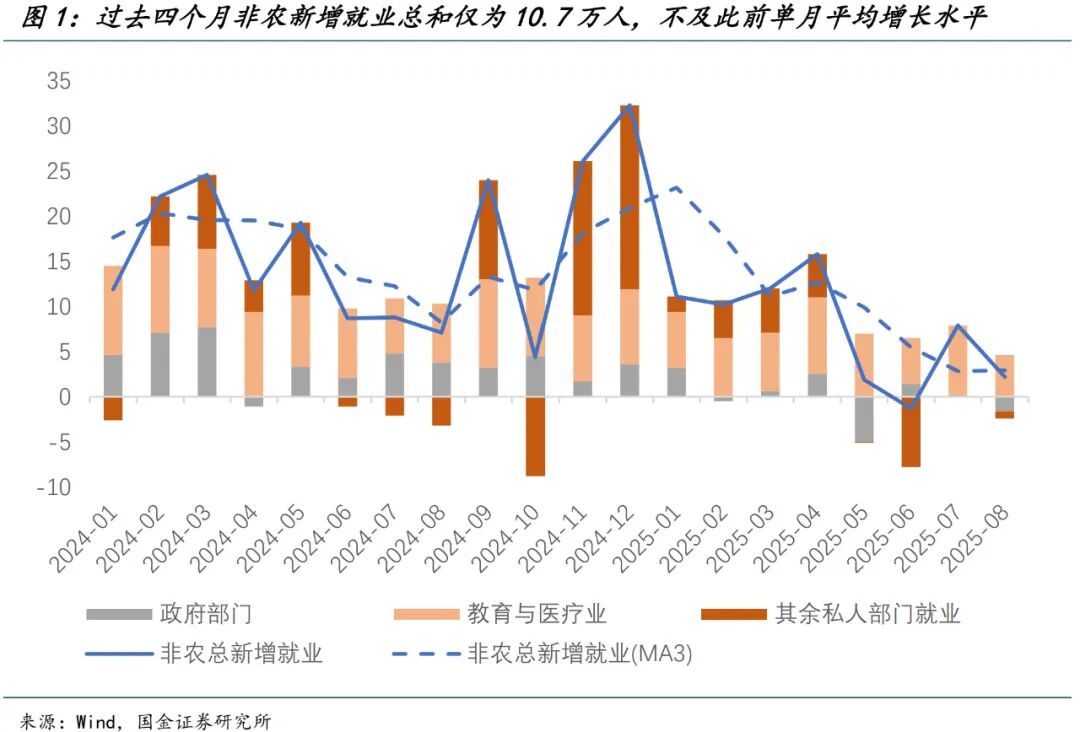
Group 1 - The initial response rate of the August non-farm survey rebounded significantly, but the trend of employment deterioration has not stopped, with private sector job additions contracting for four consecutive months [1] - The total non-farm job additions from May to August were only 107,000, which is below the average monthly growth of 127,000 in the first four months of 2025 [1] - The unemployment rate rose from 4.248% to 4.324%, primarily due to a slight recovery in labor force participation [3] Group 2 - The Kansas Fed President stated that there is no need to adjust interest rates, despite the region's employment situation being the worst in the country [6] - The employment situation in the manufacturing sector, sensitive to tariffs, has been declining, indicating potential further job losses in this area [8] - The U6 unemployment rate and the unemployment rate for African Americans have shown significant increases, highlighting structural vulnerabilities in the labor market [11] Group 3 - The combination of declining full-time employment, rising part-time employment, and increasing permanent unemployment has accumulated greater risks for a jump in the unemployment rate [7] - The labor market is facing structural issues, with young individuals lacking skills and experience struggling to find jobs, while undocumented immigrants are hesitant to work due to political climate [16] - The trend of rising unemployment is likely to continue, even if the U.S. economy does not enter a recession [16]

近7万人爆仓,比特币交易额锐减近72%
2 1 Shi Ji Jing Ji Bao Dao· 2025-09-07 00:29
Cryptocurrency Market - The cryptocurrency market has seen a significant downturn, with over 67,000 liquidations and a total liquidation amount of $118 million in the past 24 hours [2][3] - Bitcoin's price approached $110,209.2, with a trading volume drop of nearly 72%, while Ethereum's trading volume fell over 60% [1][2] - XRP's trading volume decreased by nearly 70%, and other cryptocurrencies like SOL and DOGE also experienced significant declines in trading volume [1][2] Employment Data - The U.S. non-farm payroll report for August showed an increase of only 22,000 jobs, far below the expected 75,000, with the unemployment rate rising to 4.3%, the highest since late 2021 [4] - Following the disappointing employment data, traders expect a 100% probability of a Federal Reserve rate cut in September [4] Gold Market - Gold prices have reached new highs, with spot gold surpassing $3,600 per ounce, reflecting a year-to-date increase of approximately 35% [5][6] - The rise in gold prices is attributed to multiple risks, including weakening economic data and concerns over the U.S. labor market [7][8] - Analysts suggest that if the proportion of gold in global central bank reserves continues to rise, gold prices could potentially exceed $4,500 per ounce [8]
