转型牛

Search documents
调整是增持良机?创业板 50ETF(159949)近20个交易日获16.5亿资金逆势布局
Xin Lang Ji Jin· 2025-10-14 08:52
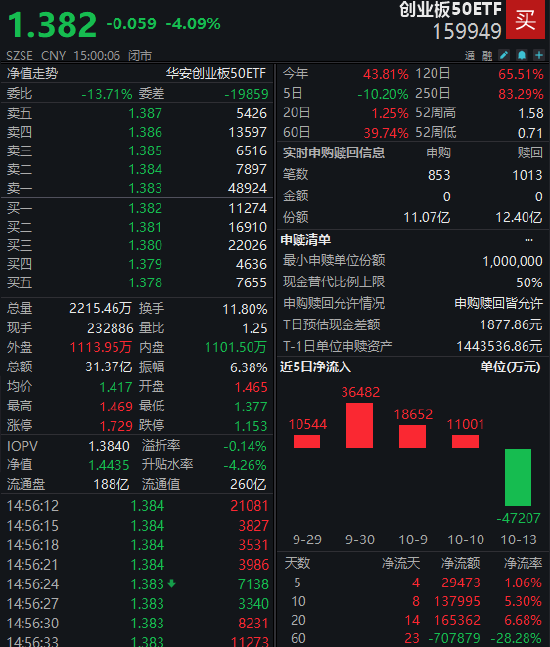
Core Viewpoint - The three major stock indices collectively declined on October 14, with the ChiNext Index dropping nearly 4%, leading to a 4.09% decrease in the ChiNext 50 ETF (159949) to 1.382 CNY. Despite this, trading activity remained active, with a turnover rate of 11.80% and a transaction volume of 3.137 billion CNY, indicating that funds are actively positioning themselves during the adjustment period [1][4]. Fund Performance - The ChiNext 50 ETF (159949) closed at 1.382 CNY, down 4.09% from the previous day [2]. - The fund experienced a net inflow of 290 million CNY over the last five trading days, 1.38 billion CNY over the last ten days, and 1.65 billion CNY over the last twenty days, suggesting a positive sentiment among investors despite the recent downturn [1][4]. Top Holdings - The top holdings of the ChiNext 50 ETF include: - CATL: 6.1 billion CNY, down 8.08% [3] - Eastmoney: 2.72 billion CNY, down 7.78% [3] - Huichuan Technology: 1.20 billion CNY, down 2.65% [3] - Mindray: 1.16 billion CNY, down 5.77% [3] - Other notable holdings include Xinyisheng, Sunshine Power, and others, with varying degrees of change in their market values [3]. Market Sentiment - The market is currently influenced by both internal and external factors, with the Chinese Ministry of Commerce responding to U.S. tariffs by emphasizing that export controls on certain materials are legitimate measures rather than prohibitions [4]. - Several institutions, including Guotai Junan Securities, view the current asset declines as a buying opportunity, highlighting the clarity of trade risks and the stability of domestic financial conditions compared to previous shocks [4][5]. - Shenyin Wanguo Securities notes that the current market index is at a higher midpoint than in April, suggesting a learning effect in the market, with optimism for the fourth quarter despite short-term adjustments [5].


亚太市场,集体跳水
Zheng Quan Shi Bao· 2025-10-14 07:04
Group 1 - The A-share market is being dragged down by the Asia-Pacific market, with significant declines observed in major indices such as the Nikkei and the Hang Seng Tech Index, which fell over 3% [1][3][5] - The decline in the markets is attributed to two main factors: ongoing uncertainties related to trade disputes and significant fluctuations in the Japanese market, particularly the appreciation of the yen and the sharp drop in Japanese stocks [1][3] Group 2 - The Korean market also experienced declines, with major indices dropping nearly 1%. Notable stock movements included a 5.8% drop in SoftBank and a 2.8% decline in Samsung Electronics, despite the latter reporting its highest quarterly operating profit in over three years [5] - In Hong Kong, all major indices weakened, with the Hang Seng Tech Index falling over 3% and the Hang Seng Index dropping more than 2%. The A-share market saw the ChiNext Index decline over 4% and the Shenzhen Component Index drop more than 2%, with over 3,500 stocks in the Shanghai and Shenzhen markets declining [5] Group 3 - The cryptocurrency market also faced significant declines, with Bitcoin dropping 2.75% to $112,620.4 and Ethereum falling 5.06% to $4,072.42, influenced by negative sentiment from social media regarding short positions [6] - The market sentiment has been impacted by structural issues, with notable declines in sectors such as semiconductors and battery stocks, leading to a significant contribution to the overall market decline from companies like Industrial Fulian and Zijin Mining [8] Group 4 - Analysts suggest that the current market conditions differ from those in April, with many core asset prices at high levels and financing balances also elevated. The focus should be on maintaining liquidity stability, with undervalued blue-chip stocks potentially becoming the mainstay during downturns [8] - The bond market experienced a rebound, indicating a potential increase in risk appetite and opportunities for returns. Analysts from Guotai Junan believe that external shocks leading to asset declines present a good opportunity to increase holdings in the Chinese market, as the boundaries of trade risks are clearer now compared to previous months [8][9]

刚刚!亚太市场,集体跳水!
券商中国· 2025-10-14 06:52
Market Overview - The A-share market was negatively impacted by the Asia-Pacific market, with significant declines observed in major indices such as the Nikkei, which dropped over 3% [1][3]. - The Korean market also followed suit, with both Kospi indices experiencing nearly 1% declines [5]. - Hong Kong's Hang Seng Technology Index fell by over 3%, contributing to a broader market downturn [5]. Key Factors Influencing Market Movement - The primary reasons for the market sell-off include ongoing uncertainties related to trade disputes and significant fluctuations in the Japanese market, particularly the yen's appreciation and the sharp decline in Japanese stocks [1][3]. - Reports of mysterious accounts shorting virtual currencies have also contributed to market fears, leading to a drop in cryptocurrency prices, including Bitcoin and Ethereum [6]. Sector Performance - In the A-share market, the ChiNext Index saw a decline of over 4%, while the Shenzhen Component Index fell by more than 2% [5]. - Key sectors such as semiconductor chips, consumer electronics, and non-ferrous metals experienced the largest declines, with over 3,500 stocks in the Shanghai and Shenzhen markets falling [5]. - Gold stocks also faced significant sell-offs, with Zijin Mining dropping over 6% after reaching a historical high earlier in the day [5]. Investment Sentiment and Future Outlook - Analysts suggest that the current market sentiment is influenced by structural issues rather than just external shocks, with a notable shift of funds towards undervalued sectors [7][8]. - The market is currently characterized by high valuations of core assets and elevated financing balances, indicating a need to stabilize and avoid liquidity risks [8]. - Despite the recent downturn, some analysts view the external shocks as potential buying opportunities for the Chinese market, given clearer boundaries on trade risks and improved domestic financial stability [8][9]. - The ongoing transformation of the Chinese economy and the demand for quality assets are seen as underlying trends that could support market recovery [9].

本次冲击或将小于“4·7行情”!把握黄金坑机会
Zheng Quan Shi Bao Wang· 2025-10-13 03:39
Group 1 - The traditional manufacturing sector in China is poised to benefit from the current geopolitical climate, as it can leverage its advantages to gain pricing power and move away from intense competition [2] - Recent export controls and licensing systems are aimed at protecting national interests and may help leading companies secure stable overseas market shares and better profitability [2] - The capital expenditure in traditional industries is showing signs of stabilization and recovery, providing a favorable environment for companies to improve their profit margins [2] Group 2 - External shocks leading to asset declines present a buying opportunity in the Chinese market, as the current trade risks are clearer compared to previous disruptions [3] - The demand for quality assets in China is surging, driven by the ongoing transformation of the economy and capital market reforms [3] - The focus remains on sectors that align with industrial development and stability, particularly in emerging technologies and cyclical finance [3] Group 3 - The market is expected to experience a short-term adjustment, but the overall resilience remains strong, with potential for new highs post-adjustment [5] - The current market conditions are more favorable than previous shocks, with investor sentiment and institutional support strengthening [5] - Key sectors to watch include military, semiconductors, and new consumption, which are positioned for marginal improvements [5] Group 4 - The core drivers of the current market rally remain unchanged, with a focus on medium to long-term policy expectations and liquidity trends [6] - Attention should be directed towards sectors with strong performance certainty, such as new productivity themes and large consumption [6] - Investment opportunities are identified in metals, agriculture, and energy sectors [6] Group 5 - The recent volatility in the technology sector is not expected to lead to significant long-term declines, as the market has learned from past experiences [7] - The focus should be on sectors that can benefit from domestic policies and self-sufficiency, including non-ferrous metals, banking, and agriculture [7] - Opportunities may arise from market corrections, particularly in sectors with strong growth potential [7] Group 6 - The mid-term outlook for A-shares remains optimistic despite external uncertainties, with a focus on traditional value sectors such as real estate and consumption [8] - The market is showing signs of a shift towards value-oriented investments, indicating a potential rebalancing of investment styles [8] - The gold market is expected to maintain a positive outlook, with no immediate signs of a peak [8] Group 7 - The current market environment is characterized by a lack of panic, suggesting that adjustments in global risk assets will be manageable [9] - The focus should be on domestic policies and the recovery of internal demand, which are expected to gain more attention in the market [9] - The recovery of manufacturing activities and investment acceleration are seen as key themes for future growth [9] Group 8 - The upcoming APEC summit is anticipated to be a significant event for potential shifts in the geopolitical landscape, impacting market sentiment [12] - The market is expected to respond positively to the stabilization of industry chains and economic resilience amid ongoing trade tensions [12] - Investment strategies should focus on sectors that align with anti-tariff measures and self-sufficiency, such as agriculture and military [12]
【机构策略】外部冲击造成的资产下跌 是增持中国市场的良机
Zheng Quan Shi Bao Wang· 2025-10-13 01:36
Core Viewpoint - External shocks causing asset declines present a good opportunity to increase holdings in the Chinese market [2] Group 1: Market Analysis - The recent escalation in the US-China trade dispute has led to panic selling, reminiscent of the situation in April [2] - Unlike the uncertainty in April regarding the impact of "reciprocal tariffs," the current trade risk boundaries are clearer, and domestic financial stability is more assured [2] - The demand for quality assets in China remains strong, and the current external conflicts should be viewed as buying opportunities rather than a trend-ending event [2] Group 2: Negotiation Dynamics - The US-China tariff negotiations are characterized by difficulty, repetition, and long-term nature, with a high probability of phased agreements [3] - Prior to negotiations, market sentiment may be suppressed due to the collection of bargaining chips, leading to downward pressure on indices [3] - After negotiations, the market typically rebounds as negative factors are digested, indicating a potential for recovery in the A-share market [3] Group 3: Market Trends - Recent declines in A-share indices were influenced by high valuations triggering financing rules, leading to a shift in market dynamics [3] - The market is undergoing a technical adjustment, but the core logic for sustained growth remains intact, suggesting a likely upward trend [3]
国泰君安:外部冲击造成的资产下跌 是增持中国市场的良机
Zheng Quan Shi Bao Wang· 2025-10-12 15:01
Core Viewpoint - External shocks leading to asset declines present a good opportunity to increase holdings in the Chinese market [1] Group 1: Market Analysis - The recent escalation in the US-China trade dispute has caused investor anxiety, reminiscent of the situation in April, resulting in panic selling [1] - In April, investors had a vague understanding of the risks associated with "reciprocal tariffs," leading to valuation contraction and diminished confidence [1] - Current trade risks are clearer compared to April, and domestic financial stability conditions are more defined, suggesting that external shocks are disturbances rather than trend-ending events [1] Group 2: Investment Opportunities - There is a strong and ongoing demand among Chinese society and investors for quality assets, particularly those with solid development logic [1] - The current external conflicts and disturbances causing asset declines are viewed as buying opportunities [1] - Geopolitical shocks and adjustments are inevitable, but they are expected to be short-lived and manageable, marking a favorable time to increase investments in China [1]

十大券商一周策略:本次冲击或将小于“4·7行情”!把握黄金坑机会
Zheng Quan Shi Bao· 2025-10-12 14:53
Group 1 - The traditional manufacturing sector in China is poised to benefit from geopolitical shifts and a move away from low-margin competition, allowing companies to gain pricing power [1] - Recent export controls are seen as a means to protect national interests and may help leading companies stabilize their overseas market share and profitability [1] - The current focus should be on upstream resource sectors and traditional manufacturing, as these areas show signs of recovery and improved profitability [1] Group 2 - External shocks leading to asset declines present a buying opportunity in the Chinese market, with a clear boundary on trade risks and improved domestic financial stability [2] - The demand for quality assets in China is surging, making current asset price declines attractive for investment [2] - The focus remains on industrial development, "anti-involution," and stable value, with emerging technologies as a key investment theme [2] Group 3 - The market is expected to experience a short-term adjustment, but the overall resilience remains strong, with key sectors like AI and semiconductors providing long-term value [4] - The current market conditions are more favorable compared to previous shocks, with investor sentiment and institutional support enhancing market stability [4] - The focus should be on sectors that can benefit from self-sufficiency and internal circulation, such as military, semiconductors, and new consumption [4] Group 4 - The core drivers of the current market rally remain unchanged, with liquidity expected to continue improving [6] - Attention should be given to sectors with strong performance certainty, including "anti-involution," new productivity, and large consumption themes [6] - Investment opportunities are identified in non-ferrous metals, agriculture, and energy sectors [6] Group 5 - The recent volatility in the technology sector is not expected to lead to significant long-term declines, as market conditions differ from previous downturns [7] - The focus should be on sectors that can leverage domestic policies and internal demand, such as non-bank financials and manufacturing [9] - The recovery of manufacturing activities and physical consumption remains a critical investment theme [9] Group 6 - The current market environment is characterized by a shift towards traditional value sectors, with real estate, brokerage, and consumer sectors showing potential [8] - The market is expected to experience a style rebalancing, favoring value-oriented investments in the fourth quarter [8] - The outlook for gold remains positive, with no immediate signs of a peak in the market [8]
国泰海通 · 晨报1013|宏观、策略、海外策略、固收
国泰海通证券研究· 2025-10-12 13:40
Macro Perspective - The recent trade tensions initiated by the Trump administration are not expected to have a significant negative impact on the market, as the real drivers of asset performance are domestic economic and policy developments [4][5] - Historical context shows that previous tariff disputes led to temporary market reactions, but the U.S. government often softens its stance due to economic realities, suggesting that current tariff uncertainties may also be manageable [5][6] Investment Strategy - The current external shocks present a buying opportunity for Chinese markets, as the trade disputes are seen as disturbances rather than a trend reversal [10] - Unlike previous trade conflicts, the current situation has clearer boundaries regarding risks, and domestic financial stability is more assured, making it a favorable time to increase investments in quality assets [11][12] Industry Comparison - The investment focus should remain on emerging technologies, with sectors like AI, semiconductors, and financials showing strong potential for growth [13] - The financial sector, after adjustments, is expected to provide stable returns, with recommendations for stocks in brokerage, banking, and insurance [13] Overseas Strategy - There has been a notable increase in southbound capital inflows into Hong Kong stocks, while foreign capital outflows have slowed, indicating a shift in market dynamics [16] - Southbound investments are diversifying across various sectors, while foreign investments remain concentrated in technology and finance [16] Fixed Income Analysis - The bond market is expected to experience limited upward movement in interest rates, with a stable outlook for October, despite ongoing trade tensions [20][21] - The current environment suggests a potential for slight declines in bond yields, but overall, the bond market is likely to remain stable [20][21]

国泰海通晨报-20250929
GUOTAI HAITONG SECURITIES· 2025-09-29 05:06
Group 1 - The report emphasizes that the recent market adjustments present investment opportunities, and the Chinese stock market is expected to continue its upward trajectory, driven by factors such as the decline in risk-free returns and capital market reforms aimed at improving investor returns [2][3][4] - The report highlights that the Chinese economy is transitioning from a "L-shaped" recovery to a more stable growth phase, with corporate revenue and inventory growth stabilizing over the past two quarters, indicating a potential for improved asset returns and stock valuations [3][4] - The report suggests that emerging technology sectors remain a key investment focus, with recommendations for increasing allocations in cyclical financial stocks, particularly in the context of the ongoing recovery in the Hong Kong stock market [4][5] Group 2 - The transportation sector is expected to see strong performance, particularly in aviation, where demand is anticipated to surge during the upcoming holiday season, leading to optimistic profit forecasts for airlines [11][12] - The oil shipping market is experiencing a significant increase in freight rates, reaching a 30-month high, which is expected to positively impact profitability in the coming quarters [13][14] - The express delivery sector is also projected to recover profitability due to effective price increases and regulatory support against excessive competition, marking a positive outlook for Q3 [14][15] Group 3 - The report indicates that the Hong Kong stock market, particularly the Hang Seng Technology Index, is undervalued compared to historical averages, with potential for significant upward movement as technology stocks recover [28][30] - It is noted that the current price-to-earnings ratios for the Hang Seng Index and Hang Seng Technology Index are significantly lower than their peaks in 2021, suggesting room for valuation recovery [28][30] - The report anticipates that the combination of improving fundamentals and continued foreign capital inflows will support the Hong Kong market reaching new highs in the fourth quarter [31][32]
国泰海通 · 晨报0929|策略、海外策略、交运
国泰海通证券研究· 2025-09-28 12:34
Group 1: Market Outlook - The market adjustment is viewed as an opportunity, with the Chinese stock market expected to continue its upward trajectory, driven by the demand for assets and capital market reforms aimed at improving investor returns [2][3] - The transition from an "L-shaped" economic recovery to a more stable growth pattern is becoming clearer, with listed companies showing revenue and inventory growth for two consecutive quarters [3][4] - The upcoming capital market reforms, including the launch of the growth tier on the Sci-Tech Innovation Board and the resumption of the fifth set of listing standards, are anticipated to accelerate market recovery [2][3] Group 2: Sector Analysis - Emerging technology remains a key focus, with recommendations for sectors such as internet, semiconductor, innovative pharmaceuticals, and robotics, while also suggesting an increase in allocation to cyclical financial stocks [4] - The financial sector has seen a correction but offers potential for increased dividend returns, making it valuable for investors [4] - The shift in economic governance is expected to improve the supply-demand dynamics for cyclical goods, including metals, chemicals, real estate, and new energy [4] Group 3: Thematic Recommendations - Investment in domestic computing power infrastructure and the increasing penetration of domestic supply chains are highlighted as promising areas [5] - The commercial aerospace sector is expected to benefit from satellite mobile communication licenses, with investment opportunities in liquid rockets and satellite payloads [5] - The trend of "de-involution" is seen as beneficial for sectors like lithium batteries, energy storage, and aquaculture, indicating a positive shift in market dynamics [5] Group 4: Hong Kong Market Insights - The valuation of the Hong Kong stock market, particularly the Hang Seng Technology Index, remains attractive, with significant upside potential compared to historical averages [9][10] - The Hang Seng Technology Index is currently trading at a PE ratio of 23.7, which is below its historical average, suggesting room for valuation recovery [10] - The anticipated inflow of foreign capital and the positive impact of AI on the technology sector are expected to drive the Hong Kong market to new highs in the fourth quarter [11]