算力

Search documents
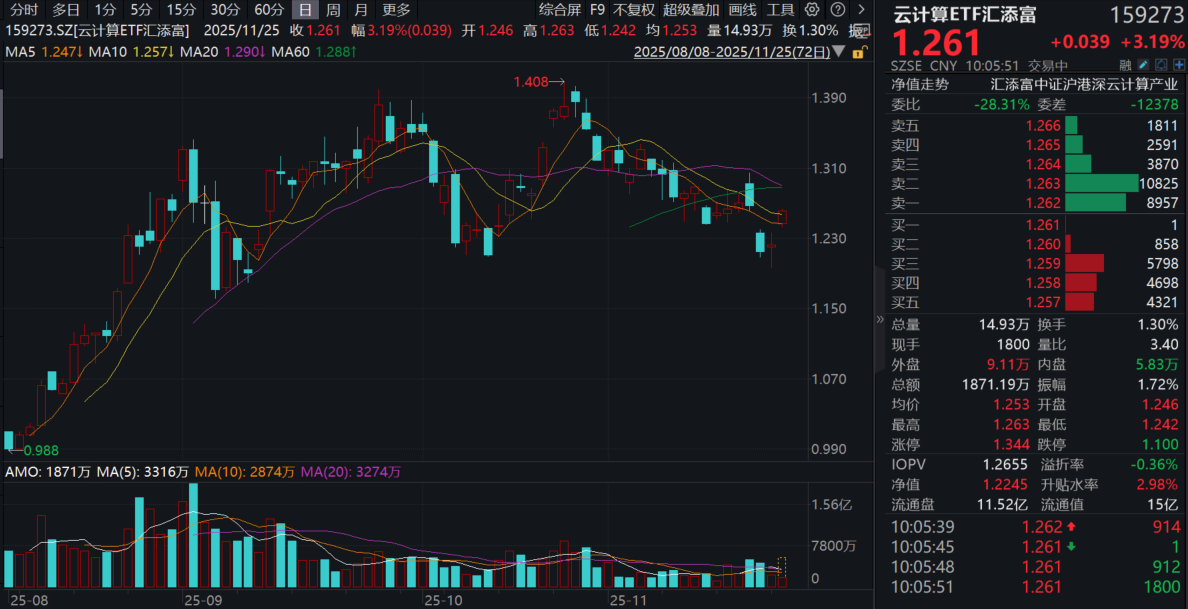
AI浪潮滚滚向前,美“创世纪计划”启动!中际旭创、新易盛涨超5%,云计算ETF汇添富(159273)大涨超3%!
Xin Lang Cai Jing· 2025-11-25 02:44
Group 1 - The core viewpoint of the news highlights the significant impact of the U.S. stock market's rise in technology stocks on the A-share computing power sector, leading to substantial gains in related stocks and ETFs [1][3] - The launch of the "Genesis Mission" by the U.S. government aims to leverage AI to transform scientific research and accelerate discoveries, indicating a strong governmental push towards AI integration in various sectors [3] - The cloud computing ETF Huatai (159273) saw a notable increase of over 3%, with trading volume exceeding 20 million yuan, reflecting investor confidence in the sector [1][3] Group 2 - NVIDIA reported a record revenue of $57.006 billion for Q3 2025, marking a 22% quarter-over-quarter increase and a 62% year-over-year increase, showcasing the robust growth of the AI industry [5] - The demand for AI-related infrastructure is expected to drive significant revenue growth, with projections indicating that NVIDIA's Blackwell and Rubin products could generate $500 billion in revenue from early 2025 to the end of 2026 [5] - The introduction of Google's Gemini 3 and Nano Banana Pro AI models is anticipated to further enhance demand for computing power, as these models demonstrate superior capabilities in various applications [6] Group 3 - The demand for optical modules is projected to increase significantly, with estimates for 2025-2027 indicating a need for 50 million, 75 million, and 100 million units respectively, driven by AI training and inference network bandwidth requirements [8] - The overall AI demand is accelerating, with cloud computing revenues exceeding expectations, and indicators such as remaining performance obligations and backlog orders suggesting sustained long-term revenue growth [7][8] - The cloud computing ETF Huatai (159273) is positioned to capture the growth opportunities in the AI-driven computing power market, covering a wide range of sectors including hardware, cloud services, and data center operations [8]


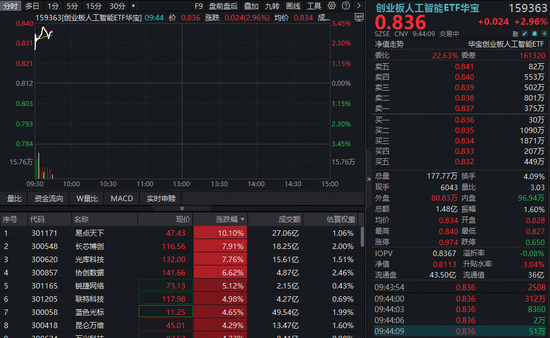
算力+AI应用全线活跃!创业板人工智能ETF(159363)飙涨超3%领跑,一举收复5日、10日线
Xin Lang Ji Jin· 2025-11-25 02:00
Core Insights - The AI sector is experiencing a resurgence, with significant activity in computing hardware and AI applications, leading to a rise of over 3% in the ChiNext AI index [1] - The ChiNext AI ETF (159363) has seen a trading volume exceeding 150 million CNY, recovering its 5-day and 10-day moving averages [1] - Alibaba's AI assistant, Qianwen App, has surpassed 10 million downloads within a week, becoming the fastest-growing AI application [1][3] Market Performance - Stocks such as Changxin Bochuang and Yidian Tianxia have surged over 7%, while several others, including Ruijie Network and Xiechuang Data, have increased by over 3% [1] - The ChiNext AI ETF is leading the market among AI-themed ETFs, with a notable increase in trading volume [1] Industry Trends - The AI industry has undergone a rotation from overseas computing power to domestic computing power and energy storage since 2025, indicating a potential for AI applications to experience a rebound [3] - The synergy between model upgrades and computing power demand is fostering a positive cycle in the AI industry, maintaining high levels of activity in the computing power sector [3] Investment Opportunities - The first ChiNext AI ETF (159363) is recommended for capturing core opportunities in the computing power and AI application sectors, with over 70% of its portfolio allocated to computing power [3] - Key focus is on leading companies in the optical module industry, which is expected to benefit from the ongoing growth in AI applications [3]

董事长专访 | 中贝通信李六兵:19亿元定增锚定AI未来
Sou Hu Cai Jing· 2025-11-24 23:58
Core Insights - The article highlights the strategic vision of Zhongbei Communication, led by Chairman Li Liubing, emphasizing the importance of balancing social benefits with precise and stable business operations [4][5][10] Company Strategy - Zhongbei Communication is advancing a fundraising plan of up to 1.922 billion yuan, with 1.102 billion yuan allocated for the construction of computing power centers [6] - The company aims to expand its computing power cluster significantly, targeting a total capacity of 20,000P to meet the growing demand for high-performance GPU clusters [6][7] - The strategic focus includes international expansion, particularly in Southeast Asia, with ongoing projects in Indonesia [6][7] Technological Development - The company is transitioning from traditional communication technology to artificial intelligence, positioning itself in the "AI + communication" era [5] - Zhongbei Communication has established computing power clusters in various locations, with a target of exceeding 15,000P by the end of 2024 and a reported revenue growth of 498.21% in the first half of 2025 [5][6] Management Philosophy - Li Liubing employs a unique "reverse management philosophy," where rules are established from the bottom up, ensuring that all employees can execute and accept the policies [9] - The company emphasizes transparency and collaboration, fostering a culture where all levels of staff can contribute effectively [9][10] Global Expansion - Zhongbei Communication is shifting its overseas strategy from "borrowing boats to go to sea" to "building boats to go to sea," establishing subsidiaries in countries like Saudi Arabia and South Africa [10] - The company is also collaborating with academic teams on early research in 6G semantic communication, which is seen as a key technology for future advancements [7][10]


东吴证券晨会纪要-20251125
Soochow Securities· 2025-11-24 23:30
Macro Strategy - The economic total faces increasing downward pressure, with weak consumer and export performance continuing due to base effects [1][18] - The Federal Reserve's hawkish signals and the delay in the release of November non-farm data have led to a significant reduction in market expectations for a rate cut in December [19][20] - It is anticipated that the Fed will likely pause rate cuts in December, but this pause is seen as a "skip" rather than a cancellation, with a high probability of a rate cut in January [20][21] Financial Products - The A-share market is expected to experience a short-term adjustment in November, with limited adjustment space, while small-cap stocks may perform relatively better [2][22] - The overall market sentiment has been negatively impacted by the suspension of high-profile stocks, leading to an increase in daily limit-down stocks [2] - There are several sectors to watch during the market adjustment, including the computing power sector, which has shown signs of rebound [2][22] Fixed Income - The yield on the 10-year government bond rose from 1.8050% to 1.8125% during the week, indicating a slight upward trend in interest rates [5][22] - The issuance of green bonds decreased significantly, with 26 new green bonds issued totaling approximately 24.619 billion yuan, down 44.489 billion yuan from the previous week [5] - The market is currently in a cautious state regarding the potential for year-end allocation opportunities in the bond market [22] Company Analysis - Baidu Group is expected to benefit from AI business commercialization, with adjusted non-GAAP net profit forecasts for 2025-2027 lowered to 19.4 billion, 21.7 billion, and 24.7 billion yuan, respectively [7] - Wangfujing's revenue decline has narrowed, and the company is expected to benefit from the duty-free policy, with adjusted net profit forecasts for 2025-2027 set at 1.80 billion, 4.28 billion, and 6.03 billion yuan [8] - Lenovo Group's FY2026-2028 net profit forecasts have been raised to 1.87 billion, 2.09 billion, and 2.33 billion USD, driven by AI-related business growth [9] - Ctrip Group is expected to see an increase in international business share and profit margins as it continues to expand overseas [9] - Kuaishou's Q3 performance exceeded expectations, with adjusted non-IFRS net profit forecasts for 2025-2027 adjusted to 20.6 billion, 22.9 billion, and 25.2 billion yuan [14] - JD Group maintains strong competitive advantages in the e-commerce sector, with non-GAAP EPS forecasts for 2025-2027 set at 9.0, 12.8, and 15.7 yuan [15] - Pinduoduo's performance exceeded expectations, with non-GAAP net profit forecasts for 2025-2027 set at 100.4 billion, 126.5 billion, and 152.4 billion yuan [16]
“国产GPU第一股”摩尔线程申购启动
Ju Chao Zi Xun· 2025-11-24 12:35
Core Viewpoint - The company Moer Thread (688795.SH), known as the "first domestic GPU stock," has launched its IPO on the Sci-Tech Innovation Board, with a share price of 114.28 yuan, aiming to raise 8 billion yuan, marking the highest IPO of the year and the largest fundraising on the Sci-Tech Innovation Board in 2023 [1][3]. Group 1: IPO Details - The IPO attracted 286 institutional investors and 7,787 allocation objects, with a bidding range from 88.79 yuan to 159.57 yuan per share, indicating high institutional participation [3]. - The final issuance price of 114.28 yuan per share corresponds to a projected diluted price-to-sales ratio of approximately 122.51 times for 2024, with a post-issue market capitalization of about 53.715 billion yuan, significantly above the average of comparable companies [3]. Group 2: Company Background - Moer Thread, established in 2020, focuses on the research and development of general-purpose GPUs and related acceleration chips, positioning itself as "China's NVIDIA" [3]. - The company is one of the few domestic GPU manufacturers capable of supporting full computational precision from FP8 to FP64 and was among the first to launch a GPU that supports the DirectX12 graphics acceleration engine [3]. Group 3: Financial Performance - According to the prospectus, Moer Thread is experiencing rapid revenue growth from 2022 to 2024 and the first three quarters of 2025, but is still in a continuous loss phase due to significant R&D and market investments, with cumulative losses exceeding 5 billion yuan [4]. - The company anticipates achieving profitability at the consolidated financial statement level by 2027 [4].
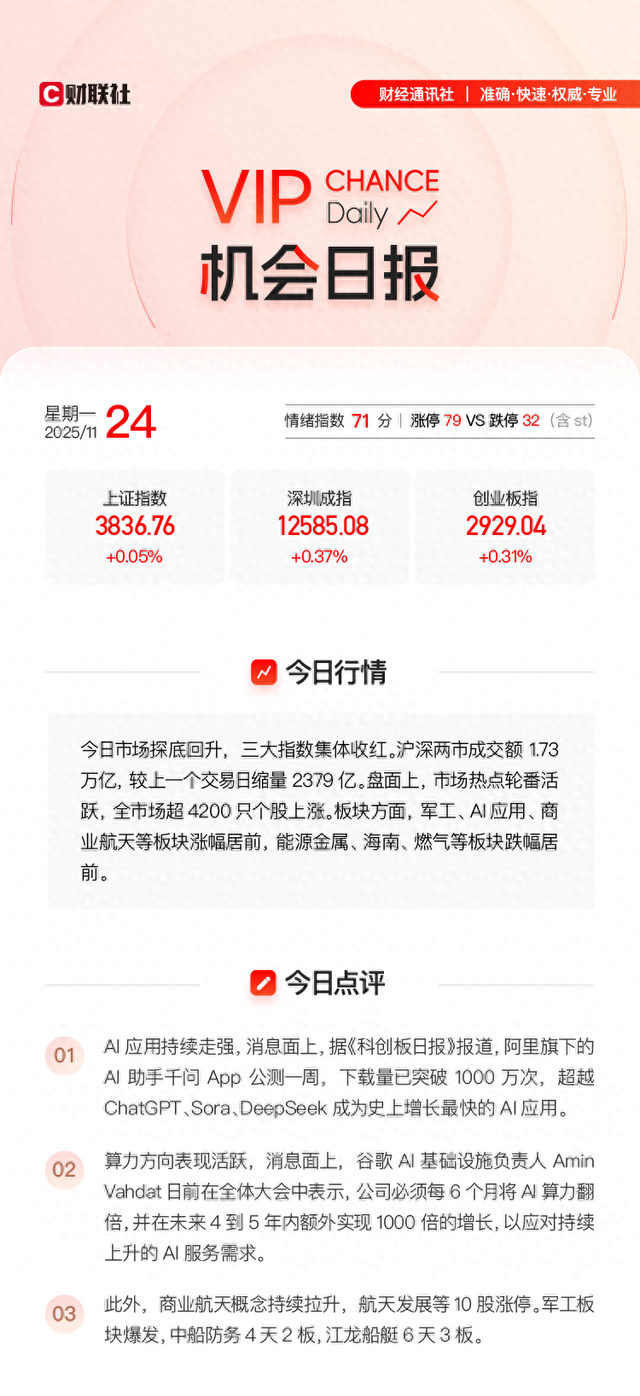
VIP机会日报AI应用持续走强 栏目追踪行业动态 提及焦点公司涨停
Xin Lang Cai Jing· 2025-11-24 10:15
Group 1: AI Applications - Alibaba's AI assistant Qianwen App has surpassed 10 million downloads within a week of public testing, making it the fastest-growing AI application historically, outpacing ChatGPT, Sora, and DeepSeek [6] - Ant Group's Lingguang has also crossed 1 million downloads, indicating strong institutional confidence in AI applications potentially becoming popular in the consumer sector before expanding to the business sector [7] - BlueFocus, a leading advertising marketing company, is accelerating its globalization strategy and optimizing partnerships with new media, which has led to a significant stock price increase [8][11] Group 2: Computing Power - Google AI infrastructure head Amin Vahdat stated that the company must double its AI computing power every six months and achieve an additional 1000 times growth in the next 4 to 5 years to meet rising AI service demands [13] - Institutions have noted that model upgrades are driving the demand for computing power, with companies like Rich Circuit and Guangku Technology seeing stock price increases of over 10% [14] - Rich Circuit specializes in high-end PCBs and is advancing new products like 800G optical modules, contributing to its stock price rise of 20.49% [20] Group 3: Commercial Aerospace - The establishment of the Commercial Aerospace Administration is indicated by recent job postings, and the "Zhuque-3" rocket is expected to be China's first operational reusable launch vehicle [22] - The commercial aerospace market in China is projected to grow from approximately 0.38 trillion yuan in 2015 to 2.3 trillion yuan by 2024, with a compound annual growth rate of about 22%. If growth continues at 25%, the market could approach 10 trillion yuan by 2030 [23]
A股异动!三大变数,突然来袭!
Sou Hu Cai Jing· 2025-11-24 08:26
Core Viewpoint - The market is experiencing unexpected weakness, with significant declines in key assets such as Industrial Fulian and Ganfeng Lithium, despite a rebound in US stocks last week [1][4]. Group 1: Industrial Fulian - Industrial Fulian has seen substantial sell-offs, contributing over 7.63 points to the Shanghai Composite Index's decline, indicating it accounted for more than half of the index's drop [3]. - The sell-off is attributed to rumors regarding Nvidia's potential entry into the L10 system and a downward revision of Q4 performance, which some institutions believe are unfounded [3]. - Industrial Fulian maintains that its Q4 operations are on track, with expected cabinet deliveries increasing by over 30% quarter-on-quarter, and no profit target adjustments have been made [3]. Group 2: Ganfeng Lithium - Goldman Sachs downgraded Ganfeng Lithium's H-shares rating to "Sell," citing a 14% reduction in lithium price expectations for the second half of 2026 due to weak short-term market feedback and slowing inventory replenishment [2][4]. - Despite improvements in the lithium market fundamentals, a prolonged inventory cycle in energy storage systems may offset the expected supply-demand balance [4]. Group 3: Japanese Financial Market - Japanese government bond yields continue to rise, with the 10-year yield above 1.78% and the 40-year yield reaching 3.678%, indicating ongoing market volatility [4]. - Analysts suggest that potential intervention measures may not reverse the broad depreciation of the yen but could slow its decline [2][5]. Group 4: A-share Market Outlook - The A-share market is currently in a "three-phase overlap," characterized by a consolidation phase in the mid-bull market, a critical period for economic verification, and a performance policy vacuum, leading to a slowdown in upward momentum [6][7]. - The market is expected to stabilize as it approaches key support levels, with a potential bottoming opportunity if the A-share index reaches the half-year line [7].


三大股指盘中集体翻绿
Shang Hai Zheng Quan Bao· 2025-11-24 06:30
Core Viewpoint - A-shares experienced a collective decline in the three major stock indices, with the ChiNext index previously rising over 1% before turning negative [1] Market Performance - As of 10:09 AM, the Shanghai Composite Index fell by 0.36% - The Shenzhen Component Index decreased by 0.07% - The ChiNext Index dropped by 0.08% [1] Sector Performance - Lithium mining, computing power, and oil and natural gas sectors showed the largest declines [1]
远东股份:“电能+算力+AI”多维布局 业绩逐步释放 天风证券给予买入评级
Zheng Quan Shi Bao Wang· 2025-11-24 06:18
Core Viewpoint - Tianfeng Securities has given a "buy" rating for Far East Holdings, highlighting the company's sustainable growth driven by its focus on "electricity + computing power + AI" [1] Group 1: Financial Performance - In the first half of 2025, Far East Holdings achieved a revenue of 12.976 billion, representing a year-on-year growth of 14.38%, marking a record high for the same period [1] Group 2: Business Strategy - The company is actively expanding into emerging markets related to artificial intelligence, computing power, and robotics, integrating "computing power + AI" into its development strategy [1] - Far East Holdings is enhancing its equipment side by accelerating the development of liquid cooling technology, high-speed connectors, high-speed copper cables, multimode optical fibers, AI servers, and backup power supplies for data centers [1] Group 3: Market Position and Partnerships - The company has supported over 200 large data centers, including those for China Telecom and Alibaba Cloud, establishing a comprehensive support system [2] - Far East Holdings has obtained vendor codes from leading global AI chip companies, enabling bulk supply of power lines and automotive lines [2] Group 4: Technological Development - The company is focusing on the research and development of liquid cooling technology, particularly in biomimetic manifold microchannel and material innovation, to meet the increasing performance requirements of cooling solutions [2] - Far East Holdings has developed a new generation of liquid cooling technology and is conducting sample testing, leveraging its proprietary liquid cooling heat dissipation technology [2]

英伟达的好业绩,是小米的坏消息
芯世相· 2025-11-24 06:07
Core Viewpoint - Nvidia reported strong financial results for Q3 FY26, with revenue reaching $57 billion, a 62% year-over-year increase, and a record quarterly growth of $10 billion, exceeding market expectations [8][9]. Group 1: Financial Performance - Nvidia's data center revenue reached $51.2 billion, growing 66% year-over-year and 25% quarter-over-quarter [8]. - The gross margin for the quarter was 73.4%, with a net profit of $31.91 billion, reflecting a 65% year-over-year increase and a net profit margin of 56% [8][10]. - The company expects Q4 revenue to reach $65 billion, a nearly 14% quarter-over-quarter increase, with gross margin projected to rise to 74.8% [12][13]. Group 2: AI Demand and Storage Chip Price Surge - The demand for AI has significantly increased, leading to a surge in storage chip prices, particularly for HBM and DDR5 [14][18]. - Traditional storage chip prices have risen dramatically, with DDR4 prices increasing by nearly 10 times since June, driven by supply constraints and panic buying from downstream suppliers [17][22]. - OpenAI's strategic partnerships with major suppliers like Samsung and SK Hynix have intensified the demand for advanced storage chips, with an estimated monthly requirement of 900,000 DRAM wafers [15][14]. Group 3: Impact on the Industry - The ongoing price increases for storage chips are expected to have a limited impact on the AI industry due to the strong bargaining power of major players like Nvidia [23]. - However, the rising costs of storage chips will significantly affect smartphone manufacturers, as they may struggle to pass on these costs to consumers, leading to reduced profit margins [26][27]. - The potential for a negative feedback loop exists if manufacturers raise prices, which could delay consumer upgrades and impact overall demand in the smartphone market [29].