自主可控

Search documents
银华多元机遇混合:2025年上半年利润5299.81万元 净值增长率9.87%
Sou Hu Cai Jing· 2025-09-05 04:20
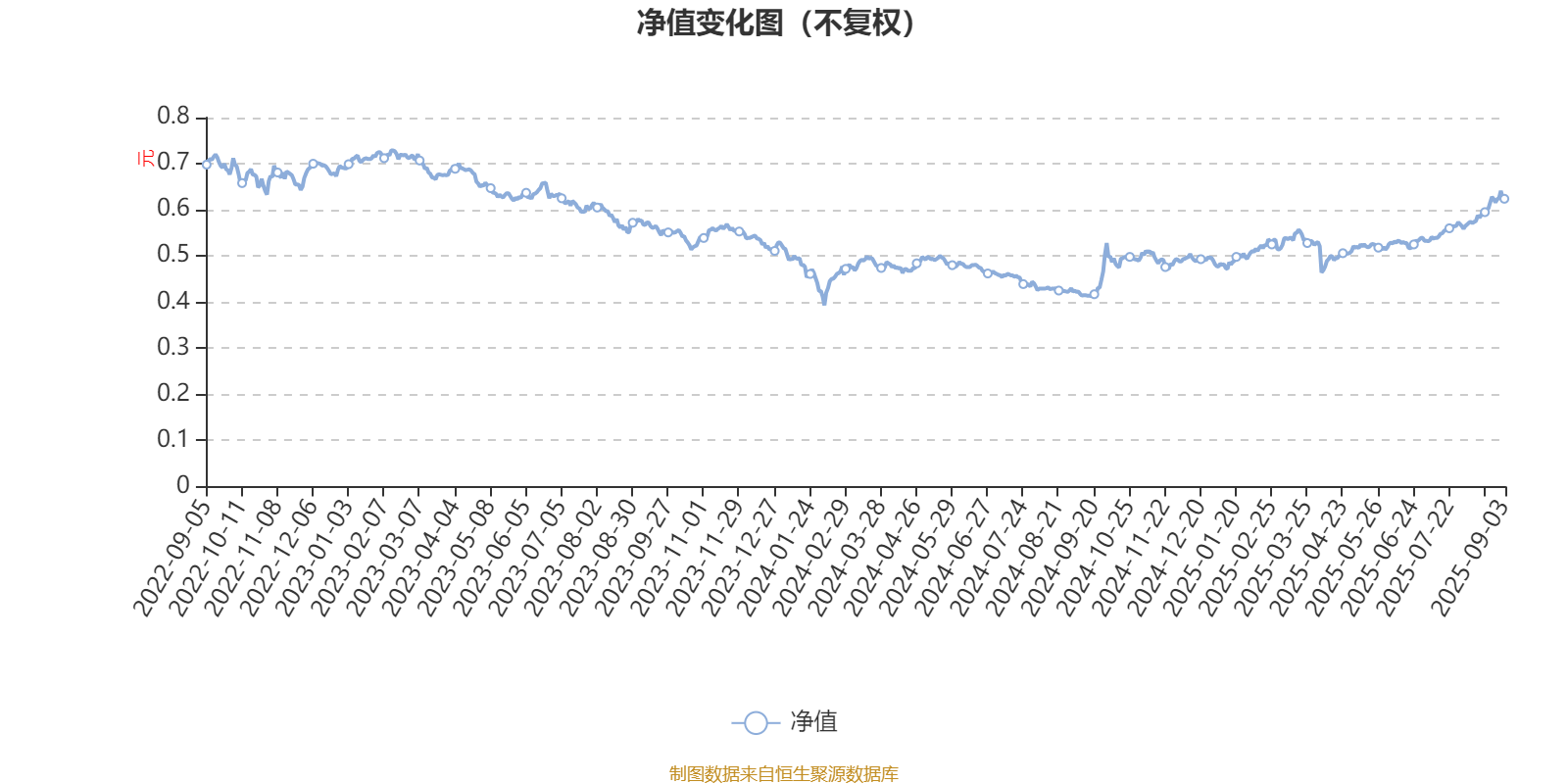
Core Viewpoint - The AI Fund Yinhua Multi-Opportunity Mixed Fund (009960) reported a profit of 52.9981 million yuan for the first half of 2025, with a net value growth rate of 9.87% and a fund size of 569 million yuan as of the end of June 2025 [2]. Group 1: Fund Performance - The fund's weighted average profit per share for the reporting period was 0.0487 yuan [2]. - As of September 3, the fund's unit net value was 0.624 yuan [2]. - The fund's net value growth rates for the past three months, six months, and one year were 20.52%, 21.41%, and 47.00%, respectively, ranking 127/256, 96/256, and 104/256 among comparable funds [6]. Group 2: Investment Outlook - The fund management anticipates upward risks in the technology sector, focusing on the implications of the major power technology competition and the guidance of the 14th Five-Year Plan [2]. - There is optimism regarding the acceleration of overseas AI industry trends and the potential for domestic AI to catch up [2]. - The report suggests that despite weak demand in traditional advanced manufacturing industries, supply-side control measures are increasing, making the downside risks manageable [2]. Group 3: Consumer Sector Insights - High-frequency data indicates a further decline in consumer sentiment, with no immediate upward trends expected, leading to a forecast of bottom oscillation in the near term [2]. - Structural opportunities exist in new consumption sectors, particularly in trendy toys and gold jewelry, with a notable surge in emotional, experiential, and social consumption recognized by the market [2]. Group 4: Valuation Metrics - As of June 30, 2025, the fund's weighted average price-to-earnings (P/E) ratio was approximately 14.79 times, significantly lower than the industry average of 26.16 times [12]. - The fund's weighted average price-to-book (P/B) ratio was about 1.68 times, compared to the industry average of 2.38 times [12]. - The weighted average price-to-sales (P/S) ratio was approximately 1.83 times, while the industry average was 2.05 times [12]. Group 5: Growth Metrics - For the first half of 2025, the fund's weighted average revenue growth rate was 0.09%, and the weighted average net profit growth rate was 0.1% [20]. - The weighted annualized return on equity was 0.11% [20]. Group 6: Fund Composition and Holdings - As of June 30, 2025, the fund had a total of 19,200 holders, with individual investors holding 99.05% of the shares [37]. - The top ten holdings included Tencent Holdings, Alibaba-W, and other notable companies, indicating a diversified portfolio [43].

分歧出现后,该怎么应对?需要关注哪些重要机会?
Sou Hu Cai Jing· 2025-09-05 01:00
来源:米筐投资 市场分歧加剧的特征在本周愈发清晰。 这种分化背后是资金调仓的明显迹象:沪深两市成交额连续第16个交易日突破万亿元,但较前一日缩量 超5000亿元,显示增量资金入场节奏放缓,存量博弈特征凸显。 北向资金的持仓结构也反映出防御倾向,二季度对金融、工业板块分别加仓446亿元和237亿元,而对消 费板块则进行了减持。 当前市场调整空间的判断需结合估值结构。上证指数市盈率处于近十年86.5%分位,但显著低于2007年 和2015年的历史峰值,整体尚未出现全面泡沫。 机构普遍认为调整幅度不会特别大,中原证券等机构指出,财政政策积极发力与货币政策维持宽松的背 景下,市场底部将呈现逐级抬升趋势。 不过结构性差异明显,科创综指市盈率已处于历史极值,部分科技标的估值与业绩匹配度不足,短期波 动风险需警惕。 后市修复需关注三重信号。政策层面,超长期特别国债发行进度与设备更新补贴落地效果将直接影响基 建产业链预期; 产业端,半导体、新能源等行业的中报业绩能否延续高增长,以及AI应用端是否出现现象级产品,将 决定成长板块的估值修复空间。 国际层面,美联储降息节奏与美元指数走势也会通过汇率渠道影响A股资金结构。 把握节奏 ...
0904A股日评:无惧风雨,“慢牛”仍在-20250905
Changjiang Securities· 2025-09-04 23:30
丨证券研究报告丨 市场策略丨点评报告 [Table_Title] 0904 A 股日评:无惧风雨,"慢牛"仍在 报告要点 [Table_Summary] 今日 A 股市场震荡走低,三大指数齐跌,今日量能小幅回升。消费板块反弹,电信业务和电子 等科技板块集体下跌,金属材料及矿业、国防军工、医疗保健等板块今日也同步走低。从指数 表现来看,上证指数下跌 1.25%,深证成指下跌 2.83%,创业板指下跌 4.25%,上证 50 下跌 1.71%,沪深 300 下跌 2.12%,科创 50 下跌 6.08%,中证 1000 下跌 2.30%,市场成交额约 2.58 万亿元。 分析师及联系人 [Table_Author] 戴清 SAC:S0490524010002 SFC:BTR264 请阅读最后评级说明和重要声明 %% %% %% %% research.95579.com 1 [Table_Title2] 0904 A 股日评:无惧风雨,"慢牛"仍在 [Table_Summary2] 事件描述 今日 A 股市场震荡走低,三大指数齐跌,今日量能小幅回升。消费板块反弹,电信业务和电子 等科技板块集体下跌,金属材料及矿业 ...

潍柴动力:公司与华为在产业资源共享等领域开展深入合作
Zheng Quan Ri Bao· 2025-09-04 08:37
Core Viewpoint - Weichai Power is collaborating with Huawei in various fields such as resource sharing, digital transformation, self-control, and innovative business exploration, with all activities progressing in an orderly manner [2] Group 1 - Weichai Power is engaging in deep cooperation with Huawei [2] - The collaboration focuses on industrial resource sharing and digital transformation [2] - The initiatives include self-control and innovative business exploration [2]
收评:沪指缩量跌逾1%,光刻机概念活跃,军工板块等下挫
Zheng Quan Shi Bao Wang· 2025-09-03 07:36
Market Overview - The Shanghai Composite Index experienced fluctuations, briefly falling below 3800 points, while the ChiNext Index showed relative strength with over 4500 stocks declining [1] - As of the market close, the Shanghai Composite Index fell by 1.16% to 3813.56 points, the Shenzhen Component Index decreased by 0.65% to 12472 points, and the ChiNext Index rose by 0.95% to 2899.37 points [1] - The total trading volume in the Shanghai and Shenzhen markets reached 239.61 billion yuan [1] Sector Performance - The military industry sector saw a significant decline, while brokerage, insurance, oil, non-ferrous metals, and liquor sectors also experienced downturns [1] - Conversely, the semiconductor and pharmaceutical sectors showed gains during the trading session, with solid-state batteries and photolithography machine concepts being particularly active [1] Investment Insights - The market's volatility is attributed to differing opinions among investors regarding future trends, despite clear policy guidance aimed at stabilizing the capital market [2] - The focus on technology and advanced manufacturing sectors is emphasized, with PMI data indicating that the production and new orders index for technology growth industries exceeds that of the overall manufacturing sector [2] - Key areas of interest include AI, autonomous control, humanoid robots, low-altitude economy, and national defense industries, as well as sectors benefiting from "anti-involution" policies promoting high-quality development [2] - Domestic demand policies are expected to create opportunities in industries such as machinery, home appliances, automobiles, consumer electronics, and urban renewal projects [2]
马云还有“狠招”!阿里备胎曝光,填补国内AI芯片空白!
Sou Hu Cai Jing· 2025-09-02 16:49
Core Viewpoint - Jack Ma has re-emerged in the public eye, indicating a recovery from past challenges, and is actively involved in both philanthropy and technology, particularly focusing on AI and cloud infrastructure investments [1][3]. Investment and Technology Development - Alibaba plans to invest over 380 billion yuan (approximately 58 billion USD) in cloud and AI hardware infrastructure over the next three years [3]. - Alibaba has developed a new AI chip that is currently in the testing phase, aimed at a wide range of AI inference tasks, and is produced entirely through domestic supply chains, reducing reliance on international manufacturers like TSMC [6][10]. Market Context and Competitive Landscape - The U.S. has intensified its restrictions on China's high-end chip technology, which has influenced Alibaba's "backup plan" for chip development [6][10]. - The NVIDIA H20 chip, designed for the Chinese market, faces performance limitations due to U.S. export controls and has raised security concerns, leading to recommendations for domestic companies to avoid its use [8][10]. Domestic Chip Innovation - Alibaba's subsidiary, Pingtouge Semiconductor, has already launched several chips, including the Lingang 800 and Yitian 710, and has made significant progress in the RISC-V architecture [8]. - The new AI inference chip from Alibaba shows compatibility with NVIDIA's CUDA ecosystem and achieves a performance of 125 TOPS, which is about 90% of the H20 chip's capabilities [8][10]. Future Outlook - The emergence of Alibaba in the AI chip sector is expected to enhance the competitiveness of domestic AI chips, marking the beginning of a long journey towards chip self-innovation in China [12].


英大证券晨会纪要-20250902
British Securities· 2025-09-02 02:33
Market Overview - The A-share market continues its upward trend, with the ChiNext Index rising over 2% and the Shenzhen Component Index increasing over 1%, both reaching new highs for the year [3][6] - The market is characterized by strong buying support following a quick recovery after a recent decline, indicating robust market sentiment [5][12] - Key sectors leading the gains include precious metals, innovative pharmaceuticals, and semiconductors, suggesting a rotation in market focus [3][11] Sector Analysis Precious Metals - The precious metals sector saw significant gains, driven by dovish signals from the Federal Reserve and rising expectations for interest rate cuts in September [7] - Factors contributing to the rise in gold prices include the onset of a Fed rate cut cycle, increased geopolitical tensions, and strong demand from global central banks [7] - Despite the positive outlook, caution is advised against chasing prices after a year of significant increases [7] Pharmaceuticals - The pharmaceutical sector, particularly innovative drugs, experienced a boost following the National Healthcare Security Administration's announcement of new drug listings [8] - The sector is viewed as having strong growth potential due to a favorable commercialization environment and the aging population driving demand [8] - Key areas for investment include innovative drugs, OTC traditional Chinese medicine, and medical services [8] Semiconductors - The semiconductor sector remains active, with a long-term positive outlook supported by national policy and increasing global demand for AI and high-performance computing [9][10] - The establishment of the National Integrated Circuit Industry Investment Fund is expected to enhance the industry's upgrade and support domestic production [10] - Investors are encouraged to focus on companies that are leading in technology and can adapt quickly to industry changes [10] Optical Communication Modules - The optical communication module sector is anticipated to remain in a high-growth cycle, driven by advancements in AI computing and data center upgrades [11] - Investors should pay attention to leading companies and those with technological advantages in this space [11] Investment Strategy - A dynamic optimization of holdings is recommended, focusing on stocks with strong performance and solid fundamentals [4][12] - Caution is advised for stocks that have seen excessive gains without strong fundamental support, suggesting a reduction in exposure [4][12] - Attention should also be directed towards undervalued sectors with solid earnings support, particularly defensive stocks that have undergone sufficient adjustments [4][12]
化工行业新材料周报(20250825-20250831):全球首款6G芯片问世,本周SAF、环氧树脂涨价-20250901
Huachuang Securities· 2025-09-01 12:05
Investment Rating - The report maintains a recommendation for SAF and epoxy resin, indicating a positive outlook for these materials in the chemical industry [1]. Core Insights - The new materials sector outperformed the broader market and the basic chemical sector, with the wind new materials index showing a weekly change of 2.53%, compared to 0.43% for the basic chemical index [8][9]. - The first global 6G chip has been launched, utilizing photonic technology to achieve a transmission speed of 100Gbps, which is expected to bridge the digital divide between urban and rural areas [4][11]. - The report highlights significant price increases for SAF in Europe (+11.01%) and China (+5.00%), as well as epoxy resin (+3.93%), while prices for threonine (-3.07%), lysine (-1.01%), and valine (-0.76%) saw declines [4][19]. Industry Updates - The report notes that the chemical industry is experiencing a recovery in prices due to easing trade tensions between China and the U.S., leading to a replenishment window in trade [9]. - The report emphasizes the importance of domestic production capabilities in new materials, particularly in light of ongoing trade tensions and the need for self-sufficiency [10]. - The report suggests that the new materials sector, particularly those with high growth potential and strong technological barriers, is poised for significant investment opportunities [14]. Trading Data - The Huachuang Chemical Industry Index stands at 71.65, reflecting a week-on-week increase of 0.59% but a year-on-year decrease of 21.87% [15][20]. - The industry price percentile is at 17.84% over the past decade, indicating a slight increase, while the industry inventory percentile is at 80.18%, suggesting a relatively high level of inventory [15]. Subsector Tracking - In the new energy materials sector, the report mentions the pricing of the SAIC MG4 semi-solid-state battery version at 99,800 yuan [27]. - The report also highlights the expected growth in the global robotics market, projected to exceed $400 billion by 2029, with China capturing nearly half of that market share [11].
博时基金市场异动陪伴9月1日:两市延续走强,创业板指涨2.29%
Xin Lang Ji Jin· 2025-09-01 08:16
Market Performance - The A-share market continued to rise, with the ChiNext Index increasing by 2.29% on September 1 [1] - The manufacturing PMI for August rebounded to 49.4%, indicating a marginal improvement in economic conditions, with production remaining in the expansion zone for four consecutive months [1] - The high-tech manufacturing PMI reached 51.9%, reflecting the leading role of industrial upgrades [1] Economic Indicators - The production index rose to 50.8%, up 0.3 percentage points from the previous month, while the new orders index remained in contraction at 49.5% [1] - The raw material purchasing price index increased to 53.3%, and the factory price index rose to 49.1%, indicating a recovery in upstream prices [1] - There is a divergence in PMI among different scales of enterprises, suggesting that a comprehensive economic recovery will take time [1] External Factors - Expectations for interest rate cuts overseas are rising, and the RMB is accelerating in appreciation, creating a favorable macro environment for the equity market [2] - The technology sector is experiencing an accelerated cycle of market and capital, with increased demands for upward logic [2] - Caution is advised regarding potential risks in crowded sectors, with opportunities in relatively underperforming downstream application areas, real estate, consumption, and dividend assets [2]

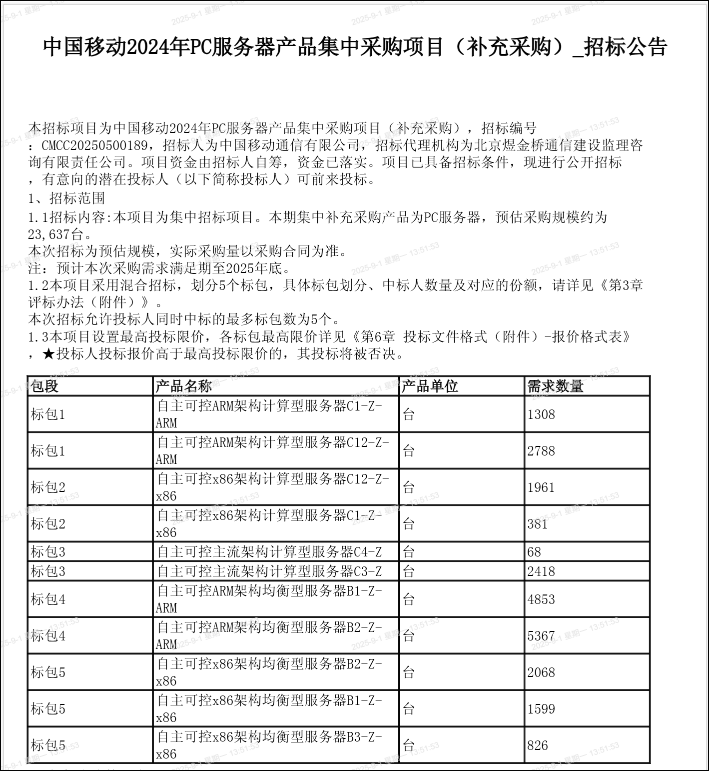
100%自主可控,中国移动补采超2.3万台PC服务器
Guan Cha Zhe Wang· 2025-09-01 06:59
Core Viewpoint - China Mobile has initiated a centralized procurement project for PC servers, with an estimated procurement scale of approximately 23,637 units, focusing on domestically controllable products [1][2][3] Group 1: Procurement Details - The procurement project is categorized into five bidding packages, with a mixed bidding approach [1][2] - The total estimated procurement volume is expected to meet demand until the end of 2025 [2] - The procurement includes 14,316 units of ARM architecture servers, 6,835 units of x86 architecture servers, and 2,486 units of mainstream architecture servers, with ARM servers accounting for about 60.5% of the total [1][2] Group 2: Financial Aspects - The total estimated value of this supplementary procurement is projected to be around 2 billion yuan [3] - Previous announcements indicated that the total procurement scale for 2024 was approximately 264,500 units, with a total bid amount of about 16.488 billion yuan for 21 packages [2][3]