能源转型

Search documents
ETF盘中资讯|背后三大推手显现!紫金矿业涨超2%,有色龙头ETF(159876)拉升1.5%,获净申购1200万份!超级周期能有多长?
Sou Hu Cai Jing· 2025-12-12 02:26
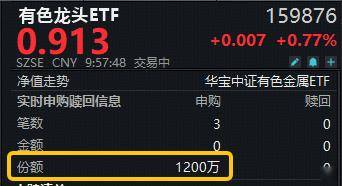
Core Viewpoint - The non-ferrous metal sector is experiencing significant growth, with the Non-Ferrous Metal Leader ETF (159876) seeing a price increase of over 1.5% during trading, reflecting strong investor confidence in the sector's future performance [1] Group 1: ETF Performance - The Non-Ferrous Metal Leader ETF (159876) has gained 0.77% as of the latest update, with a net subscription of 12 million units, indicating a total capital inflow of 140 million yuan over the past four days [1] - Key constituent stocks such as Western Mining, Tin Industry Co., and Chihong Zinc & Germanium have all risen by over 3%, while other stocks like Yunnan Aluminum and Zijin Mining have increased by more than 2% [1] Group 2: Key Stocks and Market Trends - The top-performing stocks in the ETF include Western Mining (3.96%), Tin Industry Co. (3.81%), and Chihong Zinc & Germanium (3.56%), with significant trading volumes reported [2] - The outlook for industrial metals such as copper, aluminum, cobalt, and lithium is positive for 2025, driven by three main factors: energy transition, AI revolution, and strategic reserves amid global competition [2] Group 3: Market Cycle and Investment Strategy - The duration of the super cycle for non-ferrous metals is likely to extend until 2026, influenced by the recovery of the US dollar, strategic reserve progress, and the effectiveness of "anti-involution" policies [3] - A diversified investment approach through the Non-Ferrous Metal Leader ETF and its associated funds is recommended to mitigate risks and capture the overall sector's performance [4]


中信证券:“绿色溢价”逐步收窄 绿色燃料方兴未艾
智通财经网· 2025-12-12 01:49
Core Viewpoint - Green liquid fuels are becoming a key driver for decarbonization in shipping, aviation, and chemical industries, benefiting from increased carbon tax policies and ongoing cost reductions, with potential for nearly tenfold growth in the next five years and a long-term market space reaching trillions [1] Policy Support and Market Demand - The demand for green liquid fuels, including green methanol, green ammonia, and sustainable aviation fuel (SAF), is transitioning from "potential" to "rigid" due to improved clean energy systems and decarbonization policies, with projected global demand by 2025 reaching approximately 300 million tons for green methanol, 250 million tons for green ammonia, and 250 million tons for SAF, and expected to grow significantly by 2030 [2] Supply and Demand Dynamics - Current production processes for green methanol, green ammonia, and SAF are mature, but actual project implementation is limited, with effective capacities projected to be only 50 million tons for green methanol, 130 million tons for green ammonia, and 440 million tons for SAF by 2025, while by 2030, effective capacities are expected to reach 2600 million tons for green methanol, 2400 million tons for green ammonia, and 1700 million tons for SAF [3] Cost Reduction and Pricing Trends - The production cost of green liquid fuels is currently 70%-120% higher than traditional methods, primarily due to the "green premium" from renewable electricity and equipment costs, with projections indicating that the cost of green methanol could decrease to between 2900-3700 RMB per ton by 2030, narrowing the cost gap with traditional fuels [4] Industry Chain Development - The green liquid fuel industry chain is evolving, with upstream suppliers of green electricity and biomass, integrated production operators, and downstream storage and distribution companies, where integrated firms are primarily wind power and state-owned electricity companies, enhancing their value and positioning in the emerging market [5]

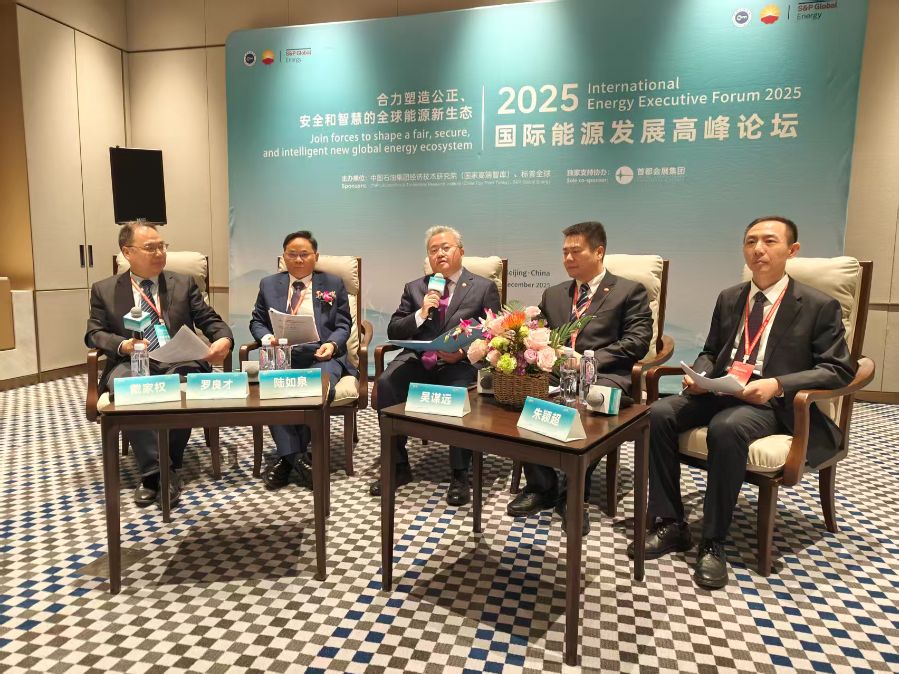
2025国际能源发展高峰论坛在京召开
Huan Qiu Wang· 2025-12-12 00:12
丹尼尔·耶金深入剖析了当前全球能源转型发展的复杂局势与未来趋势,强调能源转型的多样性与政策 协调的重要性。他提出,石油天然气在较长时期仍将扮演重要角色。能源转型背景下全球能源需求持续 增长,新能源稳步发展,石油、天然气、煤炭等传统能源持续增长,高于预期。能源转型呈现多维节 奏,中国凭借成本优势与政策驱动转型速度突出,新能源汽车发展领跑全球;欧美在气候目标与经济发 展、国防压力间权衡;全球南方国家能源转型关注经济增长,煤炭也是重要的选项。能源转型正从能源 密集型向矿产密集型演进,同时也面临着关键矿产开发周期长、政治因素复杂等问题。人工智能 (AI)用电激增推动了核电、风电以及煤电等发展。 在主论坛的主旨演讲环节,多位国际政要与知名专家先后登台。前欧洲理事会主席、比利时前首相、中 欧国际工商学院特聘教授夏尔·米歇尔(Charles Michel)分析了欧洲能源转型历史与现实,呼吁中欧双 方加强合作,共同应对全球气候变化与能源安全风险。中国国际交流协会副会长艾平指出,文明交流互 鉴是推动能源国际合作的重要动力,各国在能源领域应加强沟通与理解,推动构建人类命运共同体。复 旦大学中国研究院院长张维为认为,作为文明型国家 ...

日本因能源转型缓慢被授“化石奖”
Ren Min Ri Bao· 2025-12-11 22:11
"如果日本等发达国家执意扩大化石燃料生产与投资,全球南方国家的能源转型进程或将严重受 挫。"《化石燃料不扩散条约》倡议组织研究政策主管阿米拉·萨瓦斯表示,全球气候治理需要实际行 动,而非敷衍塞责的缓兵之计。日本若持续在能源转型上慢半拍,不仅会损害自身国际信誉,更将拖累 全球气候治理的整体进程。 不久前,在巴西贝伦举行的《联合国气候变化框架公约》第三十次缔约方大会上,日本因在摆脱化石燃 料依赖方面缺乏实质进展,再度被国际环保组织"气候行动网络"授予象征气候治理消极态度的"化石 奖"。长期以来,日本在环保领域以"技术领先""理念成熟"自居,但在全球节能减排浪潮加速、绿色转 型已成共识的当下,日本的实际行动与其塑造的国际形象形成鲜明反差,其气候治理表现持续引发国际 社会质疑。 减排目标缩水,是日本绿色转型滞后的突出表现。日本政府最新修订的《地球温暖化对策计划》提出, 到2035年在2013年基础上减少60%碳排放,到2040年减排73%。然而,国际环保组织"350.org"的测算显 示,这一目标与《巴黎协定》确立的"将全球气温升幅控制在工业化前水平1.5摄氏度以内"的要求相 比,仍存在6个百分点的差距,远不能满足全 ...
日本因能源转型缓慢被授“化石奖” 可再生能源发展水平大幅落后于国际同类国家
Ren Min Ri Bao· 2025-12-11 21:55
Core Viewpoint - Japan has been criticized for its lack of substantial progress in reducing fossil fuel dependence, receiving the "Fossil Award" from the Climate Action Network at the recent UN Climate Change Conference, highlighting a stark contrast between its self-proclaimed image of environmental leadership and its actual climate governance performance [1][4] Group 1: Emission Reduction Goals - Japan's revised "Global Warming Countermeasures Plan" aims to reduce carbon emissions by 60% from 2013 levels by 2035 and by 73% by 2040, but this still falls short by 6 percentage points compared to the Paris Agreement's target of limiting global temperature rise to 1.5 degrees Celsius above pre-industrial levels [1][2] - The slight decrease in Japan's greenhouse gas emissions is primarily attributed to changes in energy demand and the gradual restart of nuclear power plants, rather than a significant shift towards renewable energy or structural reforms in the power system [2] Group 2: Fossil Fuel Dependence - In the fiscal year 2023-2024, fossil fuel generation is expected to account for nearly 70% of Japan's electricity mix, indicating that the dominance of traditional energy sources like coal and natural gas remains unchanged [2] - Japan has not established a clear timeline for phasing out coal power, despite calls from international organizations for a decisive transition away from fossil fuel generation [3] Group 3: Renewable Energy Development - Japan faces significant challenges in developing renewable energy, including limited transmission capacity, high grid connection costs, complex local approval processes, and frequent land and maritime disputes, resulting in a substantial lag behind other countries in clean energy deployment [3] - Since the Paris Agreement came into effect in 2016, Japan's International Cooperation Bank has provided direct financial support for 26 fossil gas projects in 15 countries, which are projected to generate 408 million tons of carbon emissions by 2024, equivalent to the annual emissions of the world's second-largest emitter [3] Group 4: Global Implications - The continued expansion of fossil fuel production and investment by developed countries like Japan could severely hinder the energy transition efforts of developing nations, emphasizing the need for genuine action in global climate governance [4]
规模不低于180亿!山西百亿金融航母又一投资基金招募GP
Sou Hu Cai Jing· 2025-12-11 20:16
Core Viewpoint - Shanxi Province is establishing a significant fund, the Manufacturing Revitalization and Upgrading Fund, to promote high-quality development in the manufacturing sector, with a minimum scale of 100.01 billion yuan and a target of 180 billion yuan through a mother-fund and sub-fund structure [3][10]. Fund Overview - The Manufacturing Revitalization and Upgrading Fund was approved by the Shanxi Provincial Government on April 10 and aims to support traditional industry upgrades and the cultivation of strategic emerging industries [3][10]. - The fund will focus on key areas such as energy transition, industrial upgrading, and moderate diversification, targeting high-end equipment manufacturing, new materials, coal chemical industry, biomedicine, new energy, and digital industries [3][10]. Investment Scope and Duration - The fund has a lifespan of 15 years and will invest in unlisted company equity, directed offerings of listed companies, large transactions for mergers and acquisitions, IPO strategic placements, and other private equity fund-allowed assets [4][6]. - The fund's operational model will involve a mother-fund and sub-fund approach to achieve a combined scale of at least 180 billion yuan [3]. Management Institution Requirements - Institutions applying to manage the fund must have a registered capital of no less than 10 million yuan and a historical fund management scale of at least 5 billion yuan, with a minimum of 5 successful equity investment cases [5][6]. - Applicants should demonstrate strong industry resource reserves that align with Shanxi's needs and possess the capability to support traditional industry upgrades and emerging industry cultivation [5][6]. Previous Fund Selections - Shanxi Financial Investment Holding Group has previously selected management institutions for two funds this year, including the Shanxi Angel Equity Investment Fund and the Shanxi Low-altitude Economy and General Aviation Development Fund [7][8]. - The Shanxi Angel Equity Investment Fund aims for a minimum scale of 2.51 billion yuan and focuses on supporting early-stage technology innovation enterprises in key sectors [7][8]. Government Support and Strategic Importance - The Shanxi Provincial Government has allocated 7 billion yuan in the initial budget to support the establishment and development of related funds, indicating a commitment to enhancing the manufacturing sector [9]. - The establishment of the Manufacturing Revitalization and Upgrading Fund is seen as a crucial capital support for the upgrading of Shanxi's manufacturing industry, aligning with national directives for revitalizing traditional industries [10].

SPIE signs an agreement to acquire Artemys in France
Globenewswire· 2025-12-11 16:45
Core Insights - SPIE, a European leader in multi-technical services, has signed an agreement to acquire 93% of Artemys, a French expert in digital transformation [1][4] - Artemys, founded in 1989, generated approximately €82 million in revenue in 2024 and has a diversified client portfolio across various sectors [2][4] - The acquisition will enhance SPIE's capabilities in cloud, big data, and cybersecurity, particularly for large accounts and mid-sized companies in France [3][4] Company Overview - SPIE achieved consolidated revenues of €9.9 billion and consolidated EBITA of €712 million in 2024, with a workforce of 55,000 employees [5] - Artemys employs 420 people across 7 offices and specializes in the design, management, and transformation of information systems [2][4] Strategic Implications - The acquisition is expected to strengthen SPIE's expertise in digital transformation and improve service offerings in strategic areas such as cloud and cybersecurity [3][4] - The transaction is anticipated to be finalized by early 2026, pending approval from competition authorities [4]

道通科技“储能 + 超充”破局AI用电荒 成北美能源转型关键推手
Zheng Quan Shi Bao Wang· 2025-12-11 14:05
Core Insights - The U.S. is facing an unprecedented power supply challenge due to the exponential growth in demand for artificial intelligence and cloud computing, with a power gap of up to 270GW in the North American electricity market [1] - Daotong Technology is leveraging its power electronics technology to combine charging and energy storage, launching an integrated "Energy Storage + Ultra-Fast Charging" solution to stabilize the power system [1] - The company has successfully initiated multiple benchmark projects in the U.S. to address the electricity pressure from AI data centers [1] Group 1: Market Development - As of the end of 2025, Daotong Technology has started six benchmark projects for energy storage and ultra-fast charging in North America, with one site already completed [2] - The company plans to standardize its solution and promote it widely in the U.S., with plans for large charging stations to implement storage projects exceeding 5MWh [2] - An example project includes a fast-food chain in Southern California, which integrates 500kWh of energy storage with a 640kW ultra-fast charging station to alleviate grid load [2] Group 2: Competitive Advantages - Daotong's energy storage and charging solution has three core advantages: full suite of North American certified products, a localized team for efficient deployment and maintenance, and a modular system for scalable replication [2] - The company has achieved a systematic advantage in a market with high entry barriers, positioning itself as a key player in the energy transition in North America [2] Group 3: Business Model and Technology - Daotong Technology has established a multi-faceted revenue structure through three main avenues: peak shaving to reduce demand charges by 30%-60%, cash flow from ultra-fast charging stations, and capacity support in collaboration with local grids [3] - The company is building a power supply system based on an 820V±5% SiC platform, preparing for the trend towards 800V/900V in North America, and has developed a smart energy management system to optimize energy distribution and pricing strategies [3] - Industry experts note that as the electricity shortage from AI intensifies, the combination of charging and energy storage is becoming a necessity, with Daotong Technology emerging as a key driver of energy transformation in North America [3]

21对话|中石油经研院朱颖超:中国能源企业走出去面临四大机遇
2 1 Shi Ji Jing Ji Bao Dao· 2025-12-11 12:09
不仅如此,朱颖超指出,中长期内,油气在中国能源体系及全球能源结构中仍将保持重要地位,需求空间依然存在。由中石油 经研院发布的《2060年世界与中国能源展望》预测,在基准情景下,到2035年化石能源需求增至127亿吨标油,较2025年增加4 亿吨标油,占一次能源比重仍高于70%。"中国油气企业在30多年积累了丰富的合作经验与创新模式,这将为未来深化合作奠定 良好基础。"他说。 此外,朱颖超强调,科技创新特别是智能化、数字化发展,将为油气行业带来新的增长空间。"人工智能、数字化技术已在油气 勘探开发、炼化、储运等环节广泛应用,显著提升效率、降低成本。同时,深海、极地、页岩油气等领域的技术突破,以及液 化天然气等技术发展,也将创造新的合作机遇。" 最后,朱颖超表示,全球能源转型趋势也将提供新的增长点。"当前能源转型加速推进,中东、非洲等地正积极发展新能源。非 洲在资金与技术方面仍有缺口,而中国在新能源产业链、资金与技术方面具备优势,双方在该领域的合作前景广阔。"他说。 南方财经21世纪经济报道记者郑青亭、实习生王馨梓 北京报道 12月11日,在2025国际能源发展高峰论坛期间,中国石油集团经济技术研究院副院长朱颖超 ...
广发金材 | 铜行业专题之二:铜需求——全球新基建周期启航
Xin Lang Cai Jing· 2025-12-11 12:04
Core Viewpoint - The long-term outlook for copper demand is optimistic, driven by sectors such as electric vehicles, AI, and power grids, with expectations of a balanced supply-demand situation from 2025 to 2027, leading to an upward trend in copper prices [2][4][67]. Group 1: Copper Demand Drivers - Electric vehicles (EVs) are expected to significantly increase copper consumption, with a projected CAGR of 14% from 2025 to 2030, resulting in an annual increase of 21 million tons [11][13][67]. - The AI sector is driving demand for data centers, with an anticipated additional copper requirement of 206 million tons from 2025 to 2030, averaging 34 million tons annually [16][67]. - The power infrastructure cycle, including the upgrade of aging power grid systems and AI-driven resource construction, is expected to stabilize copper demand over the long term [20][68]. Group 2: Regional Insights - In China, stable domestic demand and the development of new productive forces are expected to boost copper demand, particularly through new infrastructure projects [20][69]. - In the United States, the need for power grid updates and expansions is anticipated to support a rebound in copper demand, driven by manufacturing return and energy transition [27][30][69]. - The European Union's focus on renewable energy sources and post-war reconstruction efforts is projected to enhance copper demand [42][69]. - Other regions, such as India and Southeast Asia, are expected to see increased copper demand due to infrastructure investments and manufacturing shifts [45][50][70]. Group 3: Short-term Factors and Market Dynamics - Recent tariff impacts are expected to ease after May 2025, contributing to a more stable outlook for copper demand [4][71]. - The copper market is characterized by regional supply and demand dynamics, with geopolitical factors affecting the flow of copper and creating potential supply risks [62][71]. - The transition from aluminum to copper in certain applications is limited by technical and market challenges, which may not significantly impact overall copper demand in the short term [64][71].