
修复式增长

Search documents
十大宏观趋势分析报告
Sou Hu Cai Jing· 2026-02-26 12:31
Group 1 - The core viewpoint of the report is that China's economy will continue to experience "reparative growth" in 2026, with the real estate sector being a key variable affecting the overall economic landscape [2][13][26] - The real estate cycle is defined as an "L-shaped" bottoming phase, indicating that it will neither continue to decline deeply nor experience a V-shaped recovery, but will stabilize gradually [2][26] - The report emphasizes that real estate is no longer the primary driver of economic growth, with a shift in policy focus towards a "new development model" that includes affordable housing construction and urban renewal [2][26] Group 2 - Inflation is expected to rise moderately, with nominal GDP growth projected to rebound from 4% in 2025 to 5% in 2026, which is crucial for improving corporate profits and household incomes [3][30][38] - The report notes that the prolonged period of low inflation has pressured corporate profit margins, leading to a perception that earning money has become increasingly difficult [3][30] - The anticipated recovery in inflation is expected to be driven by stable food prices and a rebound in core service consumption, which will positively impact nominal GDP growth [3][30][38] Group 3 - Fiscal policy is expected to become more proactive, shifting from large-scale stimulus to optimizing expenditure structures, focusing on supporting livelihoods and technology rather than traditional infrastructure [4][13][26] - The report predicts that the fiscal deficit rate may remain high, around 4%, but emphasizes the importance of where the funds are allocated [4][15][26] - There is a notable shift in fiscal spending towards social security, employment, and technology, indicating a focus on long-term competitiveness and addressing demographic challenges [4][15][26] Group 4 - The consumption engine is transitioning from goods consumption to service consumption, with an expected increase in the household consumption rate [5][14][26] - In 2025, the "trade-in" policy for appliances and automobiles was a major driver of consumption, but by 2026, service consumption is expected to take over, supported by increased transfer income and improved nominal GDP [5][14][26] - The report highlights that young families, with higher marginal consumption tendencies, will particularly drive growth in service sectors such as dining, tourism, and healthcare [5][14][26] Group 5 - Investment growth is expected to stabilize and rebound, with a narrowing decline in real estate development investment, while manufacturing and infrastructure investments will act as stabilizers [6][14][26] - The report notes that fixed asset investment experienced negative growth in 2025, but factors such as relaxed housing policies in first-tier cities and increased fiscal support for investment may lead to a turnaround in 2026 [6][14][26] - Predictions indicate a 10% decline in real estate development investment, while manufacturing and infrastructure investments are expected to grow by 5%, leading to an overall fixed asset investment growth of around 2% [6][14][26] Group 6 - The transition from old to new economic drivers is accelerating, with capital expenditure in "new economy" sectors like artificial intelligence replacing traditional real estate and infrastructure investments [7][14][26] - The report confirms this shift through macro-level data and micro-level corporate spending, indicating that technology firms are maintaining high growth in capital expenditure while real estate companies are contracting [7][14][26] - This "temperature difference" in capital allocation reveals the core drivers of future growth, emphasizing the need for technological innovation and equipment upgrades rather than reliance on traditional construction [7][14][26] Group 7 - The global liquidity environment is expected to remain accommodative, with both the Federal Reserve and the People's Bank of China likely to pursue easing measures [8][15][26] - The report suggests that if financial markets face pressure, the Federal Reserve will likely inject liquidity again, while China may also implement a reserve requirement ratio cut and interest rate reduction in 2026 [8][15][26] - This "loose monetary" environment is seen as a crucial support for stock markets and resource performance [8][15][26] Group 8 - The US dollar is expected to maintain a strong position, while the Chinese yuan may appreciate further, driven by internal and external economic rebalancing [9][15][26] - The report explains that the strong fundamentals of the US economy compared to Europe and Japan support a strong dollar, while easing trade tensions between China and the US may increase demand for the yuan [9][15][26] - The appreciation of the yuan is viewed as a reflection of China's shift from external demand reliance to internal-driven growth, which will attract international capital inflows [9][15][26] Group 9 - A-shares are seen as having more favorable opportunities compared to bonds, with a "slow bull" market foundation remaining solid [10][15][26] - The report highlights that the friendly policy environment and rising inflation will benefit corporate profit recovery, while rising bond yields will enhance the relative attractiveness of stocks [10][15][26] - The re-evaluation of technology assets, particularly in AI, and the expectation of re-inflation are expected to guide the recovery of traditional economic fundamentals [10][15][26] Group 10 - Resource commodities, especially precious and non-ferrous metals, are expected to see their strategic value continue to rise, facing long-term opportunities [11][15][26] - The report identifies three key factors: the favorable impact of a global loose monetary environment on commodity prices, increased demand for non-ferrous metals driven by the AI revolution and high-end manufacturing, and the geopolitical uncertainties leading to a "security premium" for critical minerals [11][15][26] - Particularly for gold, the report suggests that its status as a reserve asset is returning, with prices likely to rise in the context of loose monetary policy and high debt levels [11][15][26]

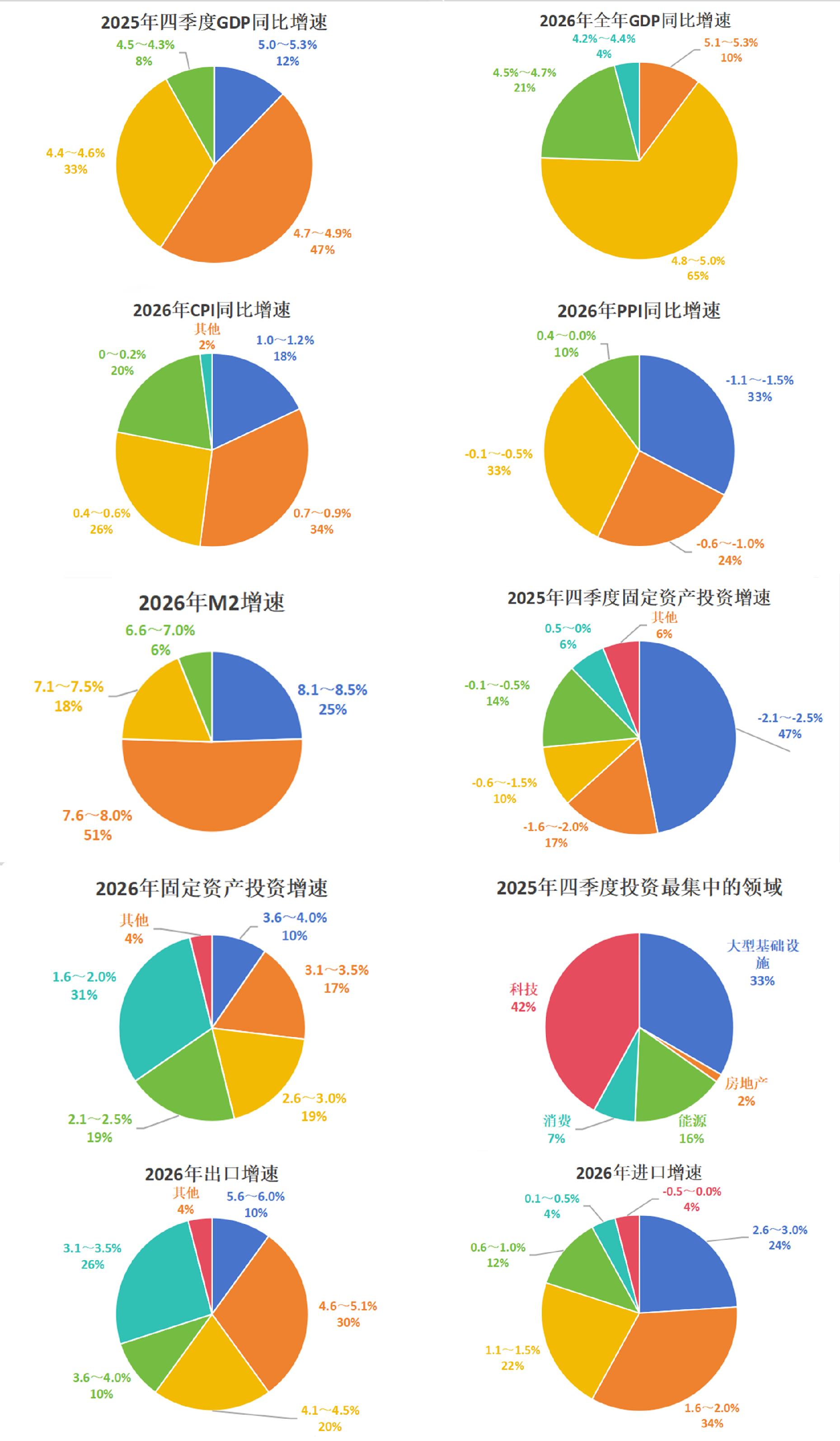
2025年四季度经济学人问卷调查:扩内需、反内卷,激活市场活力成为关键路径
Jing Ji Guan Cha Wang· 2026-01-17 14:19
Economic Outlook - China's economy is currently facing a critical period of adjustment, with old problems and new challenges intertwining, necessitating more proactive fiscal policies and moderately loose monetary policies to stimulate domestic demand and promote stable economic growth [1][7][8] - 47% of economists believe that GDP growth in Q4 2025 will be between 4.7% and 4.9%, while 65% expect 2026 growth to be in the range of 4.8% to 5.0% [1][7] Real Estate Market - The real estate market shows signs of stabilization but remains in a deep adjustment phase, with 79% of economists believing that the decline in the real estate market will slow down in 2026, although it has not yet bottomed out [1][16] - 53% of economists predict that housing prices in first- and second-tier cities will drop by 5% to 15% in 2026, while 58% expect a similar decline in third- and fourth-tier cities [16] Investment Trends - Investment remains a key support for economic recovery, with 31% of economists forecasting fixed asset investment growth of 1.6% to 2.0% in 2026, and 42% of investment is expected to focus on technology [15][29] - The report indicates that the real estate market is approaching a critical point of stabilization, with policies aimed at maintaining expectations and improving the quality of housing supply [15][18] Debt and Financial Risks - Local government debt remains a significant concern, with risks stemming from reduced land revenue due to the ongoing downturn in the real estate market [8][9] - 59% of economists anticipate a substantial increase in the government debt-to-GDP ratio globally in 2026, highlighting the need for careful management of local government debt [1][24] Consumer Demand and Employment - There is a pressing need to stimulate consumer demand, with 36% of economists suggesting increasing residents' income as a priority, followed by improving the social security system [30][31] - The unemployment rate among urban youth is rising, with significant pressure on job opportunities for recent graduates in 2026 [31] Global Economic Factors - Geopolitical tensions are viewed as the largest potential disruptor to the global economy in 2026, with 48% of economists identifying this as a key concern [33] - The combination of fiscal expansion to boost demand and monetary policy aimed at reducing costs is expected to dominate macroeconomic policy discussions in 2026 [33][34]
2026年宏观经济展望:“修复式”增长与“再平衡”
Sou Hu Cai Jing· 2025-12-11 07:36
Global Economic Outlook - The year 2026 is projected to be a transition year from "high volatility" to "weak stability" in the global macro landscape, with a growth target anchored around 5%, but actual growth may moderate to 4.5%-4.7% [1] - Inflation is expected to rise from the bottom but remain in the 0%-1% range, indicating a mild increase [1] - The policy focus is shifting from "supply-side challenges" to "demand-side rebalancing" [1] - The negative impact of real estate on GDP is expected to decrease from -1.5 to -2 percentage points in 2025 to -0.5 to -1 percentage points in 2026, reflecting a consensus expectation of diminishing macroeconomic headwinds [1] External Influences on Domestic Demand - Three external factors are identified as key determinants of China's real estate and domestic demand: 1. A decline in high U.S. dollar interest rates, with the Federal Reserve potentially lowering rates four times to 2.75%-3% by the end of 2026, reducing depreciation pressure on the RMB [2] 2. Marginal expansion of Chinese fiscal policy, with 1.5 trillion yuan in special bond quotas for 2026, including 300 billion yuan for purchasing existing homes for affordable housing [2] 3. Deepening negative population growth, with China's total population entering a negative growth phase of -1.5‰ annually, leading to a continued decline in "just demand" and extended "L-shaped" tail in real estate sales [2] Economic Growth Dynamics - The contribution of net exports to GDP, which was a significant growth driver in 2025, is expected to decline in 2026, with export growth projected to fall from 4%-5% to around 3% [4] - The focus will shift back to "internal demand rebalancing" as the primary growth driver [4] Consumption and Investment Projections - Consumption is expected to grow at a rate of 4.7%-4.8% in 2026, driven by policies such as a 300 billion yuan trade-in program and new initiatives for childcare subsidies and free preschool education [5] - Investment in infrastructure is projected to increase, with growth rates for infrastructure investment expected to rise from 3.5% in 2025 to 5%-6% in 2026, while manufacturing investment is anticipated to recover slightly to around 5% [6] - The decline in real estate development investment is expected to narrow from -10% in 2025 to around -5% in 2026, improving its negative impact on GDP [6] Inflation and Monetary Policy - A mild re-inflation is anticipated, with CPI expected to rise to a range of 0.4%-0.6% due to factors such as the pig cycle and structural supply constraints [7] - The PPI decline is expected to narrow from -2% in 2025 to around -1% in 2026, with nominal GDP growth projected to increase from 4% to 4.5%-4.8% [7] Policy Adjustments - The policy framework is shifting towards "explicit fiscal expansion" and "implicit monetary easing," with a sustained deficit rate of 4% and an increase in special government bond quotas [9] - Structural credit easing is emphasized, with targeted support for key sectors such as technology and urban renewal, while maintaining low interest rates [9] Structural Opportunities Amidst Economic Adjustment - The focus for 2026 is on "repair-type growth," characterized by moderate overall growth but ongoing structural benefits, with traditional sectors like real estate losing momentum while new sectors like technology and services gain traction [10] - The macroeconomic risks are expected to decrease, while structural opportunities are anticipated to increase, suggesting a period of relative stability and potential for investment [10]
2026年度展望:修复式增长下的再平衡与新动力|宏观经济
清华金融评论· 2025-11-25 10:42
Core Viewpoint - The article emphasizes the theme of "革故鼎新" (reform and innovation) for 2026, highlighting significant changes in economic growth, industry transitions, and macroeconomic policies compared to 2025 [5][7]. Economic Growth - The nominal GDP growth is expected to increase from 4% in 2025 to 5% in 2026, driven by a recovery in inflation [9][82]. - The economic growth model is characterized as "修复式增长" (restorative growth), indicating a gradual recovery rather than a typical economic rebound [13][19]. Industry Changes - Traditional industries are declining while new industries are emerging, with AI becoming a key driver of economic growth [10][35]. - The real estate sector is still undergoing adjustments, with a significant drop in investment by 14.7% year-on-year from January to October 2025 [28]. Internal and External Economic Rebalancing - The article stresses the importance of expanding domestic demand as a strategic foundation for economic development, moving away from reliance on external demand [10][40]. - Consumer spending is projected to recover in 2026, supported by policies aimed at increasing household income and consumption [11][45]. Policy Adjustments - Macroeconomic policies will focus on balancing short-term and long-term goals, maintaining a supportive stance in both fiscal and monetary policies [11][76]. - The fiscal policy is expected to remain proactive, with a budget deficit rate maintained at around 4% [74]. Investment Trends - Investment growth is anticipated to rebound in 2026, with manufacturing and infrastructure investments expected to increase by 5% [73]. - The real estate investment is projected to decline by 10%, but its decreasing share in total investment may lessen its overall impact [73]. Inflation and Currency Outlook - Inflation is expected to rise, with CPI projected to grow by approximately 0.4% in 2026, compared to zero growth in 2025 [80][82]. - The RMB exchange rate is likely to continue appreciating, potentially reaching 6.9 CNY/USD by the end of 2026 [83].

2026年年度展望丨革故鼎新:修复式增长下的再平衡与新动力
2025-11-25 01:19
Summary of Key Points from the Conference Call Industry and Economic Outlook - **Industry Focus**: The report emphasizes the shift towards emerging industries, particularly AI and AR technologies, while traditional sectors like real estate are expected to decline in importance [1][2][6][24]. - **Economic Growth**: China's nominal GDP growth is projected to recover from 4% in 2025 to around 5% in 2026, driven by improvements in PPI and consumer spending [1][2][24]. - **Macroeconomic Policy**: The Chinese government is expected to focus more on demand-side policies to stimulate consumer spending and address weak corporate loan demand, with a fiscal deficit rate projected to remain around 4% [1][24][25]. Key Economic Indicators - **GDP Growth Target**: The GDP growth target for 2026 is set at approximately 5%, with expectations of continued positive export growth and a potential easing of US-China trade tensions [1][2][13][14]. - **Investment Trends**: Fixed asset investment growth has seen a significant decline, with a projected 10% drop in real estate investment, while manufacturing investment may improve due to better corporate profits [16][24]. Market Strategy and Performance - **Equity Market Strategy**: The strategy for 2026 should shift from a focus on extreme growth stocks to a more balanced approach, reflecting changes in the economic environment and expectations for the Shanghai Composite Index [7][19][24]. - **Investor Focus**: Investors are advised to concentrate on emerging industries that are likely to receive more policy support, as traditional sectors lose their financial attributes [6][24]. Currency and Trade Dynamics - **RMB Exchange Rate**: The RMB is expected to continue appreciating, supported by strong export growth and increased willingness of foreign trade enterprises to convert foreign exchange [3][18][22][25]. - **Impact of US-China Relations**: The easing of trade tensions is anticipated to positively influence China's export competitiveness, despite ongoing uncertainties in US domestic politics [14][24]. Additional Insights - **Inflation and Monetary Policy**: The report indicates that inflation pressures remain low, with a need for continued supportive fiscal and monetary policies to sustain economic recovery [4][8][17][24]. - **Sectoral Performance**: Emerging sectors like wind power, components, batteries, and medical services are showing signs of improvement, while traditional sectors are still in a recovery phase [9][10][24]. Conclusion - The overall outlook for China's economy in 2026 is cautiously optimistic, with a focus on emerging industries and a balanced approach to market strategies. Continuous monitoring of macroeconomic indicators and policy changes will be essential for investors to navigate the evolving landscape [24][25].

2026年宏观经济、政策与大类资产配置展望:革故鼎新:修复式增长下的再平衡与新动力
Western Securities· 2025-11-21 13:17
Economic Outlook - The nominal GDP growth rate is expected to rise to around 5% in 2026, up from approximately 4% in 2025, indicating a significant recovery in economic performance[14] - Inflation is anticipated to rebound, with CPI growth turning positive and PPI declines narrowing significantly[3] - The government budget deficit rate is projected to remain at around 4%, with new government bond financing potentially increasing to approximately 12.8 trillion yuan[3] Structural Changes - The Chinese economy is undergoing a profound transformation characterized by the decline of "old forces" such as real estate, which is in an "L-shaped" bottoming phase, while "new forces" like AI and new productivity are emerging as key growth drivers[2] - The shift from external demand reliance to internal demand dominance is expected, with policies aimed at expanding domestic consumption and countering "involution" trends[2][15] Market Dynamics - The A-share market is likely to see opportunities as the focus shifts from liquidity-driven growth to price and earnings-driven growth, with a more balanced market style anticipated in 2026[4] - The U.S. dollar is expected to remain strong, influenced by the relative economic strength of the U.S., despite potential interest rate cuts by the Federal Reserve[4] Risks and Challenges - There are risks of economic downturns exceeding expectations, insufficient policy execution, and geopolitical uncertainties affecting market sentiment[7] - The ongoing challenges in the real estate sector and local government debt pressures may limit fiscal stimulus effectiveness[20][24]
政治局会议前瞻:如何应对?
2025-04-24 01:55
Summary of Conference Call Records Industry Overview - The records discuss the impact of the Trump administration's tariff increases on the Chinese economy and the subsequent policy responses from the Chinese government. The focus is on the economic challenges faced by China, including the effects of tariffs, the state of the real estate market, and the overall economic recovery trajectory. Key Points and Arguments Economic Impact of Tariffs - The new round of tariffs implemented on April 1, 2025, exceeded market expectations, prompting the Chinese government to consider additional fiscal measures such as special bonds and stimulus policies for consumption, infrastructure investment, and real estate [1][2][21] - China's GDP growth for Q1 2025 was reported at 5.4%, with a rebound in domestic demand and a 6.9% increase in exports, although there are concerns about potential downward pressure on exports in Q2 [1][11] - The fiscal budget deficit rate has been increased to prepare for declining external demand, with broader government financing also rising by 1.5 percentage points [1][12] Macroeconomic Policy Responses - The Chinese government is expected to adopt a cautious approach to macroeconomic policy, implementing measures gradually rather than launching a comprehensive stimulus package due to uncertainties regarding the impact of tariffs on trade and the economy [2][4][21] - Monetary policy may become more flexible, with potential interest rate cuts depending on actual economic data, particularly if export performance declines significantly [1][13][14] Long-term Economic Outlook - The Chinese economy is currently in a phase of "restorative growth," which is characterized by slower recovery rather than a rapid rebound. This is attributed to the damage to balance sheets across households, businesses, and local governments due to the pandemic and real estate market adjustments [3][5][8][22] - The expectation is that the economic recovery will take time, and there should be no over-optimism regarding a quick return to traditional growth rates [5][22][23] Real Estate Market Dynamics - The real estate market in Shaanxi province is highlighted as experiencing a delayed adjustment, with prices peaking in June 2024 before beginning to decline. This indicates that the impact of real estate market corrections is still unfolding in central and western regions of China [6] U.S.-China Economic Competition - The intensifying economic competition between the U.S. and China, particularly since Trump's first term, has created significant uncertainty for China's export-oriented sectors, complicating investment decisions [7][8] Gold Market Insights - Recent increases in gold prices are attributed to a weaker dollar and adjustments in market confidence towards the dollar. However, potential short-term risks for gold prices include geopolitical risk premium adjustments and profit-taking [15][19][20] Other Important Considerations - The records emphasize the limited effectiveness of macroeconomic policies in the short term, suggesting that while policies can stabilize the economy, they are unlikely to lead to a traditional recovery [10][23] - The records also note that the U.S. Federal Reserve's actions are influenced by various factors, including retail sales data and unemployment trends, which may affect global economic conditions and, consequently, China's economic outlook [16][17]
西部证券:晨会纪要-20240813
西部证券· 2024-08-13 01:20AI Processing
Financial Data and Key Indicators Changes - The company achieved a revenue of 8.419 billion yuan in H1 2024, representing a year-on-year increase of 5%, and a net profit attributable to shareholders of 738 million yuan, up 7% year-on-year [17][18] - For the second quarter of 2024, the company reported a revenue of 5.084 billion yuan, with a year-on-year increase of 40% and a quarter-on-quarter increase of 52% [17][18] Business Line Data and Key Indicators Changes - The overall sales volume of compound fertilizers increased by 12.38% year-on-year in H1 2024, with ordinary compound fertilizers up 10.16% and new-type compound fertilizers up 19.45% [18] - The gross margin for H1 2024 was 16.06%, an increase of 1.17 percentage points year-on-year, while the net margin was 8.79%, up 0.14 percentage points year-on-year [18] Market Data and Key Indicators Changes - The company’s new-type fertilizer sales revenue reached 2.247 billion yuan, a year-on-year increase of 10.94%, accounting for 30.43% of the overall sales volume and 35.41% of the sales revenue of compound fertilizers [18] - The company has established a competitive advantage through an integrated industrial chain, with various production capacities including 9.83 million tons/year of high-concentration phosphate fertilizers [19] Company Strategy and Development Direction and Industry Competition - The company is focusing on enhancing its integrated industrial chain advantages and expanding upstream phosphate mine layouts to strengthen its market position [19] - The company aims to achieve net profit growth targets of 30%, 65%, and 100% for the years 2024, 2025, and 2026 respectively, indicating a strong commitment to growth [15] Management's Comments on Operating Environment and Future Outlook - The management expressed confidence in the recovery of the compound fertilizer industry and the company's ability to restore volume and profit margins [17][19] - The management highlighted the importance of adapting to changes in the real estate market and consumer behavior as key factors influencing future performance [8][19] Other Important Information - The company has implemented a stock incentive plan, with performance targets set to double over three years, indicating a strong commitment to aligning management interests with shareholder value [14][15] - The company plans to repurchase 4-8 million shares for the incentive plan, which represents 0.37%-0.75% of the total share capital [14] Q&A Session All Questions and Answers Question: What are the expected profit targets for the next three years? - The company expects to achieve net profits of 1.25 billion yuan, 1.5 billion yuan, and 1.67 billion yuan for the years 2024, 2025, and 2026 respectively, reflecting a strong growth trajectory [15] Question: How does the company plan to enhance its competitive advantage? - The company plans to enhance its competitive advantage through integrated production capabilities and expanding its phosphate mining operations, which will support its fertilizer production [19]