
政策组合拳

Search documents
乐享消费!节日支付数据看热气腾腾中国年
Xin Hua She· 2026-02-24 22:44
Core Insights - The Chinese consumption market showed strong growth during the 2026 Spring Festival, with payment transactions reaching 39.302 billion and total amounts of 13.12 trillion yuan, marking increases of 37.45% and 19.26% respectively compared to the previous year [1] Group 1: Consumption Trends - Hainan's duty-free shopping reached 2.72 billion yuan, a 30.8% increase year-on-year [1] - WeChat Pay and Alipay saw significant growth in offline transaction volumes, with both categories exceeding 20% year-on-year growth [1] - The number of users for Alipay's "AI Pay" surpassed 100 million, and spending by inbound tourists using Alipay increased by over 80% compared to last year [1] Group 2: Policy Support - Multiple government departments implemented a "combination punch" of policies to boost consumption during the Spring Festival, including the "2026 'Happy Shopping Spring Festival' Special Activity Plan" [2] - The Ministry of Finance optimized interest subsidy policies for personal consumption loans and service industry loans, enhancing support for consumer spending [2] Group 3: Payment Environment Optimization - Various digital payment incentives were launched, such as 21,700 "100 yuan off 50 yuan" digital RMB red packets in Nanjing, which were quickly claimed [3] - Over 200 million yuan in consumption vouchers were distributed via the Cloud Flash Payment App in Heilongjiang, stimulating holiday spending [3] - Financial institutions introduced "Spring Festival consumption packages" to lower consumer costs, with initiatives from major banks like ICBC and Agricultural Bank of China [3] Group 4: Internet Platforms and Technology - Qianwen App announced a 3 billion yuan "Spring Festival Treat Plan," while Yuanbao App offered 1 billion yuan in cash red packets, leveraging AI to enhance consumer engagement [4] - During the peak of red packet distribution, online payment transactions reached a record high of 144,700 per second, a 7.18% increase year-on-year [4] - The number of payment transactions and amounts from foreign tourists increased by 78.10% and 44.33% respectively compared to the previous Spring Festival [4]
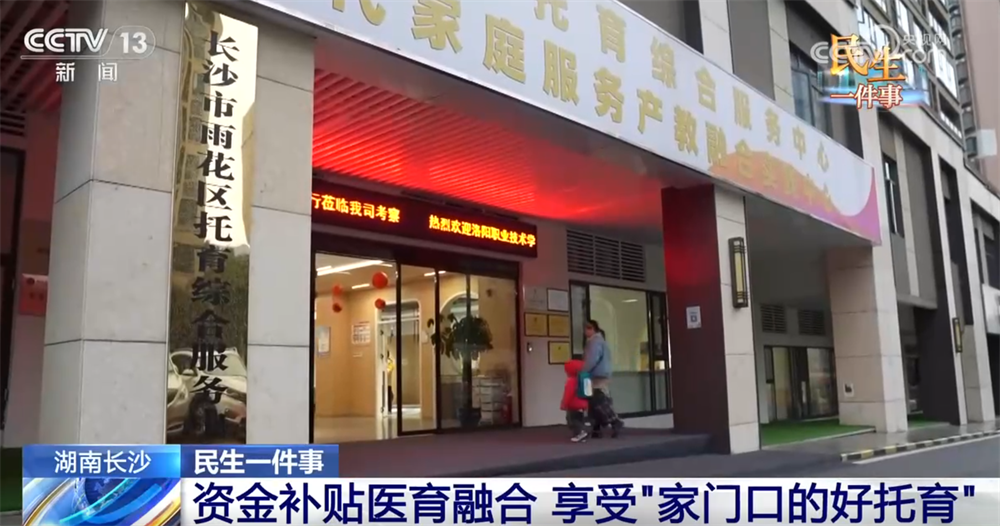
“政策组合拳”精准发力 有效破解“托育难”“入托贵”难题
Yang Shi Wang· 2026-02-10 22:34
Group 1 - The core issue of "difficult and expensive childcare" is a key topic in building a family-friendly society as the national fertility policy system improves [1] - In Changsha, Hunan, a comprehensive policy approach including planning, financial subsidies, and integration of medical and educational services has effectively reduced the burden of child-rearing on families [1] Group 2 - The Changsha Yuhua District Childcare Comprehensive Service Center has maintained a utilization rate of over 80% since its operation, serving as the first public-private childcare center at the county level in Hunan Province [2] - The center has established over 6,000 childcare spots, achieving a ratio of 4.65 spots per 1,000 people, and has fully integrated medical and educational services [2] - In Gaoqing County, Shandong, an integrated childcare and education service model has been developed since 2025, focusing on quality early education for children [3][5] - Gaoqing County has opened 19 public kindergartens offering classes for children aged 2-3, enrolling over 200 children in the first semester [6]
民生一件事|“政策组合拳”精准发力 有效破解“托育难”“入托贵”难题
Yang Shi Wang· 2026-02-05 06:05
Group 1 - The core issue of "difficult and expensive childcare" is a key topic in building a family-friendly society as the national fertility policy system improves [1] - In Changsha, Hunan, a comprehensive policy approach including planning, financial subsidies, and integration of medical and educational services has effectively reduced the burden of child-rearing for families [1] - The Rainhua District Childcare Comprehensive Service Center has maintained a utilization rate of over 80% since its operation, indicating strong demand for childcare services [4] Group 2 - The center has established over 6,000 childcare spots, achieving a ratio of 4.65 spots per 1,000 people, and has fully integrated medical and educational services [6] - In Gaoqing County, Shandong, an integrated childcare and education service system has been developed since 2025, addressing the challenges of "difficult and expensive childcare" [7] - Gaoqing County has opened 19 public kindergartens offering toddler classes, enrolling over 200 children in the first semester, with plans to enhance service quality through curriculum development and teacher training [11]

政策组合拳精准发力 房地产市场复苏动能集聚
Zheng Quan Ri Bao· 2026-02-02 00:01
Group 1 - The issuance of 8 commercial real estate REITs with a total valuation of 32.1 billion yuan and expected fundraising of 31.5 billion yuan indicates a significant improvement in market issuance and approval efficiency since the official launch of commercial real estate REITs [1] - The real estate market is experiencing a recovery driven by continuous policy support and improved supply-demand dynamics, with first-time home loan rates at historical lows and tax rebates for home purchases helping to reduce costs for buyers [1][2] - The market is transitioning towards high-quality development, with experts noting that the industry is in a critical recovery phase following deep adjustments, supported by ongoing policy benefits and accelerated market clearing [1][2] Group 2 - The average price of second-hand residential properties in 100 cities was 12,905 yuan per square meter in January, showing a month-on-month decline of 0.85%, while new residential properties saw a slight increase in average price to 17,114 yuan per square meter, up 0.18% month-on-month [2] - Policies aimed at stimulating demand include tax reductions and increased loan limits for specific groups, which are expected to activate the second-hand housing market and improve housing demand [2][3] - The supply side is also being addressed through local state-owned enterprises purchasing existing properties for affordable housing, which helps to clear inventory and enhance the housing supply system [3] Group 3 - The financial resources are increasingly directed towards quality real estate companies and projects, with a shift from large-scale expansion to improving existing stock, which is essential for the long-term healthy development of the industry [3][4] - The trend of optimizing debt structures and alleviating repayment pressures for real estate companies is evident, supported by policies that enhance financing channels and reduce costs [4][5] - The construction of quality housing has become a consensus in the industry, with improved regulatory measures reducing delivery risks and rebuilding trust within the sector [4][5]
推动物价合理回升
Sou Hu Cai Jing· 2026-01-29 23:16
Group 1 - The core viewpoint is that the reasonable recovery of prices signals the revitalization of the economy, with the Consumer Price Index (CPI) rising for four consecutive months, reaching a year-on-year increase of 0.8% in December 2025, the highest in nearly 34 months [1] - The core CPI has maintained a year-on-year growth of 1.2% for three consecutive months, marking a high point not seen in nearly 50 months [1] - The Producer Price Index (PPI) decreased by 1.9% year-on-year in December 2025, with the decline narrowing by 1.7 percentage points from the year's low, while showing a month-on-month increase for three consecutive months [1] Group 2 - The current low price level reflects the supply-demand relationship, but positive factors driving the improvement of this relationship are accumulating, supported by policies to expand domestic demand and promote consumption [1] - The growth in consumption in sectors such as culture, tourism, sports, and mid-to-high-end retail is driving the recovery of related goods and service prices [1] - The rapid development of new consumption formats, such as interest-based consumption and live e-commerce, is creating new consumption scenarios and improving the alignment of supply and demand through reverse customization [1] Group 3 - The Central Economic Work Conference emphasizes the importance of promoting stable economic growth and reasonable price recovery as key considerations for monetary policy in 2026 [3] - A combination of policies is needed to promote reasonable price recovery, including maintaining macro policy continuity and stability, implementing more proactive fiscal policies, and moderately easing monetary policies [3] - Structural policies should focus on "expanding demand and optimizing supply," with actions to boost consumption and increase residents' income [3] Group 4 - Overall, the development trend of China's economy is steadily improving, with the advantages of a super-large market being gradually released and the precision and effectiveness of policy regulation continuing to enhance [4]
以健康为中心 构建新时代全民健康管理体系
Xin Lang Cai Jing· 2026-01-28 23:06
Core Viewpoint - The representative from the Fujian Provincial Committee of the Chinese Peasants and Workers Democratic Party emphasizes the need for improvement in public health management in line with the "Healthy China 2030" planning outline, suggesting a multi-faceted approach to enhance health services and management systems [2] Group 1: Policy Recommendations - The proposal includes a comprehensive policy approach to strengthen public health investments and improve health impact assessment systems, aiming to establish a health management evaluation index covering the entire life cycle [2] - It suggests creating a four-tiered health service system linking provincial hospitals, municipal hospitals, county medical communities, and grassroots service points to enhance the quality of chronic disease health services [2] - The establishment of a unified health information sharing platform is recommended to facilitate data security and sharing across departments and regions, thereby enhancing precision in health services [2] Group 2: Talent Development - The need for strengthening public health education and expanding the training of general practitioners is highlighted, along with improving the assessment mechanisms for medical personnel [2] - The proposal includes enhancing the salary and benefits for grassroots health management personnel to address challenges in attracting and retaining talent in the sector [2]
新华读报|2026如何提振消费?政策“组合拳”来了!
Sou Hu Cai Jing· 2026-01-27 17:09
Core Viewpoint - The article emphasizes the introduction of a series of policy measures aimed at boosting consumption in 2026, with a focus on enhancing benefits for the public [1] Group 1: Policy Measures - The government plans to optimize and implement a trade-in program for consumer goods [1] - A pilot program for automotive circulation consumption reform will be initiated [1] - A prize invoice trial will be launched to encourage consumer spending [1] - Policies to promote the initial economic launch will be introduced as part of the comprehensive approach [1]
经济日报:以政策组合拳促物价合理回升
Jin Rong Jie· 2026-01-23 23:57
Core Viewpoint - The article emphasizes the importance of maintaining the supply and price stability of essential livelihood goods while addressing structural obstacles to corporate investment and consumer spending [1] Group 1 - Continuous efforts are needed to regulate the entire supply chain of essential livelihood goods, ensuring a solid foundation for people's livelihoods [1] - There is a need for a scientific understanding of the term "reasonable" to effectively manage the intensity and pace of policies [1] - The ultimate goal is to achieve "stable economic growth and reasonable price recovery" [1]
2026年开年核心城市二手房 “量价齐升”,市场热度超预期
Xin Lang Cai Jing· 2026-01-22 06:51
Core Insights - The real estate market in core cities has shown unexpected warmth at the beginning of 2026, with a significant increase in both transaction volume and prices, marking a strong recovery trend [1][9] - The recovery is driven by a series of favorable policies that have lowered transaction costs and improved market expectations, leading to increased buyer and seller activity [3][9] Policy Impact - A combination of tax reductions and credit optimizations has been implemented, effectively lowering transaction barriers and stimulating market activity [3] - The new VAT policy, effective from January 1, reduces the tax rate from 5% to 3% for personal sales of homes held for less than two years, saving nearly 100,000 yuan in transaction costs for a property priced at 5 million yuan [3] - The central bank's interest rate cuts and the extension of tax refund policies for home purchases have further supported the market, with first-time home loan rates dropping below 3% [3][6] Market Performance - Core cities like Shanghai and Shenzhen have experienced remarkable performance, with Shanghai seeing daily transactions exceeding 1,000 units and a total of over 13,000 units sold by mid-January [4][6] - New first-tier cities such as Nanjing and Hangzhou have also reported significant increases in transactions, with Nanjing achieving a single-day high of 340 units sold [6][7] Market Dynamics - The active second-hand housing market has facilitated a "sell old to buy new" chain, linking the second-hand and new housing markets and driving demand for new homes [6][7] - The price stabilization in the second-hand market has provided a reasonable benchmark for new home pricing, preventing previous discrepancies between new and second-hand home prices [7] Future Outlook - The sustainability of the current market recovery will depend on the effectiveness of policy implementation, economic recovery pace, and demand release dynamics [8] - While core cities are experiencing a recovery, lower-tier cities continue to struggle with high inventory levels, indicating a growing disparity in market performance [8][9] - The current recovery signals a shift from a "broad increase" era to a "quality competition" era in the real estate market, emphasizing the importance of location and property quality [8][9]
发改委:将强化市场优胜劣汰机制,理顺价格关系
Zheng Quan Shi Bao Wang· 2026-01-20 02:43
Core Viewpoint - The Chinese government aims to promote a reasonable recovery of prices as a key objective of macroeconomic regulation, with a focus on implementing policies that support economic growth and price recovery [1] Group 1: Economic Policy Measures - The National Development and Reform Commission emphasizes the need for a more proactive fiscal policy and moderately loose monetary policy to facilitate price recovery [1] - Structural adjustments will be made to address "involution" competition and establish a unified national market construction regulation [1] - The government plans to enhance the market mechanism for survival of the fittest, ensuring efficient resource allocation and stable supply [1] Group 2: Future Directions - The government will focus on dual supply and demand efforts to create a positive interaction between economic growth and price recovery [1] - There will be a concerted effort to streamline the exit of inefficient production capacities and improve price relationships [1]