
中美贸易摩擦

Search documents
黄金4400美元关口前夜 活得久远比跑得快重要
Jing Ji Guan Cha Bao· 2025-10-17 07:40
Core Viewpoint - The COMEX gold price reached a historic peak of $4,392 per ounce on October 17, with the market awaiting a decisive breakthrough of the $4,400 mark. The gold price has increased over 60% year-to-date, entering an unprecedented range, leading to a split consensus in the market regarding its future trajectory [1][2]. Group 1: Market Dynamics - The recent surge in gold prices is attributed to both short-term risks and long-term structural factors. On October 16, gold prices first broke the $4,300 barrier, quickly rising to $4,392 the next day [2]. - Concerns over the stability of the U.S. financial system, particularly following loan fraud issues at regional banks like Zions Bancorp and Western Alliance Bancorp, have heightened market fears and increased demand for safe-haven assets like gold [3]. - The ongoing uncertainty in the external environment, including the prolonged U.S. government shutdown and unresolved U.S.-China trade tensions, has maintained high levels of market risk aversion, providing strong support for gold prices [3]. Group 2: Long-term vs Short-term Perspectives - Proponents of gold as a "strategic allocation opportunity" argue that long-term core drivers include the normalization of geopolitical uncertainties, the long-term downtrend of real interest rates due to high debt pressures in developed countries, and the ongoing diversification of reserve assets towards "non-sovereign anchors" like gold [4]. - Conversely, those warning of "buying high risks" highlight the extreme market crowding and the concentration of long positions, which could lead to a rapid and deep correction if market sentiment shifts [4]. Group 3: Investment Strategies - Investors are advised to clearly define their investment goals. For those seeking long-term asset preservation and risk hedging, gold can be a valuable strategic allocation, but it is recommended to avoid heavy positions at current highs and instead adopt a gradual investment approach [5]. - For short-term traders, entering at current price levels is considered high-risk, and strict stop-loss discipline and position control are essential for survival in the market [5]. - Key variables driving the market, such as the resolution of the U.S. government shutdown and the evolution of regional banking risks, remain highly uncertain and could catalyze gold price movements [5].

今夜,暴涨!太疯狂了!
中国基金报· 2025-10-16 16:19
Group 1 - The core viewpoint of the article highlights the significant rise in gold prices, reaching a new high of $4,275 per ounce, driven by various factors including potential interest rate cuts by the Federal Reserve and increased safe-haven demand due to geopolitical tensions [3][5]. - Analysts attribute the surge in gold prices to the Federal Reserve Chairman Jerome Powell's indication of a possible 25 basis point rate cut, leading to lower U.S. Treasury yields, which typically benefits non-yielding precious metals like gold [5]. - The article notes that rising geopolitical tensions, particularly between the U.S. and China, have heightened risk aversion among investors, further boosting gold's appeal as a safe-haven asset [5]. Group 2 - The article discusses the volatility in the U.S. stock market, with concerns about over-reliance on AI-driven trading to propel market gains, indicating potential underlying weaknesses [7]. - The Cboe Volatility Index (VIX), known as Wall Street's "fear gauge," has shown increased volatility, reflecting market uncertainty amid ongoing U.S.-China trade tensions and a government shutdown [7]. - Analysts suggest that the current stock market may enter a more volatile phase, with a focus on large-cap and high-quality companies as key investment considerations, despite the absence of recession signals [8].

Stock market today: Dow, S&P 500, Nasdaq waver amid TSMC's stellar earnings, trade-war jitters
Yahoo Finance· 2025-10-16 13:34
Group 1: Market Overview - US stocks experienced a decline in early gains as investors assessed AI demand signals and ongoing US-China trade tensions [1] - The Nasdaq Composite rose by 0.2%, driven by AI-related stocks like Nvidia, while the S&P 500 and Dow Jones remained relatively flat [1] - Market volatility persisted despite strong quarterly results from Wall Street banks and indications that the Federal Reserve may cut interest rates again this year [3] Group 2: Chip Industry Insights - Chip stocks saw an uptick after TSMC raised its 2025 revenue growth outlook for the second time this year, indicating strong AI demand [2] - TSMC reported a nearly 40% increase in quarterly profit, surpassing estimates and achieving record results, positively impacting Nvidia, Broadcom, Micron, and other AI-related stocks [2] Group 3: US-China Trade Relations - US-China trade tensions were highlighted as President Trump confirmed that the situation remains strained, suggesting a prolonged trade war [4] - Conflicting messages emerged from the administration regarding trade restrictions and potential tariffs, with Trump threatening additional 100% tariffs in November [5] - The ongoing US government shutdown, now in its third week, is expected to continue into November, affecting economic data availability for the Fed and Wall Street [5]
香港第一金:站在黄金十字路口,该如何布局?
Sou Hu Cai Jing· 2025-10-16 08:49
Group 1 - Gold prices have shown exceptional performance in 2025, with a cumulative increase of over 50% year-to-date, reaching new highs recently. This strong upward trend is driven by a combination of short-term risk aversion, medium-term monetary policy expectations, and deeper structural changes in the global monetary system [1] - The immediate factor driving gold prices is the expectation of interest rate cuts by the Federal Reserve, with markets anticipating a continuation of these cuts in Q4 2025. Additionally, ongoing geopolitical tensions, such as US-China trade disputes and the US government shutdown crisis, have heightened market risk aversion, leading to increased investment in gold [1] - A significant medium-term support for gold prices comes from the ongoing large-scale gold purchases by global central banks. As of September 2025, China's official gold reserves have increased for 11 consecutive months, and a survey by the World Gold Council indicates that 43% of central banks plan to continue increasing their gold holdings in the next 12 months [1] - The fundamental long-term driver of the current surge in gold prices is rooted in deep concerns about the credibility of the US dollar and structural changes occurring in the global monetary system. The share of the dollar as the primary reserve currency has fallen to around 55%, the lowest in nearly 15 years, reflecting a decline in global investors' trust in the dollar-centric monetary system [1] Group 2 - The overall trend for gold prices remains bullish, but caution is advised when operating at historical highs [2] - The primary strategy suggested is to focus on buying after price corrections, with key support levels identified around $4210-$4215. A stronger support level is noted at $4180-$4170, where a stabilization signal would present an ideal buying opportunity [3] - If gold prices can effectively break and hold above the $4245-$4250 range, there is potential for further upward movement towards $4260-$4265 and even the $4300 mark [3] - Risk management is crucial, with stop-loss recommendations set below $4200 for positions entered around $4210-$4215. If prices rise to the $4250-$4260 range and face resistance, a light short position may be considered, with a stop-loss above $4265 and a target around $4220-$4210 [3]
集运日报:中国制裁韩造船商中美贸易摩擦阴晴不定,盘面或保持震荡,不建议继续加仓,设置好止损-20251016
Xin Shi Ji Qi Huo· 2025-10-16 08:10
Report Summary Investment Rating No investment rating for the industry is provided in the report. Core Viewpoints - Amid China's sanctions on South Korean shipbuilders and the uncertain Sino - US trade friction, the market may remain volatile. The core issue is the direction of spot freight rates, and the main contract may be in the bottom - building process. It's recommended to participate with a light position or just observe [2][6]. - Although the SCFI index has rebounded, the overall atmosphere is still bearish, and the market is under downward pressure. Attention should be paid to tariff policies, the Middle East situation, and spot freight rates [6]. Summary by Related Content Freight Indexes - On October 13, the Shanghai Export Container Settlement Freight Index (SCFIS) for the European route was 1031.8 points, down 1.4% from the previous period; the SCFIS for the US - West route was 862.48 points, down 1.6% from the previous period. On October 10, the Ningbo Export Container Freight Index (NCFI) for the comprehensive index was 818.97 points, up 11.50% from the previous period; the NCFI for the European route was 698.67 points, up 11.39% from the previous period; the NCFI for the US - West route was 844.43 points, down 0.34% from the previous period [4]. - On October 10, the Shanghai Export Container Freight Index (SCFI) was 1160.42 points, up 45.90 points from the previous period; the SCFI price for the European route was 1068 USD/TEU, up 9.9% from the previous period; the SCFI price for the US - West route was 1468 USD/FEU, up 10.76% from the previous period. The China Export Container Freight Index (CCFI) for the comprehensive index was 1014.78 points, down 6.7% from the previous period; the CCFI for the European route was 1287.15 points, down 8.2% from the previous period; the CCFI for the US - West route was 777.77 points, down 5.7% from the previous period [4]. Economic Data - The eurozone's September manufacturing PMI preliminary value was 49.5, back below the boom - bust line, lower than analysts' expectations and the previous value of 50.7. The service industry PMI preliminary value rose from 50.5 to 51.4, exceeding expectations of 50.5. The eurozone's September composite PMI preliminary value was 51.2, exceeding analysts' expectations. The eurozone's September Sentix investor confidence index was - 9.2, with an expected value of - 2 and a previous value of - 3.7 [4]. - In August, China's manufacturing PMI was 49.4%, up 0.1 percentage point from the previous month, and the manufacturing prosperity level improved. The comprehensive PMI output index was 50.5%, up 0.3 percentage point from the previous month, remaining above the critical point, indicating that the overall expansion of Chinese enterprises' production and business activities accelerated [5]. - The preliminary value of the US September S&P Global manufacturing PMI was 52 (the final value in August was 53); the preliminary value of the service industry PMI was 53.9 (the final value in August was 54.5); the preliminary value of the composite PMI was 53.6 (the final value in August was 54.6) [5]. Market Conditions - The Sino - US tariff issue has shown a marginal effect. As of October 10, the main contract 2512 closed at 1570.0, down 3.04%, with a trading volume of 31,500 lots and an open interest of 28,100 lots, an increase of 3834 lots from the previous day [6]. - The situation in the Middle East is improving, but the overall atmosphere is still bearish, and the market is under downward pressure [6]. Strategies - **Short - term Strategy**: The main contract is weak, and the far - month contracts are strong, which is in line with the bottom - building judgment. Risk - takers are advised to take profits. Pay attention to the subsequent market trend, do not hold losing positions, and set stop - losses [7]. - **Arbitrage Strategy**: Given the volatile international situation, each contract still follows the seasonal logic with large fluctuations. It's recommended to wait and see or try with a light position [7]. - **Long - term Strategy**: Each contract is advised to take profits when the price rises, wait for the price to stabilize after a pullback, and then determine the subsequent direction [7]. Contract Adjustments - The daily limit for contracts 2508 - 2606 is adjusted to 18% - The company's margin for contracts 2508 - 2606 is adjusted to 28% - The daily opening limit for all contracts 2508 - 2606 is 100 lots [7]
广发早知道:汇总版-20251016
Guang Fa Qi Huo· 2025-10-16 02:19
1. Report Industry Investment Ratings No industry investment ratings are provided in the reports. 2. Core Views of the Reports - The overall sentiment in the A - share market is mixed. The stock index shows a pattern of first decline and then rebound in the short - term, with the medium - to - long - term upward trend remaining unchanged. The bond market is affected by the stock market and economic data, showing a pattern of wide - range fluctuations [2][4][7]. - Precious metals are expected to maintain a strong trend due to concerns about the US economic outlook and geopolitical conflicts. The price of silver is also expected to remain strong, but the domestic silver price may lag behind the international market [8][9][10]. - The shipping index (European line) is expected to show a moderately strong and volatile pattern in the short - term [12][13]. - In the non - ferrous metal sector, the price of copper is expected to fluctuate, alumina is expected to be weakly volatile, aluminum is expected to be highly volatile, zinc is expected to fluctuate, tin is expected to be highly volatile, nickel is expected to be range - bound, stainless steel is expected to be weakly volatile, and lithium carbonate is expected to be in a consolidation phase [18][23][26][31][37][40][44]. - In the black metal sector, the steel market needs to observe the recovery of post - holiday demand, iron ore is expected to be weakly volatile, coking coal is recommended for short - term long positions, and coke is recommended for speculative long positions [45][47][52][55]. - In the agricultural product sector, soybean meal prices are expected to be under pressure, and pig prices are expected to face supply pressure in the medium - to - long - term [56][58][60]. 3. Summary by Directory Financial Derivatives Financial Futures - **Stock Index Futures**: On Wednesday, the A - share market rebounded with reduced trading volume. The export - related sectors recovered. The four major stock index futures contracts all rose, and the basis spread of the main contracts showed a narrow - range fluctuation. The Sino - US trade friction is in a stage of mutual exploration. The stock index is expected to decline first and then rebound in the short - term, with the medium - to - long - term upward trend remaining unchanged [2][3][4]. - **Treasury Bond Futures**: The treasury bond futures mostly closed down after wide - range fluctuations. The bond market was affected by the strong performance of the stock market and was less sensitive to economic data. The bond market is expected to continue to fluctuate within a range in the short - term, and it is recommended to wait and see [5][7]. Precious Metals - The US economic activity is affected by tariffs and government shutdowns. The US dollar is weakening, and precious metals continue to be strong. Gold prices reached a new high, and silver prices rose more significantly. In the future, precious metals are expected to maintain a bull market, and it is recommended to hold long positions with stop - loss and take - profit measures [8][9][10]. Shipping Index (European Line) - The spot freight rates of shipping to Europe vary among different shipping companies. The shipping index shows a mixed trend. The supply of global container capacity has increased, and the demand in the eurozone and the US shows different situations. The futures market showed an upward trend on the previous day, and it is expected to be moderately strong and volatile in the short - term [12][13]. Commodity Futures Non - Ferrous Metals - **Copper**: The spot trading is average, and the price fluctuates. The supply of copper mines is tight, and the production of refined copper may decline. The demand has strong resilience, but the high price suppresses demand. The inventory shows a pattern of de - stocking in LME and stocking in domestic and COMEX. The price is expected to fluctuate, and the main contract is recommended to focus on the support level of 84000 - 85000 [14][16][18]. - **Alumina**: The cost support is weakening, and the price is exploring the bottom. The supply is in an oversupply situation, and the demand is weak. The inventory shows a mixed trend. The price is expected to be weakly volatile, and the main contract is expected to fluctuate between 2750 - 2950 [18][20][21]. - **Aluminum**: The price has slightly declined from the high level, and the spot premium has rebounded. The supply shows a structural tightness, and the demand is differentiated. The inventory is at a relatively low level. The price is expected to be highly volatile, and the main contract is recommended to operate between 20700 - 21300 [21][23]. - **Aluminum Alloy**: The price is maintaining a high - level volatility. The cost support is strong, but the inventory pressure is increasing. The supply and demand are in a state of game. The price is expected to be highly volatile, and the main contract is recommended to operate between 20200 - 20800 [24][26]. - **Zinc**: The fundamental factors have limited support for the price, and the price fluctuates. The supply is in a state of loose - to - tight transition, and the demand has no significant improvement. The inventory is increasing. The price is expected to fluctuate, and the main contract is recommended to operate between 21500 - 22500 [27][30][31]. - **Tin**: The strong fundamentals support the high - level volatility of the price. The supply of tin mines is tight, and the demand shows a structural differentiation. The inventory shows a mixed trend. The price is expected to be highly volatile, and it is recommended to pay attention to buying opportunities when the macro - sentiment declines [31][33][34]. - **Nickel**: The price is maintaining a range - bound pattern. The macro - expectations are changing, and the supply of nickel mines has some positive factors. The demand is relatively stable, and the inventory is increasing. The price is expected to be range - bound, and the main contract is recommended to operate between 120000 - 126000 [34][36][37]. - **Stainless Steel**: The spot trading is cautious, and the demand is insufficient. The raw material prices are firm, but the downstream demand has not been effectively realized. The inventory is increasing. The price is expected to be weakly volatile, and the main contract is recommended to operate between 12400 - 12800 [38][40]. - **Lithium Carbonate**: The price is maintaining a consolidation phase. The supply is increasing, and the demand is optimistic. The inventory is decreasing. The price is expected to be in a consolidation phase, and the main contract is recommended to have a price center between 70000 - 75000 [42][43][44]. Black Metals - **Steel**: The spot price is weakly declining. The cost and profit situation is changing, and the supply and demand show different trends. The inventory is increasing. It is necessary to observe the recovery of post - holiday demand, and it is recommended to wait and see for single - side trading [45][46]. - **Iron Ore**: The supply - side disturbances are weakening, and the demand is weakening. The inventory is increasing. The price is expected to be weakly volatile, and it is recommended to wait and see for single - side trading and consider the arbitrage strategy of long coking coal and short iron ore [47][48][49]. - **Coking Coal**: The post - holiday coal price has rebounded, and the downstream replenishment demand has increased. The supply of Mongolian coal may decrease. The price is expected to rise in the short - term, and it is recommended to go long on the 2601 contract in the short - term and consider the arbitrage strategy of long coking coal and short coke [50][52]. - **Coke**: The first - round price increase was implemented before the holiday, and it is difficult to have a second - round increase. The supply is affected by the cost, and the demand is weak. The inventory shows a mixed trend. It is recommended to go long on the 2601 contract speculatively and consider the arbitrage strategy of long coking coal and short coke [53][55]. Agricultural Products - **Meal Products**: The US soybean price is under pressure. The domestic soybean supply is sufficient in the fourth quarter, and the price of soybean meal is expected to be weak. It is recommended to pay attention to the uncertainty of soybean arrivals and consider the 1 - 5 positive arbitrage [56][58]. - **Pigs**: The pig price has rebounded due to the entry of secondary fattening. However, the supply pressure will continue to be released in the medium - to - long - term. It is recommended to go short on the futures and hold the LH1 - 5 and LH3 - 7 reverse arbitrage [59][60].
黄金狂飙!4200美元大关已破 投资者如何应对?
Guo Ji Jin Rong Bao· 2025-10-15 18:25
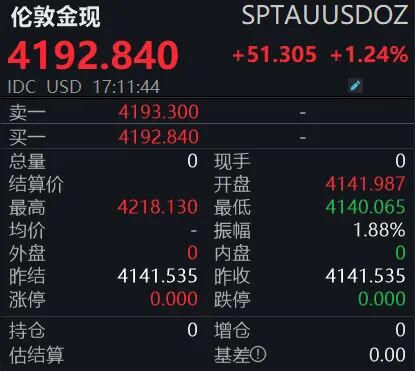
Core Viewpoint - The international gold price continues to rise, reaching historical highs, driven by optimistic expectations of interest rate cuts by the Federal Reserve, uncertainties from U.S.-China trade tensions, and various geopolitical instabilities [1][6]. Price Movement - As of October 15, the London gold price is reported at $4,192.84 per ounce, with a daily increase of 1.24%, and a peak of $4,218.13 per ounce, marking a new historical high [1][2]. - COMEX gold futures also surpassed $4,200 per ounce, reporting a daily increase of 1.06% at $4,207.4 per ounce, with an intraday high of $4,235.8 per ounce, setting another historical record [3][4]. Supporting Factors - The continuous rise in gold prices is attributed to three main factors: 1. Optimism regarding the Federal Reserve's interest rate cuts, with nearly 100% market expectation for a 25 basis point cut in October [6]. 2. Uncertainties stemming from U.S.-China trade tensions, particularly following President Trump's announcement of 100% tariffs on Chinese goods, which has led to market volatility [6]. 3. Frequent geopolitical and economic instability events, including the ongoing U.S. government shutdown and political unrest in various countries, which have impacted investor confidence [6]. Future Outlook - In the short term, gold prices may experience increased volatility due to speculative trading, with indicators showing that gold is in an overbought territory [8]. - In the medium to long term, central bank gold purchases and global monetary expansion are expected to support a continued upward trend in gold prices [8]. - Key upcoming dates include the APEC informal meeting on October 31 and the Federal Reserve's meeting on October 30, which may influence market sentiment [8]. - Investment strategies suggest maintaining gold as a core asset in portfolios, with recommendations to accumulate on price dips rather than chasing highs [8].
Morning Bid: Fed balm soothes trade war jabs
Yahoo Finance· 2025-10-15 10:36
Group 1 - U.S. Treasury yields and the dollar fell as the Federal Reserve signaled a potential halt to its balance sheet reduction, known as quantitative tightening, amid concerns about a softening labor market [2][7] - The International Monetary Fund (IMF) raised its global growth outlook for 2025, indicating that while the worst scenarios were avoided, risks remain due to policy uncertainty and rising trade frictions [4][7] - Major U.S. banks reported strong Q3 earnings, with Wells Fargo and Citigroup showing significant profit increases, supported by a solid investment-banking backdrop [7] Group 2 - Equity markets in Shanghai and Hong Kong rose over 1% on expectations of economic stimulus plans from the upcoming Communist Party plenum, despite deflationary signals from China [5] - In Europe, French stocks and bonds advanced following the decision to delay pension reforms, boosting investor confidence and contributing to the rise of France's CAC40 index [6] - The luxury sector benefited from LVMH's return to growth in Q3, positively impacting the overall market sentiment in France [6]


综合晨报-20251015
Guo Tou Qi Huo· 2025-10-15 03:08
Report Industry Investment Ratings No relevant information provided. Core Views - The mid - term outlook for crude oil remains bearish, and attention should be paid to the impact of Sino - US talks during the APAG meeting at the end of the month on risk sentiment [2]. - Precious metals have a solid long - term upward logic, but in the short term, due to over - bought signs, it is advisable to wait and see [3]. - For most commodities, factors such as Sino - US trade frictions, supply - demand imbalances, and policy changes have significant impacts on their prices and market trends [2][3][20] Summary by Categories Metals - **Copper**: Prices fell overnight. The market expects the Fed to continue cutting interest rates this month. The previous options combination strategy is continued [4]. - **Aluminum**: Overnight, Shanghai aluminum fluctuated narrowly. In the short term, it will mainly fluctuate, and the upside space should be viewed with caution [5]. - **Alumina**: Supply is in obvious surplus, and it will mainly operate weakly [6]. - **Cast Aluminum Alloy**: It follows the fluctuation of Shanghai aluminum. Whether the price difference with Shanghai aluminum can continue to narrow remains to be observed [7]. - **Zinc**: LME zinc inventory increased slightly. Shanghai zinc is expected to consolidate between 21,500 - 23,000 yuan/ton [8]. - **Lead**: LME lead inventory increased, and Shanghai lead has short - term downward pressure, with support at 16,800 - 16,900 yuan/ton [9]. - **Nickel and Stainless Steel**: Shanghai nickel operates weakly, and the center of gravity tends to move down [10]. - **Tin**: Overnight, Shanghai and LME tin prices fell. Short positions can be held against 290,000 yuan, or call options with an exercise price of 300,000 yuan for the 2511 contract can be sold [11]. - **Carbonate Lithium**: The futures price rebounded slightly, but there is a short - term callback risk [11]. - **Polysilicon**: After approaching the lower end of the range, the futures price rebounded significantly, but the upside space is still limited [12]. - **Industrial Silicon**: In October, the risk of inventory accumulation is relatively high, and the futures price is expected to fluctuate [13]. - **Iron Ore**: The overnight futures price fluctuated. It is expected to mainly fluctuate at a high level [15]. - **Coke**: The price rebounded after hitting the bottom during the day. The support near the previous low is relatively solid [16]. - **Coking Coal**: The price rebounded after hitting the bottom during the day. The support near the previous low is relatively solid [17]. - **Manganese Silicon**: The price mainly fluctuated during the day. Attention should be paid to the impact of external trade frictions [18]. - **Silicon Ferrosilicon**: The price mainly fluctuated during the day. Attention should be paid to the impact of external trade frictions [19]. Energy - **Fuel Oil and Low - Sulfur Fuel Oil**: Overnight, they followed the decline of crude oil - related varieties. High - sulfur fuel oil may face medium - term supply pressure, while low - sulfur fuel oil has a weak fundamental situation [21]. - **Asphalt**: The supply - demand remains in a tight balance. The far - month contract is more under pressure [22]. - **Liquefied Petroleum Gas**: There is a lack of positive support [23]. - **Urea**: The market demand is weak, and the supply - demand pattern is loose [24]. - **Methanol**: The main contract fell. Attention should be paid to port inventory changes and the impact of Sino - US trade disputes [24]. - **Pure Benzene**: The price fell. The industry valuation is low, and the impact of oil prices should be noted [25]. - **Styrene**: Some local producers cut prices, and downstream procurement is cautious [26]. - **Polypropylene, Plastic, and Propylene**: The supply pressure increases, and the prices are under pressure [27]. - **PVC and Caustic Soda**: PVC may fluctuate weakly, while caustic soda's downward range is expected to be limited [28]. - **PX and PTA**: The prices continued to decline. PTA's supply - demand outlook is weak [29]. - **Ethylene Glycol**: The price is at the bottom of the range, and the downward resistance increases. Attention should be paid to Sino - US trade relations [30]. Agricultural Products - **Soybeans and Soybean Meal**: The supply in the fourth quarter is generally stable, but there may be a supply shortage in the first quarter of next year. It is advisable to wait and see [35]. - **Soybean Oil and Palm Oil**: Oils are expected to be more resilient in the long - term. It is advisable to go long after the price bottoms out [36]. - **Rapeseed Meal and Rapeseed Oil**: It is recommended to use rapeseed - related products as a short - side configuration in cross - competitor strategies. The prices are expected to fluctuate weakly [37]. - **Soybean No.1**: Domestic soybeans continued to rebound. Attention should be paid to policies and fundamentals [38]. - **Corn**: The futures price rebounded at the bottom. The bottom is approaching [39]. - **Pigs**: The futures price rebounded with reduced positions. There is upward support for next year's second - half contracts [40]. - **Eggs**: The futures price rebounded with reduced positions. The near - month contracts should be shorted, and the far - month contracts can be longed [41]. - **Cotton**: The demand for US cotton is expected to remain weak. It is advisable to wait and see [42]. - **Sugar**: The international market supply is sufficient. Attention should be paid to the weather and sugarcane growth in Guangxi [43]. - **Apples**: The futures price fluctuated at a high level. It is advisable to maintain a short - side thinking [44]. - **Timber**: The futures price continued to correct. It is advisable to wait and see [45]. - **Pulp**: The futures price rose. Attention should be paid to port inventory changes [46]. Others - **Container Shipping Index (European Line)**: After initially digesting the price - increase expectations, the market is expected to return to fluctuations. The focus will be on the actual implementation of price support in November [20]. - **Stock Index**: The market sentiment fluctuates between risk - aversion and optimism. The medium - term allocation should focus on the technology growth sector, but attention should be paid to possible sector rotations [47]. - **Treasury Bonds**: The bond market will gradually enter the repair stage. The probability of a steeper yield curve increases [48].
X @外汇交易员
外汇交易员· 2025-10-15 00:58
特朗普:“我认为,中国故意不购买美国的大豆,给我们的大豆种植户造成困难,是一种经济敌对行为。作为报复,我们正在考虑终止与中国在食用油及其他贸易领域的业务往来。例如,我们自己可以轻松生产食用油,无需从中国购买。”外汇交易员 (@myfxtrader):玉渊谭天:从中国主要粮食码头获悉,今年1至9月,美国粮食运输船靠岸艘次同比下降56%,从72艘降至32艘,这是因为自7月起,来自美国的粮食运输船在该码头靠岸艘次已降为0。对比来看,5月以来,该码头每月平均有40多艘来自阿根廷、巴西、乌拉圭等南美国家的粮食运输船靠岸。这些粮食运输船90%运输的都是 ...