写字楼

Search documents
第一批租不掉的写字楼,酒店接盘了
3 6 Ke· 2026-02-27 02:05
后来到了钱江新城,我发现一栋高层的低区变成了维也纳酒店,还有一些以前从未听过的单体酒店招 牌,它们大多分布在写字楼中低层,整层嵌入了原本属于办公室的空间里。 早高峰的时候,这种错位感更加具象,电梯口排成两条长龙,一队是拎着公文包、神色匆忙的上班族, 另一队则是拖着大号行李箱、举着相机的游客。 当电梯门合上,狭窄的空间里同时交织着提神咖啡的苦涩味和各种外卖的浓郁香气。这种写字楼和酒店 共处一室的拼贴感,在视觉和嗅觉上都带来了极强的冲击。 酒店也下沉写字楼了吗? 01 春节前,我在杭州出差,去黄龙商圈一家写字楼拜访客户。 刚下滴滴,一抬头就看见醒目的Logo,全季酒店,楼上一整层都是酒店房间,门口是几个刚退房的住 客。 我进去观察了下,装修风格其实跟联合办公也差不多,前台挂着品牌LOGO,公共区域有茶水间,走廊 灯光柔和,只不过门上不是某某科技,而是房号。 后来,我和楼里经营出境游业务的朋友聊了下,他指了指外墙那些色彩斑斓的巨大灯箱:"这几年杭州 写字楼招租实在太难,空置率高得吓人,业主与其守着几万平米空房天天亏钱,还不如把楼层打包给酒 店。" 观察到这个现象后,我和同业交流了一圈,发现这种情况全国都在上演,并非 ...

北京写字楼市场报告 2025年 Q4
莱坊· 2026-02-05 07:25
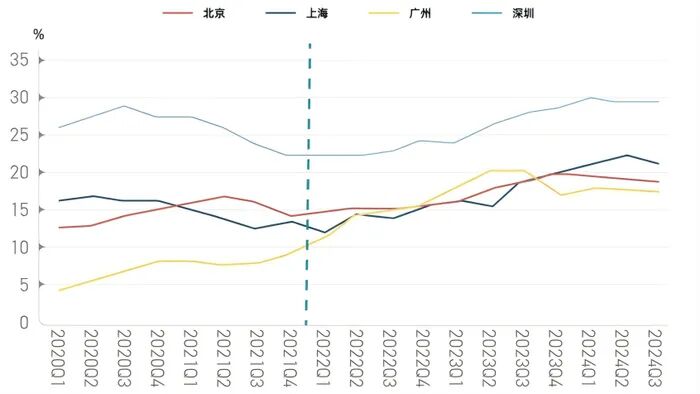
Investment Rating - The report does not explicitly state an investment rating for the Beijing Grade A office market [1]. Core Insights - The Beijing Grade A office market is experiencing a slight improvement in vacancy rates, with an average vacancy rate of 17.0%, down 0.8 percentage points quarter-on-quarter and 1.43 percentage points year-on-year [3][4]. - The average effective net rent for Grade A offices in Beijing is RMB 219.7 per square meter per month, reflecting a quarter-on-quarter decrease of 3.9% and a year-on-year decrease of 12.7% [3][13]. - The market is characterized by limited new supply and differentiated demand, with only 53,000 square meters of new supply in Q4 2025, leading to a total stock of 12,652,483 square meters [9][5]. Supply and Demand - In 2025, the total new supply of Grade A offices in Beijing was 83,000 square meters, a significant decrease of 71% compared to 2024 [9]. - The demand for Grade A offices is concentrated in specific regions, with the Central Business District (CBD) being the most active sub-market, accounting for 30%-37% of transactions [9]. - The technology sector continues to lead demand, with TMT, finance, and professional services collectively representing over 70% of the market demand [9]. Rental Trends - The overall rental levels in the Beijing Grade A office market are in a downward cycle, with rents decreasing due to competitive pressures [13][16]. - The only sub-market experiencing rental growth is Yizhuang, which saw a 2.2% increase in rent to RMB 84.4 per square meter per month, driven by demand from emerging industries [16]. - The report anticipates that the vacancy rate may rise to approximately 20.5% year-on-year, with rents expected to decline by about 9% in the coming year [4]. Investment Market - The investment market for Grade A offices in Beijing remains dominated by domestic capital, with significant transactions occurring in core locations [17]. - A notable transaction involved Beijing Yangtze River Investment acquiring the Shimao Tower for RMB 2.254 billion, reflecting a strong interest in prime office assets [17]. - The report highlights a shift in demand preferences, particularly from health sector enterprises seeking core area office spaces [17].
上海写字楼市场报告 2025年 Q4
莱坊· 2026-02-05 07:25
上海甲级写字楼市场 季度报告 2025年 第四季度 本报告重点关注上海甲级写字楼市场,包括供应和需求、租金、空置率以及 knightfrank.com.cn/research 写字楼投资市场等方面相关信息 概览和展望 供需双压下市场仍处于调整期 第 四 季 度 ,上 海 整 体 写 字 楼 市 场 租 金 继 续 延 续 下 行 态 势,环 比 下 跌3.2% 至每天每平方米人民币 6.05 元,环 比 跌 幅3.2%。供 应 方 面,两 个 新 项 目 总 计 216,585平方米的办公面积竣工交付,推 动市场空置率继续小幅攀升至23.8%。当 季市场净吸纳量增至82,570平方米。租 赁需求方面,本季度市场租赁活动主要来 自于金融机构和TMT企业,共享办公品牌 继续保持扩张势头。 十二月份的中央经济会议为明年以 及"十五五"的经济发展定下基调,继续扩 内需、科技创新,并且积极推动产业高端 化、智能化和绿色化。在积极的政策引导 下,"十五五"期间,国内经济有望减轻通 缩带来的负面影响,之于写字楼市场也将 存在温和复苏的可能。 未 来 一 年,上 海 写 字 楼 市 场 预 计 将 有 接近140万平方米的新 ...
百万平供应冲击下 深圳写字楼空置率已超三成 豪宅成全年楼市“稳定器”
Hua Xia Shi Bao· 2026-01-18 00:41
Core Insights - In 2025, Shenzhen's real estate market exhibited a contrasting performance characterized by significant supply and differentiated demand, leading to a high vacancy rate of 31.4% despite a record net absorption of 664,000 square meters in the Grade A office sector [1][3][7] Group 1: Grade A Office Market - The Grade A office market in Shenzhen saw a substantial supply increase with 1.182 million square meters added, marking a 9.4% year-on-year growth in total stock to 12.843 million square meters [3] - The net absorption reached a four-year high of 664,000 square meters, exceeding the five-year average by 16.9% [3] - Despite high absorption, the vacancy rate remained elevated at 31.4%, reflecting ongoing structural challenges in the market [3][4] Group 2: Retail Property Market - The retail property market displayed a "two extremes" scenario, with premium projects thriving while secondary locations faced leasing challenges, resulting in negative net absorption in some areas [5][6] - Total retail supply reached 825,000 square meters, an 11.2% increase year-on-year, with a cautious approach from brands in opening new stores [5] - Rental trends varied significantly, with premium projects experiencing stable or rising rents, while some older projects had to reduce rents to retain tenants [6] Group 3: Residential Market - The residential market saw a decline in overall supply by 11% to 3.5 million square meters, with transaction volume dropping by 24.2% to 3.785 million square meters [7][9] - High-end luxury properties experienced a surge in demand, with average transaction prices stabilizing at 54,765 yuan per square meter, reflecting a narrowing decline of 7.3 percentage points year-on-year [7][8] - The luxury market's growth contrasted sharply with the subdued performance of the mass housing sector, which faced significant challenges in absorption and pricing [9][10][11] Group 4: Market Outlook - The outlook for 2026 suggests continued substantial supply, potentially exceeding one million square meters, with total stock expected to rise to nearly 14 million square meters [4] - The upcoming APEC conference and ongoing policy benefits are anticipated to create new opportunities for technology and high-end manufacturing sectors, supporting office demand [4]
上海写字楼市场需求回暖 2025年四季度净吸纳量环比增长9.3%
Xin Lang Cai Jing· 2026-01-16 04:40
Core Viewpoint - The Shanghai office market is showing strong resilience amid counter-cyclical adjustments, with signs of marginal improvement in demand in the fourth quarter of last year [1] Group 1: Market Performance - The net absorption in the Shanghai office market significantly increased quarter-on-quarter in the fourth quarter [1] - The financial, professional services, and TMT (Technology, Media, and Telecommunications) sectors are the main drivers supporting the market recovery [1]
合生商业:2025年北京朝阳合生汇销售额近85亿元
Cai Jing Wang· 2026-01-14 03:34
Group 1 - The core viewpoint of the article highlights that the company has achieved a leasing rate of over 90% for office buildings and industrial complexes [1] - In terms of shopping centers, the company reported that it received over 200 million visitors in total for the year 2025 [1] - The sales figures for the Beijing Chaoyang He Sheng Hui reached nearly 8.5 billion yuan, representing a year-on-year increase of 13% [1] - The sales for the Shanghai Wujiaochang He Sheng Hui exceeded 6.6 billion yuan, with a year-on-year growth of 4% [1]
“它经济”业态多元化 深圳去年零售市场供应亮点纷呈
Zheng Quan Shi Bao Wang· 2026-01-06 12:00
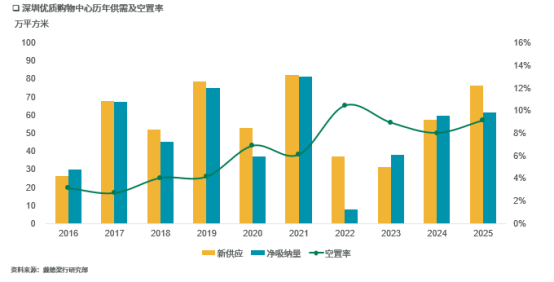
Group 1 - The "pet economy" is rapidly growing, with increasing consumer spending and diversification of pet-related services in shopping centers [1][2] - In 2025, Shenzhen will see the opening of several high-quality shopping centers, contributing to a total supply of 793.7 million square meters, with a net absorption of 61.3 million square meters [2][3] - The retail landscape in Shenzhen is evolving, with a notable increase in the proportion of dining and lifestyle services, while the pet economy is expanding into new product categories [2][3] Group 2 - The competitive environment is driving shopping center owners to introduce flagship stores to differentiate themselves, supported by policies and the growth of the tech industry [3] - The inbound tourism market in Shenzhen is growing, benefiting from an increase in visa-free countries, which is expected to boost high-end retail and tourism-related consumption [3] - The average rent for premium office buildings in Shenzhen has decreased by 10.7% to 697.1 yuan per square meter, reflecting market pressures [3][8] Group 3 - The office market is facing challenges due to economic uncertainties, with a net absorption of 26.4 million square meters in Shenzhen, which is less than half of the new supply [6][8] - The demand for office space is being driven by the TMT sector, particularly in AI and emerging consumer electronics, which are becoming significant sources of leasing demand [8][9] - Future supply of premium office buildings in Shenzhen is projected to exceed 500 million square meters over the next four years, indicating a competitive landscape [9]
2025年四季度北京甲级写字楼空置率再回落,机构预警2026年末空置率攀升
Hua Xia Shi Bao· 2026-01-04 05:56
Core Insights - The real estate industry in 2025 is still undergoing a deep adjustment cycle, with low price fluctuations and weak effective demand remaining unresolved [2] - The Beijing Grade A office market shows signs of recovery, with the vacancy rate decreasing to 19.2% by the end of Q4, a year-on-year decline of 1.5 percentage points [3][4] - The market recovery is primarily driven by the concentration of new productive forces in the Zhongguancun area, which has become a core engine for the revival of the Beijing office market [4] Market Performance - The net absorption of Beijing Grade A office space reached approximately 83,000 square meters in Q4, contributing to an annual net absorption of 330,000 square meters, indicating a sustained demand [3] - The new supply of Grade A office space in Beijing for 2025 is limited to 188,000 square meters, which has helped stabilize the market [3] - The effective rental rate for Grade A offices decreased to 222 RMB/month/square meter, a year-on-year decline of 11.5%, but the rate of decline has narrowed compared to the previous year [3] Regional Highlights - The Zhongguancun area recorded a net absorption of over 176,000 square meters in 2025, accounting for 53% of the city's total, marking a peak in nearly 20 years [4] - High-tech manufacturing industries showed significant growth, with an increase of 9.2% in value-added output from January to November [4] Future Outlook - The Beijing office market is expected to face pressure again in 2026, with over 700,000 square meters of new supply anticipated, which may lead to an increase in the vacancy rate [9] - The market's effective demand remains insufficient, with many companies still facing operational challenges, leading to a cautious approach towards office expansion [7] - The competition in the office market is intensifying, particularly in non-core areas, while the core regions are experiencing a significant decline in rental prices [6]
北京甲级写字楼市场延续回暖态势,空置率持续回落
2 1 Shi Ji Jing Ji Bao Dao· 2025-12-26 13:28
Group 1 - The 22nd Annual Conference of the China Office Industry Park Development Forum was held in Beijing, focusing on the theme "Involution and Evolution: Paradigm Shift in Commercial Office" [1] - The Deputy Director of Beijing Investment Promotion Service Center, Tang Yonghong, emphasized the importance of commercial real estate in the economic system and its role in shaping urban image and enhancing competitiveness [1] - As of the end of Q3, the average vacancy rate of Grade A office buildings in Beijing is around 19%, showing a quarter-on-quarter and year-on-year decrease of 0.6 and 0.1 percentage points respectively [1] Group 2 - Hu Feng, Managing Director of North China at Cushman & Wakefield, noted that the office market is influenced by both demand and supply, with Beijing's Grade A office stock at 13 million square meters and a vacancy rate of 16% [2] - Liu Kai, Executive Vice President of the Office Committee of the All-China Real Estate Chamber of Commerce, stated that the commercial real estate market is at a crossroads of "involution" and "evolution," requiring a process for stabilization and recovery [2] - Liu proposed six paradigm shifts needed in the office industry: from product-centered to user-centered, from incremental expansion to stock optimization, from space transformation to urban renewal, from public REITs to asset digitization, from "Internet+" to "AI+" era, and from "involution" competition to "co-opetition" [2] Group 3 - The total building area of industrial parks in China has exceeded 6 billion square meters, with an annual new supply of 14 million square meters, while actual demand growth is lagging behind supply expansion [3] - The average vacancy rate of provincial-level development zones in China exceeds 35%, with some newly built parks reaching 60% [3] - Wu Jing, Director of the Real Estate Research Center at Tsinghua University, highlighted three macro variables to focus on for the development of the office and industrial park sectors: market variables, institutional variables, and technological variables [3]
写字楼出租率不到83%,供应过剩是怎么出现的
Sou Hu Cai Jing· 2025-11-18 03:40
Core Insights - The average occupancy rate of key office buildings in major Chinese cities has declined to 82.54%, indicating a structural imbalance in supply and demand within the commercial real estate sector [1][3]. Group 1: Market Demand - The significant contraction in demand for office space is primarily driven by major tenants in sectors such as internet, finance, and professional services, which are undergoing deep adjustments and reducing their leased space [3][4]. - As core demand from these sectors decreases, the resulting increase in vacancy rates is inevitable [3]. Group 2: Supply Dynamics - The development cycle of office buildings often misaligns with industry cycles, leading to oversupply when projects initiated during peak demand are completed during downturns [3][4]. - The time required for office projects to move from land acquisition to completion can take three to five years or longer, exacerbating the mismatch between supply and demand [3]. Group 3: Adaptive Reuse Strategies - Many regions have attempted to repurpose vacant office buildings for alternative uses, such as housing or industrial spaces, to mitigate the impact of rising vacancy rates [4][5]. - The concept of "adaptive reuse" has been encouraged through government policies that provide tax incentives and streamline approval processes for converting commercial spaces into residential units [4][5]. Group 4: Urban Planning and Long-term Solutions - To prevent cyclical vacancy crises, urban planning must be more scientifically aligned with population flows and industrial structures, ensuring a balanced supply of residential, commercial, and office spaces [7]. - The demand for office space is closely linked to the performance of industries such as internet, finance, and modern services, necessitating a focus on developing high-quality industries that sustain demand for premium office spaces [7].