
精炼石油产品制造业

Search documents
数据点评 | 如何理解1月通胀分化?(申万宏观·赵伟团队)
赵伟宏观探索· 2026-02-12 16:03
文 | 赵伟、屠强 联系人 | 屠强、 耿佩璇 事件: 2月11日,国家统计局公布1月通胀数据,CPI同比0.2%、前值0.8%、预期0.4%、环比0.2%;PPI同 比-1.4%、前值-1.9%、预期-1.5%、环比0.4%。 核心观点:1月通胀分化,背后源于春节错位、输入性因素拉动提升,需求偏弱共同影响 1月PPI降幅明显收窄,主因铜价对PPI的拉动进一步增加,基期轮换也有一定程度的影响。 1月PPI环比 0.4%,同比上行0.5个百分点至-1.4%。我国价格指数每五年进行一次基期轮换,2026年开始为新一轮基 期轮换调整,但对每月PPI同比的影响仅为0.08个百分点。更重要的是,1月铜价涨幅扩大,相应有色采 选、有色压延业价格环比分别5.7%、5.2%, 拉动PPI环比0.5% ,为最强贡献项。钢价对PPI贡献也为 正, 拉动PPI环比0.1%。 相比之下,煤油等大宗商品价格、中下游PPI表现偏弱。 国际原油价格下行影响国内石油开采、精炼石 油产品制造价格分别下降3.1%和2.5%, 油价拖累PPI环比-0.08% ,煤价也有走弱, 拖累PPI环比-0.15% 。中下游产能利用率也未明显改善,导致上游涨 ...

中金:基期轮换映升级,春节扰动不足虑 ——2026年1月物价数据点评
中金点睛· 2026-02-11 23:38
中金研究 1 月 CPI 同比从 0.8% 回落至 0.2% ,主要受春节错位影响,食品和服务拖累较大。金价上涨和换新需求释放难抵服务拖累,核心 CPI 同比回落至 0.8% 。 PPI 环比涨幅走扩至 0.4% 、同比跌幅收窄至 -1.4% ,主要受国际有色涨价、化工光伏反内卷、 AI 需求推动,但中下游顺价压力仍大。基期轮换对通胀读数影 响不大,但分类和调查的调整关注新消费、新模式和新方法,权数结构变化反映消费结构从商品向服务、从生存型向发展享受型的变迁 [1] 。向前看, 2 月 CPI 同比有望回弹,但后续物价改善幅度还看内需修复速度。 点击小程序查看报告原文 春节错月拖累同比。 1月CPI同比由上月0.8%回落至0.2%,主要受春节错位影响。春节所在月份往往CPI环比较高,今年春节在2月,去年春节在1月,导致 1月食品和服务等价格在高基数、低新增下,同比由前月的1.1%和0.6%回落至-0.7%和0.1%[2],分别拖累CPI同比0.3和0.2ppt。 1月CPI环比0.2%,弱于十年同期可比均值的0.6%[3],但考虑到疫情后服务样本更具代表性的调整,这个环比与疫后春节相似的2024年1月相当(0 ...

国家统计局:输入性因素影响国内有色金属和石油相关行业价格走势分化
Xin Hua Cai Jing· 2026-02-11 02:13
编辑:吴郑思 新华财经北京2月11日电 国家统计局城市司首席统计师董莉娟在解读2026年1月份CPI和PPI数据时表 示,1月PPI环比上涨0.4%,连续4个月上涨,涨幅比上月扩大0.2个百分点。本月PPI环比运行的主要特 点:一是全国统一大市场建设持续推进带动部分行业价格上涨。水泥制造、锂离子电池制造价格环比均 上涨0.1%,均连续4个月上涨;光伏设备及元器件制造价格由上月下降0.2%转为上涨1.9%,基础化学原 料制造价格由下降0.1%转为上涨0.7%,黑色金属冶炼和压延加工业价格由下降0.1%转为上涨0.2%。二 是需求增加带动相关行业价格上涨。人工智能等数字化技术加快发展、算力需求增长带动计算机通信和 其他电子设备制造业价格环比上涨0.5%,其中电子半导体材料、外存储设备及部件价格分别上涨5.9% 和4.0%;春节前礼品和食品等备货需求增加带动工艺美术及礼仪用品制造、农副食品加工业价格分别 上涨4.1%和0.3%;冬季防寒保暖需求增加带动防寒服、羽绒加工价格分别上涨0.9%和0.8%。三是输入 性因素影响国内有色金属和石油相关行业价格走势分化。国际有色金属价格上行拉动国内有色金属矿采 选业、有色金属冶 ...
优化供需结构,持续提振投资与消费预期
2 1 Shi Ji Jing Ji Bao Dao· 2026-01-10 03:15
Group 1 - The latest data from the National Bureau of Statistics indicates that the domestic CPI rose by 0.8% year-on-year in December 2025, surpassing the previous value of 0.7%, with a month-on-month increase of 0.2%, marking a near three-year high [1] - The month-on-month increase in CPI is primarily driven by rising prices of industrial consumer goods excluding energy, which increased by 0.6%, contributing approximately 0.16 percentage points to the CPI increase [1] - The core CPI, excluding food and energy, rose by 1.2% year-on-year, maintaining a growth rate above 1% for four consecutive months, indicating a positive trend [1] Group 2 - The main factors affecting CPI include energy and automobile prices, with energy prices decreasing by 0.5% month-on-month and gasoline prices down by 1.2% [2] - PPI showed an expanding month-on-month increase and a narrowing year-on-year decline, with positive factors stemming from industry capacity governance and market competition order improvements [2] - International commodity prices, particularly for non-ferrous metals, have positively impacted domestic PPI levels, while the decline in international oil prices has negatively affected domestic oil extraction and refining prices [3] Group 3 - The current price recovery is a direct result of the demand-side expansion and supply-side governance policies in 2025, characterized by structural features and policy-driven characteristics [3] - The transition from short-term policy-driven effects to sustainable market-driven growth is a key task for 2026, with strong price expectations playing a crucial role in boosting investment and consumption [3] - Continued efforts to expand domestic demand and improve supply-demand relationships are essential for stabilizing the real estate market and stimulating stock market vitality, promoting a virtuous cycle in the Chinese economy [4]
21社论丨优化供需结构,持续提振投资与消费预期
21世纪经济报道· 2026-01-10 02:11
Group 1 - The core viewpoint of the articles indicates a positive trend in price recovery for 2025, with CPI and PPI showing simultaneous growth, suggesting a foundation for price warming in 2026 [1][2][3] - CPI increased by 0.8% year-on-year, surpassing the previous value of 0.7%, and the month-on-month CPI rose by 0.2%, marking a three-year high [1] - The rise in CPI is primarily driven by the increase in industrial consumer goods prices, excluding energy, which rose by 0.6%, contributing approximately 0.16 percentage points to the CPI increase [1] Group 2 - PPI showed a month-on-month increase of 0.2%, marking three consecutive months of growth, with the growth rate expanding by 0.1 percentage points compared to the previous month [1][2] - The improvement in PPI is attributed to industry capacity governance and market competition order, which have positively influenced supply-demand structures, leading to price increases in certain sectors [2][3] - International commodity prices, particularly in non-ferrous metals, have positively impacted domestic PPI levels, while the decline in international oil prices has negatively affected domestic oil extraction and refining prices [3] Group 3 - The current price recovery is a direct result of coordinated demand-side expansion and supply-side governance policies, with structural characteristics and policy-driven features [3] - The sustainability of this price recovery and its transmission to broader investment and consumption expectations will determine whether the economy can enter a virtuous cycle in 2026 [3] - Continued efforts to expand domestic demand and improve supply-demand relationships are essential for stabilizing the real estate market and stimulating the stock market, which will facilitate smoother transmission from PPI to CPI [4]

2025年物价低位温和回升
Xin Lang Cai Jing· 2026-01-09 22:52
Group 1: CPI Analysis - In December 2025, the Consumer Price Index (CPI) increased by 0.2% month-on-month and 0.8% year-on-year, with the core CPI (excluding food and energy) rising by 1.2% year-on-year, marking a stable recovery in demand [1][2] - The year 2025 saw the CPI remain flat compared to the previous year, while the PPI decreased by 2.6% year-on-year, indicating a low and moderate recovery in price levels [1][4] - The increase in CPI was primarily driven by rising prices of industrial consumer goods, with a notable increase in prices for communication tools, baby products, and entertainment durable goods, which rose between 1.4% and 3.0% [1][2] Group 2: PPI Analysis - The Producer Price Index (PPI) rose by 0.2% month-on-month in December 2025, marking three consecutive months of increase, influenced by improved supply-demand dynamics and ongoing capacity governance in key industries [2][3] - Year-on-year, the PPI decreased by 1.9%, but the decline was less severe than in previous months, reflecting positive changes in certain industries due to macroeconomic policies [3][5] - The PPI's year-on-year decline was initially exacerbated by insufficient external demand and structural adjustments, but improved market competition and policy effects led to a narrowing of the decline in the latter half of the year [5] Group 3: Economic Outlook - The changes in CPI and PPI in December 2025 indicate a stable and improving economic environment, with demand gradually recovering and supply-side structural optimization continuing [3][5] - The implementation of consumption-boosting policies and the deepening of the unified national market are expected to support a moderate and stable price environment moving forward [3][5] - Looking ahead to 2026, a more proactive macroeconomic policy is anticipated to foster economic growth and reasonable price recovery, with the potential for PPI to enter a recovery phase, although it may take time to turn positive [5]
提振消费政策显效、企业竞争秩序优化、新动能快速成长——2025年物价低位温和回升
Jing Ji Ri Bao· 2026-01-09 22:02
Group 1: CPI Analysis - In December 2025, the Consumer Price Index (CPI) increased by 0.2% month-on-month and 0.8% year-on-year, with the core CPI (excluding food and energy) rising by 1.2% year-on-year [1][2] - The year 2025 saw the CPI remain flat compared to the previous year, while the PPI decreased by 2.6% year-on-year, indicating a generally low and mild recovery in price levels [1][4] - The increase in CPI is attributed to rising prices of industrial consumer goods, with a notable increase in prices for communication tools, baby products, and entertainment durable goods, which rose between 1.4% and 3.0% [1][2] Group 2: PPI Analysis - The Producer Price Index (PPI) rose by 0.2% month-on-month in December 2025, marking three consecutive months of increase, despite a year-on-year decline of 1.9% [2][3] - The PPI's year-on-year decline narrowed by 0.3 percentage points compared to the previous month, reflecting improvements in supply-demand structures and effective policies in key industries [3][5] - Prices in the coal mining and processing sectors, as well as lithium-ion battery manufacturing and cement production, have shown consistent increases, indicating a positive trend in certain industries [2][3] Group 3: Economic Outlook - Analysts suggest that the changes in CPI and PPI reflect a stable and improving economic environment in China, with demand gradually recovering and supply-side structural optimization continuing [3][5] - The implementation of consumption-boosting policies and the deepening of the national unified market construction are expected to support a stable and mild recovery in prices moving forward [3][5] - Looking ahead to 2026, a more proactive macroeconomic policy environment is anticipated to foster economic growth and reasonable price recovery, with CPI expected to rise steadily [5]
解读:2025年12月份CPI同比涨幅继续扩大 PPI同比降幅收窄
Guo Jia Tong Ji Ju· 2026-01-09 03:00
Group 1: CPI Analysis - The Consumer Price Index (CPI) increased by 0.2% month-on-month and 0.8% year-on-year, with the core CPI rising by 1.2% year-on-year, indicating a recovery in consumer demand as New Year's approaches [1][2][3] - The month-on-month increase in CPI was primarily driven by rising prices of industrial consumer goods, excluding energy, which rose by 0.6%, contributing approximately 0.16 percentage points to the CPI increase [2] - Food prices rose by 1.1% year-on-year, with significant increases in fresh vegetables (18.2%) and fresh fruits (4.4%), contributing approximately 0.17 percentage points to the year-on-year CPI increase [3] Group 2: PPI Analysis - The Producer Price Index (PPI) rose by 0.2% month-on-month, marking the third consecutive month of increase, with the growth rate expanding by 0.1 percentage points compared to the previous month [4] - The month-on-month PPI increase was supported by improved supply-demand dynamics, with notable price increases in coal mining (1.3%) and lithium-ion battery manufacturing (1.0%) [4] - Year-on-year, the PPI decreased by 1.9%, but the decline rate narrowed by 0.3 percentage points, reflecting positive changes in certain industries due to ongoing macroeconomic policies [4]
2025年CPI数据发布
Di Yi Cai Jing Zi Xun· 2026-01-09 02:08
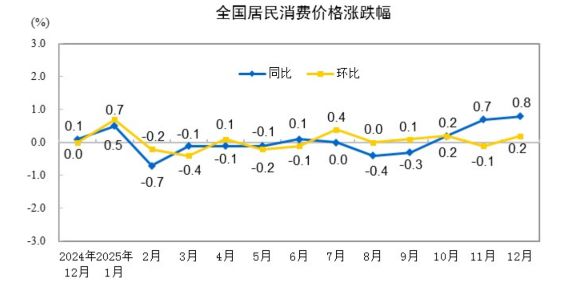
Core Viewpoint - In December 2025, the Consumer Price Index (CPI) increased by 0.8% year-on-year, with urban areas rising by 0.9% and rural areas by 0.6%, indicating a steady increase in consumer prices driven by food and non-food price changes [1][4][6]. CPI Summary - The CPI rose by 0.2% month-on-month in December, reversing a previous decline of 0.1% [5]. - Core CPI, excluding food and energy, increased by 1.2% year-on-year, maintaining a growth rate above 1% for four consecutive months [6]. - Food prices rose by 1.1% year-on-year, with significant increases in fresh vegetables (18.2%) and fresh fruits (4.4%), contributing to the overall CPI increase [6][8]. - Energy prices decreased by 3.8% year-on-year, with gasoline prices dropping by 8.4% [6]. PPI Summary - The Producer Price Index (PPI) increased by 0.2% month-on-month, marking three consecutive months of growth [8]. - Year-on-year, the PPI decreased by 1.9%, but the decline was less severe than in previous months, indicating some stabilization in industrial prices [9]. - Key industries such as coal mining and lithium-ion battery manufacturing saw price increases, reflecting improved supply-demand dynamics [8][9]. - Input factors like international commodity prices influenced the price trends in domestic industries, with non-ferrous metal prices rising due to global market conditions [8][9].
中国12月CPI环比由降转涨,同比涨幅继续扩大,核心CPI上涨1.2%
Hua Er Jie Jian Wen· 2026-01-09 01:35
Group 1: CPI Analysis - In December, the Consumer Price Index (CPI) increased by 0.8% year-on-year, up from 0.7% in the previous month, marking the highest level since March 2023 [1][4] - The core CPI, excluding food and energy, rose by 1.2% year-on-year, maintaining above 1% for four consecutive months [4] - The increase in CPI was primarily driven by a rise in food prices, which increased by 1.1%, with fresh vegetables and fruits seeing significant price hikes of 18.2% and 4.4% respectively [4][3] Group 2: PPI Analysis - The Producer Price Index (PPI) rose by 0.2% month-on-month, marking the third consecutive month of increase, with the growth rate expanding by 0.1 percentage points from the previous month [5][7] - Year-on-year, the PPI decreased by 1.9%, but the decline was narrower by 0.3 percentage points compared to the previous month, indicating some positive changes in certain industries [7] - Key industries such as coal mining and lithium-ion battery manufacturing saw price increases, reflecting improvements in supply-demand dynamics and ongoing policy effects [5][6]