国防

Search documents
美国终于找到了反制稀土的新办法,接连出手三招,逼中方就范!
Sou Hu Cai Jing· 2025-10-27 04:41
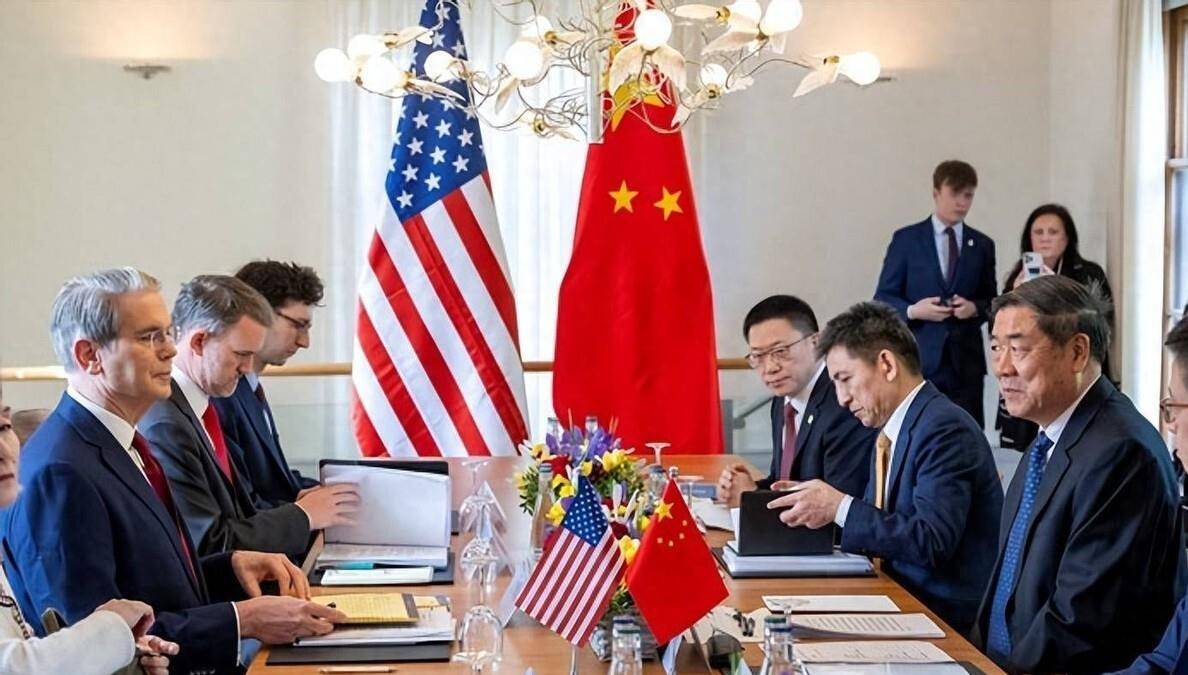
Core Points - The ongoing US-China talks in Malaysia focus on three main issues, including China's stricter rare earth export controls, which the US fears could disrupt supply chains in critical sectors like semiconductor manufacturing and defense [3] - The US aims to pressure China into relaxing these export restrictions to ensure stable raw material supplies for industries such as electric vehicles and semiconductors [3] - The US also seeks to increase Chinese imports of agricultural products like soybeans to alleviate export barriers faced by American farmers [3] - A significant goal of these talks is to prepare for a meeting between the two countries' leaders at the upcoming APEC summit in South Korea [3] Measures Taken by the US - US Treasury Secretary Mnuchin announced that if China does not lift its rare earth controls, the US will collaborate with the G7 to impose software export restrictions on China, targeting its high-tech development [4] - The US has initiated an investigation into whether China has complied with trade agreement terms signed during Trump's first term, with potential additional sanctions if non-compliance is found [7] - Starting November 1, the US plans to impose a 100% tariff on Chinese goods, a measure linked to China's rare earth export controls, which could be used as leverage in negotiations [7] China's Response - China is portrayed as a responsible nation that has historically adhered to international agreements, contrasting with the US's inconsistent approach [9] - Despite the US's pressure tactics, China remains steadfast in its negotiation stance, having learned from past experiences where it made concessions that were not reciprocated by the US [9] - The US's traditional methods of negotiation, characterized by threats and tariffs, are viewed as ineffective against China, as evidenced by the reduction of a lengthy sanctions list during the talks [9] Conclusion - The resolution of US-China differences is suggested to require equal treatment and mutual benefit, rather than unilateral pressure and sanctions, as trade wars yield no winners [11]

日本股市狂飙创新高 日元走势全线疲软
Jin Tou Wang· 2025-10-27 02:55
Group 1 - The Japanese yen weakened against other G10 and Asian currencies due to positive risk sentiment, with the USD/JPY exchange rate at 152.9600, up 0.07% [1] - Moody's economists predict that the Bank of Japan will likely maintain interest rates this Thursday due to poor trade performance and weak domestic demand, impacting economic outlook [1] - The Nikkei 225 index surpassed 50,000 points for the first time in 75 years, driven by optimism regarding the new Prime Minister's support for stimulus policies and positive news from U.S. trade negotiations [1][2] Group 2 - The Nikkei index's surge followed Prime Minister Kishi's policy speech proposing economic growth stimulation and increased defense spending, coinciding with President Trump's upcoming visit to Japan [2] - The USD/JPY exchange rate is currently between 152.79 and 153.17, with expectations of continued yen weakness due to upcoming risk events, including the U.S. Federal Reserve and Bank of Japan meetings [3] - The USD/JPY may test levels of 154.00 and 154.66 if it breaks above 153.29, as the yen remains under pressure [3]
日经225指数创阶段新高后 相关QDII基金提示溢价风险
Xin Hua Cai Jing· 2025-10-23 05:59
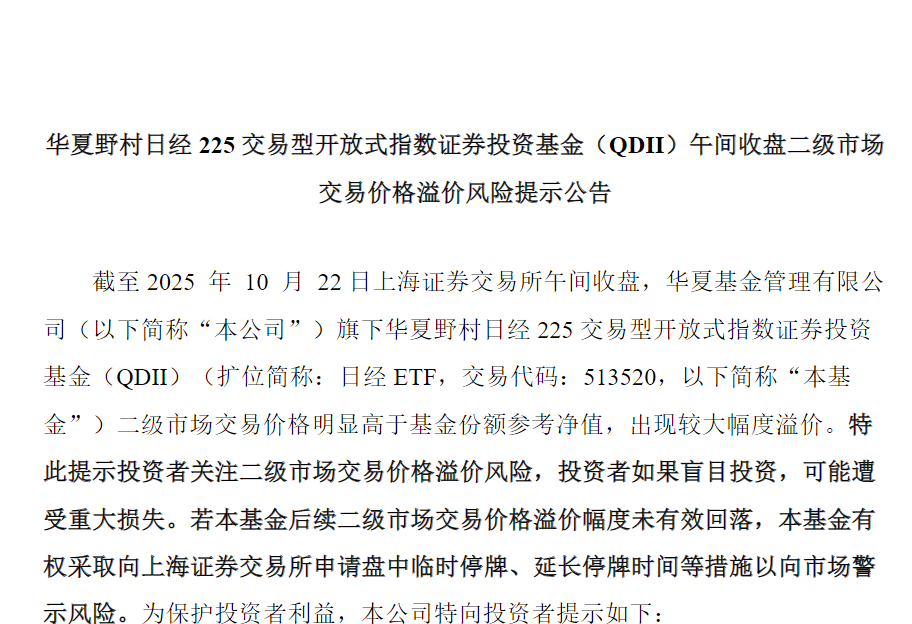
Group 1 - The Nikkei 225 index reached a peak of 49,945.95 points on October 21, closing above the 49,000 mark for the first time, indicating a significant upward trend in the market [2] - The strong performance of the stock market has led to a notable divergence between the trading prices of QDII funds tracking the Nikkei 225 index and their reference net asset values [2] - On October 23, the Huaxia Nomura Nikkei 225 Index Fund (QDII) issued a premium risk warning, highlighting that the current trading price is significantly higher than the reference net asset value, indicating a substantial premium [2] Group 2 - UBS Wealth Management's Chief Investment Office expressed optimism about the Japanese stock market, suggesting there is further room for growth [3] - The future performance of the Japanese stock market will depend on the reliability of government policies and the stability of the coalition government, maintaining an "attractive" rating for Japanese stocks [3] - Short-term investment opportunities are seen in IT services, real estate, and healthcare technology sectors, while mid-term prospects are favorable for defense, semiconductor, AI-related companies, and industrial, machinery, and materials sectors due to government policy support [3]
阿波罗:AI与工业复兴成强劲东风,美国经济增长有望重新加速
智通财经网· 2025-10-21 02:48
Core Viewpoint - Apollo Global Management's Chief Economist Torsten Slok indicates that the U.S. economy may be entering a stronger phase than many anticipated, with key credit indicators showing significant improvement, suggesting underlying economic resilience [1] Group 1: Economic Indicators - Default rates for high-yield bonds and leveraged loans have peaked, along with delinquency rates for credit cards and auto loans [1] - The improvement in these indicators is attributed to three main factors: the diminishing uncertainty from trade wars, the strong tailwinds from the AI boom, and a comprehensive recovery in U.S. industrial activity [1] Group 2: Investment and Consumer Confidence - The ongoing expansion of data centers and energy infrastructure related to AI is providing tangible support for business investment and consumer confidence [1] - Rising stock markets are enhancing household consumption capacity [1] Group 3: Industrial Revival - New capital investments in manufacturing, defense, biotechnology, and automation indicate that what is termed an "industrial revival" is in its early stages [1] - Despite ongoing trade tensions slightly dragging on global growth, these adverse factors are increasingly being offset by technology-driven and industrial momentum, raising the likelihood of a re-acceleration in U.S. economic growth in the coming months [1]
不涨军费就加税,特朗普对西班牙放出狠话,这次怕是要动真格的了
Sou Hu Cai Jing· 2025-10-19 04:31
Core Viewpoint - Trump expresses dissatisfaction with Spain for not increasing military spending to 5%, threatening trade penalties such as tariffs [3][5][10] Group 1: Military Spending and NATO - Spain is the only NATO member not to meet the 5% military spending requirement, which Trump views as disrespectful to NATO [3][5] - Spain's current military spending is approximately 17.2 billion euros, or 1.3% of its GDP, which is significantly below the requested 5% [6] - The increase to 5% would require an additional expenditure of about 50 billion euros, which is unsustainable given Spain's total budget of less than 200 billion euros for 2024 [6] Group 2: Economic Relations and Trade - Spain's economy is heavily reliant on the U.S. for technology, raw materials, and markets, making it vulnerable to U.S. tariffs [5][7] - The total trade volume between Spain and the U.S. is relatively small, around 20 billion euros, which may lessen the impact of U.S. tariff threats [7] - Spain's refusal to comply with Trump's demands reflects a broader resistance among countries facing economic constraints [9] Group 3: Political Dynamics - Spain's firm stance against increasing military spending is notable, especially as most NATO countries have complied with Trump's demands [5][10] - The geopolitical context shows that Spain's security concerns are less directly tied to NATO's overall defense strategy against Russia [3][6] - Trump's strategy to increase military spending among NATO members is seen as a means to boost U.S. arms sales, but faces significant opposition due to global economic challenges [9]
欧洲银行板块盘初下挫2.5%,国防股指数下跌3.2%
Mei Ri Jing Ji Xin Wen· 2025-10-17 07:37
Group 1 - European banking sector experienced a decline of 2.5% at the beginning of trading on October 17 [1] - Defense stock index fell by 3.2% [1]
European markets set to open lower as positive sentiment vanishes
CNBC· 2025-10-14 05:12
Market Overview - European stocks are anticipated to open lower, reversing the positive sentiment observed earlier in the week, influenced by potential trade disputes between the U.S. and China [1] - The U.K.'s FTSE index is projected to decline by 0.15%, Germany's DAX by 0.11%, France's CAC 40 by 0.16%, and Italy's FTSE MIB by 0.3% [1] Trade Relations - U.S. President Donald Trump has threatened to impose new tariffs on China in response to China's export controls on rare earth minerals, which are vital for high-tech industries [2] - China holds approximately 70% of the global supply of rare earth minerals, essential for sectors such as automobiles, defense, and semiconductors [2] Investor Sentiment - Despite Trump's threats, he suggested that trade relations with China "will all be fine," indicating a potential easing of tensions [3] - Following a recent rally driven by stimulus hopes, China's stock market is showing signs of strain as renewed trade tensions may undermine investor optimism [3]

连续3个坏消息,特朗普赶紧喊话中国,美财长:别不给美国面子
Sou Hu Cai Jing· 2025-10-08 07:24
Group 1: Political and Economic Crisis - The U.S. is facing a severe political crisis, with 71% of the population expressing extreme concern about the country's future, according to a recent poll [1] - The government shutdown has resulted in an economic loss of $15 billion within just one week [1][7] - The shutdown has led to 750,000 federal employees being furloughed, significantly impacting various sectors including aviation and public health [7] Group 2: Military Leadership Turmoil - Recent turmoil in U.S. military leadership includes the resignation of key figures, such as Air Force General Thomas Bissell and Special Operations Command Chief Brian Fenton, reflecting deep divisions within the military regarding new defense strategies [3][5] - Over 1 million active-duty military personnel are affected by the government shutdown, leading to concerns about equipment maintenance and supply shortages [5] Group 3: Diplomatic Relations - The U.S. is experiencing a decline in confidence from European allies, with discussions in the EU about reducing reliance on the U.S. and strengthening ties with China [9][11] - China's recent diplomatic engagements in Europe indicate a shift towards deeper strategic cooperation, which may further challenge U.S. influence [9][11] Group 4: Economic Indicators and Housing Market - The National Association of Home Builders reports that the housing market index has dropped to a two-year low due to multiple pressures, including labor and material shortages [12] - Rising mortgage default rates and declining consumer confidence are additional indicators of economic strain [12] Group 5: U.S.-China Trade Relations - U.S. soybean exports to China fell by 39% in the first half of 2025, significantly impacting the agricultural economy in the Midwest [14] - Upcoming high-level negotiations between the U.S. and China are seen as critical for stabilizing market conditions, with potential compromises on tariffs and technology exports [14][16] Group 6: Global Economic Impact - The International Monetary Fund (IMF) has noted a significant decline in global confidence in U.S. Treasury bonds and the dollar, with emerging market currencies showing resilience [18] - The ongoing crises in the U.S. could lead to a broader international trust crisis if not addressed promptly [18]
This New GMO ETF Lets You Bet On America's Industrial Comeback
Benzinga· 2025-10-06 22:49
Core Viewpoint - The launch of GMO's Domestic Resilience ETF (DRES) provides investors with a focused investment vehicle aimed at benefiting from the reshoring of manufacturing and growth in key sectors such as energy, transportation, automation, and defense [1][3]. Group 1: ETF Overview - DRES is an actively managed fund that targets American companies with strong domestic revenue exposure, distinguishing itself from diversified U.S. equity indexes [2]. - The fund debuted on October 1, indicating a strategic entry into the market [2]. Group 2: Investment Strategy - The portfolio of DRES is designed to capitalize on firms that are expected to thrive as the U.S. strengthens its industrial base [3]. - The fund focuses on sectors including manufacturing, transportation, energy, automation, and defense, aligning with America's economic plans for reshoring and industrial innovation [5]. Group 3: Market Context - Portfolio managers express that a unique opportunity has arisen due to changes in public policy and corporate strategy, positioning DRES as a means for investors to engage in the next phase of U.S. growth [3]. - DRES complements GMO's existing range of ETFs, enhancing the options available for investors seeking exposure to domestic growth [4].

由于美国参议院拒绝批准预算,美国停摆才几天,国内就乱了,美国130万军人工资停发
Sou Hu Cai Jing· 2025-10-06 15:06
Core Viewpoint - The recent government shutdown in the United States has led to the suspension of military salaries, highlighting the fragility of American households and the impact of political gridlock on financial stability [1][6][11] Group 1: Economic Impact - Approximately 1.3 million active-duty military personnel and over 800,000 reservists are affected by the salary suspension due to budgetary issues [3][6] - The U.S. military budget exceeds $900 billion annually, accounting for about 3.5% of GDP, yet the inability to disburse salaries reveals significant cash flow vulnerabilities [3][5] - The household savings rate in the U.S. has dropped to just over 3%, compared to China's consistent rate above 30%, indicating a lack of financial resilience among American families [5] Group 2: Political Context - The current budget impasse is part of a long history of government shutdowns, with the U.S. experiencing 20 shutdowns since 1976, but this instance is notable for its direct impact on military personnel [6][8] - Political dynamics, particularly the influence of key figures like Donald Trump, play a crucial role in the ongoing budget negotiations and the potential resolution of the shutdown [8][10] Group 3: Social Implications - A significant portion of American households, approximately 40%, cannot cover an emergency expense of $400, reflecting broader societal financial insecurity [8][11] - The reliance on credit and family support for military personnel stationed abroad raises concerns about their financial stability when domestic salaries are halted [10][11] - The systemic vulnerabilities in American society are exposed by the combination of high consumption, low savings, and political stalemate, suggesting a precarious situation for many families [11][13]