
水泥

Search documents
传统建材板块有望触底回升,建材ETF(159745)盘中涨超1.6%,资金积极布局,近20日净流入超14亿元
Mei Ri Jing Ji Xin Wen· 2026-02-11 06:10
Group 1 - The traditional building materials sector is expected to bottom out and recover due to a combination of factors such as the slowdown in new real estate demand and the gradual release of stock update demand, with significant benefits for consumer building materials [1] - In the cement industry, demand is notably affected by the decline in real estate investment, but strict capacity replacement, production restrictions, carbon emission policies, and anti-competition measures are expected to accelerate capacity reduction on the supply side [1] - The ongoing urban renewal and renovation of old residential areas are expected to support demand, improving supply and demand expectations, which may provide good support for prices [1] Group 2 - The fiberglass industry is benefiting from the explosive demand for computing power, with strong demand for specialty fabrics such as electronic fiberglass cloth, leading to supply tightness and an overall increase in industry price levels [1] - The overall demand structure in the industry is changing, with significant growth potential in renovation of existing homes, urban renewal, and infrastructure-related demand [1] - The building materials ETF (159745) tracks the construction materials index (931009), which mainly includes listed companies in the cement, glass, and ceramics sectors, with constituent companies being industry leaders and possessing strong market competitiveness [1]
环保公用-市场大幅扩容-版图清晰
2026-02-11 05:58
Summary of Key Points from the Conference Call Industry Overview - The conference call discusses the expansion of China's carbon market, which now includes high-energy-consuming industries such as petrochemicals, chemicals, construction materials, non-ferrous metals, paper, and banking, with a full implementation expected by 2027 [1][2]. Core Insights and Arguments - The new industries added to the carbon market are expected to contribute an additional 1 to 1.5 billion tons of carbon emissions, which is relatively limited compared to the existing emissions from the power, steel, cement, and aluminum sectors that account for 70-80% of China's total carbon emissions [2][7]. - The carbon market is transitioning from energy consumption control to carbon emission control, with local governments facing assessments based on carbon intensity, impacting project approvals and officials' promotions [2][23]. - The pricing of carbon credits is expected to stabilize and gradually rise, with projections estimating prices to be between 150 to 200 yuan by 2030 [2][25][26]. Allocation of Carbon Quotas - New high-energy industries will likely have their carbon quotas allocated based on production output, with specific methods such as baseline allocation for different product concentrations in industries like caustic soda [4][9]. - For complex industries, historical total or intensity methods may be used, which could disadvantage advanced companies planning to expand production [4][10]. - The aviation sector is currently only partially included, with airports subject to carbon management while airlines will be managed separately by the Civil Aviation Administration [5][16]. Impact on Related Industries - The expansion of the carbon market will directly affect downstream industries such as petrochemicals, chemicals, construction materials, non-ferrous metals, and paper, requiring them to report and manage their carbon emissions [3]. - The clean energy sector is expected to benefit from this expansion, with opportunities arising in areas like green electricity, green hydrogen, and biofuels [3]. - Companies involved in energy-saving equipment and carbon monitoring technologies are also anticipated to gain from the market's growth [3]. Regulatory and Compliance Aspects - Companies failing to meet carbon quota requirements face severe penalties, as illustrated by a case where a company was fined 420 million yuan for not clearing its carbon emissions [20]. - The carbon quota distribution process includes a pre-allocation phase (typically 70%) followed by final adjustments based on actual verified data [19]. Future Projections and Considerations - The carbon market is expected to gradually tighten its regulations, particularly for new coal-fired power plants, while industries like steel and cement may benefit from historical production quotas [14]. - The transition to carbon emission control will require industries to adapt their operations, with different pathways for emission reductions depending on the sector [15]. Additional Important Points - The carbon market's current coverage includes approximately 7 to 8 billion tons of emissions, with the total carbon emissions in China around 10 billion tons [7]. - The methodology for quota allocation may evolve, with potential shifts towards more comprehensive management strategies that consider both historical production and emission intensity [10][11].
春节错月致1月CPI同比涨幅回落,反内卷带动相关领域价格改善
Di Yi Cai Jing· 2026-02-11 04:17
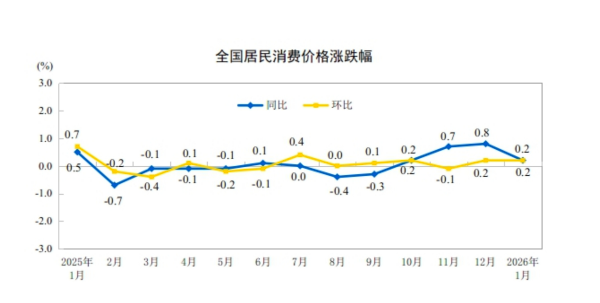
Group 1: Consumer Price Index (CPI) - In January, the CPI increased by 0.2% month-on-month and year-on-year, reflecting a decrease of 0.6 percentage points compared to December [1] - The decline in CPI is attributed to the Spring Festival timing and a significant drop in energy prices, which decreased by 5.0%, impacting CPI by approximately 0.34 percentage points [3] - Core CPI, excluding food and energy, rose by 0.8% year-on-year and 0.3% month-on-month, marking the highest increase in six months, indicating a steady recovery in consumer demand [3] Group 2: Producer Price Index (PPI) - The PPI rose by 0.4% month-on-month in January, marking the fourth consecutive month of increase, with an expansion of 0.2 percentage points from the previous month [5] - Factors contributing to the PPI increase include the ongoing construction of a unified national market and rising demand in certain industries [5] - Prices in sectors such as photovoltaic, battery, cement, and steel have shown positive improvements due to the "anti-involution" policies implemented last year [5] Group 3: Industry-Specific Price Changes - In January, prices for cement manufacturing and lithium-ion battery manufacturing increased by 0.1%, continuing a four-month upward trend [5] - The price of photovoltaic equipment and components shifted from a 0.2% decrease to a 1.9% increase, while basic chemical raw materials saw a 0.7% increase [5] - The prices of non-ferrous metal mining and smelting industries rose significantly, with silver smelting prices increasing by 38.2% and copper smelting by 8.4% [6] Group 4: Future Price Trends - The National Bureau of Statistics indicates that favorable factors for moderate price recovery are accumulating, supported by policies aimed at boosting consumption and stabilizing market expectations [6] - The implementation of coordinated fiscal and financial policies is expected to gradually expand consumer demand, providing a foundation for stable price operations [6] - Emphasis on industry self-regulation and capacity management is anticipated to further enhance price recovery in key sectors [6]

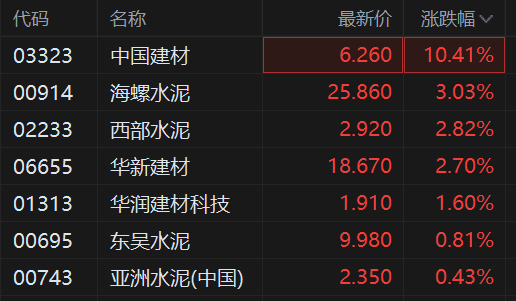
建材水泥股拉升,中国建材大涨超10%领衔,刷新阶段新高
Ge Long Hui· 2026-02-11 03:45
Group 1 - The core viewpoint of the article highlights a significant rise in Hong Kong's cement stocks, particularly China National Building Material, which surged over 10%, reaching a new high since April 2023 [1] - Longjiang Securities' research report recommends the cement sector due to policy-driven opportunities, indicating clear signals of an industry bottom after four consecutive years of demand decline and price competition [1] - The report suggests that the industry's profitability bottom is evident for the second half of 2025, with many mid-tier and lower-tier companies potentially facing substantial losses [1] Group 2 - The report mentions that overproduction management has led to a decrease in capacity, with production starting according to registered capacity from 2026, which may improve industry capacity utilization by 10-15 percentage points [1] - The dual carbon policy may see intensified implementation starting in 2026, which could lead to a steeper cost curve, benefiting leading companies with lower energy consumption [1] - Recently, China National Building Material secured four consecutive overseas contracts, including a project for the renovation of a cement raw material warehouse in France, showcasing the company's comprehensive service capabilities in cement engineering asset renovation and upgrades [1]
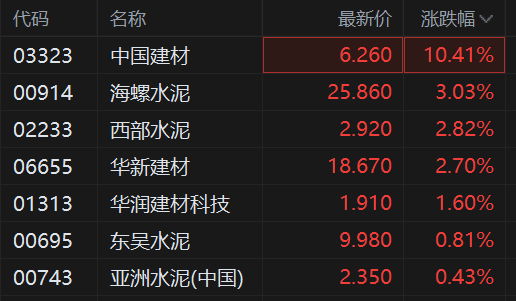
中国建材再涨超10% 资产减值属单次 反内卷下行业盈利能力有望温和回升
Zhi Tong Cai Jing· 2026-02-11 03:43
Group 1 - China National Building Material (03323) saw a stock increase of 10.76%, reaching HKD 6.28, with a trading volume of HKD 541 million [1] - The company issued a profit warning, expecting a shareholder loss of up to approximately RMB 4 billion in 2025, primarily due to asset impairment related to cement capacity replacement, estimated between RMB 6 billion to 8.3 billion [1] - Bank of America Securities reported that the loss magnitude exceeds their expectations, indicating that the anticipated dividend yield of around 5% for 2025 may face risks [1] Group 2 - Zhongtai Securities noted that the cement industry is actively implementing strict production regulations according to designed capacity, reducing actual clinker capacity from 2.1 billion tons to 1.6 billion tons, which is expected to improve industry capacity utilization [1] - Although there is still a mismatch between supply and demand, higher capacity utilization is likely to facilitate off-peak production, leading to a continuous increase in industry net profit per ton and overall industry profitability [1]
港股异动 | 中国建材(03323)再涨超10% 资产减值属单次 反内卷下行业盈利能力有望温和回升
智通财经网· 2026-02-11 03:42
Group 1 - China National Building Material (CNBM) shares rose over 10%, reaching HKD 6.28 with a trading volume of HKD 5.41 billion [1] - CNBM issued a profit warning, expecting a shareholder loss of up to approximately HKD 4 billion in 2025, primarily due to asset impairment related to cement capacity replacement, estimated between HKD 6 billion to HKD 8.3 billion [1] - Bank of America Securities reported that the loss magnitude exceeds their expectations, indicating that the anticipated dividend yield of around 5% for 2025 may face risks [1] Group 2 - China’s cement industry is actively implementing strict production regulations according to designed capacity, reducing actual clinker capacity from 2.1 billion tons to 1.6 billion tons, which is expected to improve industry capacity utilization [1] - Despite supply-demand mismatches, higher capacity utilization is likely to facilitate staggered production, leading to a potential increase in net profit per ton for the industry, thereby enhancing overall industry profitability [1]
印尼减产+进口通道畅通,能源国企有望持续受益,国企红利ETF(159515)涨0.25%
Xin Lang Cai Jing· 2026-02-11 03:38
东方证券指出,低位周期中具备红利吸引力的板块值得关注,宏观层面看,目前正处于PPI持续下行的 触底期,从市场预期角度看,PPI和行业盈利正处在低位回升的节点。在反内卷背景下有政策变化的行 业内,关注供给出清且有盈利弹性的板块,重点关注其中红利吸引力提升的板块。(文中所列示的行业 仅供参考,不预示本基金未来表现,不作为投资收益保证,也不构成对具体行业的投资建议) 国企红利ETF紧密跟踪中证国有企业红利指数,从国有企业中选取现金股息率高、分红比较稳定且有一 定规模及流动性的100只上市公司证券作为指数样本,反映国有企业中高股息率证券的整体表现。 据Wind数据显示,截至2026年1月30日,中证国有企业红利指数前十大权重股分别为中远海控、潞安环 能、西部矿业、山煤国际、恒源煤电、平煤股份、山西焦煤、兖矿能源、陕西煤业、华阳股份,前十大 权重股合计占比16.61%。(以上所列示股票为指数成份股,仅做示意不作为个股推荐。过往持仓情况 不代表基金未来的投资方向,也不代表具体的投资建议,投资方向、基金具体持仓可能发生变化。市场 有风险,投资需谨慎) 2026年2月11日早盘,截至11:05,中证国有企业红利指数上涨0.2 ...
港股异动丨建材水泥股拉升,中国建材大涨超10%领衔,刷新阶段新高
Ge Long Hui A P P· 2026-02-11 03:03
Group 1 - The core viewpoint of the article highlights a significant rise in Hong Kong's cement and building materials stocks, particularly China National Building Material, which surged over 10%, reaching a new high since April 2023 [1] - Longjiang Securities' research report recommends the cement sector due to policy-driven opportunities, indicating clear signals of industry bottoming after four consecutive years of demand decline and price competition [1] - The report suggests that the industry's profitability bottom is evident for the second half of 2025, with many mid-tier and lower-tier companies potentially facing substantial losses [1] Group 2 - The article notes that production overcapacity management has led to a decrease in capacity, with a projected increase in industry capacity utilization rates by 10-15 percentage points starting in 2026, based on registered production capacity [1] - The dual carbon policy may see intensified implementation in 2026, which could lead to a steeper cost curve, benefiting leading companies with lower energy consumption [1] - Recently, China National Building Material secured four consecutive overseas contracts, including a project for the renovation of a cement raw material depot in France, showcasing the company's comprehensive service capabilities in cement engineering asset renovation and upgrades [1]
建材行业2025年信用回顾与2026年展望
新世纪评级· 2026-02-11 01:19
新世纪评级 建材行业 2025 年信用回顾与 2026 年展望 建材 水泥:(弱)稳定 建筑玻璃:负面 建材行业 2025 年信用回顾与 2026 年展望 工商企业评级部 杨亿 袁诗怡 摘要 建材行业所涉范围广泛,本文着重就水泥及建筑玻璃行业展开分析。建材 行业系典型的投资拉动型行业,2025 年前三季度下游房地产行业持续低 迷,投资降幅走阔,基建投资则因财政支出重心转移及重大项目投资不利 而增长放缓,建材需求缺乏实质性提振。(水泥)2025 年以来,主要因我 国房地产市场深度调整,加之交通运输和公共建筑等领域投资情况不济, 水泥需求持续收缩。水泥行业错峰生产常态化开展,执行力度有所加强, 2025 年前三季度我国水泥产量同比有所下降,但需求跌幅超预期下,价 格中枢下移。2025 年煤炭价格先跌后涨,前三季度成本压力减轻下,行 业盈利状况有所改善,第四季度成本转嫁压力虽有所加大,但估计行业全 年利润总额仍同比小幅增长。(建筑玻璃)2025 年前三季度,房地产竣工 规模同比降幅较大,建筑玻璃需求持续收缩。2025 年以来行业产能开工 率波动相对较大,玻璃供给量同比小幅收缩,但远不及需求降幅,玻璃库 存维持高位, ...
生态筑基 “绿”动三秦
Shan Xi Ri Bao· 2026-02-11 00:49
生态文明建设功在当代、利在千秋。良好生态环境是最公平的公共产品,是最普惠的民生福祉。 2020年4月,习近平总书记在陕西考察时强调,陕西生态环境保护,不仅关系自身发展质量和可持 续发展,而且关系全国生态环境大局。 陕西全面落实习近平生态文明思想和习近平总书记历次来陕考察重要讲话重要指示精神,统筹推进 高水平保护和高质量发展,努力推动发展方式绿色低碳转型,全力推进美丽陕西建设。 "十四五"时期是陕西生态环境质量改善成效最大、绿色低碳转型发展步伐最大的时期,秦岭生态环 境质量稳居一类水平,黄河干流陕西段连续4年达到Ⅱ类水质,2025年空气优良天数超过300天…… 筑牢生态屏障 绘就美丽画卷 2023年5月,习近平总书记在听取陕西省委和省政府工作汇报时指出,要着力推动发展方式绿色低 碳转型,提升生态文明建设水平。牢固树立和践行绿水青山就是金山银山的理念,继续打好蓝天碧水净 土保卫战。 谆谆教诲,言犹在耳。陕西以高度的政治责任感,筑牢黄河流域、秦岭区域、南水北调中线工程水 源地三大屏障。 秦岭和合南北、泽被天下,是我国的中央水塔,是中华民族的祖脉和中华文化的重要象征。观察陕 西生态文明建设,秦岭是一个切入口。 在陕西 ...