连锁餐饮

Search documents
8点1氪:塔斯汀90天闭店907家;新东方员工发长文控诉加班遭秒删;乐视网回应“负债238亿拟花1.8亿炒股”
36氪· 2025-12-05 00:12
Group 1 - Tasting opened 968 new stores and closed 907 stores in the past 90 days, resulting in approximately 10,296 operating stores currently [2][3] - The brand has rapidly expanded in lower-tier markets and is now entering first-tier cities, achieving the status of a "10,000-store brand" in the second half of this year [5] Group 2 - New Oriental employees expressed grievances about excessive overtime and unrealistic performance targets, highlighting a "996" work culture [6][7] - The company has acknowledged the issue and stated that it will follow up on the matter through its internal reporting mechanisms [6] Group 3 - Micron Technology announced its exit from the retail storage business to focus on advanced storage chips for the AI era [23] - Palantir Technologies launched an operating system for AI infrastructure in the U.S., partnering with companies like NVIDIA [23]


8点1氪丨塔斯汀90天闭店907家;新东方员工发长文控诉加班遭秒删;乐视网回应“负债238亿拟花1.8亿炒股”
3 6 Ke· 2025-12-05 00:11
Group 1 - The core point of the news highlights the significant developments in various companies and industries, including the challenges faced by New Oriental and the financial strategies of LeEco [1][2][3][4][5][6][7][8][9][10][11][12][13][14][15][16][17][18][19][20][21][22][23][24]. Group 2 - New Oriental employees expressed grievances about excessive working hours, claiming a "996 single rest" routine, which contradicts their labor contracts [1][2]. - LeEco announced plans to invest 1.8 billion yuan in stock purchases despite having a debt of 238 billion yuan, clarifying that the investment aims to enhance capital operation returns [3][4]. - Xiaomi's president, Lu Weibing, reported that the company's advancements in AI models and applications have exceeded expectations [5]. - The Hong Kong government is providing financial relief to residents affected by a recent fire, including tax reductions and fee waivers [6]. - The new national standard for food delivery platforms aims to address issues like "ghost deliveries" and enhance merchant management [7]. - ByteDance refuted rumors regarding management changes and clarified that there are no new policies regarding employee management [15]. - Apple is set to open its sixth retail store in Beijing, emphasizing sustainable design practices [8]. - Meta has hired a top design executive from Apple, indicating its commitment to advancing in AI consumer devices [9].
战略解码:从“空中楼阁”到“脚下生根”的惊险一跃
Xin Lang Cai Jing· 2025-12-04 11:25
Core Insights - The essence of strategic planning lies not in the documentation but in the depth of execution [2][4] Group 1: Strategic Execution Challenges - A well-known home appliance company wasted millions hiring an international consulting firm for strategy, which ultimately became ineffective due to departmental autonomy [1][13] - An emerging tech company's founder aimed for "100 billion in three years" but failed due to internal resource conflicts during execution [1][13] Group 2: Strategic Decoding as Organizational Revolution - The case of Huawei's server business being transferred to a new entity, Super Fusion, illustrates the need for strategic resource alignment, especially under external pressures like U.S. sanctions [2][14] - This move not only avoided technology blockades but also achieved precise matching of strategic resources through equity restructuring [3][15] - Successful strategic decoding requires a seamless connection between strategy, organization, and resources [4][16] Group 3: Importance of Decoding Tools - The OGSM framework is favored by multinational companies for its comprehensive linkage from objectives to measurable goals [5][17] - A chain restaurant utilized OGSM to translate its strategy of enhancing brand image into actionable steps, resulting in a 5 yuan increase in average customer spending within six months [5][17] Group 4: Scene-Based Strategic Decoding - A new energy vehicle company creatively defined its strategy for autonomous driving by establishing 12 specific metrics, such as urban road scene coverage and extreme weather recognition accuracy [6][19] - This approach transformed traditional R&D into cross-departmental collaboration, allowing the company to surpass leading international competitors in autonomous driving tests [6][19] Group 5: Organizational Capability Reflection - Companies that struggle with strategic execution often fail in the "last mile" of organizational collaboration [8][9] - Future competition will focus on industry ecosystems rather than individual companies [10] - Companies need to build a triadic decoding system of strategy, organization, and technology, enabling every employee to contribute to strategic implementation [11][10]
王鹏:中企赴美展现两国强大“耦合”韧性
Sou Hu Cai Jing· 2025-12-03 23:07
Group 1 - Several Chinese chain restaurant brands are entering the U.S. market, opening dozens to hundreds of stores in multiple cities, despite structural pressures faced by Chinese companies operating in the U.S. [1] - The drive for Chinese companies to invest in the U.S. market stems from a strategic need to pursue technological influence, brand power, and market standard-setting, moving beyond mere trade and resource orientation [1][2] - Companies like Heytea and Nayuki are targeting the U.S. market to establish a second growth curve and achieve global brand elevation, shifting from cost advantages to model and efficiency advantages [2] Group 2 - Chinese companies face significant challenges in the U.S. market, including high localization costs, intense market competition, and political and policy risks from the U.S. government [2] - Despite the rhetoric of "decoupling," the economic relationship between China and the U.S. shows strong resilience, with mutual dependencies in supply chains that are difficult to sever [3] - The dynamic market structure allows for strategic depth and flexibility for Chinese companies, as they can leverage domestic e-commerce channels to buffer against external demand fluctuations [3] Group 3 - The journey of Chinese companies entering the U.S. market is complex, characterized by both opportunities and challenges, rooted in the internal demand for globalization and external geopolitical shocks [4] - Success for these companies relies on irreplaceable technological innovation, deep localization operations, and a high respect for global rules, which are essential for building true multinational competitiveness [4]
瑞银最新消费预判:服务消费刺激与旅游结构性变革,谁是2026新引擎?
Mei Ri Jing Ji Xin Wen· 2025-12-02 11:57
Group 1: Consumer Market Trends - The Chinese consumer market is experiencing structural differentiation amid a challenging global consumption environment, with new consumption sectors like trendy toys, high-end jewelry, and pet products showing strong alpha opportunities [1][2] - UBS analysts suggest that while overall consumption growth may continue to slow, the focus of consumption stimulus policies is shifting from home appliance subsidies to service and livelihood sectors [2][3] - The integration of outdoor activities with traditional tourism is creating a complementary effect, enhancing visitor stay duration and stimulating local diverse consumption [1][3] Group 2: Policy and Economic Factors - Macro policies are identified as key variables influencing future consumption, with a potential increase in support for childbirth, welfare for unemployed individuals, and service consumption [2][3] - The upcoming closure of Hainan's free trade port and the expansion of visa-free policies are expected to drive the evolution of China's consumption and tourism market towards higher quality and diversification [1][5] Group 3: Specific Industry Insights - The trendy toy industry is evolving into a global emotional consumer goods market, driven by supply-side innovations and localization capabilities [3] - The pet economy has maintained double-digit growth despite recent online competition pressures, with Chinese pet companies transitioning from OEM to proprietary brands and product innovation [3] - The consolidation of well-known chain restaurants in China is ongoing, with larger companies gaining market share during economic downturns, leading to increased industry concentration [3][4] Group 4: Tourism and Travel Dynamics - The return of Chinese tourists is reshaping the global tourism market, with international visitor flow recovering to pre-pandemic levels, particularly in popular destinations like South Korea [5][6] - The growth of inbound tourism is seen as a new opportunity for the Chinese tourism market, with significant potential for expansion as inbound tourist spending currently represents only 0.5% to 0.8% of China's GDP [7] - Hainan's duty-free industry is poised for development, with recent policy changes leading to a significant increase in sales, particularly among Russian tourists who are contributing to higher margins in high-value goods [6][7]
巴比食品20251128
2025-12-01 00:49
Summary of Baba Foods Conference Call Company Overview - **Company**: Baba Foods - **Industry**: Food and Beverage, specifically focusing on steamed buns (小笼包) Key Points and Arguments 1. **Expansion and Sales Performance**: New Baba Foods steamed bun stores in South China and Hefei have achieved sales exceeding 10,000 yuan per day, indicating a high acceptance and promotional potential for the steamed bun model nationwide, supporting the company's expansion strategy [2][4] 2. **Impact of Delivery Services**: New stores without delivery services have already reached sales of over 10,000 yuan, and the introduction of delivery services is expected to increase total store revenue by approximately 20% [2][6] 3. **Technological Innovations**: Baba Foods has solved technical challenges related to retaining soup in frozen raw buns after steaming and preventing the bottom of buns from sticking, enhancing product quality and competitive advantage [2][8][9] 4. **Partnerships with Delivery Platforms**: The company has established deep collaborations with delivery platforms like Meituan and Ele.me, utilizing promotional activities to enhance brand visibility and customer loyalty [2][10] 5. **Store Opening Plans**: Baba Foods plans to accelerate its store opening pace, with expectations to continue opening new stores in 2026 and upgrade existing ones with new design styles to boost overall sales [2][11] 6. **Differentiated Brand Strategy Post-Merger**: The company employs a differentiated operational strategy for acquired brands, with "Light Braise" receiving more support for upgrades, while earlier acquired brands maintain their original identity without expansion [2][5][12] 7. **Market Competition and Supply Chain Strength**: Baba Foods acknowledges potential competition but emphasizes its strong supply chain capabilities as a significant barrier to entry for other brands [2][7] 8. **Product Composition in Stores**: In over 5,000 stores, the majority utilize a combination of frozen dough, fillings, and finished buns, with 99% of stores ordering frozen dough, indicating a high level of operational efficiency [2][14] 9. **Challenges in New Restaurant Models**: The company faces challenges in securing prime locations for new steamed bun outlets, as many suitable spots are occupied by small brands, necessitating strategies to attract these operators [2][16] 10. **Future Growth Outlook**: While specific same-store growth data for 2026 is not available, the company remains cautiously optimistic, influenced by macroeconomic conditions and market competition [2][13] Additional Important Information - **Sales Performance by Region**: New stores in South China and Hefei show sales stability comparable to those in East China, indicating a successful model that can be replicated across regions [4] - **Member System and Customer Engagement**: The company is focused on enhancing its membership system and service quality to maintain a competitive edge in the market [8][10] - **No Current Plans for Stock Incentive Programs**: There are no immediate plans to continue stock incentive programs [2][17]

12月起,这些民生新规将影响你我生活
Xin Hua She· 2025-11-30 13:05
Core Viewpoint - A series of new regulations affecting public welfare will take effect from December 1, including updates to food safety laws, regulations for chain restaurants, and standards for campus meal services, as well as the cessation of old standards for electric bicycles. Group 1: Food Safety Regulations - The revised Food Safety Law will enhance supervision over the transportation of liquid foods and infant formula, introducing a licensing system for key liquid food transport and strict legal responsibilities for violations [1] - Infant formula liquid milk will be subject to registration management, prohibiting production under different brands using the same formula, ensuring quality and safety [1] Group 2: Chain Restaurant Regulations - New regulations will clarify the responsibilities of chain restaurant headquarters regarding food safety management, requiring them to allocate a portion of their revenue for food safety measures [2] - The regulations will define the roles of headquarters, branches, and stores in food safety, aiming to eliminate the issue of mutual blame when problems arise [2][3] Group 3: Campus Meal Standards - The first national standard for campus meal services will be implemented, providing guidelines for meal preparation, ingredient management, and emergency handling for service providers catering to schools [4] Group 4: Electric Bicycle Regulations - The new mandatory safety standards for electric bicycles will lead to the cancellation of certifications based on outdated standards, prohibiting the sale of non-compliant bicycles [4][5] - The updated standards will improve fire safety and prevent illegal modifications, while consumers are advised to look for CCC certification when purchasing electric bicycles [5]
探索连锁餐饮 智慧监管路径
Su Zhou Ri Bao· 2025-11-30 01:17
Core Viewpoint - The implementation of the new regulations by the State Administration for Market Regulation aims to enhance food safety management in chain catering enterprises, which is crucial for public health and quality of life [1] Group 1: Regulatory Framework - The new regulations titled "Supervision and Management Regulations for the Implementation of Food Safety Main Responsibility by Chain Catering Enterprises" will officially take effect on December 1 [1] - The local market regulation bureau is conducting specialized training for chain catering enterprises to clarify key points in food safety management system construction [1] Group 2: Management Practices - The core requirements of the "daily control, weekly inspection, monthly scheduling" work mechanism are being emphasized to strengthen the awareness of corporate responsibility [1] - Regulatory personnel are providing targeted guidance at the headquarters of chain enterprises, focusing on optimizing organizational structure, clarifying job responsibilities, and improving risk control lists [1] Group 3: Technological Integration - The local market regulation bureau is exploring smart regulatory paths by encouraging enterprises to utilize digital tools for information reporting, daily control records, and risk assessment [1] - Pilot projects are being launched to promote technologies such as AI recognition and blockchain, establishing an "intelligent warning - real-time rectification" mechanism to enhance the precision and effectiveness of food safety supervision [1]
遇见小面今起招股;快乐猴超市加速拓店;宗馥莉卸任娃哈哈董事长
Sou Hu Cai Jing· 2025-11-27 21:42
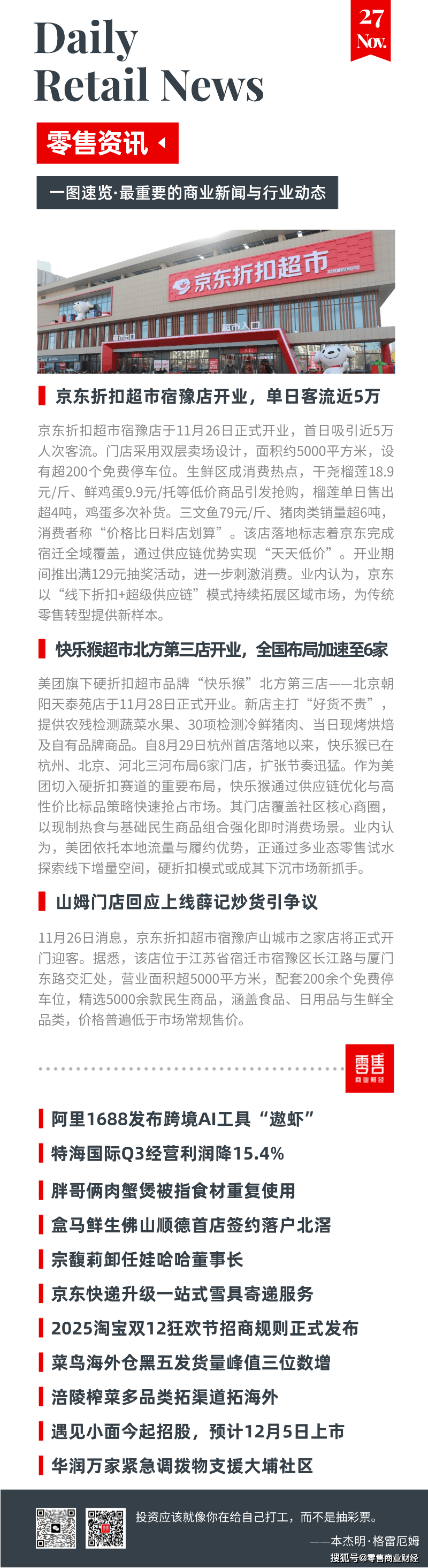
Group 1: JD Discount Supermarket - JD Discount Supermarket in Shuyang opened on November 26, attracting nearly 50,000 visitors on its first day. The store features a two-level design with an area of approximately 5,000 square meters and over 200 free parking spaces [7] - The fresh produce section became a consumer hotspot, with durians priced at 18.9 yuan per pound and fresh eggs at 9.9 yuan per tray, leading to significant sales, including over 4 tons of durians sold in one day [7] - The store's opening signifies JD's complete coverage of Suqian, leveraging supply chain advantages to offer "everyday low prices" [7] Group 2: Happy Monkey Supermarket - Meituan's hard discount supermarket brand "Happy Monkey" opened its third store in northern China on November 28, accelerating its national expansion to six stores [10] - The new store emphasizes "good products at low prices," offering tested vegetables and fruits, fresh pork, and self-branded products [10] - Happy Monkey's rapid market capture is attributed to supply chain optimization and high-cost performance strategies, focusing on community core business districts [10] Group 3: Sam's Club Controversy - Sam's Club faced criticism for introducing two products from Xueji Fried Goods, with some consumers questioning the frequency of common product introductions in a membership-based store [11] - A staff member clarified that the products were priced lower than at Xueji's stores and were conveniently packaged for transport [11] Group 4: Alibaba's Cross-Border AI Tool - Alibaba's 1688 platform launched a cross-border e-commerce AI tool named "Ao Xia," which provides one-stop supply chain services for small and medium-sized businesses [11] - The tool enhances product selection efficiency to the top 20% of human buyers and boasts an 80% inquiry task resolution rate [11] Group 5: Tehai International Q3 Performance - Tehai International reported a 7.8% year-on-year revenue increase to $214 million in Q3 2025, with same-store sales up 2.3% to $182 million [12] - However, operating profit fell by 15.4% to $12.6 million, with a profit margin of 5.9%, primarily due to increased foreign exchange losses [12] Group 6: Hema Fresh Store Expansion - Hema Fresh signed a contract to open its first store in Shunde, Foshan, expanding its presence in Guangdong [14] Group 7: Wahaha Leadership Change - Zong Fuli has stepped down as chairman of Wahaha, with Xu Simin taking over the role, while Zong retains a 29.40% stake in the company [16] Group 8: JD Express Service Upgrade - JD Express upgraded its one-stop ski equipment delivery service in response to the early start of the ice and snow season, offering customized packaging and free storage for seven days [16] Group 9: Taobao Double 12 Festival - The 2025 Taobao Double 12 Festival's promotional rules were released, with the event scheduled from December 8 to December 12, featuring official discounts [17] Group 10: Cainiao's Black Friday Performance - Cainiao's overseas warehouses experienced a three-digit percentage increase in daily shipping volume during Black Friday, with order processing capacity nearly tripling [18] Group 11: Fuling Mustard's Market Strategy - Fuling Mustard plans to expand its product matrix and channels while continuing to develop overseas markets to drive overall sales [20] Group 12: Encountering Small Noodles IPO - Guangzhou Encountering Small Noodles began its IPO process, planning to list on the Hong Kong Stock Exchange on December 5, with a share price range of 5.64 to 7.04 HKD [21] Group 13: China Resources' Emergency Relief - China Resources initiated an emergency relief plan to support the Dapu community in Hong Kong, providing over 5,000 essential supplies to residents affected by recent disasters [22]



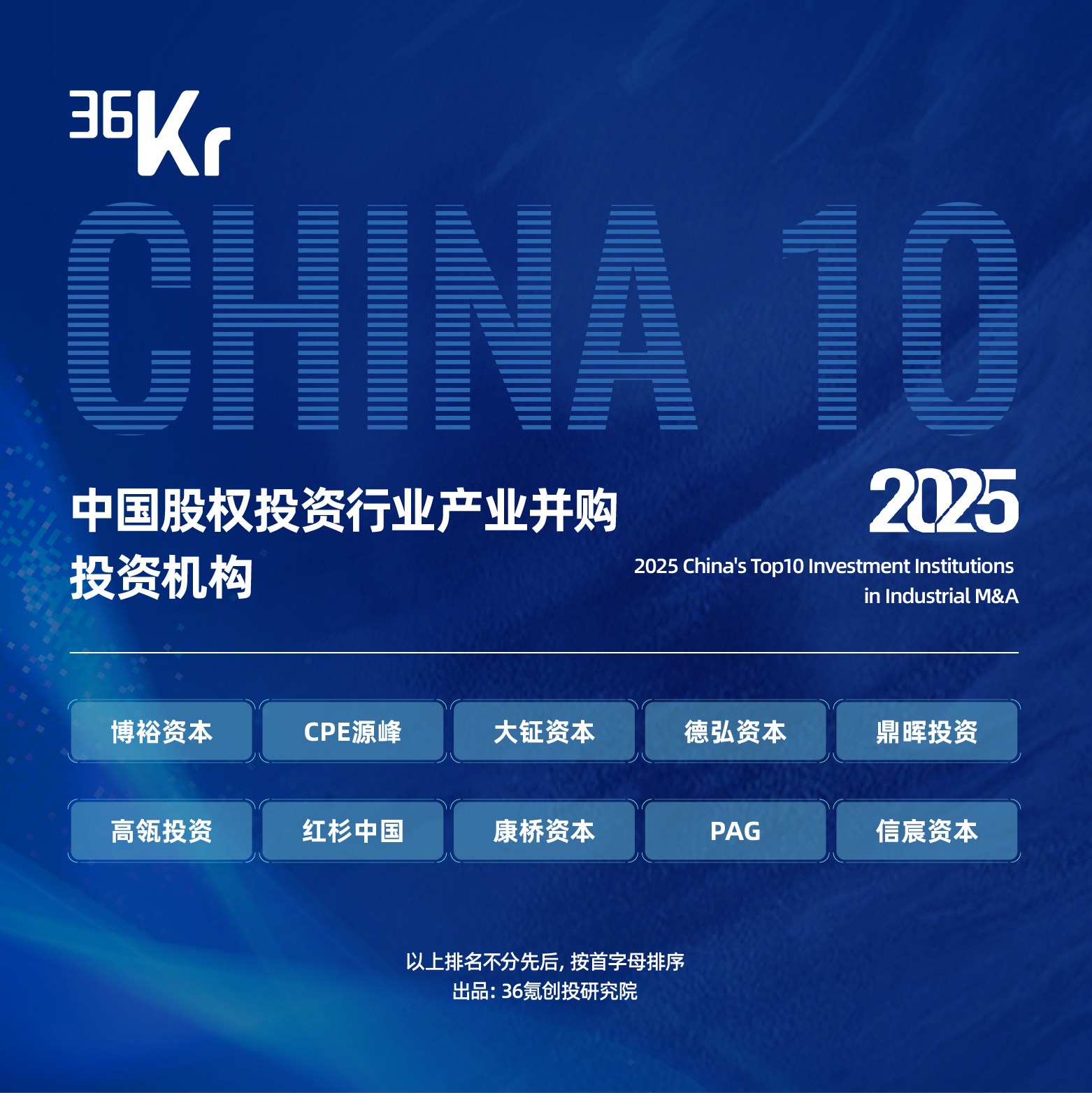
2025年度中国股权投资行业「产业并购」投资机构系列名册揭晓!
3 6 Ke· 2025-11-27 12:36
Core Insights - The year 2025 marks a significant turning point for China's M&A market, transitioning from "strategic attempts" to "systematic prosperity" due to supportive policies and resilient macroeconomic conditions [1][2] - Capital is increasingly focused on high-quality assets with strong cash flow, brand equity, and market share, moving away from merely seeking high returns [2] - The pressure for exits in the primary market has led to innovative liquidity solutions, with M&A becoming a widely accepted exit strategy for investors and entrepreneurs [2] M&A Trends - VC/PE institutions are undergoing a transformation, actively seeking control or leading stakes in quality assets rather than passively waiting for financial returns [2] - As of 2025, there have been over 25 significant M&A cases exceeding 5 billion, which redefine the relationship between investment institutions and the companies they invest in [2][3] Notable Transactions - CPE Yuanfeng's acquisition of 83% of Burger King's China operations is a strategic move to enhance digital operations and local menu innovation [3] - The partnership between Boyu Capital and Starbucks aims to leverage local market insights to drive growth in lower-tier markets and digital transformation [3] - Sequoia China’s acquisition of a majority stake in British audio brand Marshall for 1.1 billion euros highlights the trend of utilizing China's supply chain advantages to empower global brands [3] Investment Institutions - A list of notable investment institutions involved in M&A activities includes Boyu Capital, CPE Yuanfeng, Sequoia China, and others, reflecting their commitment to reshaping corporate DNA through acquisitions [6][9]