锂离子电池制造

Search documents
重磅经济数据发布!
证券时报· 2025-12-10 04:35
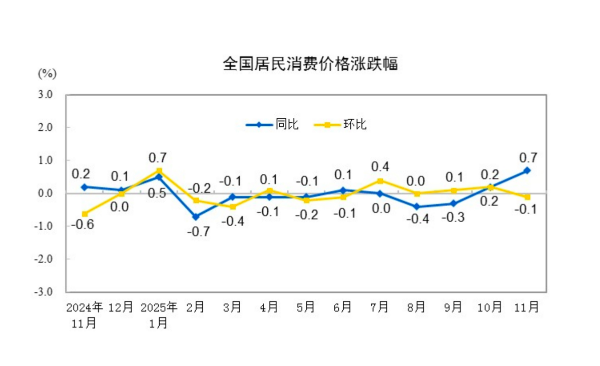
Group 1 - The core viewpoint of the article highlights the continuous recovery of consumer spending in November, with the Consumer Price Index (CPI) showing a year-on-year increase of 0.7%, marking the highest growth since March 2024 [1][3] - The core CPI, excluding food and energy prices, rose by 1.2% year-on-year, maintaining a growth rate above 1% for three consecutive months [5][6] - The Producer Price Index (PPI) experienced a year-on-year decline of 2.2%, with the drop rate expanding by 0.1 percentage points compared to the previous month, primarily due to a high comparison base from the previous year [9][10] Group 2 - In November, food prices increased by 0.5%, exceeding seasonal levels by 0.9 percentage points, largely driven by a significant rise in fresh vegetable prices, which turned from a 7.3% decline to a 14.5% increase [4][3] - Fresh vegetable prices rose by 7.2% month-on-month, significantly higher than the average seasonal decline of 3.2%, contributing approximately 0.17 percentage points to the month-on-month CPI increase [2][3] - The increase in food prices was complemented by rising prices in other categories, such as household appliances and clothing, which rose by 4.9% and 2.0% respectively [7] Group 3 - The article notes that the comprehensive rectification of "involution-style" competition has shown results, with price declines in industries such as coal mining, photovoltaic equipment manufacturing, and lithium-ion battery manufacturing narrowing for several consecutive months [1][10] - Emerging industries are experiencing rapid development, leading to price increases in related sectors, such as a 13.9% rise in external storage devices and components, and a 3.8% increase in graphite and carbon products manufacturing [11] - The effective release of consumer potential is reflected in price recoveries in various industries, including a 20.6% increase in the manufacturing of arts and crafts and ceremonial goods [11]


1.2%↑!创2024年3月以来新高!
Zheng Quan Shi Bao Wang· 2025-12-10 03:53
Group 1: Consumer Price Index (CPI) Trends - In November, the Consumer Price Index (CPI) increased by 0.7% year-on-year, with the growth rate expanding by 0.5 percentage points compared to the previous month, marking the highest increase since March 2024 [2] - Food prices contributed to the CPI increase, with fresh vegetable prices rising by 14.5% after a decline of 7.3% in the previous month, significantly impacting the CPI [2] - The core CPI, excluding food and energy, rose by 1.2% year-on-year, maintaining a growth rate above 1% for three consecutive months [3] Group 2: Producer Price Index (PPI) Trends - The Producer Price Index (PPI) decreased by 2.2% year-on-year in November, with the decline rate expanding by 0.1 percentage points compared to the previous month, influenced by a high comparison base from the previous year [4] - The PPI showed signs of improvement in specific industries, with price declines narrowing in coal mining, photovoltaic equipment manufacturing, and lithium-ion battery manufacturing [4][5] - Emerging industries are driving price increases, with external storage devices and components rising by 13.9% year-on-year, and other sectors like integrated circuit manufacturing and carbon product manufacturing also showing positive trends [5]

11月CPI同比升至20个月新高,发生了什么
Di Yi Cai Jing· 2025-12-10 03:45
扣除食品和能源价格的核心CPI同比上涨1.2%。 国家统计局12月10日发布最新居民消费价格指数(CPI)和工业生产者出厂价格指数(PPI)数据。 随着扩内需政策持续落地见效,居民消费持续恢复,11月份CPI同比上涨0.7%,为2024年3月份以来最 高。受国内部分行业供需结构优化、国际大宗商品价格传导等因素影响,PPI环比上涨0.1%,同比下降 2.2%。 国家统计局城市司首席统计师董莉分析,11月CPI同比上涨0.7%,涨幅比上月扩大0.5个百分点,同比涨 幅扩大主要是食品价格由降转涨拉动。食品价格由上月下降2.9%转为上涨0.2%,对CPI同比的影响由上 月下拉0.54个百分点转为上拉0.04个百分点。 食品中,鲜菜价格由上月同比下降7.3%转为上涨14.5%,为连续下降9个月后首次转涨,对CPI同比的上 拉影响比上月增加约0.49个百分点;鲜果价格由上月下降2.0%转为上涨0.7%;猪肉和禽肉类价格分别同 比下降15.0%和0.6%,降幅均有收窄。 PPI同比下降2.2%,降幅比上月扩大0.1个百分点,主要受上年同期对比基数走高影响。 董莉娟表示,我国各项宏观政策不断显效,价格呈现积极变化。综合整治" ...
1.2%↑!创2024年3月以来新高!
券商中国· 2025-12-10 03:32
Core Viewpoint - In November, consumer spending continued to recover, and the effectiveness of comprehensive rectification of "involution-style" competition became evident, with notable changes in price trends across various industries [2][7]. Consumer Price Index (CPI) - In November, the CPI increased by 0.7% year-on-year, with the growth rate expanding by 0.5 percentage points compared to the previous month, marking the highest increase since March 2024 [3][4]. - Food prices rose by 0.2% year-on-year, while non-food prices increased by 0.8%. Fresh vegetable prices turned from a decline of 7.3% last month to an increase of 14.5%, contributing approximately 0.49 percentage points to the CPI [3][4]. - Month-on-month, fresh vegetable prices rose significantly by 7.2%, far exceeding the average seasonal decline of 3.2%, impacting the CPI by about 0.17 percentage points [3]. Core CPI - The core CPI, excluding food and energy, rose by 1.2% year-on-year, maintaining a growth rate above 1% for three consecutive months [5]. - Prices for services and industrial consumer goods, excluding energy, increased by 0.7% and 2.1%, respectively, contributing approximately 0.29 and 0.53 percentage points to the CPI [5]. Producer Price Index (PPI) - The PPI decreased by 2.2% year-on-year, with the decline rate expanding by 0.1 percentage points compared to the previous month, primarily due to a high comparison base from the previous year [6]. - The PPI showed a month-on-month increase for two consecutive months, attributed to seasonal demand increases in certain domestic industries [8]. Industry Price Trends - The comprehensive rectification of "involution-style" competition has led to a narrowing of price declines in related industries, such as coal mining, photovoltaic equipment manufacturing, and lithium-ion battery manufacturing [7]. - Emerging industries are rapidly developing, driving price increases in sectors like external storage devices (up 13.9% year-on-year) and integrated circuit manufacturing (up 1.7%) [7]. - Consumer potential is being effectively released, reflected in price increases in sectors such as craft art and ceremonial supplies (up 20.6% year-on-year) and sports ball manufacturing (up 4.3%) [7].
高基数下11月PPI同比降幅有所扩大,但部分行业价格呈回升态势
Sou Hu Cai Jing· 2025-12-10 03:15
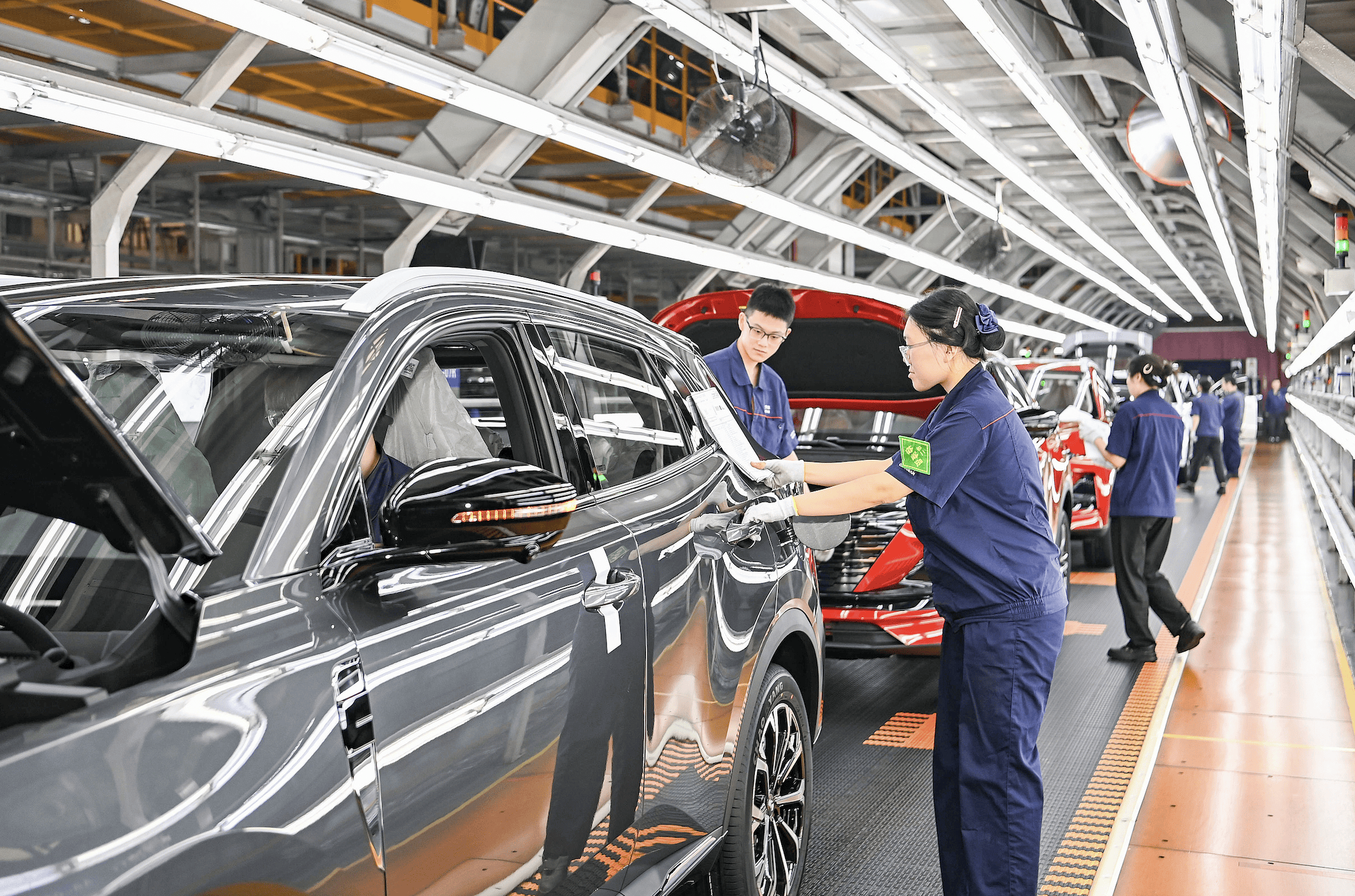
国家统计局周三公布数据显示,11月工业品出厂价格(PPI)同比下降2.2%,降幅较上月扩大0.1个百分点,结束连续三个月降幅收窄进程;环比上涨0.1%, 连续两个月上涨。 国家统计局城市司首席统计师董莉娟在当天发布的新闻稿中解读称,PPI同比降幅有所扩大主要是受上年同期对比基数走高影响。我国各项宏观政策不断显 效,价格呈现积极变化。 统计局提到,随着综合整治"内卷式"竞争成效显现,相关行业价格同比降幅收窄。重点行业产能治理持续推进,市场竞争秩序不断优化,煤炭开采和洗选 业、光伏设备及元器件制造、锂离子电池制造价格同比降幅比上月分别收窄3.8个、2.0个和0.7个百分点,均已连续多个月收窄。 记者 辛圆 往后看,西南证券在最近发布的研究报告中指出,随着10月底发布的"十五五"规划推进落地,一系列扩内需与"反内卷"政策的效能将持续释放,有望推动重 点行业价格企稳回升。在宏观政策支持与供需结构改善的背景下,后续价格水平预计将延续向好态势,预计PPI同比降幅将呈现收窄态势。 不过,东方金诚首席宏观分析师王青表示,"反内卷"对年底前基础原材料和工业品价格的带动作用有待进一步观察,需求不足会继续制约工业品价格上行空 间, ...
国家统计局:综合整治“内卷式”竞争成效显现,相关行业价格同比降幅收窄
Bei Jing Shang Bao· 2025-12-10 02:49
北京商报讯(记者 和岳)12月10日,国家统计局城市司首席统计师董莉娟表示,综合整治"内卷式"竞 争成效显现,相关行业价格同比降幅收窄。重点行业产能治理持续推进,市场竞争秩序不断优化,今年 11月煤炭开采和洗选业、光伏设备及元器件制造、锂离子电池制造价格同比降幅比上月分别收窄3.8 个、2.0个和0.7个百分点,均已连续多个月收窄;新能源车整车制造价格降幅比上月收窄0.6个百分点。 ...
好评中国|聚力前行,为做好经济工作积蓄磅礴力量
Huan Qiu Wang· 2025-12-02 08:58
Group 1 - China's economy is maintaining a stable and progressive development trend, showcasing strong resilience and a bright outlook for the future [1] - In the first three quarters, the GDP grew by 5.2% year-on-year, accelerating by 0.2 and 0.4 percentage points compared to the previous year and the same period last year, respectively [1] - The urban unemployment rate averaged 5.2% in the first three quarters, remaining stable compared to the first half of the year [1] - The scale of foreign trade reached a historical high, with import and export growth rates gradually recovering, and foreign exchange reserves maintained above $3.3 trillion [1] Group 2 - The optimization of China's economic structure and the transition of growth drivers are progressing steadily, with significant advancements in high-quality development [2] - In the first three quarters, the added value of the equipment manufacturing industry and high-tech manufacturing industry accounted for 35.9% and 16.7% respectively, indicating a clear trend of industrial upgrading [2] - Investment in equipment and tools increased by 14% year-on-year, with emerging industries like lithium-ion battery manufacturing and new energy vehicles showing rapid growth [2] Group 3 - China's strong resilience is fundamental to its ability to cope with uncertainties and achieve stable long-term growth [3] - The first three quarters of stable growth laid a solid foundation, while new productive forces are being cultivated to create new growth points [3] - The macro policy space remains ample, providing continuous support for the economy, with positive factors accumulating as indicated by leading indicators and high-frequency data [3]
前10月江苏省工业增加值同比增长6.8%
Guo Ji Jin Rong Bao· 2025-11-21 07:13
Group 1: Industrial Growth - The industrial added value in Jiangsu Province increased by 6.8% year-on-year from January to October, with a 5.8% increase in October alone [1] - Among the 40 major industries, 27 experienced year-on-year growth, resulting in a growth coverage of 67.5% [1] - The top ten key industries, including electronics, pharmaceuticals, and power generation, outperformed the provincial average, contributing a total of 4 percentage points to the overall industrial growth [1] Group 2: Equipment Manufacturing - The added value of the equipment manufacturing sector accounted for 55.4% of the total industrial added value, showing an increase of 0.2 and 1.1 percentage points compared to the previous months and 2024, respectively [1] - In October, the equipment manufacturing sector's added value grew by 8%, surpassing the overall industrial growth by 2.2 percentage points, contributing 76.9% to the total industrial added value growth [1] - Key sectors such as electronics and aerospace have maintained double-digit growth for ten consecutive months [1] Group 3: High-tech Manufacturing - High-tech manufacturing and digital core product manufacturing saw year-on-year growth of 11.7% and 9.4%, respectively, exceeding the overall industrial growth by 5.9 and 3.6 percentage points [2] - Specific industries like optoelectronic devices, lithium-ion batteries, and integrated circuits experienced significant growth rates of 21%, 27.6%, and 34.1% [2] - Production volumes for integrated circuits, industrial robots, and semiconductor components also showed robust growth, with increases of 18.5%, 19.9%, 11.3%, and 10.5% [2] Group 4: Fixed Asset Investment and Consumption - From January to October, fixed asset investment in Jiangsu Province decreased by 8.7%, with infrastructure investment down by 2.2% [2] - Manufacturing investment fell by 4.1%, although the decline was 0.4 percentage points less than in the previous months [2] - Real estate development investment saw a significant drop of 19.8% [2] Group 5: Retail Sales - The total retail sales of consumer goods reached 38,816.8 billion yuan, marking a year-on-year growth of 4.0% from January to October [3] - In October, retail sales of household appliances and audio-visual equipment, as well as computers and related products, grew by 7.4% and 48%, respectively [3] - Year-on-year sales growth for wholesale and retail sectors was 5.1% and 7.6%, while accommodation and catering sectors saw increases of 2.7% and 5.1% [3]
10月经济:新动能加快塑造,政策持续加力
2 1 Shi Ji Jing Ji Bao Dao· 2025-11-15 23:39
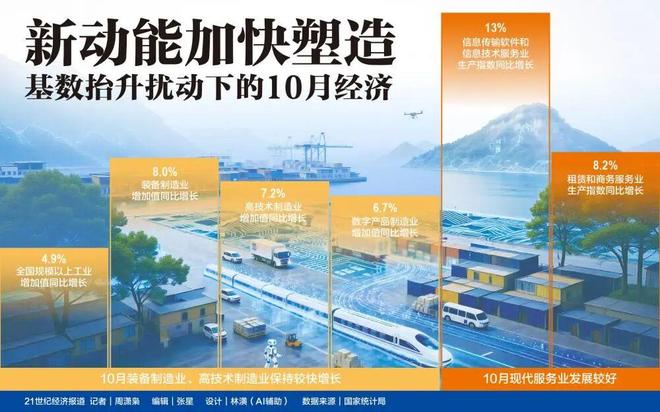
Economic Overview - In October, some economic indicators showed a downward trend due to last year's high base, deep adjustments in the real estate sector, and weak domestic demand [2][6] - Despite the downturn, there were positive signs such as a rebound in service retail sales driven by the National Day and Mid-Autumn Festival holidays, indicating significant consumption potential [2][6] Industrial Performance - The industrial added value for October grew by 4.9% year-on-year, a decline of 1.6 percentage points from the previous month, marking the lowest monthly growth this year [6][12] - The manufacturing sector is transitioning towards high-end production, with equipment manufacturing increasing by 8%, outpacing overall industrial growth [6][10] Investment Trends - From January to October, fixed asset investment (excluding rural households) decreased by 1.7%, with infrastructure investment down by 0.1% and real estate development investment down by 14.7% [7][14] - High-tech sectors such as aerospace and information services saw significant investment growth, with aerospace manufacturing up by 19.7% and information services up by 32.7% [7][12] Trade Dynamics - In October, the total import and export volume grew by 0.1% year-on-year, with exports declining by 0.8% and imports increasing by 1.4% [8][9] - The trade growth slowdown was attributed to last year's high base, with some exports delayed from September due to typhoons [9][10] Policy Measures - The government is implementing policies to enhance the adaptability of supply and demand in consumer goods, aiming to stimulate consumption and investment [3][13] - Recent policies include the introduction of 500 billion yuan in new policy financial tools and the acceleration of local government bond usage to support effective investment [13][14] Economic Outlook - Despite the challenges, the overall economic operation remains stable, with a GDP growth of 5.2% in the first three quarters, laying a solid foundation for achieving the annual target of around 5% [12][15] - Analysts suggest that additional policy measures may be necessary to counteract weak demand and support economic recovery, particularly in the real estate sector [14][15]
10月经济:新动能加快塑造,政策持续加力
21世纪经济报道· 2025-11-15 23:31
Economic Overview - In October, economic indicators showed a downward trend due to factors such as last year's high base, deep adjustments in the real estate sector, and weak domestic demand [1][4] - Despite the downturn, there were positive signs in the economy, particularly in service retail sales, which rebounded due to the National Day and Mid-Autumn Festival holidays, indicating significant consumption potential [1][11] Production and Investment - The industrial added value and service production index both recorded their lowest monthly growth rates of the year in October, with industrial added value growing by 4.9%, down 1.6 percentage points from the previous month [5][11] - Fixed asset investment (excluding rural households) decreased by 1.7% year-on-year from January to October, with infrastructure investment down by 0.1% and real estate development investment down by 14.7% [6][12] Trade and Exports - In October, the total import and export volume grew by only 0.1%, with exports declining by 0.8% and imports increasing by 1.4%, reflecting a significant drop in growth compared to previous months [7][11] Policy Measures - The State Council is implementing measures to enhance the adaptability of supply and demand in consumer goods, aiming to stimulate consumption and improve project funding arrangements [2][12] - Recent policies include the accelerated deployment of 500 billion yuan in new policy financial tools and the utilization of 500 billion yuan in local government debt limits to boost effective investment [12][14] Economic Challenges and Outlook - The economy faces challenges from weak domestic demand and structural issues, necessitating stronger growth policies to reverse the current downward trend and promote recovery [13][14] - Despite the pressures, achieving the annual growth target of around 5% remains likely, with expectations for further fiscal and monetary policy support in the coming months [13][14]