
铜业

Search documents
新能源及有色金属日报:进口铜到货,铜价维持震荡格局-20250819
Hua Tai Qi Huo· 2025-08-19 03:50
1. Report Industry Investment Rating - Copper: Cautiously bullish [8] - Arbitrage: On hold [8] - Options: short put@77000 yuan/ton [8] 2. Core View of the Report The current processing fees have rebounded, but the relative shortage of mine resources is difficult to change temporarily. Consumption is also hard to show excellent performance. However, with relatively stable grid orders, it won't collapse significantly. Macro factors are relatively favorable for copper prices. Therefore, it is recommended to mainly use buy - in - hedging on dips, with an operating range of 77,500 - 77,800 yuan/ton. Attention should be paid to the later development of the Putin - Trump meeting. If the situation continues to improve, the LME may accept Russian copper again, which may put downward pressure on LME copper prices [8]. 3. Summary According to Related Catalogs Market News and Important Data Futures Quotes On August 18, 2025, the main contract of Shanghai copper opened at 79,060 yuan/ton and closed at 78,950 yuan/ton, a - 0.14% decline from the previous trading day's close. The night - session main contract opened at 78,840 yuan/ton and closed at 78,840 yuan/ton, a 0.14% decline from the afternoon close of the previous day [1]. Spot Situation The domestic electrolytic copper spot market showed a supply - demand game. Shanghai's spot quotes had a premium of 170 - 280 yuan/ton over the 2509 contract, with an average premium of 225 yuan/ton, up 45 yuan/ton from the previous day. The spot price range was 79,160 - 79,400 yuan/ton. The import window opening brought a profit margin of 200 yuan/ton. Weekend arrivals increased Shanghai's inventory, and imported supplies were sufficient, but domestic copper circulation was still tight, supporting a strong spot premium. It is expected that today's spot premium may decline under pressure [2]. Important Information Summary - Macro: The Jackson Hole Global Central Bank Annual Meeting will be held on Friday, and Fed Chairman Powell will speak. Due to the resilience of US inflation and the employment market, there are large differences in short - term market expectations for future interest - rate cuts. It is expected that Powell will have difficulty giving clear guidance on the future interest - rate path [3]. - Tariffs: Trump threatened to impose a 50% tariff on Indian goods. India's Prime Minister Modi plans to reform the goods and services tax, simplifying four tax brackets to two. The German government said the US must reduce tariffs on European - made cars before finalizing a broader trade agreement [3]. - Mine: Marimaca Copper's new drilling in the Pampa Medina mine in northern Chile expanded the ore body. Codelco requested to restart operations at the El Teniente copper mine's Andes Norte and Diamante mines, and some mines have resumed operations [4]. - Smelting and Import: In July 2025, China's exports of unwrought copper and copper products were 190,796 tons, a 35.4% year - on - year increase; the cumulative export from January to July was 934,046 tons, a 10.0% year - on - year increase. Imports in July were 480,000 tons, a 10.0% year - on - year increase; the cumulative import from January to July was 3.11 million tons, a 2.6% year - on - year decrease [5]. - Consumption: Last week, the domestic refined copper rod industry's operating rate rose to 70.61%, a 1.75 - percentage - point increase from the previous week but a 10.31 - percentage - point decrease from the same period last year. It is expected to rise to 71.79% next week. The copper cable enterprise's operating rate fell to 69.3%, a 0.59 - percentage - point decrease from the previous week, and is expected to further drop to 67.6% next week [5]. - Inventory and Warehouse Receipts: LME warehouse receipts decreased by 50 tons to 155,600 tons. SHFE warehouse receipts increased by 938 tons to 25,498 tons. On August 18, the domestic electrolytic copper spot inventory was 133,700 tons, an increase of 8,100 tons from the previous week [6][7]. Strategy - Copper: Cautiously bullish. It is recommended to use buy - in - hedging on dips in the range of 77,500 - 77,800 yuan/ton, but pay attention to the Putin - Trump meeting [8]. - Arbitrage: On hold [8]. - Options: short put@77000 yuan/ton [8].
国泰君安期货所长早读-20250819
Guo Tai Jun An Qi Huo· 2025-08-19 02:35
1. Report Industry Investment Ratings No specific industry investment ratings are provided in the report. 2. Core Views of the Report - The central bank's Q2 monetary policy implementation report indicates that there are more positive factors for a moderate recovery in price levels, and promoting service consumption can help boost domestic demand [8]. - The hog market is under pressure with an oversupply situation, and the 9 - month contract is expected to shift to a discount structure [9][10]. - The bond market is expected to be volatile and bearish, with short - term contracts showing some resilience and long - term contracts facing potential adjustments [11]. - Various commodities have different trends, such as gold and silver being affected by PPI data, copper lacking driving forces and oscillating, and zinc facing downward pressure [13][17][22]. 3. Summaries by Related Catalogs 3.1 Central Bank Policy and Consumption - The central bank's Q2 2025 monetary policy implementation report emphasizes that promoting service consumption by improving high - quality service supply is important. In 2024, the service consumption proportion in residents' per - capita consumption expenditure was about 46.1%, with significant growth potential [8]. 3.2 Hog Market - Since July, leading hog groups have increased supply and reduced weight, causing the spot price to decline. The market's previous bullish expectations have failed, and there is an oversupply situation. The 9 - month contract is expected to shift to a discount structure [9][10]. 3.3 Bond Market - The bond market is expected to be volatile and bearish. The central bank's policy emphasizes "continuing easing" and "structural adjustment." Short - term contracts have some resilience, while long - term contracts may face adjustments due to inflation expectations, macro - policies, and equity market risk preferences [11]. 3.4 Commodity Market - **Precious Metals**: Gold and silver prices are affected by PPI data. Gold and silver prices declined slightly, and their trend intensities are - 1 [13][17][20]. - **Base Metals**: - **Copper**: Lacks driving forces and oscillates. US 7 - month PPI growth and changes in Chilean copper production and China's copper imports affect the market [22]. - **Zinc**: Faces downward pressure, and the trend intensity is - 1 [13][25][26]. - **Lead**: LME inventory reduction provides some support for prices, and the trend intensity is 0 [13][28][29]. - **Tin**: Oscillates within a range, and the trend intensity is - 1 [13][32][33]. - **Aluminum and Related Products**: Aluminum's volatility converges, alumina's center of gravity moves down, and cast aluminum alloy follows electrolytic aluminum. The trend intensities of aluminum and cast aluminum alloy are 0, and that of alumina is - 1 [13][35][37]. - **Nickel and Stainless Steel**: Nickel oscillates narrowly based on fundamentals, and stainless steel oscillates due to the game between macro - expectations and reality. Their trend intensities are both 0 [13][38][42]. - **Energy and Chemicals**: - **Carbonate Lithium**: Supply disruptions and improving demand may lead to a continued bullish oscillation. The trend intensity is 1 [13][43][45]. - **Industrial Silicon and Polysilicon**: Industrial silicon requires attention to market sentiment changes, and polysilicon requires attention to market news. The trend intensity of industrial silicon is 0, and that of polysilicon is 1 [13][46][49]. - **Iron Ore**: Macro - risk appetite has not significantly declined, providing support. The trend intensity is 1 [13][51][52]. - **Steel Products**: Rebar and hot - rolled coils oscillate widely, and their trend intensities are both 0 [13][54][58]. - **Ferroalloys**: Ferrosilicon oscillates weakly due to weak sector sentiment, and silicomanganese oscillates widely with a firm spot price. Their trend intensities are both 0 [13][59][61]. - **Coke and Coking Coal**: Both oscillate at high levels, and their trend intensities are both 0 [13][62][64]. - **Logs**: Oscillate repeatedly, and the trend intensity is 0 [13][65][68]. - **Petrochemicals**: Paraxylene is in a short - term oscillating market with increased supply and decreased demand but improved terminal demand. PTA has a weak reality and strong expectations, suitable for a monthly spread reverse arbitrage. MEG oscillates within a range, and attention should be paid to terminal demand improvement [13][69].
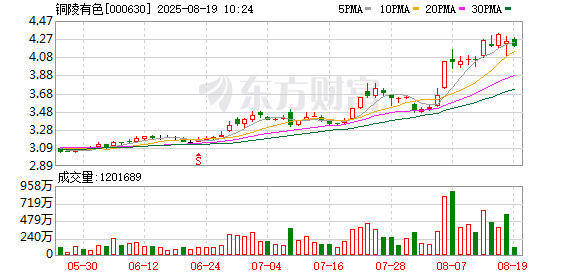
国信证券发布铜陵有色研报,米拉多铜矿盈利能力提升,二期即将投产
Mei Ri Jing Ji Xin Wen· 2025-08-19 02:23
Group 1 - The core viewpoint of the report is that Guotai Junan Securities has given Tongling Nonferrous Metals Group (000630.SZ) an "outperform" rating based on several factors [2] - The company's net profit attributable to shareholders is expected to decline by 34% year-on-year in the first half of 2025 [2] - Tongling Nonferrous is set to become the world's largest copper smelting company [2] - The company is experiencing an increase in copper production from its mines, along with a decrease in costs [2] Group 2 - The report highlights potential risks, including significant fluctuations in copper prices and a decline in copper concentrate processing fees [2]


金属和矿业公司面临数百万美元关税成本
Wen Hua Cai Jing· 2025-08-19 02:19
Core Viewpoint - The tariffs imposed by President Trump on various trade partners have significantly increased cost pressures and operational challenges for metal and mining companies, particularly affecting copper and aluminum producers while benefiting steel manufacturers [1][5]. Group 1: Impact of Tariffs on Companies - North American aluminum producers, including Alcoa and Rio Tinto, reported millions in tariff costs due to the doubling of aluminum import tariffs from 25% to 50% [2]. - Alcoa incurred $115 million in tariff costs in Q2, as 70% of its Canadian production is sold to the U.S. [3]. - Rio Tinto faced a total cost of $321 million for its Canadian aluminum exports due to U.S. tariffs [3]. - Freeport-McMoRan, the largest copper producer in the U.S., indicated that tariffs would increase costs by 5% [3]. - Caterpillar estimated the tariff impact in Q2 to be between $250 million and $350 million, leading to a 22% decline in adjusted operating profit [3]. Group 2: Steel Industry Perspective - The U.S. steel industry supports the increase in steel import tariffs from 25% to 50%, viewing it as a means to boost domestic demand and stabilize prices [5][6]. - Executives from Cleveland-Cliffs emphasized the necessity of strict enforcement of tariffs to maintain a strong domestic steel industry [7]. - Despite rising raw material costs, steel companies believe they can adjust their supply chains to cope with the changes [7]. - Steel companies expect improved operating conditions and profitability by the second half of 2025 due to stable demand [8]. Group 3: Operational Adjustments and Future Planning - Companies are reassessing their operational decisions in light of the tariff policies [9]. - Teck Resources reported an increase in capital requirements for its Highland Valley copper mine expansion project, raising its budget from CAD 2.1 billion to CAD 2.4 billion, reflecting a 14.3%-16.7% increase due to inflation and rising input costs [10]. - Grupo Mexico is evaluating U.S. investment opportunities, focusing on increasing smelting and refining capacity in response to tariff policies over the next 3-5 years [12].





北方铜业股价下跌2.53% 半年报显示贵金属业务增长52%
Jin Rong Jie· 2025-08-18 17:01
Group 1 - The stock price of Northern Copper on August 18 was 11.55 yuan, down 0.30 yuan or 2.53% from the previous trading day [1] - The trading volume on that day was 1.4136 million lots, with a total transaction amount of 1.623 billion yuan [1] - Northern Copper primarily engages in copper mining, smelting, and processing, with products including cathode copper, copper wire, and copper strip [1] Group 2 - For the first half of 2025, the company reported revenue of 12.811 billion yuan and a net profit of 487 million yuan [1] - Revenue from precious metals business reached 2.529 billion yuan, a year-on-year increase of 52.04%, accounting for 19.74% of total revenue [1] - The revenue from sulfuric acid business was 102 million yuan, showing a year-on-year growth of 197.33% [1] Group 3 - The company's R&D expenses increased by 48.60% year-on-year, contributing to a 3-5 percentage point increase in gross margin for new products [1] - On August 18, the net outflow of main funds was 210 million yuan, with a net outflow of 114 million yuan over the past five days [1]

全球关税地震!巴西印度重灾区!50%重压下全球贸易战一触即发
Sou Hu Cai Jing· 2025-08-18 13:30
Core Viewpoint - The implementation of the global tariff policy by the Trump administration marks a significant shift in U.S. trade policy, leading to widespread implications for global trade dynamics and economic conditions [1][6]. Group 1: Impact on Specific Countries - Brazil faces severe consequences with tariffs as high as 50%, leading to a drastic reduction in orders for export-oriented factories [3][5]. - India's traditional export sectors, such as textiles and jewelry, are also under pressure as tariffs approach 50%, prompting companies to reassess their global market strategies [3][11]. - Southeast Asian countries like Thailand and Indonesia are subjected to a 19% tariff, negatively impacting their agricultural and manufacturing sectors, particularly affecting Thailand's fruit exports [3][5]. Group 2: Reactions from Affected Countries - Many countries are sending delegations to negotiate tariff exemptions, with Brazil's orange juice industry successfully obtaining a waiver, allowing continued access to the U.S. market [7][10]. - Chile's copper industry has also secured special exemptions, leading to a rise in market confidence and stock prices for copper companies [7]. - Japan and South Korea are actively negotiating to protect their automotive and electronic sectors, with Japan particularly focused on the timing of reduced tariffs on cars [9][11]. Group 3: Broader Economic Implications - The average effective tariff rate in the U.S. has surged to its highest level in nearly a century, indicating a major shift in trade policy that could lead to increased consumer prices and a rise in protectionism globally [5][6]. - The uncertainty surrounding the U.S. tariff policy is prompting multinational companies to reevaluate their global supply chains, with some considering relocating production to other regions [12][14]. - The potential for a restructuring of global supply chains may lead to market volatility and economic disruptions in the short term, particularly affecting Southeast Asian economies that are integral to the electronics supply chain [14].
冠通期货铜周度策略展望-20250818
Guan Tong Qi Huo· 2025-08-18 11:10
1. Report Industry Investment Rating No relevant content provided. 2. Core Viewpoints of the Report - Overseas, after the release of US CPI data, the market increased expectations for a Fed rate cut, with the probability of a rate cut exceeding 90%. However, the soaring US PPI data on Thursday reduced the possibility of an unexpected rate cut, and the US dollar index rebounded accordingly. Domestically, nine departments including the Ministry of Finance jointly implemented a "discount interest" policy for service - industry loans to reduce financing costs and stimulate consumption. The economic data in July was weaker than before, and the central bank stated that it would implement a moderately loose monetary policy [4]. - In terms of supply, the port inventory of refined copper ore has declined to the lowest level in the past five years. The collapse of the El Teniente copper mine in southern Chile led to a short - term reduction in global supply. The TC/RC fees of smelters continued to stabilize and rebound. Long - term contract orders were profitable, while spot orders were still at a loss. The sulfuric acid price was at a historically high level, supporting smelter profits. Only one smelter had a maintenance plan in August, and a newly put - into - production smelter in East China started production. It is expected that the refined copper output will not fluctuate significantly, but smelters may cut or stop production in the later third quarter due to tight ore resources and sulfuric acid inventory [4]. - Regarding demand, downstream demand was lukewarm. Although new orders increased, market trading volume decreased month - on - month. The real estate sector still dragged down downstream demand, with real estate development investment from January to July decreasing by 12% year - on - year and the sales area of newly built commercial housing decreasing by 4% year - on - year. However, the power grid and new energy sectors brought demand resilience. The inventory of the Shanghai Futures Exchange increased this week, reflecting weak short - term demand and a pattern of loose supply and demand [4]. - Overall, last week, the rising expectation of a Fed rate cut boosted the Shanghai copper price. After the PPI data exceeded expectations on Thursday, the Shanghai copper price first rose and then fell, but the overall center of gravity maintained an upward trend. Due to the expected tight supply and the impact of the Chilean copper mine incident, and with the demand side in the off - season, downstream operations remained stable with a downward trend, and the market trading sentiment was lukewarm. The Shanghai copper price maintained a range - bound pattern. A Fed rate cut in September has been confirmed, and an unexpected rate cut should be watched out for [4]. 3. Summary According to Relevant Catalogs 3.1 Macro Information - On August 12, the US Bureau of Labor Statistics announced that the US CPI in July was flat year - on - year at 2.7%, lower than the expected 2.8%, and rose 0.2% month - on - month, in line with market expectations. The core CPI in July rose 3.1% year - on - year, higher than the expected 3%, reaching a new high since February. After the data release, the probability of a Fed rate cut in September exceeded 90%. - On August 14, the US Bureau of Labor Statistics announced that the PPI in July soared to 3.3% year - on - year, the highest level since February this year, far exceeding the expected 2.5%; it rose 0.9% month - on - month, the largest increase since June 2022, cooling the Fed rate - cut expectation [10]. 3.2 Shanghai Copper Price Trend - Last week, Shanghai copper showed an overall oscillatory and strengthening trend. The highest price of the week was 79,510 yuan/ton, the lowest was 78,410 yuan/ton, the weekly amplitude was 1.4%, and the range increase was 0.73% [14]. 3.3 Shanghai Copper Spot Market - As of August 18, the average spot premium in East China was 200 yuan/ton, and the average premium in South China was 40 yuan/ton. The market supply was tight, and with more domestic smelter maintenance, the spot premium strengthened. It is expected that the premium will face pressure after the arrival of imported goods next month [21]. 3.4 LME Copper Price and Inventory - As of August 18, the weekly change rate of LME copper was +0.31%, closing at $9,730/ton. The LME copper spot discount continued to weaken, and the LME copper inventory continued to increase, with sufficient deliverable goods in the market [27]. 3.5 Copper Concentrate Supply - According to customs data, in July 2025, China imported 2.56 million tons of copper concentrate and its ores, a year - on - year increase of 18.24% and a month - on - month increase of 8.94%. From January to July 2025, China imported 17.314 million tons of copper concentrate and its ores, a year - on - year increase of 8.0%. As of August 15, 2025, the inventory of imported copper concentrate at 16 Chinese ports was 422,000 tons, a decrease of 6,700 tons from the previous week. - The El Teniente copper mine of Codelco in Chile had a mine collapse on July 31, and the smelter restarted on August 13 [32]. 3.6 Smelter Fees - As of August 15, the spot rough smelting fee (TC) in China was -$37.65/ton, and the RC fee was -3.76 cents/pound. The TC/RC fees continued to stabilize and rebound. The TC/RC of the long - term contract negotiation result was set at $0/ton and 0 cents/pound. Long - term contract orders were profitable, while spot orders were still at a loss. The sulfuric acid price was at a historically high level, supporting smelter profits. Factory seasonal maintenance plans in September and October will still lead to production reduction [36]. 3.7 Refined Copper Supply - In July, SMM's electrolytic copper output in China was 1.1743 million tons, a month - on - month increase of 39,400 tons and a year - on - year increase of 14.21%. From January to July, the cumulative output was 7.7673 million tons, a year - on - year increase of 11.82%. With the gradual recovery of previously maintained smelters, only one smelter has a maintenance plan in August, and a newly put - into - production smelter in East China started production. It is expected that the output will not fluctuate significantly. In the later third quarter, production may be cut or stopped due to tight ore resources and sulfuric acid inventory. - In July, China's imports of unwrought copper and copper products were 480,000 tons. From January to July, the cumulative imports were 3.113 million tons, a year - on - year decrease of 2.6% [40]. 3.8 Scrap Copper Supply - In June 2025, scrap copper imports were 183,200 tons, with a relatively high year - on - year import volume and higher than market expectations. - As the price difference between refined and scrap copper increased, the substitution advantage of scrap copper decreased, and the scrap copper utilization rate of smelters decreased [46]. 3.9 Apparent Demand - As of June 2025, the apparent consumption of copper was 1.3705 million tons, at a historically high level. Since the beginning of this year, the apparent consumption of copper has been at a high level. It is estimated that China's refined copper consumption will increase by about 2% in 2025 and about 0.8% in 2026. - Downstream demand was lukewarm. Although new orders increased, market trading volume decreased month - on - month. However, the power grid and new energy markets were resilient, providing price support [50]. 3.10 Copper Products - According to Ganglian data, in July 2025, the capacity utilization rate of domestic refined copper rods was 61.32%, a month - on - month decrease of 0.99% and a year - on - year decrease of 0.85%. The start - up rate was lower than expected. Downstream cable procurement was cautious, the processing fee of copper rods was under pressure, and some refined copper rod enterprises cut production unexpectedly. Currently, the operating load is at a historically low level, and the reduction in August is expected to be limited. - The operating load of copper tube enterprises remained basically stable, showing a slight downward trend. Some manufacturers planned to increase production due to concerns about future supply shortages. Market demand was weak, and there was also phased replenishment [55]. 3.11 Power Grid Project Data - According to data from the National Energy Administration, from January to June, the investment in power grid projects was 291.1 billion yuan, a year - on - year increase of 14.6%, reaching a record high for the same period. From January to June, the investment in power source projects was 363.5 billion yuan, a year - on - year increase of 5.9%. Solar and wind power increased by 98.8% and 107% year - on - year respectively. The power grid project is still a rigid demand for copper, supporting the copper price [59]. 3.12 Real Estate and Infrastructure Data - From January to July, real estate development investment decreased by 12% year - on - year, and the sales area of newly built commercial housing decreased by 4% year - on - year. From January to July, the sales area of newly built commercial housing was 515.6 million square meters, a year - on - year decrease of 4.0%, 0.5 percentage points wider than that from January to June; the sales volume of newly built commercial housing was 4,956.6 billion yuan, a decrease of 6.5%, 0.5 percentage points wider than that from January to June [64]. 3.13 Automobile/New Energy Automobile Industry Data - From August 1 - 10, the retail sales of new - energy passenger vehicles were 262,000, a year - on - year increase of 6% and a month - on - month increase of 6%, with a penetration rate of 57.9%. As of now, the cumulative retail sales this year were 6.717 million, a year - on - year increase of 28% [70]. 3.14 Global Copper Inventory in Major Exchanges - After the end of the copper siphon effect and a large increase in LME copper inventory, the inventory increase rate has recently slowed down. As of August 15, the LME copper inventory was 155,800 tons, a week - on - week decrease of 0.03% and a month - on - month increase of 28.76%. The increase rate of COMEX inventory also gradually slowed down. The COMEX copper inventory was 267,200 tons, a week - on - week increase of 1.16% and a month - on - month increase of 11.59% [76]. - On August 14, the cumulative spot inventory of copper in the bonded areas of Shanghai and Guangdong was 86,800 tons, an increase of 5,900 tons compared with July 7 and an increase of 5,300 tons compared with August 11. The bonded area inventory continued to increase. During the week, the exported goods of smelters continued to arrive and be stored in the warehouse. Although some goods in individual warehouses were cleared and imported into the country, the overall inbound volume was greater than the outbound volume, resulting in an increase in inventory. - The inventory of the Shanghai Futures Exchange remained in a low - level oscillation and has not increased significantly yet, but it increased by 3,288 tons compared with the previous week, still showing a pattern of weak downstream demand and loose supply [81].
港股收评:冲高回落!恒指跌0.37%,影视股全天强势,半导体、内银股多数走低
Ge Long Hui· 2025-08-18 08:30
Market Overview - The Hong Kong stock market experienced a mixed performance with the Hang Seng Index closing down 0.37%, the Hang Seng China Enterprises Index down 0.06%, and the Hang Seng Tech Index up 0.65% after reaching a peak increase of 2.3% during the day [1] Technology Sector - Major technology stocks saw a narrowing of gains in the afternoon, with JD.com rising by 2.65%, Alibaba, Baidu, and Xiaomi each increasing by less than 1%, while Kuaishou fell by 1.47%. Tencent and Meituan also showed negative performance [1] Entertainment Industry - The summer box office continued to perform strongly, driven by positive reviews of major films, which boosted overall viewing demand. Film-related stocks were robust, with Lingmeng Film rising over 21%, Daocaoxiong Entertainment up nearly 15%, and Maoyan Entertainment increasing by nearly 6% [1] Healthcare Sector - Internet healthcare stocks collectively rose, with Ping An Good Doctor and JD Health both increasing by over 8% [1] Other Active Sectors - Rare earth concept stocks, military industry stocks, brain-computer interface concept stocks, automotive stocks, and Apple-related stocks showed active performance [1] Real Estate Sector - The real estate sector continued to weaken in July, with domestic property stocks generally declining [1] Commodities and Other Industries - The U.S. announced an expansion of tariffs on steel and aluminum imports by 50%, leading to declines in steel and copper stocks. Coal, oil, semiconductor, domestic banking, and shipping stocks mostly performed poorly [1]
沪铜小幅飘绿 社会库存有所增加【8月18日SHFE市场收盘评论】
Wen Hua Cai Jing· 2025-08-18 07:57
Group 1 - The core viewpoint of the article indicates that copper prices are experiencing slight fluctuations, with a minor decline of 0.01% at closing, influenced by limited macroeconomic guidance and increased social inventory at the beginning of the week [1] - Domestic copper concentrate processing fees are showing a rising trend, suggesting that demand-side expectations for price increases remain, although forward contracts for the fourth quarter are still around -40, indicating no substantial improvement in the tight supply situation [1] - As of August 18, domestic electrolytic copper inventory reached 144,200 tons, an increase of 11,800 tons compared to August 14, with significant inventory growth observed across various markets, particularly in Shanghai due to increased imports [1] Group 2 - According to Everbright Futures, copper prices are maintaining narrow fluctuations due to recent macroeconomic uncertainties, including mixed signals from tariff negotiations with the U.S. and ongoing uncertainties regarding key agreements with China [1] - The fundamental outlook for U.S. refined copper remains divided, particularly with concerns over excess inventory potentially leading to a weaker market, which could impact global copper prices [1] - Despite the potential for price weakness, the expectation of a seasonal increase in demand during September may stimulate downstream purchasing and inventory replenishment, thereby limiting the extent of price declines [1]
智利下调铜矿产量指引,稀土磁材需求旺盛 | 投研报告
Zhong Guo Neng Yuan Wang· 2025-08-18 06:33
Market Overview - The Shanghai Composite Index increased by 1.70% to close at 3696.77 points, while the CSI 300 Index rose by 2.37% to 4202.35 points. The SW Nonferrous Metals Industry Index saw a gain of 3.62%, closing at 5905.88 points as of August 15 [2][4]. Sub-industry Performance - Among the five sub-industries in the nonferrous metals sector, the changes compared to the previous week were as follows: Industrial metals +5.31%, Precious metals -3.45%, Minor metals +1.73%, Energy metals +2.79%, and New metal materials +7.67% [2][4]. Key Metal Prices - Key metal prices on the Shanghai Futures Exchange were as follows: Copper at 79,060 CNY/ton (+0.79%), Aluminum at 20,770 CNY/ton (+0.48%), Zinc at 22,505 CNY/ton (0.00%), Lead at 16,850 CNY/ton (-0.09%), Nickel at 120,600 CNY/ton (-0.46%), and Tin at 266,820 CNY/ton (-0.49%) [3]. - On the London Metal Exchange, prices were: Copper at 9,760 USD/ton (-0.02%), Aluminum at 2,603 USD/ton (-0.23%), Zinc at 2,797 USD/ton (-1.08%), Lead at 1,981 USD/ton (-1.32%), Nickel at 15,195 USD/ton (+0.26%), and Tin at 33,610 USD/ton (-0.04%) [3]. Lithium and Cobalt Prices - Battery-grade lithium carbonate and industrial-grade lithium carbonate prices increased significantly, with battery-grade lithium carbonate at 84,000 CNY/ton (+23.08%) and industrial-grade at 83,000 CNY/ton (+23.42%). Battery-grade lithium hydroxide rose by 14.19% to 77,875 CNY/ton, while Australian lithium concentrate increased by 33.33% to 864 USD/ton [3]. - Domestic cobalt prices showed mixed results, with electrolytic cobalt at 258,500 CNY/ton (-1.71%) and other cobalt products experiencing slight increases [3]. Investment Recommendations - The global copper supply is facing disruptions, particularly from the El Teniente copper mine in Chile, which has led to a downward revision of copper production forecasts for the year to 5.58 million tons, a 1.5% increase year-on-year [4][5]. - Despite being in a seasonal demand lull, strong demand from the power grid and new energy sectors is expected to support copper prices. The current low inventory levels in China are also contributing to a favorable price environment [5]. - Companies to watch include Zijin Mining, Luoyang Molybdenum, Western Mining, and Jinchuan Group, as they are well-positioned to benefit from these trends [5]. - The rare earth sector is also expected to see price increases due to stricter export controls and strong domestic demand, with key companies like Northern Rare Earth, Zhuhai Yinlong, and others being highlighted for potential growth [5].