
金融

Search documents
尚福林:以人工智能赋能金融高质量发展
Xin Lang Cai Jing· 2026-01-01 12:36
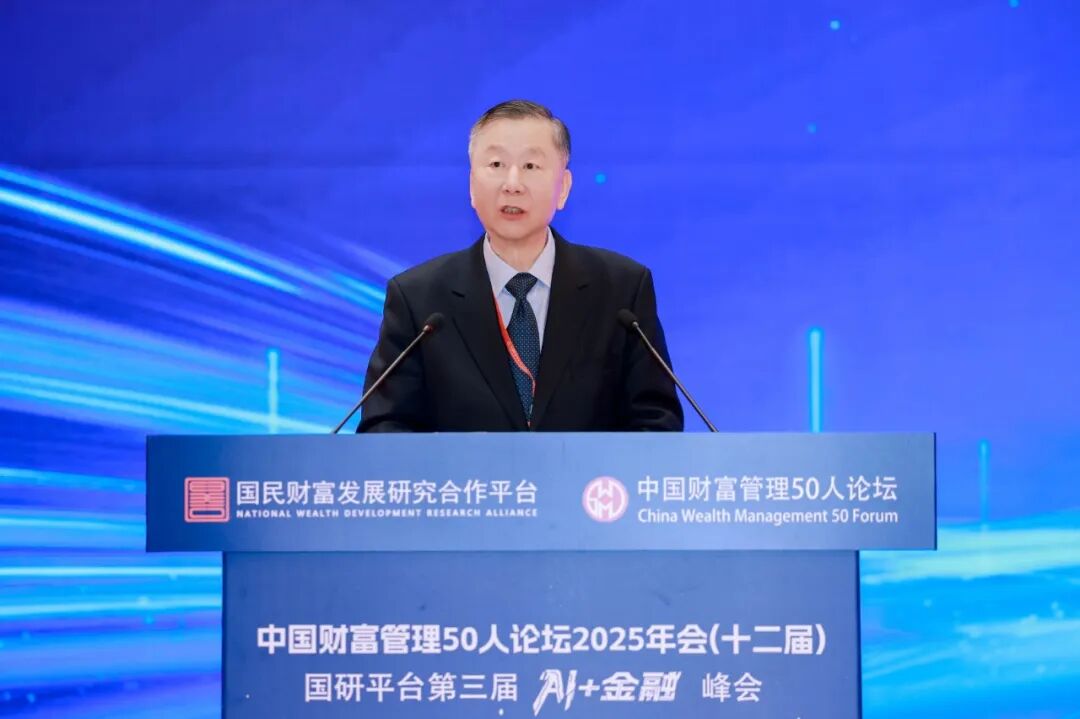
12月28日,在中国财富管理50人论坛2025年会暨国研平台第三届"AI+金融"峰会上,中国财富管理50人论坛理事长、原银监会主席、证监会原主席尚福林 发表题为"以人工智能赋能金融高质量发展"的致辞演讲。 尚福林表示,当前新一轮科技革命和产业变革深入推进,以人工智能为代表的前沿技术加速演进,并不断向经济社会各领域渗透融合。对于金融业而言, 这一轮技术变革的影响尤为深远。"AI+金融"既是技术命题,也是发展命题,更是治理命题。它蕴含着提升金融体系效率和韧性的巨大机遇,也伴随着新 的不确定性和风险挑战。未来推进"AI+金融"健康发展,关键在于统筹好创新与规范、效率与安全。一方面,要积极拥抱变革,鼓励金融机构在依法合规 的前提下积极探索;另一方面,要筑牢安全屏障,完善数据治理体系、内部控制流程和风险防控机制,切实维护金融安全。 当前,新一轮科技革命和产业变革深入推进,以人工智能为代表的前沿技术加速演进,并不断向经济社会各领域渗透融合。人工智能已逐步从单一的技术 工具,演变为具有基础性、通用性的关键能力,深刻重塑着产业结构和经济运行逻辑,成为塑造未来经济形态和竞争格局的重要变量。 对于金融业而言,这一轮技术变革的影响 ...

“股票盛世”!全球股市连续第3年“两位数上涨”
华尔街见闻· 2026-01-01 12:20
Core Viewpoint - The global stock market is expected to achieve double-digit growth for the third consecutive year in 2025, despite uncertainties from Trump's trade policies and concerns over AI sector bubbles. The MSCI global index has risen over 20% this year, outperforming most analysts' expectations [1]. Group 1: US Market Performance - After a significant downturn at the beginning of the year, the US stock market rebounded strongly, with the S&P 500 index showing an annual increase of nearly 16.5%. The release of a large language model by DeepSeek shocked Silicon Valley and led to a drop in tech stocks. Trump's announcement of large tariffs in April triggered sell-offs in stocks, bonds, and the dollar, but strong corporate earnings, expectations of Fed rate cuts, and better-than-expected economic growth quickly brought investors back to the market [2]. - Despite strong performance in the US market, other markets such as China, Japan, the UK, and Germany have outperformed the S&P 500 this year, with emerging market stock indices also performing better than US stocks. Investors sought more diversified allocations after experiencing volatility in the US market at the beginning of the year [4]. Group 2: Economic Resilience and Market Support - The resilience of the US economy, combined with the clear outlook for a shift in Fed monetary policy towards rate cuts, has been a core support for market performance, driving significant capital inflows into the stock market and reinforcing long-term bets on AI potential. Additionally, better-than-expected US economic growth data has alleviated market anxieties and boosted risk appetite [8]. Group 3: Valuation Concerns - Market valuations are significantly above historical averages, with analysts warning that the current rally, driven by tech giants, may not be sustainable. The Shiller cyclically adjusted price-to-earnings ratio for the S&P 500 is nearing 40 times, the second highest level since the early 2000s internet bubble [6][10]. - Following such a strong rally, market sentiment has begun to turn cautious, with some investors and analysts warning about the sustainability of the current market conditions. The rally has shown significant structural concentration and valuation divergence, primarily driven by a few tech giants, leading to a substantial deviation from long-term historical averages [10]. Group 4: Concentration Risk - The current market rally, driven by a small number of stocks, is accumulating structural risks. The so-called "seven giants" of US tech have reached about a quarter of the MSCI global developed market stock index, creating a deep binding of global index movements to the performance of these individual giants, thereby increasing overall market fragility [12]. - The increasing concentration trend in the market is prompting a deep examination of the merger frenzy in the AI sector. This trend has created a complex and interdependent financial network, exemplified by OpenAI, which not only holds stakes in key infrastructure suppliers but also receives substantial investments from other industry participants, potentially amplifying systemic risks [14].
全球主权财富基金:AUM达15万亿,AI投资660亿
Sou Hu Cai Jing· 2026-01-01 11:15
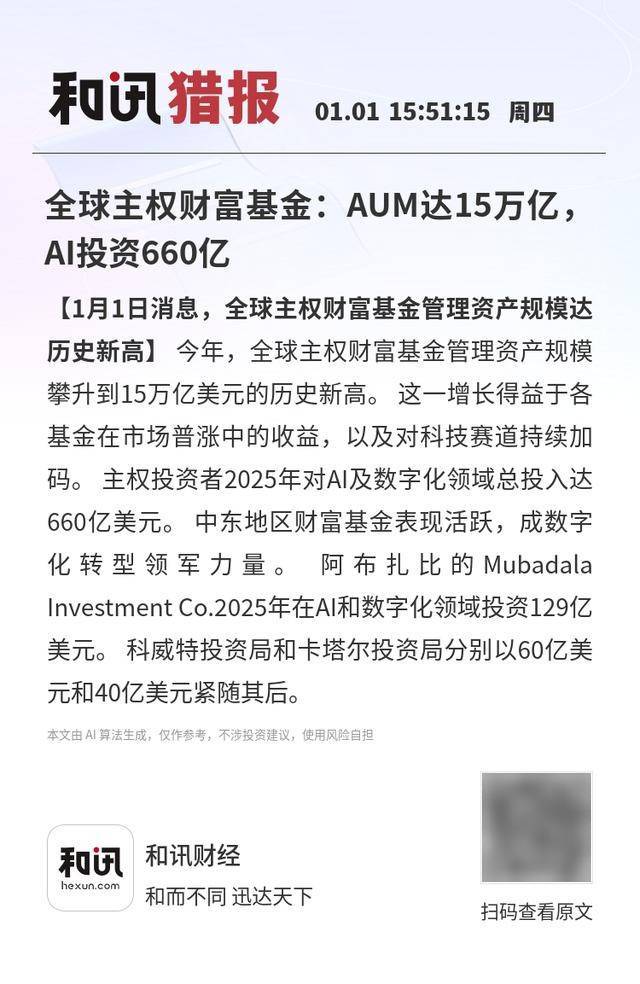
Group 1 - The global sovereign wealth funds' assets under management (AUM) have reached a historic high of $15 trillion this year [1][2] - This growth is attributed to the gains from a rising market and increased investments in technology sectors [1][2] - Sovereign investors are projected to invest a total of $66 billion in AI and digitalization by 2025 [1][2] Group 2 - Middle Eastern wealth funds are becoming key players in digital transformation [1][2] - Mubadala Investment Co. from Abu Dhabi plans to invest $12.9 billion in AI and digitalization by 2025 [1][2] - The Kuwait Investment Authority and Qatar Investment Authority are following with investments of $6 billion and $4 billion, respectively [1][2]
国家外汇管理局:2025年9月末我国对外金融资产115073亿美元
Xin Lang Cai Jing· 2026-01-01 07:31
Core Viewpoint - As of September 2025, China's external financial assets amounted to 11,507.3 billion USD, while external liabilities were 7,459.7 billion USD, resulting in a net external asset of 4,047.6 billion USD [1] Group 1: External Financial Assets - China's external financial assets include direct investment assets of 34,336 billion USD, securities investment assets of 19,520 billion USD, financial derivative assets of 26.4 billion USD, other investment assets of 24,064 billion USD, and reserve assets of 36,889 billion USD, which account for 30%, 17%, 0.2%, 21%, and 32% of total external financial assets respectively [1] - The total external financial assets are valued at 83,935 billion SDR as of September 2025 [1] Group 2: External Financial Liabilities - The external liabilities consist of direct investment liabilities of 37,430 billion USD, securities investment liabilities of 23,272 billion USD, financial derivative liabilities of 239 billion USD, and other investment liabilities of 13,656 billion USD, representing 50%, 31%, 0.3%, and 18% of total external liabilities respectively [1] - The total external financial liabilities are valued at 54,412 billion SDR as of September 2025 [1] Group 3: Net External Assets - China's net external assets stand at 40,476 billion USD, which is equivalent to 29,524 billion SDR as of September 2025 [1]
2025年终复盘,在混乱分裂的市场抓住确定性
Sou Hu Cai Jing· 2026-01-01 03:13
Group 1: Global Economic Landscape - 2025 marks a pivotal year for global economic restructuring post-pandemic, characterized by a shift from synchronized monetary tightening to differentiated policy approaches among central banks [3][5] - The Federal Reserve initiated a liquidity easing cycle with three rate cuts, contrasting with the European Central Bank's stability and Japan's rate hikes, influencing global capital flows [3][4][5] - AI technology is on the brink of large-scale implementation, with Nvidia achieving a market cap of $5 trillion, highlighting the value of computational power dominance [1][9] Group 2: Market Dynamics and Investment Opportunities - Emerging markets, particularly Chinese assets, demonstrated resilience, with A-shares leading the tech sector and Hong Kong IPOs regaining global prominence [2][33] - Gold and other precious metals emerged as top-performing asset classes due to their dual role as safe havens and inflation hedges, with gold prices soaring [2][38] - The investment landscape is shaped by a closed loop of policy transmission, capital flow, industrial linkage, and risk spillover, setting the stage for market trends in 2026 [2] Group 3: Central Bank Policies - The Federal Reserve's rate cuts were driven by slowing economic growth and declining inflation, with GDP growth expected to drop from 2.4% to 1.8% in 2025 [4][6] - Other major central banks maintained stable rates, with the ECB emphasizing core inflation persistence and Japan's shift to rate hikes reflecting domestic economic recovery [5][6] Group 4: Technology Sector Developments - Nvidia's market cap surge is attributed to its monopoly in high-end computing chips, with significant revenue growth from its data center business [9][10] - The launch of China's DeepSeek AI model, surpassing OpenAI's GPT-5, signifies a breakthrough in the global AI landscape, prompting a reevaluation of Chinese hard tech investments [13][15] Group 5: Trade and Debt Challenges - Trump's "reciprocal tariffs" policy disrupted global trade, leading to a slowdown in trade growth and increased inflationary pressures [21][22] - Global public debt reached a historic high of 95% of GDP, driven by multiple factors including increased defense spending and rising social security costs [24][25] Group 6: Chinese and Hong Kong Markets - The A-share market experienced a tech-driven bull run, with significant liquidity activation and a record number of new tech listings [30][31] - Hong Kong's IPO market rebounded strongly, supported by southbound capital flows and foreign investment, reclaiming its status as a global capital hub [33][34]

“惠享四季·购在陇原”2026年甘肃省促消费活动启动
Xin Lang Cai Jing· 2026-01-01 02:19
Core Viewpoint - The province is launching a year-round consumption promotion initiative titled "Enjoy Four Seasons · Shopping in Longyuan," aimed at enhancing economic development through collaborative efforts among government, banks, and enterprises, while optimizing the consumption environment and enriching quality supply [1] Q1 Summary - The first quarter focuses on integrating traditional festivals with emerging business formats to stimulate spring consumption, featuring activities like online New Year goods festivals and promotions for agricultural products [2] - Initiatives include a "one-stop" shopping experience for New Year goods, encouraging the replacement of old appliances, and organizing invoice lottery activities to protect consumer rights [2] - Ice and snow events are also highlighted, with activities such as the "Ice and Snow Carnival" to further boost consumption [2] Q2 Summary - The second quarter emphasizes financial empowerment and summer consumption, introducing initiatives like interest-free installment plans and immediate subsidies in key sectors such as automotive and home appliances [3] - Activities include holiday shopping promotions and green smart appliance sales, alongside a focus on showcasing local products at the sixth China Consumer Expo [3] - The aim is to invigorate summer consumption and expand consumer experiences [3] Q3 Summary - The third quarter leverages large exhibitions and events to enhance both goods and service consumption, with a focus on the Provincial Sports Games and the Lanzhou Fair [4] - Development of derivative products related to the sports event, such as sports gear and wellness packages, is planned to promote related consumption [4] - The China International Fair for Trade in Services will feature a "Gansu Services" exhibition area to boost service consumption quality and expansion [4] Q4 Summary - The fourth quarter centers on winter and ice-themed consumption, creating a "snow + warmth" multi-dimensional consumption system [5] - Activities include promoting winter tourism experiences that combine ice sports with wellness services, and addressing winter living needs through various consumer initiatives [5] - The integration of online and offline sales channels is emphasized, with plans for special exhibitions and promotions to enhance market supply during the winter season [6]
体系化学理化研究阐释 | 经济改革理论的创新和突破
Xin Lang Cai Jing· 2026-01-01 02:18
转自:求是网 体系化学理化研究阐释 经济改革理论的创新和突破 ——学习习近平经济思想的经济改革理论 丁晓钦 改革是解放和发展社会生产力的关键,通过经济改革不断健全和完善经济体制,是激发经济发展活力、 确保经济持续健康发展的重要途径。党的十八大以来,习近平总书记深刻把握我国经济发展阶段性特征 和外部环境变化,立足我国经济社会发展伟大实践,着眼于推动高质量发展,坚持以经济体制改革为重 点全面深化改革,创造性地提出一系列新思想新观点新论断,形成了习近平经济思想的经济改革理论。 经济改革理论作为习近平经济思想的重要内容,既是改革思想的经济篇,也是经济思想的改革篇,深刻 回答了新时代以来我国以改革促发展的一系列重大理论和实践问题,揭示了社会主义现代化进程中经济 改革的一般规律,阐明了当前和今后一个时期以中国式现代化全面推进强国建设、民族复兴伟业的动力 所在,具有重大理论和实践意义。 一 经济改革的主要目的,在于通过不断调整生产关系激发社会发展内生动力,促进上层建筑更好适应经济 基础,最大限度地释放经济发展潜力,提升经济运行整体效率。纵观全球发展历程,二战后世界各国都 把经济改革当作破解经济发展难题、走出经济发展困境的重 ...

沪滨协同创新赋能 杭州高新区(滨江)上市后备企业上海研学活动圆满举行
Quan Jing Wang· 2026-01-01 02:18
Core Insights - The event aimed to enhance the integration of technology, industry, and capital, facilitating effective connections between tech companies and financial markets [1] - The three-day study tour in Shanghai provided executives from nearly twenty backup listed companies in Binjiang with opportunities to learn from industry leaders and financial institutions [1][6] Group 1: Event Overview - The study tour was organized by the Binjiang Development and Reform Bureau and other local entities, focusing on deepening regional collaborative innovation and empowering high-quality corporate development [2] - The event featured a mix of on-site visits, in-depth dialogues, and experiential learning to bridge the gap between tech enterprises and financial markets [2] Group 2: Key Activities - The first day included a visit to the Shanghai Humanoid Robot Innovation Incubator, where participants learned about cutting-edge developments in the humanoid robotics sector [2] - The second day featured participation in the listing ceremony of the first "5050 Talent Special ABS" at the Shanghai Stock Exchange, showcasing innovative financial products that provide new capital operation paths for tech companies [3] - The study group also visited the Shenzhen Stock Exchange Shanghai Center, where they received insights on the multi-tiered capital market and its support for innovative enterprises [4] Group 3: Industry Insights - The final day included discussions with executives from leading semiconductor companies, Huada Semiconductor and Zhichun Technology, focusing on their core business areas and future industry trends [5] - Both companies emphasized their strong product matrices and solutions in automotive electronics, industrial control, and IoT applications, highlighting their roles in the semiconductor supply chain [5] Group 4: Outcomes and Impact - The study tour enriched the executives' understanding of capital market operations, core paths to listing, and key challenges, broadening their perspectives on innovation [6] - The event established a solid bridge for resource integration between Binjiang and Shanghai, injecting new vitality into the deep integration of technology, industry, and capital [6]


新招破解美元!美财长见证7800亿美债结算变革,人民币国际化加速
Sou Hu Cai Jing· 2026-01-01 01:48
你或许没想到,世界顶级的金融对决,居然悄悄发生在咱们看不见的账本背后。 有人说,中国手里的美债能砸晕美国,但现在的玩法早就不是你想象的那种"砸场子",而是一场让美国高管都得瞪大眼睛的花式操作。 这年头,谁还按套路出牌? 专家们最近都在讨论一个现象:财经新闻天天吵得你头大,真正"大动静"反而低调得出奇。 其实,金融圈子里最狠的动作,往往都不是用喊出来的。 你看,华尔街精英们,前阵子还没回过神来,数据一翻,才发现中国已经把持有的7800亿美元美债,变着法子"流转"掉了。 这不是简单抛售,根本没人敢接盘那么大的量。 更妙的是,这一切完全在美国自己定的规则里完成,连美国财政部都挑不出毛病来。 不少朋友问我,这事儿到底有啥门道? 大家都怕踩塌地板。 但中国玩出了新花样,"三角置换"成了金融圈的热词。 其实最大的变化,就是中国用卢森堡的SPV,也就是特殊目的实体,把美债打包流转,合规合法,像走红毯一样把钱变了个身。 你能想象吗? 美国人引以为傲的金融规则,反倒成了中国拆解美元霸权的"工具箱"。 这背后的逻辑,真是让人拍案叫绝。 美国的债务账本可不乐观。 2025年,美国联邦债务突破了38万亿美元,每个美国人摊上11万美元 ...
巨头收购、A股亮点频出...盘点2025金融大事件
Sou Hu Cai Jing· 2025-12-31 16:23
Group 1: Global Financial Market Dynamics - The international financial market in 2025 is characterized by turmoil, primarily due to the U.S. imposing or threatening tariffs on trade partners, which has become a significant variable affecting global markets [1][3] - The announcement of a 20% tariff on most imported goods by the U.S. led to unprecedented volatility in the stock market, with the Dow Jones experiencing a dramatic intraday fluctuation of 2600 points within a short period [3] - The fear of economic and industrial impacts from tariffs triggered panic in global markets, with significant declines observed in Asian and European indices, including a nearly 9% drop in Japan's Nikkei 225 and over 4% declines in major European indices [3] Group 2: Gold Market Trends - The gold market has seen a significant rise, with prices reaching as high as $4505.7 per ounce by December 24, 2025, driven by geopolitical risks and a decline in the credibility of the U.S. dollar [5] - Gold has surpassed the euro to become the second-largest reserve asset globally and has also exceeded U.S. Treasury bonds in central bank reserves for the first time [5] - In China, gold has become increasingly popular among investors, with various investment tools like gold ETFs and physical gold bars gaining traction among different demographics [5] Group 3: Mergers and Acquisitions - 2025 has witnessed a surge in high-value mergers and acquisitions, with notable deals such as Netflix acquiring parts of Warner Bros. Discovery and Union Pacific Railroad's acquisition of Norfolk Southern Railway [7][8] - The mining sector is also experiencing consolidation, exemplified by Anglo American's acquisition of Teck Resources, which is reshaping the global mining landscape [8] Group 4: A-Share Market Developments - The A-share market has shown remarkable performance, with the Shanghai Composite Index reaching a peak of 4010.73 points, marking a significant milestone after ten years [10] - The technology sector's market capitalization has surpassed 25% of the total A-share market, indicating a structural shift in investment focus [10] - New IPOs in the A-share market have attracted significant attention, with companies in AI and technology sectors becoming highly sought after [10] Group 5: Hong Kong IPO Market - The Hong Kong Stock Exchange has emerged as a leader in global IPO fundraising, with over 70 companies raising more than 270 billion HKD by December 11, 2025 [12][13] - The IPOs have predominantly featured companies in emerging industries such as AI pharmaceuticals and digital twins, showcasing the market's dynamism [12][13]
