
有色金属

Search documents
焦点复盘市场全天现深强沪弱,AI硬件端表现火热,大消费板块延续调整
Sou Hu Cai Jing· 2026-02-12 12:19
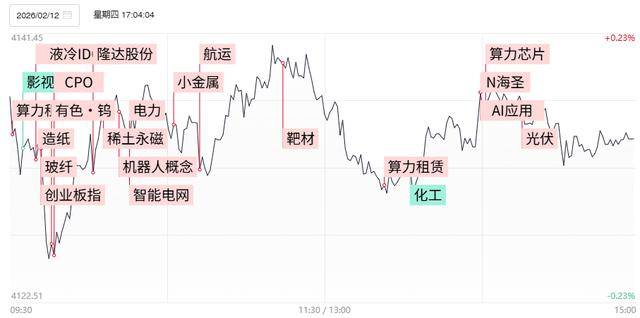
Market Overview - A total of 60 stocks hit the daily limit up, while 19 stocks faced limit down, resulting in a sealing rate of 76% [1] - The three major indices closed higher, with the ChiNext Index and the Sci-Tech 50 Index both rising over 1% [1] - The total trading volume in the Shanghai and Shenzhen markets reached 2.14 trillion yuan, an increase of 157.5 billion yuan compared to the previous trading day [1] - Despite the overall market performance, over 3,200 stocks declined [1] Sector Performance - Leading sectors included computing power leasing, power grid equipment, liquid cooling servers, and small metal sectors [1] - Conversely, the film, food and beverage, tourism, and retail sectors experienced declines [1] Stock Analysis - The rate of stocks achieving consecutive limit ups increased to 45.45%, with five stocks hitting limit up for three days or more [3] - High-profile stocks such as Hengdian Film and Jin Niu Chemical faced significant declines, impacting the film sector negatively [3] - The recent surge in price concepts has spread from cyclical sectors to the computing power industry chain, indicating market caution regarding uncertainties during the upcoming holiday [3] Key Stocks - Major stocks achieving consecutive limit ups include Dazhi Technology, Decai Co., Zhangyue Technology, and Yabo Co., all reaching four consecutive limit ups [4] - Dazhi Technology's stock price surged due to the rising demand for computing power, with a notable increase in the stock price of 10% [5] - The liquid cooling server sector saw strong performance following a report from a supplier, with several stocks hitting limit up [6] Commodity Trends - The tungsten market remains strong, with ammonium paratungstate (APT) prices exceeding 1 million yuan per ton [7] - The export of tungsten products is projected to decline by 27.5% year-on-year, which may support higher prices for upstream mining resources [7] - The energy metals sector, including nickel and cobalt, has also shown strength due to supply cuts announced by Indonesia [7] Future Outlook - The market demonstrated resilience against selling pressure, with major indices closing in the green [9] - Despite a significant number of stocks hitting limit up, there remains a divergence in market sentiment regarding future performance [9] - The potential for upward movement in indices is supported by technical indicators, with the Shanghai Composite Index maintaining levels above its 20-day moving average [9]

春节前夕深市迎“分红红包雨”近120家公司派现超375亿元
Zheng Quan Ri Bao Wang· 2026-02-12 11:45
Group 1 - The core viewpoint of the articles highlights the increasing trend of cash dividends among A-share listed companies, particularly in the Shenzhen market, with nearly 120 companies distributing over 37.5 billion yuan in cash dividends since December 2025, showcasing a strong commitment to shareholder returns [1] - Private enterprises are the main contributors to the pre-festival dividends, with around 70 out of the 120 companies being private, representing about 60% of the total, indicating their robust operational strength and responsibility towards shareholders [1] - Tianshan Aluminum, as an example, has implemented two rounds of dividends in 2025, totaling over 1.379 billion yuan, and has committed to a cash dividend ratio of no less than 50% of its net profit for 2025, positioning itself as a benchmark for high dividends in the non-ferrous metal sector [1] Group 2 - The regulatory policies have encouraged an increase in dividend distributions among Shenzhen-listed companies, with a total cash dividend payout of 547.56 billion yuan in 2025, maintaining above the 500 billion yuan mark for two consecutive years, indicating a positive ecosystem for dividends [2] - By January 31, 2026, 1,714 out of 2,866 Shenzhen-listed companies had pre-disclosed their 2025 performance, with nearly 60% showing improved results, collectively achieving a net profit of 82.009 billion yuan, a significant increase of 155.67 billion yuan year-on-year [2] - Many companies are enhancing the transparency and predictability of their dividend policies through amendments to company bylaws and establishing medium to long-term dividend plans, thereby solidifying stable return expectations for investors [2] Group 3 - Yilian Network, a representative "cash cow" enterprise in the ChiNext board, has maintained a consistent and stable dividend policy since its listing in 2017, mandating a minimum annual cash distribution of 20% of distributable profits, ensuring long-term returns for investors [3] - The company has executed 12 cash dividend distributions to date, totaling over 8.5 billion yuan, with an average dividend payout ratio close to 60%, establishing itself as a model for high and regular dividends in the industry [3] - The new "National Nine Articles" policy is expected to enhance the willingness, profitability, and regulatory compliance of listed companies regarding dividends, facilitating the establishment of a normalized, diversified, and stable dividend mechanism [3]

铜日报:铜价高位偏强运行,警惕春节期间的宏观波动-20260212
Tong Hui Qi Huo· 2026-02-12 11:29
Copper Futures Market Data Analysis - **Main Contract and Basis**: On February 11, 2026, the SHFE main contract price rose slightly to 102,000 yuan/ton, up 0.11% from the previous day. The basis weakened overall, with the spot premium/discount widening. The discount of premium copper deepened to -25 yuan/ton, that of flat copper to -70 yuan/ton, and that of wet-process copper to -130 yuan/ton. The LME (0-3) discount remained at -76.1 dollars/ton [1][35]. - **Position and Trading Volume**: As the Spring Festival holiday approached, market trading was light, and the position volume shrank significantly. On February 10, the LME position decreased by 1,683 lots to 325,291 lots, while the SHFE inventory increased to 192,100 tons. The trading volume contracted due to the completion of downstream enterprises' stockpiling and logistics restrictions, weakening overall market liquidity [1][37]. Industry Chain Supply, Demand, and Inventory Analysis - **Supply Side**: In December 2025, Codelco's copper production in Chile increased by 3.7% year-on-year to 181,400 tons, but Escondida's output decreased by 16.5% to 111,500 tons, and Collahuasi's output decreased by 12.1% to 36,200 tons. North American copper mine projects are expanding. Supported by Chinese policies, the smelting end saw an increase in the arrival of goods due to the opening of the import window, resulting in an overall loose supply [2][40]. - **Demand Side**: The demand in the power sector was strong, but the traditional sectors were weak. The home appliance, construction, and consumer electronics sectors were affected by the Spring Festival. Overall, demand was differentiated, showing a seasonal decline before the festival [2][44]. - **Inventory Side**: Global inventories continued to accumulate. On February 11, 2026, the LME inventory increased to 178,897 tons, the SHFE inventory to 192,100 tons, and the COMEX inventory to 591,459 short tons. The inventory in the United States increased fivefold to 534,000 metric tons, intensifying the tightness of the circulable supply, but the increase in exchange inventories alleviated the pressure [2][41]. Price Trend Judgment - The copper price is expected to maintain a volatile pattern in the next 1 - 2 weeks. The driving factors include the accumulation of inventories on the supply side alleviating the tightness, but the limited increase in North American projects. On the demand side, the power investment support and the post - festival restocking expectation offset the weakness in home appliances. The macro sentiment is neutral to optimistic (China's CPI rose moderately by 0.2%, and the enhanced risk appetite pushed up the LME price). The copper price is expected to fluctuate around 102,000 yuan/ton [3][47].
铝产业链日度数据跟踪-20260212
Zhong Xin Qi Huo· 2026-02-12 11:23
Report Summary 1. Report Industry Investment Rating No information provided. 2. Core View The report provides daily data tracking of the aluminum industry chain, including prices, inventories, and other indicators for alumina, electrolytic aluminum, and aluminum alloys. 3. Summary by Directory Alumina - On February 12, the domestic ore price was 491 yuan/ton, with no change from the previous day; the Guinea imported ore price was 61 US dollars/dry ton, also unchanged [1]. - The spot price index on February 12 was 2646 yuan/ton, with no change [1]. - The futures inventory on February 12 was 276,825 tons, a decrease of 210 tons from the previous day [1]. Electrolytic Aluminum - On February 12, the spot average price of electrolytic aluminum was 23,991 yuan/ton, an increase of 86 yuan/ton from the previous day; the premium/discount was -160 yuan/ton, an increase of 30 yuan/ton [1]. - The futures inventory on February 12 was 200,654 tons, an increase of 33,088 tons from the previous day [1]. - The aluminum rod processing fee on February 12 was 94 yuan/ton, an increase of 30 yuan/ton [1]. Aluminum Alloy - On February 12, the price of raw aluminum was 17,250 yuan/ton, with no change; the price of cooked aluminum was 17,650 yuan/ton, also unchanged [1]. - The price of ADC12 on February 12 was 23,100 yuan/ton, with no change [1]. - The futures inventory on February 12 was 66,638 tons, a decrease of 210 tons from the previous day [1].
春节前夕再现“红包雨”:深市公司全年现金分红超5000亿
2 1 Shi Ji Jing Ji Bao Dao· 2026-02-12 10:44
Core Viewpoint - The Shenzhen Stock Exchange (SZSE) companies are increasingly engaging in cash dividend distributions, with a total of over 375 billion yuan distributed since December 2025, indicating a robust investment return mechanism and a shift towards a more favorable dividend ecosystem [1][4]. Group 1: Dividend Distribution Trends - Nearly 120 SZSE companies have implemented profit distributions since December 2025, with cumulative cash dividends exceeding 375 billion yuan [1]. - In 2025, SZSE companies distributed a total of 5,475.59 billion yuan in cash dividends, marking the second consecutive year of surpassing 5,000 billion yuan [1]. - During the "14th Five-Year Plan" period, the total amount of dividends distributed by SZSE companies exceeded 20 trillion yuan, reflecting a growing trend of companies willing to distribute and frequently pay dividends [1]. Group 2: Company Performance and Profitability - As of January 31, 2026, 1,714 out of 2,866 SZSE companies pre-disclosed their 2025 operating performance, accounting for 59.39% of the total number of companies and 48.48% of market capitalization, with nearly 60% showing improved performance [1]. - The pre-disclosed companies collectively achieved a net profit of 820.09 billion yuan, an increase of 1,556.70 billion yuan year-on-year [1]. - Among the top 100 companies by market capitalization, 40 disclosed their 2025 operating performance, all of which are expected to be profitable, with a combined net profit forecast of 2,056.27 billion yuan, representing a year-on-year growth of 66.51% [1]. Group 3: Notable Companies and Their Dividend Policies - Luxshare Precision announced a cash dividend of 1.6 yuan per 10 shares, totaling approximately 1.165 billion yuan, supported by a revenue increase of 24.69% year-on-year [2]. - Tianshan Aluminum implemented a cash dividend of 1 yuan per 10 shares, totaling about 459 million yuan, with a commitment to a minimum cash dividend of 50% of the net profit attributable to shareholders for 2025 [2]. - Yilian Network, known for its high dividend payout, distributed 5 yuan per 10 shares, totaling 633 million yuan, maintaining a high payout ratio of over 50% of its net profit [3]. Group 4: Regulatory and Market Changes - The new "National Nine Articles" has led to a continuous increase in dividend levels among SZSE companies, with multiple distributions per year becoming the norm, enhancing investor satisfaction and establishing a positive cycle in capital market returns [4].
1月底日本三大港口铝库存环比下降约1.5%
Wen Hua Cai Jing· 2026-02-12 10:42
Core Viewpoint - Marubeni Corporation reported that aluminum inventories at Japan's three major ports decreased to 312,200 tons by the end of January, representing a month-on-month decline of approximately 1.5% [1] Group 1 - The data was collected from the ports of Yokohama, Nagoya, and Osaka [1]
金属涨跌互现 沪镍涨逾1% 碳酸锂涨超3% 欧线集运涨逾6%
Sou Hu Cai Jing· 2026-02-12 10:39
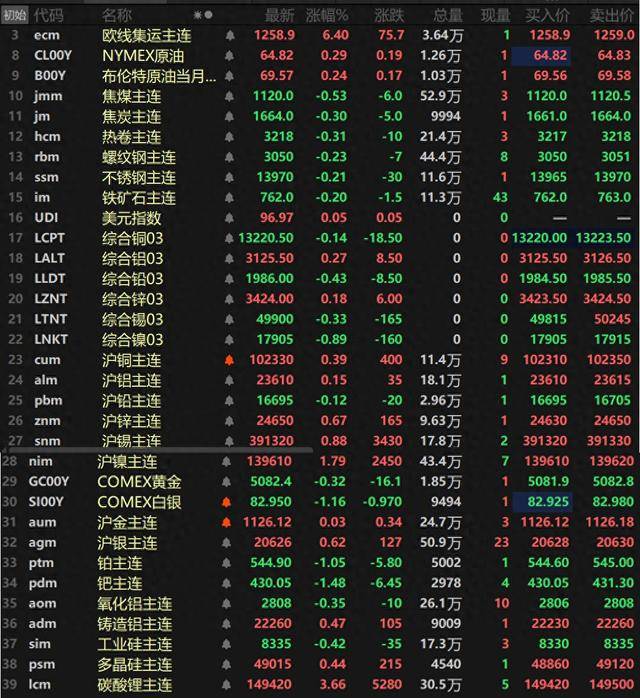
Metal Market - Domestic base metals experienced a general increase, with the exception of lead, which fell by 0.12%. Nickel led the gains with an increase of 1.79%, while other metals saw increases of less than 1% [1] - In the aluminum sector, alumina futures dropped by 0.35%, while casting aluminum futures rose by 0.47% [1] - Lithium carbonate futures increased by 3.66%, while industrial silicon futures fell by 0.42%, and polysilicon futures rose by 0.44% [1] - The European shipping index rose by 6.4% to 1258.9 [1] - In the black metal sector, iron ore, rebar, and stainless steel all saw declines of around 0.2%, with hot-rolled coil down by 0.31%. Coking coal fell by 0.53%, and coking coke dropped by 0.3% [1] - Internationally, base metals showed mixed results, with London aluminum up by 0.27% and lead up by 0.18%, while other metals experienced slight declines [1] - Precious metals saw COMEX gold down by 0.32% and silver down by 1.16%, while domestic gold rose by 0.03% and silver by 0.62% [1][2] Macro Environment - The State Administration for Market Regulation released guidelines for compliance in the automotive industry, highlighting significant legal risks associated with various pricing behaviors that could lead to below-cost pricing [5] - The National Energy Administration announced that by 2025, China's new wind and solar power installations are expected to exceed 430 million kilowatts, marking a 22% year-on-year increase [6][7] - The National Energy Administration emphasized the importance of developing new energy storage and future industries such as hydrogen and nuclear fusion energy [8] - The Ministry of Commerce announced that consumers purchasing new cars during the 2026 Spring Festival can apply for subsidies under the old-for-new vehicle policy [9] - The People's Bank of China conducted a net injection of 448 billion yuan through reverse repos, maintaining liquidity in the market [9]
周刊:马年投资锦囊|嘉实基金杨欢:“制造业优势+科技创新”的双轮驱动逻辑依然坚实,今年四大赛道蕴含机遇
Sou Hu Cai Jing· 2026-02-12 10:30
Core Viewpoint - The dual-driven logic of "manufacturing advantages + technological innovation" remains solid, and current adjustments provide opportunities for long-term investment [1]. Group 1: Market Outlook for 2025 - The market in 2025 is divided into three phases: - The first phase from post-Spring Festival to April focuses on technology revaluation, driven by the international recognition of the DS model, with strong performances from Hong Kong internet giants and A-share tech companies [5]. - The second phase from May to September highlights accelerated AI capital expenditure and overseas expansion trends, with record-breaking collaborations in innovative drugs and enhanced competitiveness in the energy storage sector driving related stocks up [5]. - The third phase in the fourth quarter shifts towards expectations of PPI recovery due to "anti-involution" policies, benefiting cyclical sectors like chemicals [5]. - The non-ferrous metals industry is a consistent highlight throughout the year, with precious metals performing strongly in a weak dollar environment, leading to increases in industrial metals like copper and silver [5]. Group 2: Investment Opportunities for 2026 - Four key industrial tracks are identified for investment based on the "14th Five-Year Plan": - The AI industry remains central, with a focus on computing power investment as domestic internet companies are expected to significantly increase capital expenditure, benefiting the domestic computing power supply chain [6]. - The overseas expansion of the renewable energy sector, particularly in energy storage and electric vehicles, continues to be promising due to declining lithium battery costs and global energy transition demands [6]. - The commercial aerospace sector is entering an acceleration phase, supported by policy and industry resonance, with significant satellite reserves laid out for industry development [6]. - The internationalization of innovative drugs is progressing, with Chinese companies moving from licensing to direct overseas expansion, showcasing competitive R&D efficiency in large molecule drugs [6]. Group 3: Strategies for Market Volatility - Recent market volatility is attributed to rapid price increases raising demand concerns and emotional disturbances from uncertain events. A strategy of "not chasing high prices, focusing on valuation, and looking long-term" is recommended [7]. - For high-priced assets, careful evaluation of the potential for exceeding performance expectations is necessary, while solid companies with growth potential present opportunities during short-term adjustments [7]. - In managing product portfolios, dynamic adjustments are made through in-depth industry research, tracking changes in competitive landscapes, and timely adjustments to overvalued assets while focusing on undervalued companies with significant growth potential [7]. Group 4: Investment Strategy for the Year of the Horse - The overall market outlook for 2026 is optimistic, with the capital market remaining in a favorable environment. Continuous technological advancements and enhanced competitiveness in high-end manufacturing are expected to support corporate profitability and market stability [8]. - The market is anticipated to trend upward with fluctuations, necessitating a focus on rhythm and structural opportunities. Identifying certainty amid volatility through in-depth research and patient holding is expected to yield good returns [8].

2026年1月物价数据点评:“反内卷”与新质生产力发展并进
BOHAI SECURITIES· 2026-02-12 10:11
Group 1: CPI Analysis - In January 2026, the CPI increased by 0.2% year-on-year, a decrease from the previous value of 0.8%[11] - Core CPI's month-on-month growth reached its highest level in six months, driven by increased travel demand and rising international gold prices[4] - Food prices remained stable month-on-month, with fresh vegetable prices decreasing by 4.8%[14] Group 2: PPI Analysis - In January 2026, the PPI's year-on-year decline narrowed, while the month-on-month increase expanded[5] - Prices in the upstream raw materials sector turned from decline to increase due to the "anti-involution" effect, with basic chemical raw materials rising by 0.7%[25] - The month-on-month increase in production materials prices expanded, while living materials prices shifted from stable to rising[25] Group 3: Future Outlook - The CPI is expected to increase in February 2026, influenced by sufficient pig supply and potential price rises in fresh vegetables before the Spring Festival[16] - The PPI is projected to maintain a similar month-on-month increase in February, with a further narrowing of the year-on-year decline to around -1.0%[5] - Input inflation may rise in February, driven by ongoing "anti-involution" and the rapid development of new productive forces[26]
A股市场投资策略周报:PPI同比降幅继续收窄,节后交易热度有望回归-20260212
BOHAI SECURITIES· 2026-02-12 09:51
Investment Strategy - The report indicates that the PPI year-on-year decline continues to narrow, and trading activity is expected to return after the holiday [1][3] - The A-share market is currently experiencing a consolidation phase, with a focus on the upcoming policy expectations as the market approaches the Two Sessions [3][32] Market Review - In the past five trading days (February 6 to February 12), major indices have risen, with the Shanghai Composite Index up 1.43% and the ChiNext Index up 2.08% [4] - The average daily trading volume has decreased to 2.13 trillion yuan, down 399 billion yuan from the previous five trading days [10][21] Inflation Trends - In January, the CPI increased by 0.2% year-on-year and month-on-month, while the PPI decreased by 1.4% year-on-year but increased by 0.4% month-on-month [27][30] - The narrowing of the PPI decline is attributed to improvements in supply-demand structures in key sectors and rising international metal prices [27][30] Monetary Policy - The central bank's fourth-quarter monetary policy report emphasizes the continuation of a moderately loose monetary policy, focusing on stabilizing economic growth and reasonable price recovery [30] - There is an expectation that short-term adjustments in reserve requirements and interest rates are unlikely, with future policies aimed at expanding domestic demand and stabilizing prices [30] Sector Analysis - The report highlights that in the recent trading period, sectors such as comprehensive, non-ferrous metals, and building materials have shown strong performance, while food and beverage, beauty care, and retail sectors have lagged [21][32] - Investment opportunities are identified in the TMT sector and robotics due to ongoing AI capital expansion and domestic computing power replacement [32] - The power equipment industry is also noted for potential investment opportunities driven by overseas photovoltaic expansion plans and significant investments from the State Grid [32]