通信

Search documents
华泰期货:股指震荡调整,当前可重点关注IC的入场机会
Xin Lang Cai Jing· 2026-01-21 01:47
Group 1 - The core viewpoint of the article emphasizes the introduction of a comprehensive fiscal policy aimed at boosting domestic demand, including a 500 billion yuan special guarantee plan for private investment and a new interest subsidy policy for small and micro enterprises [2][9] - The fiscal policy will cover 14 key industrial chains and related sectors, including new energy vehicles and agricultural industries, with measures to optimize loan interest subsidies for service industry entities and personal consumption loans [2][9] - In the stock market, A-shares experienced fluctuations, with the Shanghai Composite Index closing at 4113.65 points, a slight increase of 0.01%, while the ChiNext Index fell by 1.79% [10][11] Group 2 - The futures market showed an increase in trading volume and open interest for stock index futures, indicating a potential entry opportunity for investors [3][10] - Global indices fell due to geopolitical risks stemming from the Trump administration and concerns over Japan's fiscal situation, while domestic market activity cooled down under policy guidance [4][11] - The total trading volume in the Shanghai and Shenzhen markets reached 2.8 trillion yuan, reflecting a decrease in market heat and index levels [10][11]


每日解盘:三大指数收跌,化工板块逆势爆发,贵金属概念延续强势-1月20日
Sou Hu Cai Jing· 2026-01-21 01:05
Market Overview - The three major indices collectively declined on January 20, 2026, with the Shanghai Composite Index down 0.01% to 4113.65 points, the Shenzhen Component down 0.97% to 14155.63 points, and the ChiNext Index down 1.79% to 3277.98 points [2] - The total trading volume in the two markets was 27,775 billion yuan, an increase of approximately 694 billion yuan compared to the previous trading day [2] Market Observation - The market opened high but closed low, with core broad-based indices showing more declines than gains. The China Securities Dividend Index and Dividend Index led the gains, while the Growth and Sci-Tech Innovation 50 indices led the declines [3] Index Performance - The A-share market saw varied performance across indices, with the Dividend Low Volatility Index up 1.5% while the ChiNext Index fell by 1.8%. The Shanghai Composite Index remained flat over the day [4] - Over the past five days, the Shanghai Composite Index is down 0.6%, while the ChiNext Index has seen a decline of 1.3% [4] Sector Performance - The oil and petrochemical, construction materials, and real estate sectors saw gains, with oil and petrochemical up 1.7%, construction materials up 1.7%, and real estate up 1.5% [5][6] - Conversely, sectors such as communication, defense, aerospace, and computing experienced declines, with the computing sector down 1.9% [5][6] Hot Industry - Oil and Petrochemical - The oil and petrochemical sector rose by 1.7%, with East China Securities noting that while pressures remain, there is potential for recovery. Key conditions for an upward cycle include rising oil prices, supply-side capacity clearance, and demand-side stimulation through monetary easing [7] - The World Bank forecasts moderate GDP growth in 2026 and 2027, indicating potential for recovery in the sector as capital expenditures decrease and outdated capacities are eliminated [7] Fiscal Policy Insights - The Ministry of Finance announced that overall fiscal spending in 2026 will continue to increase, with a focus on improving structure and efficiency [8] - The government debt ratio remains low compared to G20 averages, with a projected fiscal deficit rate of around 4% for 2025, an increase of 1 percentage point from the previous year [8] - A special guarantee plan for private investment has been introduced, with a total quota of 500 billion yuan to support small and medium-sized enterprises [9]

沪指探底回升再收十字星,止跌企稳了吗?
Sou Hu Cai Jing· 2026-01-21 01:01
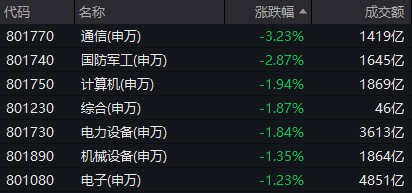
Market Overview - On January 20, the A-share market experienced adjustments, with the Shanghai Composite Index briefly falling below 4100 points before closing at 4113.65, a slight decrease of 0.01% [1] - The Shenzhen Component Index and the ChiNext Index also saw declines, closing down 0.97% and 1.79% respectively [1] Sector Performance - According to Wind data, previously strong sectors such as telecommunications, computers, and electronics led the market decline on January 20 [2] - The telecommunications sector fell by 3.23% with a trading volume of 141.9 billion, while the defense and military industry dropped by 2.87% with a volume of 164.5 billion [3] - The computer sector decreased by 1.94% with a trading volume of 186.9 billion, and the electronics sector fell by 1.23% with a volume of 485.1 billion [3] Market Dynamics - Analysts attribute the market adjustment to two main factors: the impact of counter-cyclical policy adjustments and a shift in market style [5] - Recent trading days have shown a significant decrease in trading volume, with three out of the last four days recording less than 3 trillion in trading volume [5] - The market is experiencing a "high-low switch," with funds moving towards traditional sectors as earnings forecasts for listed companies are set to peak [5] Technical Analysis - The Shanghai Composite Index formed a doji candlestick pattern, indicating potential stabilization, but the market remains cautious with a focus on defensive strategies [5] - Analysts suggest that as long as the index does not fall below 4080 points, there is a likelihood of a resumption of upward momentum [6] - The average price-to-earnings ratios for the Shanghai Composite and ChiNext are currently above their three-year median levels, indicating suitability for medium to long-term investments [6] Earnings Season Impact - As earnings forecasts enter a peak disclosure period, the correlation between stock prices and earnings is expected to increase significantly [7] - The market may undergo structural adjustments based on fundamentals, with previous hot sectors facing earnings validation while some low-priced, high-quality stocks may attract new capital [7]
TMT行业周报(1月第2周):阿里巴巴举办千问产品发布会
Century Securities· 2026-01-21 00:25
Investment Rating - The report does not explicitly state an investment rating for the industry, but it suggests a positive outlook for Alibaba and related sectors, indicating a favorable investment environment [2]. Core Insights - Alibaba's "Qianwen" product launch signifies a shift in AI capabilities from a "Q&A assistant" to a "task executor," integrating over 400 functions across its ecosystem, which is expected to enhance user engagement and commercial viability [3][5]. - The emergence of the GEO (Generative Engine Optimization) business model is transforming marketing strategies, shifting focus from SEO to GEO, which is anticipated to benefit marketing agencies and authoritative media platforms while traditional traffic platforms may face challenges [3][5]. - The TMT sector showed a strong performance in the week of January 12-16, with notable gains in sub-sectors such as portal websites and semiconductor equipment, outperforming the broader market [3][5]. Market Weekly Review - The TMT sector's performance from January 12-16 showed a rise in the computer sector by 3.82%, electronics by 3.77%, media by 2.04%, and communication by 1.42%, collectively outperforming the CSI 300 index, which fell by 0.57% [3][5]. - The top-performing sub-industries included portal websites (17.69% increase), integrated circuit packaging and testing (14.47% increase), and semiconductor equipment (9.31% increase) [3][5]. Industry News and Key Company Announcements - Alibaba's "Qianwen" product launch on January 15 is a significant event, showcasing its AI capabilities and integration with various services [3][5]. - The report highlights the rapid growth of the "Qianwen" app, which achieved over 100 million monthly active users within two months of launch, indicating strong market acceptance [3][5]. - The report notes that the GEO model is expected to enhance the profitability of marketing agencies and elevate the status of authoritative media platforms, while traditional traffic platforms may experience a decline [3][5].

A股市场大势研判:A股震荡调整
Dongguan Securities· 2026-01-20 23:43
Market Performance - The A-share market experienced a turbulent adjustment with all major indices closing lower, including the Shanghai Composite Index down by 0.01% to 4113.65, the Shenzhen Component down by 0.97% to 14155.63, and the ChiNext down by 1.79% to 3277.98 [2][4] - The total trading volume in the Shanghai and Shenzhen markets reached 2.78 trillion yuan, an increase of 694 billion yuan compared to the previous trading day [6] Sector Performance - The top-performing sectors included Oil & Petrochemicals (up 1.74%), Building Materials (up 1.71%), Real Estate (up 1.55%), Transportation (up 1.25%), and Building Decoration (up 1.24%) [3][4] - Conversely, the worst-performing sectors were Communication (down 3.23%), Defense & Military (down 2.87%), Computer (down 1.94%), Comprehensive (down 1.87%), and Electric Equipment (down 1.84%) [3][4] Concept Index Performance - The leading concept indices were Epoxy Propylene (up 5.78%), Glyphosate (up 3.45%), Acrylic Acid (up 2.64%), NMN Concept (up 1.95%), and Cultured Diamonds (up 1.93%) [3][4] - The lagging concept indices included Satellite Navigation (down 3.16%), Terahertz (down 3.15%), 6G Concept (down 2.98%), F5G Concept (down 2.97%), and Chengfei Concept (down 2.87%) [3][4] Future Outlook - The report indicates that the A-share market is in a short-term adjustment phase, with a potential shift from a "fund-driven" rapid growth model to a "performance-driven" slow bull market [6] - It is anticipated that macroeconomic improvements and a rebound in corporate earnings will drive mid-term upward trends, with the spring market expected to continue [6] - Investors are advised to maintain a balanced portfolio, focusing on sectors such as non-ferrous metals, technology growth, new energy, and dividend stocks [6] Policy Developments - On January 20, the Ministry of Finance and other departments announced five documents establishing a special guarantee plan through the National Financing Guarantee Fund, with a scale of 500 billion yuan to be implemented over two years [5] - The policy includes extending the personal consumption loan interest subsidy until the end of 2026, with a subsidy rate of 1% for credit card installment payments and 1.5% for fixed asset loans related to equipment upgrades [5]
加纳经济持续走强
Shang Wu Bu Wang Zhan· 2026-01-20 17:21
Core Viewpoint - Ghana's economy continues to show strong growth momentum, with a projected year-on-year growth of 3.8% in October 2025, primarily driven by the services sector [1] Economic Growth Indicators - The monthly economic growth indicators reveal that agriculture grew by 0.9%, industry by 3%, and services by 5.5% [1] - The composite economic activity growth index for the three sectors stands at 112.7, up from 108.6 in the same period last year [1] Sector Contributions - The growth in the services sector is mainly driven by telecommunications, wholesale, and retail trade [1] - Industrial growth is primarily supported by the manufacturing sector [1] - Agricultural growth is largely attributed to the fisheries sector [1] Future Outlook and Recommendations - The sustained upward trend indicates that Ghana's economy is likely to maintain positive growth, especially in the services and industrial sectors [1] - The statistical office encourages the government to continue enhancing industrial productivity and value addition while addressing structural challenges in the agricultural sector to improve its resilience [1]
南向资金今日净买入36.63亿港元,腾讯控股净买入6.63亿港元
Zheng Quan Shi Bao Wang· 2026-01-20 15:44
Core Viewpoint - The Hang Seng Index fell by 0.29% on January 20, with southbound capital transactions totaling HKD 97.283 billion, resulting in a net inflow of HKD 36.63 billion [1] Group 1: Southbound Capital Transactions - Total southbound capital transactions amounted to HKD 97.283 billion, with buy transactions at HKD 50.473 billion and sell transactions at HKD 46.810 billion, leading to a net buy of HKD 36.63 billion [1] - The Hong Kong Stock Connect (Shenzhen) recorded a total transaction amount of HKD 37.804 billion, with net buying of HKD 2.18 billion, while the Hong Kong Stock Connect (Shanghai) had a total transaction amount of HKD 59.479 billion, with net buying of HKD 34.44 billion [1] Group 2: Active Stocks - Tencent Holdings had the highest transaction amount among active stocks, totaling HKD 63.88 billion, with a net buy of HKD 6.63 billion, despite a closing price drop of 1.48% [1][2] - Other notable stocks included Alibaba-W and Xiaomi Group-W, with transaction amounts of HKD 48.94 billion and HKD 46.53 billion, respectively [1] - The most significant net sell was recorded for SMIC, with a net sell of HKD 7.18 billion and a closing price drop of 3.25% [1][2] Group 3: Continuous Net Buying - Five stocks experienced continuous net buying for more than three days, with Tencent Holdings leading at 10 days, followed by Alibaba-W at 7 days and Huahong Semiconductor at 4 days [2] - The total net buying amounts during this period were HKD 106.21 billion for Tencent Holdings, HKD 47.56 billion for Alibaba-W, and HKD 14.29 billion for Xiaomi Group-W [2]




港股通(深)净买入2.18亿港元
Zheng Quan Shi Bao Wang· 2026-01-20 15:44
Core Viewpoint - On January 20, the Hang Seng Index fell by 0.29%, closing at 26,487.51 points, while southbound funds through the Stock Connect recorded a net buy of HKD 36.63 billion [1]. Group 1: Market Activity - The total trading volume for the Stock Connect on January 20 was HKD 972.83 billion, with a net buy of HKD 36.63 billion [1]. - The Shanghai Stock Connect accounted for HKD 594.79 billion in trading volume with a net buy of HKD 34.44 billion, while the Shenzhen Stock Connect had a trading volume of HKD 378.04 billion and a net buy of HKD 2.18 billion [1]. Group 2: Active Stocks - In the Shanghai Stock Connect, Tencent Holdings was the most actively traded stock with a transaction amount of HKD 37.26 billion, followed by Xiaomi Group-W and Alibaba-W with transaction amounts of HKD 30.51 billion and HKD 23.91 billion, respectively [1]. - Tencent Holdings had a net buy of HKD 5.03 billion, despite its closing price dropping by 1.48% [1]. - China Mobile recorded the highest net sell amount of HKD 6.37 billion, closing flat [1]. Group 3: Shenzhen Stock Connect Activity - In the Shenzhen Stock Connect, Tencent Holdings also led with a transaction amount of HKD 26.62 billion, followed by Alibaba-W and SMIC with transaction amounts of HKD 25.02 billion and HKD 19.36 billion, respectively [2]. - Meituan-W had the highest net buy amount of HKD 2.54 billion, although it closed down by 1.17% [2]. - SMIC experienced the largest net sell amount of HKD 5.42 billion, closing down by 3.25% [2].


【20日资金路线图】建筑装饰板块净流入近28亿元居首 龙虎榜机构抢筹多股
Zheng Quan Shi Bao· 2026-01-20 11:47
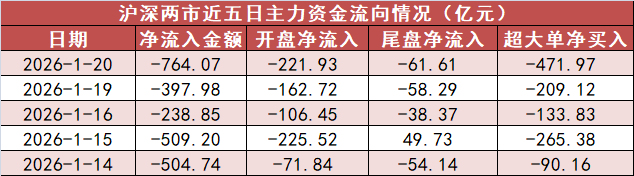
Market Overview - The A-share market experienced an overall decline on January 20, with the Shanghai Composite Index closing at 4113.65 points, down 0.01%, the Shenzhen Component Index at 14155.63 points, down 0.97%, and the ChiNext Index at 3277.98 points, down 1.79% [1] - The North Stock 50 Index also fell by 2% [1] Capital Flow - The main capital outflow from the A-share market reached 764.07 billion yuan, with a net outflow of 221.93 billion yuan at the opening and 61.61 billion yuan at the close [2] - The CSI 300 index saw a net outflow of 199.71 billion yuan, while the ChiNext experienced a net outflow of 388.98 billion yuan, and the Sci-Tech Innovation Board had a slight net inflow of 1.17 billion yuan [4] Sector Performance - Among the 8 sectors that saw capital inflows, the construction and decoration industry led with a net inflow of 27.91 billion yuan [6] - The top five sectors with net inflows included: - Construction and Decoration: 27.91 billion yuan, up 0.27% - Banking: 18.88 billion yuan, up 1.19% - Real Estate: 16.88 billion yuan, up 1.40% - Public Utilities: 15.06 billion yuan, up 0.72% - Transportation: 12.43 billion yuan, up 0.48% [7] - Conversely, the sectors with the largest net outflows included: - Electronics: -305.40 billion yuan, down 0.79% - Power Equipment: -268.40 billion yuan, down 1.47% - Computers: -198.78 billion yuan, down 1.55% - Machinery: -165.45 billion yuan, down 1.22% - Telecommunications: -160.92 billion yuan, down 2.61% [7] Stock Highlights - Zhejiang Wenhu Internet saw the highest net inflow of 5.1 billion yuan [8] - Institutions showed significant interest in several stocks, with Hunan Baiyin (002716) experiencing a net institutional buy of 80.83 million yuan, while Sanwei Communication (002115) faced a net institutional sell of 193.59 million yuan [10][11] Institutional Focus - Recent institutional ratings and target prices for selected stocks include: - Xingyu Co., Ltd.: Buy rating with a target price of 222.42 yuan, current price 121.24 yuan, indicating a potential upside of 83.45% - Dongyangguang: Buy rating with a target price of 35.28 yuan, current price 28.26 yuan, indicating a potential upside of 24.84% - Shuijingfang: Buy rating with a target price of 47.84 yuan, current price 40.35 yuan, indicating a potential upside of 18.56% [12]
谨慎加仓?
第一财经· 2026-01-20 10:40
Market Overview - The A-share market shows a differentiated adjustment pattern, with the Shanghai Composite Index demonstrating resilience, regaining the 4100-point level, primarily driven by the real estate, banking, and oil sectors [4] - A total of 2231 stocks experienced an increase [5] - The market exhibited a clear divergence, with the real estate sector leading gains, while the TMT (Technology, Media, Telecommunications) sector and power equipment faced significant adjustments [6] Trading Activity - The total trading volume of both markets reached 1 trillion yuan, an increase of 2.56%, indicating a moderate increase in trading activity as funds shifted from previously popular sectors to those with lower valuations or solid fundamentals [7] - Institutional investors are reallocating their portfolios, selling off previously popular sectors like power equipment and telecommunications, and moving towards defensive sectors such as banking, construction, insurance, and real estate [9] Fund Flows - There was a net outflow of 68.4 billion yuan from major funds, while retail investors saw a net inflow [8] - Retail investors are absorbing the selling pressure and speculating on themes, with some funds flowing into short-term overbought stocks, partially offsetting the outflow from popular sectors like semiconductors and commercial aerospace [9] Investor Sentiment - As of January 20, 32.96% of investors increased their positions, while 20.13% reduced their holdings, with 46.91% remaining unchanged [12] - Retail investor sentiment is currently at 75.85% [10]