
有色金属冶炼

Search documents
全国31省经济数据出炉,东部巩固经济“压舱石”作用中西部稳中求进
Lian He Zi Xin· 2026-02-06 12:33
Economic Overview - By the end of January 2026, all 31 provinces in China had released their 2025 economic data, with GDP rankings remaining stable except for Chongqing surpassing Liaoning[4] - In 2025, the GDP growth rate for Tibet led the nation, while 18 provinces exceeded the national average growth rate of 5.0%, a decrease of 3 from 2024[4] Eastern Region - The eastern region accounted for over 50% of the national GDP, with Guangdong, Jiangsu, and Shandong remaining the top three provinces; Shandong's GDP surpassed 10 trillion for the first time[5] - Guangdong's GDP represented over 10% of the national total, with a new economy value-added ratio of 26.7% and high-tech manufacturing accounting for 34.7% of industrial output[6] Central Region - The central region's total economic output reached 29.91 trillion, with Henan, Hubei, and Anhui leading in growth rates of 5.6%, 5.5%, and 5.5% respectively[10] - In 2025, Henan's strategic emerging industries accounted for over 25% of industrial value-added, significantly contributing to economic stability[10] Western Region - The western region saw most provinces exceed the national average growth rate, with Tibet's growth rate at the top and its GDP surpassing 300 billion for the first time[14] - Gansu's industrial output increased by 9.5%, driven by a 19.5% growth in the non-ferrous metal smelting industry, benefiting from new industry demands[14] Northeast Region - The Northeast region, led by Liaoning, faced significant challenges with a notable decline in economic growth, as it was surpassed by Chongqing in GDP ranking[15] - Liaoning's industrial output growth was only 0.6%, far below the national average of 5.9%, indicating difficulties in transitioning traditional industries[15]
中色股份:哈萨克斯坦30万吨/年铜冶炼厂项目合同尚未生效
Mei Ri Jing Ji Xin Wen· 2026-02-06 10:35
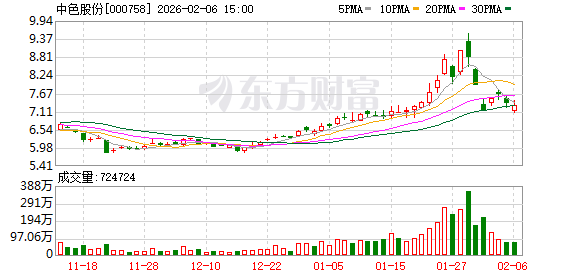
中色股份(000758.SZ)2月6日在投资者互动平台表示,您好!公司一直积极推进相关项目:青海中色 自成立以来依托成熟技术团队与高效管理模式,持续完善青海地区资源储备体系,优选资源开发项目, 积极推进项目合作勘查;达瑞矿业聚焦项目选硫无尾建设方案变更,已完成无尾矿选硫技术可行性研究 报告,公司将加快办理相关手续的备案和审批工作,全力推进项目进度;哈萨克斯坦30万吨/年铜冶炼 厂项目合同尚未生效,如后续有相关进展且达到披露标准,公司将严格按照相关规定及时履行信息披露 义务。感谢您的关注。 (文章来源:每日经济新闻) 每经AI快讯,有投资者在投资者互动平台提问:青海中色矿业停了吗?中色印尼达瑞矿业项目停了 吗?哈萨克斯坦30万吨/年铜冶炼厂项目停了吗? ...


粤东西北12市2025年经济数据出炉 产业向好向新 经济稳中有增
Nan Fang Ri Bao Wang Luo Ban· 2026-02-06 08:31
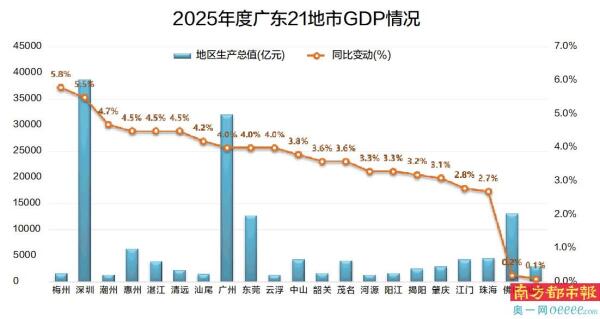
工业支撑有力 发展持续向好 6市经济增速跑赢全省,10市经济增速好于去年,梅州、潮州经济增长排名全省第一、第三; 多市技改投资、基础设施投资、全社会用电量等实现较快增长,阳江、潮州等市技改增速超30%,河 源、云浮全社会用电量实现两位数增长…… 近日,粤东西北12市2025年经济数据陆续出炉,各地经济发展可圈可点,相关地市工业、投资、消费等 相关指标实现稳中有增,经济向好的基础不断巩固。 2025年,梅州、潮州、湛江、清远、汕尾、云浮6市经济增长跑赢全省3.9%的增速,分别为5.8%、 4.7%、4.5%、4.5%、4.2%、4.0%。 去年,云浮市规上工业取得5.2%的增速,贵金属行业表现良好,带动云浮采矿业实现高速增长。该市 非金属矿采选业、有色金属冶炼和压延加工业、化学原料和化学制品制造业分别增长41.3%、57.1%、 19.3%,合计拉动规上工业增加值增长5.6个百分点。 从地区生产总值上看,粤东西北12市地区生产总值分为4个梯队。其中,茂名地区生产总值达到4106.4 亿元,是粤东西北唯一GDP4000亿+城市;处在3000亿+梯队的有湛江、汕头,分别为3952.94亿元、 3023.83亿元,湛 ...
深圳经济总量居首 梅州GDP增速第一
Nan Fang Du Shi Bao· 2026-02-06 06:00
Economic Overview - As of February 5, 2025, all economic data for 21 cities in Guangdong has been released, with Shenzhen leading the province with a GDP of 3.87 trillion yuan [3] - The overall GDP growth rate for Guangdong is 3.9%, with Meizhou leading at 5.8%, followed by Shenzhen at 5.5% and Chaozhou at 4.7% [3] Industrial Growth - Zhanjiang leads the province in industrial added value growth at 10.7%, with Huizhou and Meizhou both at 8.6% [4] - Zhanjiang's industrial sector contributes over 40% to its economic growth, with significant increases in communication equipment and computer manufacturing [4] - Meizhou's industrial added value growth is 8.6%, with notable increases in non-ferrous metal smelting and electronic equipment manufacturing [5] Investment and Consumption - Industrial technological transformation investment in Yangjiang exceeds 60%, with several cities maintaining high investment levels in key and high-tech industries [7] - Guangzhou's retail sales of consumer goods show significant growth, particularly in furniture and communication equipment [8] - The consumption policies, such as trade-in programs, have positively impacted the consumer market across various cities [8] Foreign Trade - Shenzhen's total import and export volume reaches a record high of 4.55 trillion yuan, with exports at 2.74 trillion yuan [9] - Zhaoqing leads the province in export growth at 21.1%, with significant contributions from electromechanical products [10] - Guangzhou's foreign trade also shows strong performance, with a total volume of 1.2 trillion yuan and a 10.4% year-on-year growth [11] Agriculture - Agricultural production remains strong, with cities like Maoming and Zhanjiang exceeding 110 billion yuan in total agricultural output [13] - Zhuhai's agricultural output grows by 6.6%, leading the province, particularly in fisheries [13] - Yangjiang's agricultural output also shows positive growth, with a 6.4% increase [13]
2026年02月06日:期货市场交易指引-20260206
Chang Jiang Qi Huo· 2026-02-06 05:24
期货市场交易指引 2026 年 02 月 06 日 | | 宏观金融 | | --- | --- | | ◆股指: | 中长期看好,逢低做多 | | ◆国债: | 震荡运行 | | | 黑色建材 | | ◆焦煤: | 短线交易 | | ◆螺纹钢: | 区间交易 | | ◆玻璃: | 逢低做多 | | | 有色金属 | | ◆铜: 观望 | | | ◆铝: | 建议加强观望 | | ◆镍: | 建议观望 | | ◆锡: | 区间交易 | | ◆黄金: | 区间交易 | | ◆白银: | 区间交易 | | ◆碳酸锂: | 区间震荡 | | | 能源化工 | | ◆PVC: | 区间交易 | | ◆烧碱: | 暂时观望 | | ◆纯碱: | 暂时观望 | | ◆苯乙烯: | 区间交易 | | ◆橡胶: | 区间交易 | | ◆尿素: | 区间交易 | | ◆甲醇: | 区间交易 | | ◆聚烯烃: | 偏弱震荡 | | | 棉纺产业链 | | ◆棉花棉纱: | 震荡调整 | | ◆苹果: | 震荡运行 | | ◆红枣: | 震荡运行 | | | 农业畜牧 | | ◆生猪: | 反弹滚动空机会 | | ◆鸡蛋: | ...
金融期货早评-20260206
Nan Hua Qi Huo· 2026-02-06 03:31
Group 1: Macroeconomics - The European Central Bank and the Bank of England maintained their benchmark interest rates unchanged. The ECB kept its three key interest rates steady for the fifth consecutive meeting, while the BoE's decision, with four out of nine policymakers voting for a 25 - basis - point cut, signaled a dovish stance [1]. - The UK's GDP growth forecast was downgraded to 0.9%, and the unemployment rate is expected to rise to 5.3%, indicating weak domestic demand. The visit of UK's Starmer to China is seen as a practical choice to break through growth bottlenecks [2]. - The US 12 - month JOLTS job openings reached a new low since September 2020, and the US Challenger job cuts in January hit a record high for the same period since 2009, surging 205% month - on - month [4][5]. Group 2: Exchange Rates - The RMB - US dollar exchange rate showed a trend of first depreciation and then appreciation. The on - shore RMB against the US dollar closed at 6.9408 at 16:30, down 32 basis points, and the night - session closed at 6.9363. The central parity rate was set at 6.9570, down 37 basis points [3]. - Due to weak US employment data and AI - related panic, the market's risk - aversion demand increased, supporting the US dollar index. The RMB's appreciation momentum may decline after the holiday as seasonal settlement demand weakens [3]. - Short - term export enterprises are advised to lock in forward settlement at around 7.01, and import enterprises can adopt a rolling purchase strategy at the 6.93 level [4]. Group 3: Stock Index Futures - The stock index fell collectively, with the large - cap index relatively more resilient. The trading volume in the two markets dropped to around 2.1 trillion yuan. The short - term stock index is expected to continue to adjust, with the large - cap index outperforming, but the adjustment range is limited [4][5]. Group 4: Treasury Bonds - Treasury bond futures rose across the board. The open - market operation injected cross - festival funds, and the money market was stable. The yield of spot bonds declined across the board. The bond market may gain upward momentum as the A - share market is likely to adjust [5][6]. Group 5: Container Shipping (European Routes) - The main contract EC2604 of container shipping on European routes fluctuated widely. The market's core contradiction lies in the game between geopolitical risks and weak fundamentals. Short - term, it will maintain a volatile pattern with limited upside [6][7][8]. - It is recommended to shift long positions on the medium - term during intraday adjustments and take profits on the March contract at high levels. Short - term, consider shorting lightly at high levels [6][8]. Group 6: New Energy (Carbonate Lithium and Industrial Silicon) - Carbonate lithium futures prices fell, with a daily decline of 9.81%. The trading volume increased by 70.48%, and the open interest decreased by 30,100 lots. It is recommended to reduce positions before the Spring Festival to avoid risks [9]. - Industrial silicon and polysilicon futures prices declined. They are expected to trade in a narrow range, with industrial silicon between 8300 - 9100 and polysilicon between 48000 - 52000 [10][11][13]. Group 7: Non - ferrous Metals - Copper prices fell. It is recommended to seize the opportunity to replenish inventory when prices decline. The copper market is affected by factors such as inventory changes and holiday - related demand [15][16][20]. - Aluminum prices may oscillate, with support at 23000 - 23500. Alumina prices are expected to oscillate in the short - term, with a long - term weakening trend. Cast aluminum alloy prices are also expected to oscillate [21][22][23]. - Zinc prices are expected to fluctuate widely in the future. Nickel - stainless steel prices are affected by the broader market and are expected to be weak and volatile. Tin prices are likely to follow the sector in wide - range adjustments [23][24][26]. - Lead prices are expected to be weakly volatile, with support at the bottom but lacking upward drivers before the Spring Festival [26][27]. Group 8: Oils and Fats, and Feeds - For oilseeds, the external market of US soybeans is strong. Domestic soybean meal is expected to rebound in the short - term, and rapeseed meal is difficult to have an independent upward trend. It is recommended to participate in long positions in spreads and single - side trades lightly [28]. - For oils, the short - term is expected to be in a consolidation phase. The overall situation in the first quarter is still supported, and short - selling is not recommended [29]. Group 9: Energy and Oil & Gas - Fuel oil is in a weak operation. The supply of high - sulfur fuel oil is gradually recovering, and the demand is mainly in the bunkering market. The long - term high - sulfur cracking trend is downward [31]. - Low - sulfur fuel oil has a low cracking spread. The supply is relatively abundant, and the demand is stable. The inventory decline provides a slight boost [31][32]. - Asphalt prices are struggling to rise. The short - term is expected to be in a volatile state, with limited upside and downside [32][33][34]. Group 10: Precious Metals - Platinum and palladium prices in NYMEX retreated significantly. The short - term "tightening trade" does not change the long - term "loosening trend." Attention should be paid to position control [34][35][36]. - Gold and silver prices fell under pressure. In the short - term, they are weak and may continue to decline. In the long - term, the upward trend remains unchanged, and it is recommended to buy on dips [36][37][38]. Group 11: Chemicals - Pulp and offset paper futures prices rebounded from lows. It is recommended to hold short positions in pulp futures and consider short - term long positions in offset paper futures [39][40]. - LPG prices are affected by the US - Iran negotiation. Attention should be paid to the negotiation results [40][41][42]. - PX - PTA is recommended to be bought on dips. The processing fee of PTA is expected to narrow [43][44][45]. - MEG - bottle chips are weakly volatile. The short - term is expected to be in a range - bound state [45][46]. - Methanol is recommended to be observed on the long - side. 3 - 5 and 5 - 9 spreads can be shorted, and the MTO spread can be widened [46][47][48]. - Plastics and PP are weakly volatile. It is recommended to observe in the short - term and focus on post - holiday inventory accumulation and demand recovery [48][49]. - Pure benzene and styrene are in a consolidation phase. It is recommended to observe in the short - term and pay attention to geopolitical and demand factors [49][50][52]. - Rubber prices are supported at the bottom. It is recommended to be lightly - positioned before the long holiday and consider option strategies [53][57][81]. - Urea prices are expected to correct in the short - term. It is recommended to exit long positions [57][58]. - Glass and soda ash are weakly volatile. Soda ash is in an oscillating state, and glass is in a situation of weak supply and demand [58][59][60]. - Propylene is affected by cost, supply - demand, and market sentiment. Attention should be paid to risks [60][61]. Group 12: Black Metals - Rebar and hot - rolled coils are in a state of inventory accumulation and are expected to be weakly volatile. The price range of rebar 2605 is expected to be between 3050 - 3200, and that of hot - rolled coils 2605 is between 3200 - 3350 [62]. - Iron ore is in a state of weak supply and demand. It is recommended to observe cautiously before the Spring Festival [63][64]. - Coking coal and coke prices fell. The short - term rebound has limited sustainability [64][65]. - Ferrosilicon and ferromanganese are in an oscillating pattern with support at the bottom and pressure at the top. The price range of ferrosilicon 05 is between 5400 - 5900, and that of ferromanganese 05 is between 5700 - 6100 [65][66][67]. Group 13: Agricultural and Soft Commodities - Hog prices are in a bottom - grinding state. It is recommended to observe before clear demand signals and consider spread strategies [69]. - Cotton prices are expected to be strong but are restricted by the price difference between domestic and foreign cotton. It is recommended to buy on dips [70][71][72]. - Sugar prices are expected to have limited upward space, with pressure at the 60 - day moving average [72][73]. - Egg prices fell below the previous low. It is recommended to sell call options on JD2603 - C - 3100 [74]. - Apple prices are likely to be strong. The consumption peak is coming to an end, but the delivery contradiction provides support [81][82][83]. - Red date prices are expected to be in a low - level oscillation in the short - term and face pressure in the long - term [84][85]. - Log prices may rise. It is recommended to try long positions on dips and sell put options [86][87].
宏达股份股价涨5.63%,鹏华基金旗下1只基金位居十大流通股东,持有2382.22万股浮盈赚取2191.64万元
Xin Lang Ji Jin· 2026-02-06 02:29
Group 1 - The core point of the news is that Hongda Co., Ltd. experienced a stock price increase of 5.63%, reaching 17.25 yuan per share, with a trading volume of 706 million yuan and a turnover rate of 2.14%, resulting in a total market capitalization of 45.568 billion yuan [1] - Hongda Co., Ltd. is primarily engaged in mining, non-ferrous metal smelting, and the production and sales of phosphate chemical products, with revenue composition as follows: zinc metal and by-products 45.55%, ammonium phosphate series products 33.44%, compound fertilizer products 11.82%, synthetic ammonia 5.16%, and others 3.27% [1] Group 2 - Among the top ten circulating shareholders of Hongda Co., Ltd., Penghua Fund has a fund that entered the list, holding 23.8222 million shares, accounting for 1.17% of the circulating shares, with an estimated floating profit of approximately 21.9164 million yuan [2] - The Penghua Zhongzheng Subdivision Chemical Industry Theme ETF Link A (014942) has a total asset scale of 1.16 billion yuan, with a year-to-date return of 5.71% and a one-year return of 49.78%, ranking 1041 out of 4288 in its category [2]

有色早报-20260206
Yong An Qi Huo· 2026-02-06 02:16
Group 1: Report Investment Rating - No information provided on the report's industry investment rating Group 2: Core Views - The copper market currently has strong support from rigid demand, and the fundamentals are characterized by limited supply and stable demand. In the medium - term, the price of copper is expected to rise, and in the short - term, the stabilization of copper prices depends on the stabilization of precious metals. Attention should be paid to the support levels of 97,000 and 99,000 for Shanghai copper [1] - Aluminum prices fluctuated sharply this week. If there is a callback opportunity, one can consider going long. However, if the Iranian situation deteriorates, aluminum prices may rise further [1] - The domestic fundamentals of zinc are average, but the market is optimistic about its allocation flexibility due to limited long - term capital investment and potential supply disruptions from Iran. Attention should be paid to reverse arbitrage opportunities [2] - The short - term fundamentals of nickel are weak, and the short - term sentiment of the non - ferrous metals market is dominant, affected by the reduction of the Indonesian nickel ore quota [3] - The supply - demand contradiction of lead has been alleviated, and it is recommended to try short - selling at high prices in the short term [8] - The short - term fundamentals of tin are not weak, and it is recommended to wait and see under the current large macro - sentiment fluctuations. In the long - term, if the macro situation changes, the price may decline significantly in the second half of the year [11] - The supply of industrial silicon is expected to decrease, and the price is expected to fluctuate with costs. In the long - term, the price will mainly fluctuate at the bottom of the cycle [12] - The short - term fundamentals of lithium carbonate are strong, and there is a large space for positive arbitrage between months if the inventory in the intermediate link is further reduced [12] - The fundamentals of stainless steel are weak, and the short - term sentiment of the non - ferrous metals market is dominant, affected by the news of the Indonesian quota [14] Group 3: Summary by Metal Copper - This week, copper prices fluctuated significantly. The US's ability to siphon inventory is disappearing, but global consumption is good. The downstream showed obvious price - setting behavior after the price adjustment. The support from the industrial side remains. The stabilization of copper prices depends on the stabilization of precious metals, and attention should be paid to the support levels of 97,000 and 99,000 for Shanghai copper [1] Aluminum - Aluminum prices fluctuated sharply this week due to the seasonal decline in the start - up rate of aluminum products, the spill - over of the overall fluctuations in the domestic non - ferrous and precious metals sectors, and overseas macro and geopolitical events. If there is a callback opportunity, one can consider going long. If the Iranian situation deteriorates, aluminum prices may rise further [1] Zinc - On the supply side, the domestic and imported TC is accelerating its decline, and the domestic zinc ore is tightening. The smelting profit is supported by the high prices of sulfuric acid and silver. On the demand side, domestic demand is seasonally weak, and overseas demand is average. The market is optimistic about the allocation flexibility of zinc, and attention should be paid to reverse arbitrage opportunities [2] Nickel - On the supply side, the output of pure nickel decreased slightly. On the demand side, it is weak. The inventory in China is increasing, and the LME inventory remains stable. The short - term fundamentals are weak, and the short - term sentiment of the non - ferrous metals market is dominant [3] Lead - On the supply side, the production of primary lead is driven by profit, and the production of recycled lead is affected by environmental protection and losses. On the demand side, the battery start - up rate is high, but there is an expectation of weakening demand. The supply - demand contradiction is alleviated, and it is recommended to try short - selling at high prices in the short term [8] Tin - This week, tin prices fluctuated sharply. On the supply side, there are differences in the recovery expectations of Wa State in the first quarter, and Indonesia has determined its quota for 2026. On the demand side, there are differences in the downstream restocking willingness, and the overseas consumption is flat. The domestic inventory has increased slightly, and the overseas LME inventory has increased. It is recommended to wait and see in the short term, and the price may decline significantly in the second half of the year if the macro situation changes [11] Industrial Silicon - The production in the southwest region is mostly shut down, and some factories in Xinjiang are reducing production. The monthly supply is expected to continue to shrink, and there is an expectation of inventory reduction in February. The price is expected to fluctuate with costs. In the long - term, the price will mainly fluctuate at the bottom of the cycle [12] Lithium Carbonate - Last week, the absolute price and positions of lithium carbonate declined significantly due to macro - sentiment, regulatory tightening, and concerns about terminal negative feedback. The short - term fundamentals are strong, and there is a large space for positive arbitrage between months if the inventory in the intermediate link is further reduced [12] Stainless Steel - On the supply side, the steel mill production decreased slightly. On the demand side, the downstream is entering the off - season. The cost has increased slightly, and the inventory has increased slightly. The fundamentals are weak, and the short - term sentiment of the non - ferrous metals market is dominant [14]
宏观金融类:文字早评2026-02-06-20260206
Wu Kuang Qi Huo· 2026-02-06 02:01
文字早评 2026/02/06 星期五 宏观金融类 股指 【行情资讯】 1、八部门印发《中药工业高质量发展实施方案(2026—2030 年)》,到 2030 年中药工业全产业链协同 发展体系初步形成; 2、2026 年 APEC 标准与合格评定分委会首次会议在广州召开,会议聚焦脑机接口技术等相关国际标准在 APEC 经济体实施; 3、比特币价格日内一度跌破 7 万美元关口。分析认为,在这一轮大跌后,比特币的上涨动能、市场叙 事以及"避险资产"的标签几乎同时瓦解; 4、美国联邦通信委员会受理 SpaceX 百万颗卫星系统部署申请。这一卫星系统将建立一个环绕地球轨道 的数据中心网络。此外,SpaceX 计划推出星链手机。 基差年化比率: IF 当月/下月/当季/隔季:-1.02%/1.08%/4.05%/4.21%; IC 当月/下月/当季/隔季:0.55%/3.08%/9.04%/6.96%; IM 当月/下月/当季/隔季:-4.86%/3.39%/12.81%/9.94%; IH 当月/下月/当季/隔季:-6.05%/-0.76%/0.43%/2.34%。 【策略观点】 近期市场轮动节奏加快,热点板块持续性不 ...
去年有色金属企业工业增加值增长6.9%
Ren Min Ri Bao· 2026-02-05 22:20
Core Insights - The industrial added value of China's non-ferrous metal enterprises is projected to grow by 6.9% by 2025, with the production of ten types of non-ferrous metals expected to exceed 80 million tons for the first time, reaching 81.75 million tons, an increase of 3.9% compared to the previous year [1] Investment Trends - The fixed asset investment structure in the non-ferrous metal industry has been optimized, with significant growth in the mining sector. Last year, fixed asset investment in the non-ferrous metal industry increased by 4.9%, surpassing the national industrial investment growth rate by 2.3 percentage points [1] - Specifically, fixed asset investment in the non-ferrous metal mining and selection industry saw a remarkable increase of 41.0% compared to the previous year [1] Trade Performance - The total import and export trade volume of non-ferrous metals reached a new high, amounting to $412.24 billion, which represents a growth of 12.4% from the previous year [1]