
硬件设备

Search documents
超百亿资金趁跌抢筹港股!恒生科技ETF天弘(520920)连续7日“吸金”,支持T+0交易
Ge Long Hui· 2025-10-17 03:26
Core Viewpoint - The Hong Kong stock market is experiencing a downturn, primarily influenced by renewed US-China trade tensions, leading to significant fluctuations and profit-taking among investors [1] Market Performance - The Hang Seng Index fell by 1.3%, while the Hang Seng Tech Index dropped by 2.3%, with cumulative declines of 4.8% and 9% respectively since October began [1] - The volatility in the Hong Kong market is attributed to the offshore market dynamics and the impact of the "4·7" event earlier this year [1] Capital Flows - Despite the downturn, there has been a net inflow of capital into Hong Kong stocks, with a total of HKD 41.4 billion in net purchases from southbound funds in October [1] - The Hang Seng Tech ETF Tianhong (520920) has seen a continuous inflow of HKD 1.374 billion over seven days since its listing on September 30 [1] Investment Sentiment - The strong inflow of funds is driven by major Chinese internet giants like Alibaba, Baidu, and Tencent signaling their commitment to AI investments [1] - Anticipation of potential interest rate cuts by the Federal Reserve is also contributing to the positive sentiment among foreign investors, with expectations of a return of foreign capital to the Hong Kong market [1] Sector Focus - Foreign capital has predominantly flowed into Hong Kong's software services and hardware sectors during Q3, indicating a consensus on increasing investments in Chinese tech assets [1] - Analysts suggest that the recent significant adjustments in the Hong Kong market may lead to stabilization, particularly for core stocks supporting T+0 trading, such as the Hang Seng Tech ETF Tianhong (520920, Class C: 012349) [1]
港股三大指数低开低走,恒生科技指数跌幅扩大至2.5%
Sou Hu Cai Jing· 2025-10-17 02:28
Group 1 - The Hong Kong stock market indices collectively declined, with the Hang Seng Tech Index dropping over 2.5% during the session, reflecting a downturn in tech stocks and fluctuations in gold stocks [1] - The largest ETF tracking the Hang Seng Tech Index (513180) followed the index's downward trend, with most holdings declining, except for NIO which saw an increase [1] - According to China Merchants Securities, the Hong Kong stock market is expected to experience a rebound after a short-term decline, driven by factors such as continuous innovation in China's tech industry and a lower probability of high tariffs being implemented [1] Group 2 - As of October 16, the cumulative net inflow of southbound funds reached a record high of 12089.46 billion HKD this year, with over 20 billion HKD net inflow on the day of reporting [2] - Foreign capital has shown a tendency to flow into Hong Kong stocks, particularly in software services and hardware sectors, indicating a consensus among foreign investors to increase their positions in Chinese tech assets [2] - The current valuation of the Hang Seng Tech Index ETF (513180) stands at a P/E ratio of 22.88, which is approximately 28.79% of its historical valuation range, suggesting that the index remains relatively undervalued [2]
2025Q3股市外资季度动向跟踪:中国科技资产成外资加仓共识
GUOTAI HAITONG SECURITIES· 2025-10-16 14:48
Group 1 - The report highlights that foreign capital has shown a consensus in increasing allocations to Chinese technology assets, particularly in the context of rising demand for computing power and strengthened AI narratives, which have enhanced expectations for application recovery [1][7] - In Q3, foreign capital experienced a net outflow of approximately 841 billion HKD from Hong Kong stocks, although this was an improvement compared to Q2. The primary inflows were observed in software services (172 billion HKD from stable foreign capital and 47 billion HKD from flexible foreign capital) and hardware equipment (36 billion HKD and 105 billion HKD) [5][7] - For A-shares, the Northbound capital saw an overall outflow of 158.2 billion CNY in Q3, with a smaller net outflow of about 20.3 billion CNY when excluding Chinese custodial funds. Stable long-term foreign capital accounted for a significant portion of this outflow, while short-term flexible foreign capital saw an inflow of approximately 99.9 billion CNY [8][21] Group 2 - The report indicates that foreign capital has increased its allocation to various technology sectors in both Hong Kong and A-shares, including new energy, electronics, and machinery, while reducing exposure to banks and consumer sectors [5][8] - Specific sectors such as electric power equipment and electronics saw notable increases in foreign capital allocation, with stable foreign capital's overweight in electric power equipment rising by 3.7 percentage points compared to Q2 [21][22] - The report lists individual stocks that attracted significant foreign inflows, including BYD (138.4 billion CNY) and CATL (133.8 billion CNY) in the automotive and electric power equipment sectors, respectively, while companies like Kweichow Moutai and China Ping An experienced substantial outflows [22]





科技制造仍是市场主线?| 财经头条
Di Yi Cai Jing· 2025-10-16 09:29
Group 1 - Northbound capital has increased its holdings in A-shares for three consecutive quarters, with a significant flow into technology manufacturing, particularly in hardware equipment and semiconductors [1] - The current focus among institutions is whether there will be a style shift in the market, debating between dividends and technology as the main market theme [1] - According to Wei Jixing, Chief Strategist at Kaiyuan Securities, the market does not yet have the conditions for a comprehensive style switch, indicating that technology stocks will outperform in the medium to long term [1] Group 2 - The MACD golden cross signal has formed, indicating a positive trend for certain stocks [2]
2025年三季度港股承销排行榜
Wind万得· 2025-10-10 22:40
Core Insights - The Hong Kong stock market has shown a strong upward trend in Q3 2025, with the Hang Seng Index rising approximately 33.88% year-to-date, and the Hang Seng Tech Index leading with a nearly 45% increase, indicating sustained investor interest in technology innovation companies [1] - The primary equity financing market in Hong Kong has performed robustly, with total equity financing (including IPOs and refinancing) reaching HKD 414.8 billion in the first three quarters of 2025, a significant increase of 253.30% compared to HKD 117.4 billion in the same period last year [1] Group 1: Equity Financing Overview - The total equity financing in the Hong Kong primary market for the first three quarters of 2025 reached HKD 414.8 billion, more than doubling from HKD 117.4 billion in the same period last year, with a growth rate of 253.30% [4] - The IPO financing scale was HKD 186.2 billion, up 233.97% from HKD 55.8 billion year-on-year [21] - The placement financing scale saw a remarkable increase, raising HKD 218.2 billion, a growth of 541.01% compared to the previous year [4] Group 2: Financing Methods Distribution - In the first three quarters of 2025, the IPO fundraising amount was HKD 186.2 billion, accounting for 44.89% of total fundraising; placement raised HKD 218.2 billion, making up 52.61% [8][11] - Rights issues raised HKD 58.15 billion, representing 1.40%, while consideration issues and public offerings raised HKD 22.86 billion and HKD 22.77 billion, each accounting for 0.55% [8][11] Group 3: Industry Distribution of Financing - The top three industries in terms of fundraising amounts were hardware equipment (HKD 634 billion), pharmaceuticals and biotechnology (HKD 603 billion), and automotive and parts (HKD 570 billion) [12] - The pharmaceutical industry led in the number of financing events with 49 occurrences, followed by software services with 42 and non-bank financials with 36 [15] Group 4: IPO Trends - The number of IPOs in Hong Kong for the first three quarters of 2025 was 68, an increase of 51.11% from 45 in the same period last year [18] - The total amount raised through IPOs was HKD 186.2 billion, significantly up from HKD 55.8 billion year-on-year [21] - The highest fundraising industry for IPOs was electrical equipment, raising HKD 436 billion, followed by non-ferrous metals at HKD 357 billion and pharmaceuticals at HKD 200 billion [25] Group 5: Refinancing Trends - Total refinancing raised HKD 2,285.73 billion in the first three quarters of 2025, a substantial increase of 270.77% from HKD 616.48 billion in the previous year [38] - The hardware equipment sector led refinancing amounts at HKD 507 billion, primarily from Xiaomi Group's placement of HKD 426 billion [42] - The pharmaceutical sector had the highest number of refinancing projects with 38, followed by software services with 37 [45] Group 6: Institutional Rankings - CICC topped the IPO sponsorship scale with HKD 328.13 billion, followed by CITIC Securities (HK) at HKD 242.40 billion and Morgan Stanley at HKD 221.44 billion [52] - Goldman Sachs led in refinancing underwriting with HKD 308.84 billion, followed by CICC at HKD 226.69 billion and CITIC Securities (HK) at HKD 195.35 billion [66]



创年内新高后意外回落,港股“日历效应”将如何演绎?
Di Yi Cai Jing· 2025-10-03 11:36
Market Performance - After a significant rise, the Hong Kong stock market experienced a notable pullback on October 3, with the Hang Seng Index closing down 0.54% and the Hang Seng Tech Index down 0.9% [1][2] - The automotive sector was a major drag on the market, with BYD Co. Ltd. falling 3.95% and other new energy vehicle manufacturers like Li Auto and Xpeng also declining over 2% [2][3] - Despite the overall market decline, hydrogen energy stocks showed resilience, with Shanghai Electric surging 13%, reaching a new closing high not seen in over a decade [1][3] Sector Analysis - The automotive and components sector saw a decline of over 2%, significantly impacting the overall market performance [2] - Gold stocks reversed their earlier strong performance, with companies like Tongguan Gold and Lingbao Gold dropping 4.17% and 3.53%, respectively, amid a decrease in international gold prices [2] - The technology sector experienced volatility, particularly Alibaba, which initially dropped 4.7% but later closed up 1.09% [3] Historical Context and Future Outlook - Historically, the Hong Kong market exhibits a "calendar effect" during the National Day holiday, with an 86.7% probability of the Hang Seng Index rising during this period [4][6] - In September, the Hang Seng Tech Index rose 13.9%, leading among global indices, while the Hang Seng Index and Hang Seng China Enterprises Index increased by 7.1% and 6.8%, respectively [4][5] - Analysts suggest that while short-term adjustments are expected, the medium to long-term outlook for the Hong Kong market remains positive, driven by structural industry recovery and valuation improvements in certain sectors [6][7]
港股大涨,中芯国际,历史新高
Zhong Guo Zheng Quan Bao· 2025-10-02 09:45
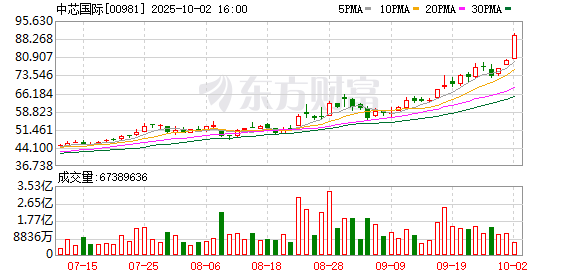
Group 1 - The Hong Kong stock market showed strong performance on October 2, with all three major indices closing higher. The Hang Seng Index rose by 1.61% to 27,287.12 points, the Hang Seng China Enterprises Index increased by 1.77% to 9,724.38 points, and the Hang Seng Tech Index surged by 3.36% to 6,682.86 points [3] - The semiconductor, electrical equipment, non-ferrous metals, pharmaceutical biology, and hardware equipment sectors performed strongly. Notably, the semiconductor sector saw a significant rise, with SMIC increasing by over 12% and Hua Hong Semiconductor rising by more than 7% [4] - SMIC's stock price reached a new high, increasing by 12.70% to 90.35 HKD per share, marking a cumulative increase of 22.89% over three consecutive trading days. As of September 30, southbound funds held over 2.5 billion shares of SMIC, with a market value exceeding 200 billion HKD, accounting for over 20% of its total market capitalization [6] Group 2 - The global semiconductor industry is experiencing a notable recovery, with a market size of 346 billion USD in the first half of the year, reflecting an 18.9% year-on-year growth. This growth is primarily driven by investments in AI infrastructure and demand for end-user applications [7] - The domestic market size is projected to reach 102.6 billion RMB by 2025, with SMIC playing a crucial role as a leading foundry in the expansion of mature processes and the localization of the supply chain [7]

2025年前三季度A股大数据排行榜
Wind万得· 2025-10-01 03:18
Market Performance - In the first three quarters of 2025, the A-share market showed strong performance, with major indices rising over 10%, and both the ChiNext Index and the Sci-Tech 50 Index leading with a cumulative increase of 51.2% [1][3] - The North Exchange 50 Index increased by 47.29%, while the Shenzhen Component Index, CSI 1000, and Wind All A Index all saw gains exceeding 20% [3] Industry Performance - Among the 35 industries classified by Wind, 31 recorded gains in the first three quarters, with the non-ferrous metals industry leading at a cumulative increase of 65.52% [5] - The hardware equipment and semiconductor industries also performed well, with increases of 56.97% and 54.74%, respectively [5] - The daily consumer retail sector lagged, with a cumulative decline of 6.27%, while coal and telecommunications services fell by 4.47% and 2.77% [5] Concept Performance - Key concepts such as artificial intelligence, rare earths, and robotics were notably active, with the optical module (CPO) index showing the strongest performance, rising by 116.20% [10] - Other significant indices included the copper-clad board, AI+ index, optical chip, and optical communication indices, with cumulative increases of 114.60%, 98.89%, 96.36%, and 91.82%, respectively [10] Market Capitalization - As of the end of Q3 2025, the total market capitalization of the A-share market was approximately 115.86 trillion yuan, reflecting a 23.3% increase from the end of 2024 [16] - The Shanghai main board had the highest number of listed companies at 1,695, accounting for 31.18% of the total [13] Trading Volume - The total trading volume in the A-share market for Q3 was 137.6 trillion yuan, representing a quarter-on-quarter increase of 81.77% and a year-on-year increase of 217.05% [20] Margin Financing - By the end of Q3, the margin financing balance in the A-share market was reported at 24,288 billion yuan, up 32.0% from the end of Q2 and up 74.2% year-on-year [24] IPO Activity - In the first three quarters of 2025, the A-share market saw a total of 76 IPOs, an increase of 7 from the previous year, with Q3 alone accounting for 28 IPOs [51] - The total fundraising from IPOs in the first three quarters reached 759.7 billion yuan, a 66.6% increase year-on-year [54]

招银国际每日投资策略-20250929
Zhao Yin Guo Ji· 2025-09-29 04:21
Market Overview - Global markets showed mixed performance, with the Hang Seng Index down 1.35% and the S&P 500 up 0.59% year-to-date performance for the Hang Seng Index stands at 30.25% [1][2] - The Chinese stock market saw declines, particularly in the technology, healthcare, and consumer discretionary sectors, while essential consumer goods, energy, and financials experienced gains [3] Industry Insights - The Chinese pharmaceutical industry is witnessing a recovery in domestic innovation research and development demand, with the MSCI China Healthcare Index up 74.0% since early 2025, outperforming the MSCI China Index by 37.3% [4] - The demand for early-stage research is showing positive signs, supported by a resurgence in capital market financing and a favorable environment for biotech innovation [9] - The CXO industry is expected to see performance recovery in the second half of 2025 due to increased demand for early-stage research and development [4][9] Company Analysis - WuXi AppTec (药明康德) is maintaining a strong growth trajectory in its TIDES business, with plans to expand peptide production capacity significantly by the end of 2025 [8] - The company reported a 14.5% year-on-year increase in new orders for preclinical services in the first half of 2025, with a notable 19.9% increase from U.S. clients [9] - WuXi AppTec's management is confident in maintaining resilient profitability, with adjusted gross and net profit margins reaching historical highs of 44.5% and 30.4% respectively in the first half of 2025 [10]

“重估牛”系列之港股资金面:9月W4港股资金:南向流入互联网,外资加码消费者服务
Changjiang Securities· 2025-09-28 13:14
Group 1 - The core viewpoint of the report indicates that from September 22 to 25, 2025, southbound funds recorded a net inflow of 14.493 billion HKD, primarily flowing into sectors such as consumer discretionary retail, non-ferrous metals, semiconductors, hardware equipment, and software services, with the top five sectors accounting for a total net inflow of 12.234 billion HKD [2][6][34] - The five sectors with the highest net inflow were: consumer discretionary retail (6.964 billion HKD), non-ferrous metals (1.992 billion HKD), semiconductors (1.198 billion HKD), hardware equipment (1.092 billion HKD), and software services (0.989 billion HKD) [2][6][34] - Conversely, the sectors with the most significant outflows included pharmaceuticals and biotechnology (-1.492 billion HKD), durable consumer goods (-0.255 billion HKD), consumer services (-0.225 billion HKD), automotive and parts (-0.216 billion HKD), and chemicals (-0.137 billion HKD) [2][6][34] Group 2 - During the same period, foreign intermediary funds experienced a net outflow of 19.015 billion HKD, with notable inflows into consumer services, non-bank financials, electrical equipment, pharmaceuticals and biotechnology, and real estate II, totaling a net inflow of 6.005 billion HKD across the top five sectors [7][41] - The sectors with the highest net inflow from foreign intermediaries were: consumer services (2.836 billion HKD), non-bank financials (1.419 billion HKD), electrical equipment (0.837 billion HKD), pharmaceuticals and biotechnology (0.683 billion HKD), and real estate II (0.231 billion HKD) [7][41] - The sectors that saw the most significant outflows included consumer discretionary retail (-8.9 billion HKD), medical equipment and services (-4.081 billion HKD), banking (-3.612 billion HKD), semiconductors (-1.356 billion HKD), and transportation (-1.283 billion HKD) [7][41]