国防军工

Search documents
【盘中播报】沪指跌0.13% 石油石化行业跌幅最大
Zheng Quan Shi Bao Wang· 2025-11-24 03:39
| 申万行业 | 行业涨跌(%) | 成交额(亿元) | 比上日(%) | 领涨(跌)股 | 涨跌幅(%) | | --- | --- | --- | --- | --- | --- | | 国防军工 | 2.40 | 425.36 | 35.85 | 航天环宇 | 19.99 | | 综合 | 1.70 | 23.55 | -22.80 | 南京新百 | 5.01 | | 通信 | 1.28 | 473.69 | -0.98 | 光库科技 | 14.46 | | 社会服务 | 1.05 | 64.17 | -17.07 | 国义招标 | 12.32 | | 传媒 | 1.02 | 376.17 | 10.75 | 值得买 | 11.60 | | 房地产 | 0.94 | 141.27 | -13.54 | 世联行 | 10.10 | | 建筑装饰 | 0.84 | 143.67 | -6.41 | 招标股份 | 20.00 | | 医药生物 | 0.75 | 366.57 | -27.71 | 中源协和 | 10.02 | | 农林牧渔 | 0.57 | 186.71 | -25.90 | 永安林业 | 1 ...
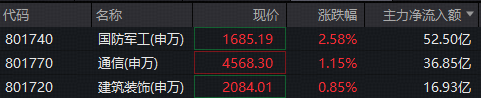
国防军工领跑全市场,超50亿主力资金涌入!国防军工ETF逆市涨逾2%,中船防务涨停再创四年新高!
Xin Lang Ji Jin· 2025-11-24 02:37
Core Insights - The defense and military industry sector is experiencing significant strength, leading the market with a net inflow of over 5.2 billion yuan as of November 24 [1] - The popular defense military ETF (512810) has risen over 2%, indicating strong buying interest and potential for further capital inflow [1][2] - The sector's fundamentals are supported by a projected revenue increase of 16.99% year-on-year, with a net profit growth of 14.01% in the third quarter of 2025 [3] Investment Trends - Major stocks in the defense sector, such as China Shipbuilding Defense and China Aerospace Science and Technology, have seen significant price increases, with some hitting new highs [2] - The defense military ETF (512810) is highlighted as an efficient investment tool, covering various themes including commercial aerospace and military AI [5][6] Market Performance - The defense sector's revenue for the third quarter reached 600.375 billion yuan, showing a recovery from previous lows [3] - The ETF has attracted a net subscription of 130 million yuan over the past ten days, reflecting strong investor interest [1]



六大机构,最新A股研判来了
Zhong Guo Zheng Quan Bao· 2025-11-23 14:12
Group 1 - The technology growth sector has experienced a significant pullback, leading to adjustments in the A-share market, but the downside space is considered limited after continuous adjustments, with expectations for a market recovery starting in November and an early layout window for the spring 2026 market [1][7] - Investment institutions suggest focusing on dividend stocks, cyclical stocks benefiting from rising commodity prices, as well as innovative pharmaceuticals and defense industries; there are also rebound opportunities in AI computing power, storage, energy storage, and robotics sectors [1][6][7] Group 2 - The Ministry of Industry and Information Technology is committed to advancing high-quality development of the industrial internet, emphasizing smart, green, and integrated directions to support new productive forces [2] - The State-owned Assets Supervision and Administration Commission is promoting the professional integration of central enterprises, with key project signings in critical areas such as new materials, artificial intelligence, and logistics [3] Group 3 - Sixteen hard technology-themed funds have been approved, including the first batch of AI ETFs and chip ETFs, indicating a growing interest in technology investments [4] - Market sentiment remains cautious, with a focus on dividend stocks for defensive strategies, and a potential rebound in the technology sector as concerns over AI bubbles diminish [5][6] Group 4 - The lithium battery industry chain is experiencing high demand, driven by strong market conditions in energy storage and the upcoming sales peak for new energy vehicles, with expectations for continued high prosperity [8] - The AI industry continues to show strong momentum, supported by domestic policies promoting self-innovation and new productive forces, with long-term value becoming more apparent if AI giants enhance their profitability [9][10] Group 5 - Future market outlook suggests that major A-share indices may exhibit strong oscillation patterns, with a focus on three key areas: essential resource products with rigid supply, traditional industries benefiting from supply-side reforms, and high-elasticity sectors like military and AI industry chains [11]
建议择机入场
HTSC· 2025-11-23 13:24
Quantitative Models and Construction A-Share Market Timing Model - **Model Name**: A-Share Multi-Dimensional Timing Model [10] - **Construction Idea**: The model integrates valuation, sentiment, capital, and technical dimensions to assess the directional outlook of the A-share market [10][12][16] - **Construction Process**: - Signals are generated daily for each dimension, with values of 0, ±1 representing neutral, bullish, and bearish views respectively [10] - **Valuation Dimension**: Uses equity risk premium (ERP) to capture mean-reversion characteristics [12][16] - **Sentiment Dimension**: Includes option put-call ratio, implied volatility, and futures member position ratio to reflect market sentiment [12][16] - **Capital Dimension**: Tracks financing purchase amounts to identify market trends [12][16] - **Technical Dimension**: Employs Bollinger Bands and individual stock turnover ratio differences to capture trend continuation [12][16] - The final market view is determined by the sum of scores across all dimensions [10] - **Evaluation**: The model effectively combines mean-reversion and trend-following strategies, balancing risk avoidance and opportunity capture [10] Style Timing Model - **Model Name**: Dividend Style Timing Model [18] - **Construction Idea**: Targets the relative performance of the CSI Dividend Index against the CSI All Index using trend-based indicators [18][22] - **Construction Process**: - Three indicators are used to generate daily signals (0, ±1 for neutral, bullish, bearish views) [18] - **Relative Momentum**: Positive indicator for dividend style [22] - **10Y-1Y Term Spread**: Negative indicator for dividend style, as wider spreads favor growth assets [22] - **Interbank Repo Volume**: Positive indicator for dividend style, reflecting asset scarcity [22] - Signals are aggregated to determine the overall view on dividend style [18] - **Evaluation**: The model captures dividend style trends effectively, leveraging macroeconomic and liquidity factors [18] - **Model Name**: Large-Cap vs Small-Cap Style Timing Model [23] - **Construction Idea**: Differentiates between macro-driven trends in low congestion and fund-driven reversals in high congestion [23][25] - **Construction Process**: - **Momentum Difference**: Calculates the difference in momentum between the Wind Micro-Cap Index and CSI 300 Index across multiple windows, averaging the top/bottom results for small/large-cap scores [27] - **Turnover Ratio**: Similar calculation for turnover ratio differences across windows, averaged for small/large-cap scores [27] - **Congestion Score**: Combines momentum and turnover scores to determine congestion levels (high congestion >90% for small-cap, <10% for large-cap) [27] - **Trend Model**: Uses small/large parameter double moving average models based on congestion levels [25] - **Evaluation**: The model adapts to market conditions, balancing long-term trends and short-term reversals [23][25] Sector Rotation Model - **Model Name**: Genetic Programming Sector Rotation Model [30] - **Construction Idea**: Directly mines factors from sector index data using genetic programming without relying on predefined scoring rules [30][33] - **Construction Process**: - **Factor Mining**: Utilizes NSGA-II algorithm to optimize for monotonicity and top-group performance simultaneously [33][34] - **Factor Combination**: Combines factors with weak collinearity using greedy strategy and variance inflation coefficient [34] - **Weekly Rebalancing**: Selects top five sectors based on multi-factor scores for equal-weight allocation [30] - **Example Factor**: Calculates covariance between standardized weekly low prices and monthly open prices over 25 days, adjusted by standardized weekly high prices over 15 days [38] - **Evaluation**: The model enhances factor diversity and reduces overfitting risks, achieving robust sector rotation performance [33][34] All-Weather Enhanced Portfolio - **Model Name**: China All-Weather Enhanced Portfolio [39] - **Construction Idea**: Implements macro factor risk parity to diversify risks across underlying macro drivers rather than assets [39][42] - **Construction Process**: - **Macro Quadrant Division**: Divides growth and inflation dimensions into four quadrants based on whether they exceed or fall short of expectations [42] - **Quadrant Portfolio Construction**: Constructs sub-portfolios within each quadrant, focusing on downside risk [42] - **Risk Budgeting**: Adjusts quadrant weights monthly based on macro momentum indicators combining buy-side and sell-side expectations [42] - **Evaluation**: The strategy demonstrates strong defensive attributes during market downturns while maintaining consistent returns [40][43] --- Backtesting Results A-Share Market Timing Model - **Annualized Return**: 24.94% [15] - **Maximum Drawdown**: -28.46% [15] - **Sharpe Ratio**: 1.16 [15] - **Calmar Ratio**: 0.88 [15] - **YTD Return**: 43.84% [15] - **Weekly Return**: 5.28% [15] Dividend Style Timing Model - **Annualized Return**: 15.67% [21] - **Maximum Drawdown**: -25.52% [21] - **Sharpe Ratio**: -0.26 [21] - **Calmar Ratio**: 0.85 [21] - **YTD Return**: 20.86% [21] - **Weekly Return**: -3.63% [21] Large-Cap vs Small-Cap Style Timing Model - **Annualized Return**: 27.04% [28] - **Maximum Drawdown**: -32.05% [28] - **Sharpe Ratio**: 1.13 [28] - **Calmar Ratio**: 0.84 [28] - **YTD Return**: 71.14% [28] - **Weekly Return**: -7.80% [28] Sector Rotation Model - **Annualized Return**: 30.83% [33] - **Annualized Volatility**: 17.74% [33] - **Sharpe Ratio**: 1.74 [33] - **Maximum Drawdown**: -19.63% [33] - **Calmar Ratio**: 1.57 [33] - **YTD Return**: 35.44% [33] - **Weekly Return**: -4.39% [33] All-Weather Enhanced Portfolio - **Annualized Return**: 11.51% [43] - **Annualized Volatility**: 6.18% [43] - **Sharpe Ratio**: 1.86 [43] - **Maximum Drawdown**: -6.30% [43] - **Calmar Ratio**: 1.83 [43] - **YTD Return**: 10.75% [43] - **Weekly Return**: -1.53% [43]

晓数点丨一周个股动向:创业板指周跌超6% 这只军工股大涨超60%
Di Yi Cai Jing· 2025-11-23 08:51
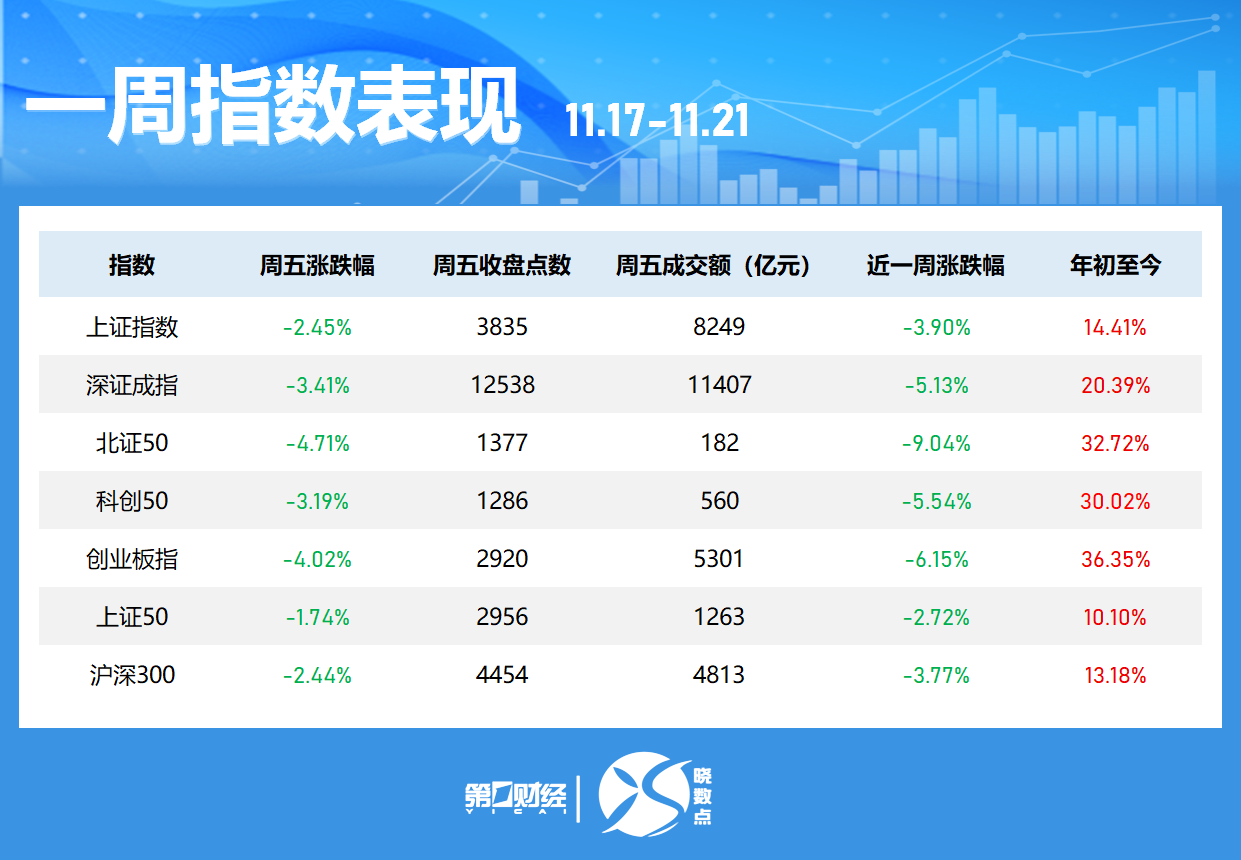
Market Performance - All three major indices declined during the week from November 17 to 21, with the Shanghai Composite Index falling by 3.90%, the Shenzhen Component Index by 5.13%, and the ChiNext Index by 6.15% [1][2]. Stock Movements - A total of 17 stocks experienced a weekly increase of over 30%, with Jianglong Shipbuilding leading at a rise of 64.97%. Other notable gainers included Rongji Software (61.06%), Zhongshui Fishery (61.05%), and *ST Dongtong (45.41%) [3][4]. - Conversely, 58 stocks saw declines exceeding 20%, with Huasheng Lithium Battery leading the drop at 33.19%, followed by Shanshui Bide (31.71%) and Zhongneng Electric (28.42%) [3][4]. Trading Activity - 78 stocks had a turnover rate exceeding 100%, with C South Network leading at 256.12%, followed closely by Jianglong Shipbuilding at 251.43% and C Hengkun at 243.47% [5][6]. - The majority of stocks with turnover rates above 100% were from the power equipment, computer, and pharmaceutical sectors [5]. Capital Flow - No industry saw net inflows from major funds during the week, with the power equipment sector experiencing a net outflow exceeding 50 billion yuan. Notably, Kaimeteqi received a net inflow of 1.297 billion yuan, marking a weekly increase of 13.93% [8][9]. - Other stocks with significant net inflows included Yidian Tianxia (9.04 billion yuan), Rongji Software (7.71 billion yuan), and C South Network (7.68 billion yuan) [8][9]. Margin Trading - Ningde Times topped the list for net buy amounts in margin trading, with a net buy of 2.117 billion yuan despite a weekly decline of 8.44%. Other notable net buys included Zhongji Xuchuang and Aerospace Development [10][11]. Institutional Research - A total of 441 listed companies were researched by institutions, with Ninebot Company-WD receiving the most attention from 179 institutions. Other companies like Rongbai Technology and Lens Technology were also highlighted [13][14]. - Institutions showed a focus on sectors such as industrial machinery, electronic components, and specialty chemicals [13]. New Institutional Interests - Institutions initiated coverage on 50 stocks this week, with nine stocks receiving target prices. Notable mentions include Tanshihua with a target price of 11.14 yuan and Beifang Navigation with a target price of 15.60 yuan [15][16].






申万宏源策略一周回顾展望(25/11/17-25/11/22):调整是也只是怀疑牛市级别
Shenwan Hongyuan Securities· 2025-11-22 12:46
Core Viewpoints - The current adjustment is characterized as a "doubtful bull market level," indicating that the major trends in the AI industry chain have not ended, although there are short-term fluctuations and a temporary lack of cost-effectiveness in large trends. This situation resembles historical patterns observed in early 2014, early 2018, and early 2021 [1][3][5] - The "two-stage bull market theory" remains unchanged, suggesting that the transition from Bull Market 1.0 to 2.0 is a typical feature of the A-share bull market cycle. The transition period is expected to occur in the first half of 2026, with a full bull market potentially starting in the second half of 2026 [1][5][6] Summary by Sections Adjustment Phase - The adjustment phase is seen as a "doubtful bull market level," where the AI industry chain is experiencing a lack of cost-effectiveness, leading to a market correction. Historical experiences indicate that such adjustments are typical and often occur in quarterly cycles [3][4] - The current market conditions show that the implied equity risk premium (ERP) in sectors like telecommunications and electronics is still above historical lows, while the price-to-earnings (PE) ratios are at absolute historical highs [3][4] Spring Market Outlook - The spring market is expected to be more promising post-adjustment, with economic growth needing to maintain a high level to achieve the 2035 medium-developed country goal. The third quarter of 2025 showed weak economic performance, and December 2025 is seen as a critical window for laying out economic policies for 2026 [6][7] - The technology sector is anticipated to see a rapid improvement in cost-effectiveness, with institutional investors reducing their technology holdings in the short term. The micro-structural improvements in the technology sector are also expected to play a significant role in the spring market rotation [6][7] 2026 Industry Style and Rhythm Outlook - The transition from Bull Market 1.0 to 2.0 is expected to favor high-dividend defensive stocks. The actual improvement in economic sentiment will catalyze cyclical stocks to lead index breakthroughs, with technology trends and manufacturing global influence being the main themes of the bull market [8] - In the spring of 2026, the early validation of policy bottoms, cyclical price increases, and improved year-on-year PPI expectations will provide a foundation for cyclical assets. Key areas of focus include basic chemicals, industrial technology, innovative pharmaceuticals, and defense industries, with potential rebounds in AI computing power, storage, energy storage, and robotics [8]
申万宏源策略一周回顾展望:调整是也只是“怀疑牛市级别”
Shenwan Hongyuan Securities· 2025-11-22 11:49
Group 1 - The report indicates that the current adjustment phase is characterized as a "doubtful bull market level," with the AI industry chain experiencing a significant trend that has not yet ended, while smaller fluctuations are present and the cost-effectiveness of large trends is temporarily insufficient. This situation resembles historical patterns observed in early 2014 with the ChiNext, early 2018 with food and beverage, and early 2021 with new energy [4][6][7] - The "bull market two-stage theory" remains unchanged, confirming the high-level area of the bull market 1.0 phase. The transition from bull market 1.0 to 2.0 is expected to occur in the first half of 2026, with a focus on the accumulation of conditions for a comprehensive bull market and adjustments in industry trends to digest cost-effectiveness issues [6][7][9] - The report emphasizes that while adjustments are occurring, it is crucial to maintain a firm belief in the bull market. The adjustment phase is seen as a potential bottom, particularly when it aligns with the core track's bull-bear boundary [6][7] Group 2 - The report expresses optimism for the spring market following the adjustment, highlighting that achieving the 2035 medium-developed country goal requires maintaining a high economic growth rate. The economic performance in Q3 2025 was weak, and December 2025 is identified as a critical window for laying out economic policies for 2026, with the possibility of an early verification of the "policy bottom" [7][8] - Two key clues for the spring market are discussed: first, the management's emphasis on economic growth and the potential early verification of the "policy bottom"; second, the mid-term upward trend of the technology industry remains unchanged, with the AI industry still in "stage 3" and moving towards "stage 4," indicating non-linear growth in industry profits [8][9] - The report anticipates that the transition from bull market 1.0 to 2.0 will favor high-dividend defensive strategies, with the actual improvement in economic sentiment catalyzing a breakthrough in cyclical stocks, while the technology industry's trend and global influence of manufacturing will be the main lines of the bull market [9] Group 3 - The report outlines expectations for the 2026 industry style rhythm, indicating that cyclical stocks may serve as the foundational assets for the spring market, with basic chemicals and industrial technology being highlighted as higher elasticity directions. The technology sector is expected to rebound, focusing on innovative pharmaceuticals and national defense industries [9][10] - Specific sectors such as AI computing power, storage, energy storage, and robotics are anticipated to have rebound opportunities in the spring [9][10] - The report includes quantitative sentiment indicators and ETF tracking data, providing insights into market dynamics and investor sentiment [2][17]
苏州两院院士增加四位
Su Zhou Ri Bao· 2025-11-22 00:41
Core Insights - The Chinese Academy of Sciences and the Chinese Academy of Engineering announced the results of the 2025 academician elections, electing 73 academicians from the former and 71 from the latter, highlighting significant contributions from Suzhou experts [1][2] Group 1: New Academicians - Four experts from Suzhou were elected as academicians, including Zhu Lan and Qian Linfang for the Chinese Academy of Sciences, and Wang Jianwei and Sun Baode for the Chinese Academy of Engineering [1] - Zhu Lan, a prominent figure in obstetrics and gynecology, has made significant contributions to clinical, teaching, and research work, establishing a strong international influence [1] - Qian Linfang, an expert in artillery weapon systems, has played a crucial role in the development of China's artillery technology and modernization of national defense equipment [1] Group 2: Contributions of Suzhou Academicians - Wang Jianwei, director of the Chinese Center for Disease Control and Prevention, has led over 10 national-level major research projects focusing on the pathogenic mechanisms and prevention of respiratory viral infections [2] - Sun Baode, a professor at Shanghai Jiao Tong University, has conducted extensive research in metal materials and solidification technology, leading over 50 major projects with applications in aerospace and high-voltage transmission [2] Group 3: Suzhou's Commitment to Science and Talent - Suzhou is recognized as a "city of academicians," actively promoting initiatives to attract full-time academicians, including the establishment of "Suzhou Scientist Day" and various funding measures [3] - The city has implemented policies offering up to 30 million yuan in project funding and 3 million yuan in personal rewards to attract high-level scientific talent [3] - Suzhou aims to provide the highest recognition and support for talents, reinforcing its commitment to becoming a hub for scientific innovation and development [3]
【21日资金路线图】两市主力资金净流出超980亿元 传媒行业实现净流入
证券时报· 2025-11-21 14:00
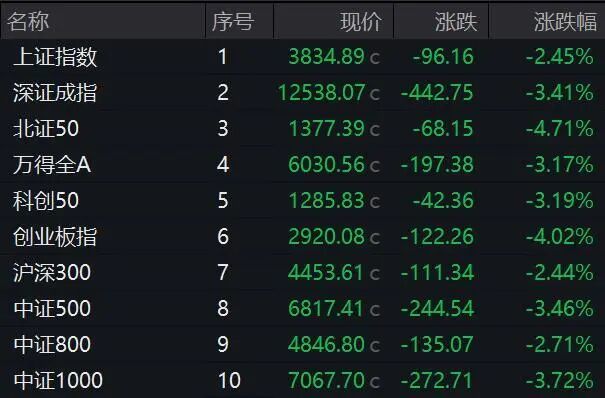
盘后数据出炉。 今日(11月21日),A股单边下挫,市场逾5000股下跌,截至收盘,上证指数跌2.45%,深证成指跌3.41%,创业板指跌4.02%,A股全天成交1.98万亿元,上日成交 1.72万亿元。 1.两市主力资金净流出超980亿元 今日沪深两市主力资金开盘净流出392.77亿元,尾盘净流出143.68亿元,两市全天主力资金净流出985.55亿元。 | | | 沪深两市最近五个交易日主力资金流向情况 (亿元) | | | | --- | --- | --- | --- | --- | | 日期 | 净流入金额 | 开盘净流入 | 尾盘净流入 | 超大单净买入 | | 2025-11-21 | -985.55 | -392.77 | -143.68 | -521.53 | | 2025-11-20 | -366.03 | -48.79 | -67.73 | -155.72 | | 2025-11-19 | -348.42 | -123.87 | 5.59 | -178.90 | | 2025-11-18 | -624.24 | -232.22 | -66.11 | -354.10 | | 2025-11 ...

A股这一板块,获大举加仓
Zheng Quan Shi Bao· 2025-11-21 09:45
Core Viewpoint - The A-share market experienced significant adjustments this week, with major indices declining due to external market volatility and profit-taking after six consecutive months of gains. High-dividend stocks, particularly in the banking sector, have gained popularity among investors [1][6]. Market Performance - The Shanghai Composite Index fell to 3834.89, down 2.45%, while the Shenzhen Component Index dropped to 12538.07, down 3.41%. Other indices, including the ChiNext and CSI 50, also saw declines, with the ChiNext Index down 4.02% [2]. - Average daily trading volume decreased to below 2 trillion yuan, totaling 9.33 trillion yuan for the week, a reduction of nearly 900 billion yuan compared to the previous week [2]. Fund Flows - The financing balance decreased slightly by approximately 3 billion yuan this week, maintaining a high historical level. The defense and military industry saw over 1.6 billion yuan in net financing purchases, while the computer sector received over 1.1 billion yuan [3]. - The computer sector attracted over 21 billion yuan in net inflows from major funds, with media and defense industries also receiving over 10 billion yuan each. Conversely, the electronic sector experienced net outflows exceeding 2.9 billion yuan [3]. Sector Highlights - High-dividend stocks, particularly in the banking sector, have been favored by the market. China Bank's stock price has risen significantly, achieving a historical high with a cumulative increase of over 21% over seven weeks [3]. - Despite the continuous rise in bank stocks, overall valuations remain low, with most A-share listed banks trading below their net asset values. The median price-to-book ratio is approximately 0.6 times, with the lowest being 0.32 times for Minsheng Bank [5]. Dividend Yields - The median dividend yield for bank stocks over the past year is 4.24%, significantly higher than deposit rates, with the highest yield at 7.55% for Industrial Bank. Other banks also reported yields exceeding 6% [6]. - High-dividend stocks such as Aopu Technology and Midea Group have shown strong performance amid recent market adjustments, with China Petroleum reaching a ten-year high [6]. Market Outlook - The market is currently undergoing adjustments due to external risks, but the overall trend is expected to remain upward in the long term. Analysts suggest that the current market conditions provide an opportunity for repositioning funds, with potential policy support likely to drive future market movements [6][7].