
农产品

Search documents
美元流动性维持宽松,商品短期或偏稳运行
Guo Tou Qi Huo· 2025-12-29 13:36
1. Report Industry Investment Rating No relevant content provided. 2. Core Viewpoints of the Report - The commodity market as a whole rose 4% last week, with precious metals leading the way with a 9.69% increase. The short - term commodity market may run stably due to the loose dollar liquidity [2]. - The Fed's loose outlook and geopolitical risks support the strength of precious metals. The short - term market fluctuates greatly as various varieties hit new highs [2]. - The non - ferrous sector may oscillate strongly in the short term due to the weak dollar and the support from the expected contraction of mine supply [3]. - The black sector may oscillate as the demand and supply situation is complex, with factors such as changes in steel mill production and raw material supply [3]. - Oil prices continue to be under pressure due to the long - term loose supply - demand background, despite the geopolitical tension in Venezuela [3]. - The polyester chemical varieties may be affected by supply and demand changes, and attention should be paid to the downstream polyester load [4]. - The short - term trend of agricultural products and oils and fats is expected to be oscillatory, influenced by factors such as weather and export expectations [4]. 3. Summary According to Related Catalogs 3.1 Market Review - The overall commodity market rose 4% last week, with precious metals up 9.69%, non - ferrous metals up 4.97%, energy and chemicals up 2.98%, agricultural products up 2.53%, and black metals up 0.08%. Silver, PTA, and nickel were the top gainers, while tin, coke, and rebar were the top losers [2][6]. - The 20 - day average volatility of the commodity market increased, with only the black and coal - chemical related varieties showing a decline in volatility. The overall market scale increased, but only the precious metal and non - ferrous sectors had net inflows, with most funds concentrated in silver [2][6]. 3.2 Outlook for Different Sectors - **Precious Metals**: Supported by the Fed's loose policy and geopolitical risks, the shortage of spot makes silver, platinum, and palladium more favored by funds. The gold - silver ratio has fallen below the average. Exchange restrictions and risk warnings have led to large short - term market fluctuations [2]. - **Non - ferrous Metals**: The weak dollar and better - than - expected GDP growth in the US provide a neutral - warm macro environment. Although the inventory is increasing and the spot premium is weakening, the expected contraction of mine supply supports the price, and the sector may oscillate strongly in the short term [3]. - **Black Metals**: The demand for rebar decreased, production increased slightly, and inventory continued to decline. The slowdown of blast furnace production cuts and the stable molten iron output need attention to the sustainability of environmental protection restrictions. The supply of raw materials is relatively sufficient, and the sector may oscillate in the short term [3]. - **Energy**: The geopolitical tension in Venezuela increases the risk premium of crude oil, but the impact on global supply is limited. The US shale oil production remains high, and oil prices are under pressure due to the long - term loose supply - demand situation [3]. - **Chemical Industry**: Polyester varieties may face supply pressure from device restarts, but the strong expectation remains, and attention should be paid to the downstream polyester load [4]. - **Agricultural Products**: The improving weather in South America and the expected transition of La Nina to ENSO neutral increase the expectation of a bumper harvest in South America. The fundamentals of palm oil are less negative, and the short - term trend of oils and fats may be oscillatory [4]. 3.3 Commodity Fund Overview - Gold ETFs generally had positive returns last week, with the total scale of gold ETFs increasing by 0.77% and the total trading volume increasing by 29.04%. The total scale of commodity ETFs increased by 0.86% and the trading volume increased by 23.22% [36]. - Among them, the returns of different gold ETFs ranged from 3.21% to 3.60%, and the return of the silver fund was 17.43%, while the returns of energy - chemical, bean - meal, and non - ferrous metal ETFs were 4.25%, 1.69%, and 4.34% respectively [36][38].
兴证策略张启尧团队:近期涨价链梳理与展望
Xin Lang Cai Jing· 2025-12-29 12:17
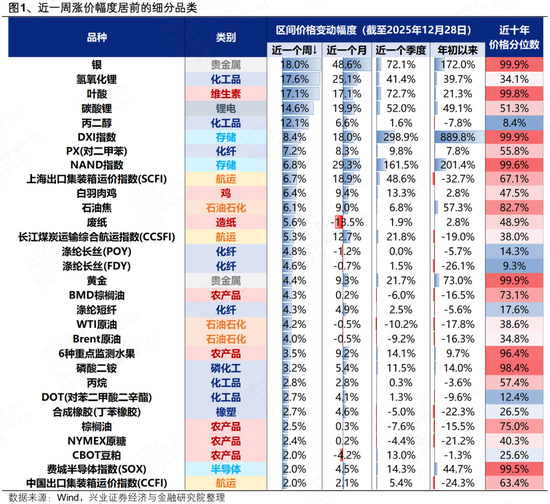
Core Viewpoint - The recent price increase chain in the capital market is primarily focused on non-ferrous metals, petrochemicals, certain chemicals, shipping, storage, and some agricultural products, driven by global liquidity easing and domestic PPI recovery [1][2]. Price Increase Drivers - Global liquidity easing and geopolitical risk sentiment are driving the price increases in non-ferrous metals, including silver and gold [2]. - Trends in AI and the new energy industry are translating into physical consumption, particularly in storage and lithium batteries (lithium hydroxide, lithium carbonate) [2]. - Supply disruptions (e.g., U.S. military blockade of Venezuelan oil) and geopolitical concerns (e.g., escalating Middle East tensions) are pushing oil prices higher, affecting petroleum coke, crude oil, and palm oil [2]. - Seasonal factors are contributing to supply-demand mismatches, including a decrease in terminal operating rates leading to tighter supply of chemicals (e.g., ethylene glycol, chemical fibers), pre-holiday shipping surges, year-end "export rush," and increased winter electricity demand affecting shipping indices [2]. Price Change Data - Significant price changes have been observed in various commodities, with the DXI index showing an increase of 889.8% year-to-date, and the DRAM index increasing by 366.3% [3][11]. - Other notable increases include: - Wafer: 256Gb TLC at 336.6% - Wafer: 512Gb TLC at 295.0% - Gold at 73.0% - Oil products at 57.3% [3][11]. Seasonal Outlook - The first quarter is typically a favorable time for price increases, especially as it transitions into the "golden March and silver April" peak construction season, with policy implementations expected after the March Two Sessions [4][12]. - Historical data suggests that the first quarter is a critical verification window for whether the PPI can stabilize and rise, as previous inflation cycles have shown accelerated PPI increases during this period [6][14].

2025年12月中旬流通领域重要生产资料市场价格变动情况 - 国家统计局
Guo Jia Tong Ji Ju· 2025-12-29 09:36
Core Viewpoint - The monitoring of market prices for 50 important production materials across nine categories shows a mixed trend, with 15 products experiencing price increases, 31 seeing declines, and 4 remaining stable in mid-December 2025 compared to early December 2025 [2][3]. Group 1: Price Changes in Major Categories - In the black metal category, prices for rebar decreased by 22.0 yuan per ton to 3169.8 yuan, while wire rod fell by 15.0 yuan to 3354.5 yuan [5]. - In the non-ferrous metals category, electrolytic copper saw an increase of 1822.7 yuan per ton, reaching 92520.8 yuan, while aluminum ingots dropped by 65.8 yuan to 21796.7 yuan [6]. - Chemical products showed varied results, with sulfuric acid increasing by 44.0 yuan to 1057.9 yuan, while several other chemicals like caustic soda and methanol experienced price declines [6][7]. Group 2: Energy and Coal Prices - The price of liquefied natural gas (LNG) decreased by 172.7 yuan to 3919.5 yuan per ton, while liquefied petroleum gas (LPG) fell by 4.2 yuan to 4405.4 yuan [7]. - Coal prices showed a slight increase for some types, with non-caking coal rising by 7.5 yuan to 930.5 yuan per ton, while other types like Shanxi mixed coal saw declines [8]. Group 3: Agricultural Products and Inputs - In agricultural products, the price of rice increased by 25.6 yuan to 3943.2 yuan per ton, while wheat and corn prices saw minor declines [8][9]. - Fertilizer prices varied, with urea decreasing by 1.4 yuan to 1711.8 yuan per ton, while compound fertilizer increased by 61.8 yuan to 3390.6 yuan [9]. Group 4: Monitoring Methodology - The price monitoring covers over 2000 wholesalers, agents, and dealers across more than 300 trading markets in 31 provinces, utilizing methods such as on-site price collection and electronic inquiries [12][13].
玉米周报:强现实弱预期,盘面震荡偏强-20251229
Guo Mao Qi Huo· 2025-12-29 09:27
1. Report Industry Investment Rating - The investment view is that the corn market will be in a state of oscillation, with the disk expected to be oscillating and slightly stronger [4]. - The trading strategy suggests a one - side trading of oscillating and slightly stronger, and an arbitrage strategy of C03 - C05 positive spread [4]. 2. Core View of the Report - The current situation of the corn market is characterized by a strong reality and weak expectations, with the disk oscillating and slightly stronger. The fast progress of grain sales at the grass - roots level, low inventory levels at ports and downstream, and the uninitiated strategic inventory building of most traders are expected to drive the disk to be oscillating and slightly stronger under the replenishment demand of the middle and lower reaches [4]. 3. Summary by Directory 3.1 Main Views and Strategy Overview - **Supply**: Bullish. The current grass - roots grain sales progress has exceeded 40%, faster than the same period last year. In the 2025/2026 season, the planting cost continues to decline. There are increases in production in the Northeast and Northwest, and a decrease in production in North China. The overall national production is expected to be abundant [4]. - **Demand**: Slightly bullish. In November 2025, the national industrial feed production was 28.73 million tons, a month - on - month decrease of 1.2% and a year - on - year increase of 2.7%. The proportion of corn in the compound feed produced by feed enterprises was 43.8%. The high pig inventory and the slow capacity reduction support short - term feed demand, but the current breeding profit is in deficit, and national policies tend to control pig inventory and weight, which may affect long - term supply. Feed enterprises have a rigid demand for inventory replenishment but are cautious. Deep - processing enterprises have seasonal inventory - building needs but are also cautious [4]. - **Inventory**: Bullish. Due to good shipping demand, the inventory accumulation speed at the northern ports is slow, and the inventory is still at a low level. The grain inventory at the southern ports is also at a low level. Feed enterprises and deep - processing enterprises have low corn inventories [4]. - **Basis/Spread**: Slightly bullish. The basis is at a relatively high level, and the 1 - 3 spread is firm [4]. - **Profit**: Bearish. The breeding profits of pigs and egg - laying poultry are in deficit, and the processing profits of deep - processing starch and alcohol are also in deficit [4]. - **Valuation**: Neutral. Considering the planting cost, the valuation of new - season corn is high; from the perspective of the basis, the valuation of the corn futures price is low [4]. 3.2 Futures and Spot Market Review - **Spot Market**: The price is stable with a slight decline [7]. - **Futures Market**: The positions are at a high level [11]. 3.3 Domestic Corn Supply and Demand Fundamental Data - **Grain Sales Progress**: The sales progress is fast, and the channel supply volume is shrinking [21][24]. - **Port Situation**: The inventory at the northern ports has increased slightly, and the grain inventory at the southern ports is at a low level [38]. - **Feed Enterprises**: The inventory days are at a low level, and the monthly feed production shows certain trends [44][46]. - **Livestock and Poultry Breeding**: Pig prices have declined slightly, and the weight reduction is not obvious. The breeding profits of pigs, broilers, and egg - laying poultry are in different situations [48][52][56]. - **Deep - processing Industry**: The corn consumption of deep - processing shows seasonal recovery, and the inventory is at a low level. The starch processing profit has deteriorated, and the starch inventory is at a high level. The alcohol production rate has declined, and the processing profit has decreased [64][72][94]. - **Starch Demand**: The performance in the beverage sector is poor, while the papermaking sector has a high operating rate and a significant increase in profit [84][85]. - **Wheat Market**: The wheat price has increased, and the flour demand is weak [102]. 3.4 Foreign Corn Supply and Demand Fundamental Data - **2025/2026 Report**: The corn inventory - to - consumption ratios of major exporting countries have been lowered [113]. - **US Corn**: The export sales performance is good [119].
全国首个农产品质量分级示范店在深圳启动
Nan Fang Ri Bao Wang Luo Ban· 2025-12-29 09:01
Core Viewpoint - The launch of the first agricultural product quality grading demonstration store in Shenzhen marks a significant innovation in the traceability and quality assessment of fruits, allowing consumers to access detailed information about the products they purchase [1] Group 1: Quality Grading System - Shenzhen's fruit quality grading standard evaluates the entire supply chain from cultivation to consumption, converting various attributes such as appearance, taste, nutrition, and safety into quantifiable quality indicators [1] - Fruits are categorized into three grades: A+, A, and B, enabling consumers to better understand the quality of the fruits they are buying [1] Group 2: Market Impact and Future Prospects - The initiative aims to promote premium pricing for graded products, enhancing the competitiveness of high-quality agricultural products in both domestic and international markets [1] - The establishment of the Shenzhen Agricultural Product Quality Improvement Alliance allows merchants to voluntarily apply for quality grading, which will be internally evaluated before being marketed [1] - There are hopes for the nationwide promotion of this pilot program in the future, which could lead to improved cultivation techniques and higher quality products for consumers [1]

南华浩淞棕榈油期货气象分析报告:年底降雨回归,大部分地区土壤湿度暂时性好转
Nan Hua Qi Huo· 2025-12-29 08:32
Report Summary 1. Report Industry Investment Rating No industry investment rating is provided in the report. 2. Core Viewpoints - A weak La Niña phenomenon has formed and is expected to last until early 2026, currently having limited impact on palm oil - producing areas [1]. - Recent rainfall in the Malay Archipelago has increased, with significant improvement in soil moisture in southern Peninsular Malaysia and some areas in Indonesia. However, the rainfall is not persistent, and there is a risk of soil drying in 2026 [1]. - Short - term catastrophic weather disturbances are insufficient, but continuous attention should be paid to areas with low soil moisture. If the situation does not improve, it may affect palm oil production in the second half of next year [1]. 3. Summary by Related Catalogs 3.1 El Niño and Southern Oscillation Index - Since October, the Southern Oscillation Index has exceeded the threshold of 1, and the El Niño index was - 0.55 as of the end of November, indicating the formation of a La Niña phenomenon [1]. 3.2 Precipitation Forecast in Producing Areas - Recent rainfall has improved, and rainfall in southern Peninsular Malaysia has increased [3]. 3.3 Soil Moisture in Producing Areas - **Indonesia** - In Jambi, soil moisture has improved year - on - year at the end of the year [22]. - In West Kalimantan, soil moisture has increased, but cumulative precipitation is lower year - on - year [28]. - In Central Kalimantan, the soil moisture level is higher year - on - year [34]. - In East Kalimantan, precipitation is abundant, and the soil is moist [41]. - In Riau, rainfall has slightly improved at the end of the year, but soil moisture is still slightly behind the same period in previous years [47]. - In South Sumatra, soil moisture is currently low, but it is expected to exceed last year's level at the end of the year [54]. - In North Sumatra, rainfall is limited at the end of the year, and soil moisture remains low [58]. - **Malaysia** - In Johor, rainfall has increased, and soil moisture has improved [65]. - In Pahang, rainfall has returned to a low level, and the increase in soil moisture is insufficient [71]. - In Perak, rainfall has decreased at the end of the year, and soil moisture has declined [78]. - In Sabah, cumulative rainfall is abundant, and the soil is relatively moist [83]. - In Sarawak, cumulative rainfall is insufficient, and soil moisture is the same as last year [89].
“12岁”的秦巴地区商品交易会迎来首个“主宾国” 秦巴好物携手闯世界
Si Chuan Ri Bao· 2025-12-29 07:04
Core Insights - The 12th Sichuan Dazhou Qinba Region Commodity Fair was held from December 18 to 21, showcasing over 316 enterprises and attracting significant participation from various provinces [6][10] - The fair achieved a total transaction amount of over 5 million yuan in the offline exhibition area, with 18 local enterprises reaching procurement agreements worth 21.1 million yuan [6][10] - Thailand was invited as the first guest country, featuring 9 Thai enterprises and becoming one of the most popular exhibition areas [11] Group 1: Event Overview - The fair was themed "Meeting in Qinba, Going Global" and was co-hosted by Dazhou and 20 cities from five provinces [6][10] - The event included a variety of products, such as agricultural specialties, traditional Chinese medicine, and industrial products, with a focus on enhancing Dazhou's external image [7][8] Group 2: Economic Impact - The offline exhibition area generated a transaction amount of over 5 million yuan, with international cooperation areas achieving nearly 500,000 yuan in transactions and 3.8 million yuan in intended orders [6][10] - The fair facilitated significant economic interactions, including a cooperation agreement between Dazhou's agricultural company and a Hebei enterprise, enhancing market coverage and brand influence [10] Group 3: Cultural Promotion - The fair featured a cultural tourism promotion event for the Ba Mountain Grand Canyon, aiming to create a national 5A scenic area and promote local cultural heritage [8] - Dazhou's cultural tourism bureau introduced themed travel routes, offering diverse options for visitors to explore local attractions [8] Group 4: International Collaboration - The establishment of an international cooperation exhibition area aimed to connect the Qinba region with global markets, featuring products from countries along the Belt and Road Initiative [11] - Over 70 Dazhou suppliers and 30 domestic and international buyers participated in face-to-face negotiations, resulting in intended procurement agreements worth 21.1 million yuan [11]

全国人大罕见表态:美方已触及大陆底线,若不收手后果自负
Sou Hu Cai Jing· 2025-12-29 04:53
Group 1 - China's National People's Congress Foreign Affairs Committee issued a strong statement to the U.S., indicating a shift from passive defense to active countermeasures in response to external pressures [1][3] - The U.S. has been applying pressure on China through various means, including military sales to Taiwan and the seizure of Chinese vessels, prompting China to formally activate its Anti-Foreign Sanctions Law as a core tool for retaliation [3][4] - The strategic competition between China and the U.S. has entered a new phase, with China adopting systematic and institutionalized countermeasures to ensure compliance with legal procedures [4][8] Group 2 - A U.S. military helicopter forcibly boarded a Chinese oil tanker, highlighting the misuse of judicial power by the U.S. in international waters [6] - China's response to U.S. actions is now characterized by strong legal measures, marking the beginning of a new era of legal countermeasures [8][10] - The cancellation of a 132,000-ton wheat order from U.S. farmers to China signifies a strategic decision to reduce reliance on U.S. agricultural products, despite higher costs from Canadian suppliers [11] Group 3 - The impact of China's countermeasures is felt globally, with U.S. wheat futures dropping 3%, the largest single-day decline in three months, and negative growth in exports to China [12] - U.S. companies, such as synthetic rubber manufacturers, are facing anti-dumping investigations amounting to $780 million, leading to production line shutdown risks [12] - China's countermeasures are targeted, focusing on U.S. political constituencies and industries, indicating that provocations will have domestic political consequences [13] Group 4 - In the technology sector, U.S. bans on DJI drones have backfired, as the company holds a 70% market share globally, complicating the search for alternatives and increasing costs for U.S. emergency services [15] - The semiconductor industry is similarly affected, with U.S. chip manufacturers experiencing a drop in capacity utilization to 20% after losing $15 billion in orders from China [17] - The so-called technology blockade has inadvertently accelerated China's innovation, allowing companies like DJI to strengthen their global leadership [18] Group 5 - China's holdings of U.S. Treasury bonds have fallen to $688.7 billion, the lowest since the 2008 financial crisis, signaling a move away from reliance on U.S. dollar assets [20] - The daily processing volume of China's Cross-Border Interbank Payment System (CIPS) has surpassed 4 trillion yuan, indicating a shift in international trade settlements away from the SWIFT system [20] - The U.S. military aid to Taiwan, while appearing generous, imposes heavy financial burdens on Taiwan, revealing the strategic implications of U.S. support [20]
长江期货粕类油脂周报-20251229
Chang Jiang Qi Huo· 2025-12-29 04:12
1. Report Industry Investment Rating No relevant content provided. 2. Core Views of the Report - In the soybean meal market, prices are expected to be strong in the near - term due to de - stocking expectations and cost support, but the upside is limited. The 03 contract is likely to perform strongly, while the 05 contract may be weak under the background of South American bumper harvest expectations and domestic supply - demand relaxation. The pattern of near - term strength and long - term weakness will continue [7]. - In the oils market, in the short term, domestic three major oils have bottomed out and rebounded, but the upside space is limited. In the long run, with the intensification of Malaysia's production cuts, India's pre - Ramadan stocking, the advancement of Indonesia's B50 biodiesel plan, and the implementation of the US biofuel policy in the first quarter of 2026, it will help the three major oils to bottom out and strengthen again [73][74]. 3. Summary by Relevant Catalogs 3.1 Soybean Meal 3.1.1 Price and Basis - As of December 26, the spot price in East China was 3050 yuan/ton, up 40 yuan/ton week - on - week; the M2605 contract closed at 2790 yuan/ton, up 55 yuan/ton week - on - week; the basis was 05 + 260 yuan/ton, down 20 yuan/ton week - on - week [7][9]. 3.1.2 Supply - Globally, the 2025/26 soybean production is expected to be 422 million tons, a year - on - year decrease of 5.39 million tons. Brazil's production is 175 million tons, while the US and Argentina's production decreases year - on - year. In China, the 2025/26 soybean import volume is expected to be 112 million tons, an increase of 4 million tons year - on - year. From December to March, domestic soybean arrivals will decrease, and soybeans and soybean meal will enter the de - stocking cycle. From April to September, domestic soybean arrivals will remain high at over 9 million tons [7]. 3.1.3 Demand - Current soybean meal demand remains high. Pig and poultry inventories are at a high level, and the good cost - performance of soybean meal supports its demand. In the 51st week of 2025, the national oil mill soybean inventory was 7.2236 million tons, a decrease of 171,200 tons from the previous week, a decrease of 2.32%. The soybean meal inventory of national oil mills increased to 1.1371 million tons, an increase of 40,200 tons from the previous week, an increase of 3.66% [7]. 3.1.4 Cost - The cost of Brazilian 2025/26 soybeans is 950 cents/bushel. The domestic soybean meal cost from May to August is estimated to be 2580 yuan/ton, and from July to September, it will rise to 2760 yuan/ton. The domestic import cost of US soybeans in the second half of the 2025/26 season is estimated to be 3000 yuan/ton. Brazilian soybean crushing profit is around 30 yuan/ton [7]. 3.2 Oils 3.2.1 Price and Basis - As of the week of December 26, the palm oil main 05 contract rose 276 yuan/ton to 8568 yuan/ton; the soybean oil main 05 contract rose 124 yuan/ton to 7836 yuan/ton; the rapeseed oil main 05 contract rose 302 yuan/ton to 9046 yuan/ton. The spot prices of palm oil, soybean oil, and rapeseed oil also increased, and the basis of each oil showed different changes [74][76]. 3.2.2 Palm Oil - In Malaysia, from December 1 - 25, palm oil exports increased, and production decreased. It is expected that the inventory accumulation in December will be less than previously estimated, but it is still difficult to start de - stocking. In China, palm oil purchases from December to January are relatively small, and the market demand is average, limiting the de - stocking speed. As of the week of December 19, domestic palm oil inventory rebounded to 700,000 tons [74]. 3.2.3 Soybean Oil - In the US, although there are reports of large - scale Chinese purchases of US soybeans, the actual purchase volume announced by USDA is much lower. In South America, Brazil's 2025/26 soybean production is expected to reach a record high of 180 million tons. The US soybean futures price is under pressure, but it is limited by the planting cost and potential bio - diesel policies. In China, soybean arrivals have decreased seasonally since October, and soybean oil inventory decreased to 1.1235 million tons as of the week of December 19 [74]. 3.2.4 Rapeseed Oil - Currently, the domestic rapeseed oil market shows a state of strong current situation and weak future expectations. Domestic rapeseed and rapeseed oil imports are at a medium - level. The first shipment of Australian rapeseed is expected to be pressed in January 2026, and the supply is expected to gradually ease. As of the week of December 19, domestic rapeseed oil inventory was 303,000 tons [74].
棉花早报-20251229
Da Yue Qi Huo· 2025-12-29 03:17
交易咨询业务资格:证监许可【2012】1091号 棉花早报——2025年12月29日 大越期货投资咨询部 王明伟 从业资格证号:F0283029 投资咨询证号: Z0010442 联系方式:0575-85226759 重要提示:本报告非期货交易咨询业务项下服务,其中的观点和信息仅作参考之用,不构成对任何人的投资建议。 我司不会因为关注、收到或阅读本报告内容而视相关人员为客户;市场有风险,投资需谨慎。 CONTENTS 目 录 1 前日回顾 2 每日提示 3 4 5 今日关注 基本面数据 持仓数据 棉花: 1、基本面:2026新疆棉种植面积调控,预计可能减幅超10%。ICAC11月报:25/26年度产量 2540万吨,消费2500万吨。USDA11月报:25/26年度产量2614.5万吨,消费2588.3万吨,期末 库存1653.2万吨。海关:11月纺织品服装出口238.69亿美元,同比下降5.12%。11月份我国棉 花进口12万吨,同比增加9.4%;棉纱进口15万吨,同比增加25%。农村部12月25/26年度:产 量670万吨,进口140万吨,消费760万吨,期末库存835万吨。偏多。 2、基差:现货3128 ...