服务业

Search documents
抢出口脉冲下,为何量增价降?——5月PMI数据点评
Changjiang Securities· 2025-05-31 13:20
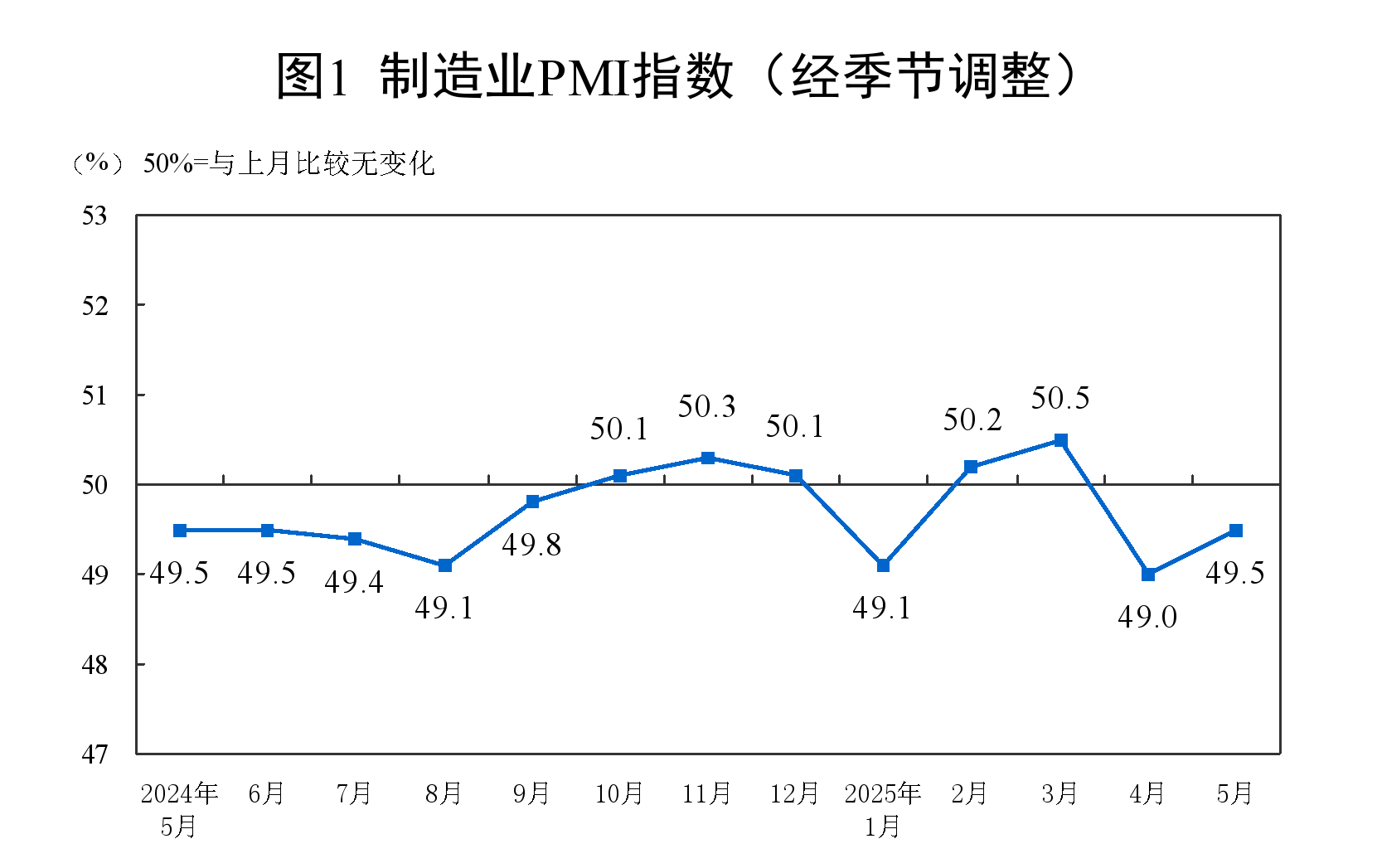
Group 1: Economic Indicators - The manufacturing PMI in May rose to 49.5%, remaining below the expansion threshold but showing a 0.5 percentage point increase from the previous month[4] - The production index increased to 50.7%, indicating a return to expansion after a period of contraction[7] - New export orders index rose by 2.8 percentage points to 47.5%, reflecting a slight improvement in external demand[7] Group 2: Supply and Demand Dynamics - Supply and demand improvements are likely to be short-lived due to uncertainties in tariff policies, leading to a potential decline in production after the current export surge[2] - Companies are actively reducing inventory, as indicated by the finished goods inventory index dropping to 46.5%[7] - The purchasing price index for raw materials fell to 46.9%, while the factory price index decreased to 44.7%, indicating increasing downward pressure on prices[7] Group 3: Sector Performance - The construction PMI fell to 51%, primarily due to reduced intensity in residential construction, while infrastructure construction remains strong[7] - The service sector PMI increased to 50.2%, driven by holiday-related activities, but still lags behind historical averages since 2013[7] Group 4: Policy Recommendations - To prevent a downward spiral in quantity and price, early policy intervention is necessary to support domestic demand and clarify anti-competitive regulations[2] - There is a need for measures to stimulate demand to avoid a rapid decline in production once the current export surge subsides[2]
价格回落势头渐止——5月PMI数据解读【陈兴团队•财通宏观】
陈兴宏观研究· 2025-05-31 08:13
Core Viewpoint - The national manufacturing PMI for May recorded at 49.5%, showing a 0.5 percentage point increase from the previous month, indicating a near median level for the same period over the past five years [1][3][4]. Demand and Supply - Both demand and supply sides have improved, with external demand rebounding more strongly than internal demand. The new order index rose to 49.8%, up 0.6 percentage points, while the new export order index increased by 2.8 percentage points to 47.5% [6][12]. - The production index rose by 0.9 percentage points to 50.7%, indicating a recovery in manufacturing production [6][10]. Industry Performance - The equipment manufacturing and high-tech manufacturing sectors showed significant growth in new orders, with indices above 52%. Consumer goods manufacturing also saw a stable increase, with new export orders rising over 6 percentage points into the expansion zone [1][8]. - However, some industries, such as textiles and non-ferrous metal processing, reported new order and production indices below the critical point, indicating insufficient release of production and demand [6][8]. Price Trends - The decline in price indices has narrowed significantly, with raw material prices and factory gate prices both decreasing by only 0.1 percentage points compared to the previous month. This indicates that the ability of companies to pass on costs has not yet recovered [10][12]. Non-Manufacturing Sector - The non-manufacturing business activity index recorded at 50.3%, slightly down by 0.1 percentage points but still above the critical point. The construction sector showed a business activity index of 51%, indicating ongoing expansion [12][13]. - The service sector's business activity index rose to 50.2%, reflecting a slight recovery driven by holiday consumption demand [13].


国家统计局服务业调查中心高级统计师赵庆河解读2025年5月中国采购经理指数
Guo Jia Tong Ji Ju· 2025-05-31 01:36
Group 1: Manufacturing PMI Insights - In May, the Manufacturing PMI rose to 49.5%, an increase of 0.5 percentage points from the previous month, indicating an improvement in economic conditions [2][3] - The production index reached 50.7%, up by 0.9 percentage points, signaling accelerated manufacturing activity, while the new orders index increased to 49.8%, up by 0.6 percentage points [3] - Large enterprises saw their PMI rise to 50.7%, returning to the expansion zone, with production and new orders indices at 51.5% and 52.5%, respectively [3] Group 2: High-Tech and Export Performance - High-tech manufacturing PMI stood at 50.9%, maintaining expansion for four consecutive months, while equipment manufacturing and consumer goods PMIs were at 51.2% and 50.2%, respectively [4] - New export orders and import indices improved to 47.5% and 47.1%, reflecting a recovery in foreign trade orders, particularly from companies engaged in U.S. trade [4] Group 3: Non-Manufacturing Sector Performance - The Non-Manufacturing Business Activity Index was at 50.3%, slightly down by 0.1 percentage points but still indicating expansion [5] - The service sector's business activity index rose to 50.2%, driven by increased consumer activity in tourism and dining during the May Day holiday [5] - The construction sector maintained expansion with a business activity index of 51.0%, although it showed a slight decline from the previous month [6] Group 4: Composite PMI Overview - The Composite PMI Output Index increased to 50.4%, up by 0.2 percentage points, indicating continued expansion in production and business activities across sectors [7]
国家统计局:5月份制造业采购经理指数回升,非制造业商务活动指数延续扩张
news flash· 2025-05-31 01:34
Group 1: Manufacturing PMI Insights - In May, the manufacturing PMI rose to 49.5%, an increase of 0.5 percentage points from the previous month, indicating an improvement in economic conditions [1][2] - The production index reached 50.7%, up 0.9 percentage points, signaling accelerated manufacturing activity, while the new orders index increased to 49.8%, up 0.6 percentage points [2] - Large enterprises saw their PMI rise to 50.7%, returning to the expansion zone, with production and new orders indices at 51.5% and 52.5%, respectively [2] Group 2: High-Tech and Export Performance - High-tech manufacturing PMI stood at 50.9%, maintaining expansion for four consecutive months, while equipment manufacturing and consumer goods sectors also showed improvement [3] - New export orders and import indices increased to 47.5% and 47.1%, respectively, reflecting a recovery in foreign trade orders, particularly from companies engaged with the U.S. market [3] Group 3: Non-Manufacturing Sector Performance - The non-manufacturing business activity index was 50.3%, slightly down by 0.1 percentage points but still indicating expansion [4] - The service sector's business activity index rose to 50.2%, driven by increased consumer activity during the "May Day" holiday, with significant growth in transportation and hospitality sectors [4] - The construction sector maintained expansion with a business activity index of 51.0%, although it showed a slight decline from the previous month [4] Group 4: Composite PMI Overview - The composite PMI output index increased to 50.4%, up 0.2 percentage points, indicating continued expansion in production and business activities across sectors [5][6] - The manufacturing production index and non-manufacturing business activity index contributed to the composite PMI, standing at 50.7% and 50.3%, respectively [6]
2025年5月中国采购经理指数运行情况
Guo Jia Tong Ji Ju· 2025-05-31 01:30
国家统计局服务业调查中心 中国物流与采购联合会 一、中国制造业采购经理指数运行情况 5月份,制造业采购经理指数(PMI)为49.5%,比上月上升0.5个百分点,制造业景气水平改善。 供应商配送时间指数为50.0%,比上月下降0.2个百分点,位于临界点,表明制造业原材料供应商交货时间与上月基本持平。 表1 中国制造业PMI及构成指数(经季节调整) 单位:% 从企业规模看,大型企业PMI为50.7%,比上月上升1.5个百分点,高于临界点;中型企业PMI为47.5%,比上月下降1.3个百分点,低于临界点;小型企业PMI 为49.3%,比上月上升0.6个百分点,低于临界点。 从分类指数看,在构成制造业PMI的5个分类指数中,生产指数高于临界点,供应商配送时间指数位于临界点,新订单指数、原材料库存指数和从业人员指 数均低于临界点。 生产指数为50.7%,比上月上升0.9个百分点,升至临界点以上,表明制造业企业生产活动有所加快。 新订单指数为49.8%,比上月上升0.6个百分点,表明制造业市场需求景气度回升。 原材料库存指数为47.4%,比上月上升0.4个百分点,低于临界点,表明制造业主要原材料库存量降幅有所收窄。 从业 ...
“反脆弱”系列专题之十:财政“前置”后该关注什么?
Shenwan Hongyuan Securities· 2025-05-30 14:11
Group 1: Fiscal Characteristics - In the first four months of 2025, the broad fiscal expenditure growth rate reached 7.2%, with a spending progress of 28.4%, exceeding the five-year average of 28.2%[3] - The broad fiscal expenditure growth rate in Q1 2025 was 5.6%, surpassing the nominal GDP growth rate, marking the best performance since 2023[3] - In April 2025, broad fiscal expenditure increased by 12.9% year-on-year, indicating strong fiscal support for the economy[3] Group 2: Revenue and Debt Financing - From January to April 2025, broad fiscal revenue decreased by 1.3% year-on-year, falling short of the budget target by 1.5 percentage points, primarily due to declines in tax and land transfer revenues[3] - Government debt net financing reached 4.8 trillion yuan in the first four months, an increase of 3.6 trillion yuan year-on-year, becoming a core support for broad fiscal expenditure[4] - As of May 24, 2025, the issuance of government bonds had reached 42.7% of the budget target, significantly higher than the average of 16.9% from 2020 to 2024[4] Group 3: Future Fiscal Policies - The total net financing scale for government debt in 2025 is set at 13.86 trillion yuan, with 6.3 trillion yuan already financed by the end of May, leaving 7.5 trillion yuan to be issued[5] - The issuance of special bonds and long-term bonds is expected to accelerate, with a projected net financing increase of 2.3 trillion yuan in Q2 and maintaining high levels in Q3[5] - Incremental policies may be introduced to smooth fiscal expenditure and ensure the achievement of annual economic targets amid uncertainties in economic recovery[6] Group 4: Investment Focus - Key areas for fiscal investment to stabilize growth include service consumption, fertility policies, and infrastructure investment[8] - Service consumption currently shows significant recovery potential, needing policy support to enhance consumer spending[8] - The government aims to improve income distribution mechanisms and strengthen social security to boost consumption effectively[8]
【宏观经济】一周要闻回顾(2025年5月21日-5月27日)
乘联分会· 2025-05-27 08:36
点 击 蓝 字 关 注 我 们 国家能源局20日发布的信息显示,4月份全社会用电量7721亿千瓦时,同比增长4.7%。 4月份,分产业用电看, 第一产业用电量110亿千瓦时,同比增长13.8%;第二产业用电量5285亿千瓦时, 同比增长3%;第三产业用电量1390亿千瓦时,同比增长9%。城乡居民生活用电量936亿千瓦时,同比增长 7%。 前4月,全社会用电量累计31566亿千瓦时,同比增长3.1%,其中规模以上工业发电量为29840亿千瓦时。 分产业用电看,第一产业用电量424亿千瓦时,同比增长10%;第二产业用电量20497亿千瓦时,同比增长 2.3%;第三产业用电量5856亿千瓦时,同比增长6%。城乡居民生活用电量4789亿千瓦时,同比增长2.5%。 (来源:国家能源局 ) 前4个月我国全行业对外直接投资同比增长7.5% 本文全文共 976 字,阅读全文约 3 分钟 4月份全社会用电量同比增长4.7% 4月份全社会用电量同比增长4.7% 前4个月我国全行业对外直接投资同比增长7.5% 2025年1-4月全国吸收外资3207.8亿元人民币 (来源: 商务部 ) 2025年1-4月全国吸收外资3207.8亿元 ...

宏观观察2025年第22期(总第594期):从国际对比看中国服务消费的发展潜力与空间*
Zhong Guo Yin Hang· 2025-05-27 06:23
Group 1: Current State of Service Consumption in China - In 2023, service consumption accounted for 45.2% of total consumption in China, significantly lower than the US (67.5%), Japan (56.2%), and Germany (50.5%) [6] - China's per capita service consumption was approximately $2,317 in 2023, only 6% of the US level and about 20% of other major economies [8] - The total service consumption in China was about $3.3 trillion in 2023, which is only 26% of the US service consumption [7] Group 2: Factors Affecting Service Consumption Growth - Cultural factors lead to a lower average consumption tendency in China, with residents preferring savings over immediate consumption [25] - The quality of service supply in China is still developing, affecting consumer confidence and willingness to spend [28] - Urban-rural disparities result in lower overall service consumption, with urban residents spending 7-8 percentage points more on service consumption than rural residents [29] Group 3: Future Growth Potential and Recommendations - The Chinese government aims to promote service consumption growth in areas like catering, home services, and cultural entertainment, with a focus on sustainable development [33] - The health industry in China is projected to exceed $9 trillion by 2024, indicating significant growth potential in health-related services [48] - Financial services need to expand their coverage to support service consumption, with a focus on innovative and personalized financial products [56]
从国际对比看中国服务消费的发展潜力与空间
Zhong Guo Yin Hang· 2025-05-27 06:18
Group 1: Current State of Service Consumption in China - In 2023, service consumption accounted for 45.2% of total consumption in China, significantly lower than the US (67.5%), Japan (56.2%), and Germany (50.5%) [6] - China's per capita service consumption was approximately $2,317 in 2023, only 6% of the US level and about 20% of other major economies [8] - The total service consumption in China was about $3.3 trillion in 2023, which is only 26% of the US service consumption [7] Group 2: Factors Affecting Service Consumption Growth - Cultural factors lead to lower consumption willingness in China, with a higher emphasis on saving compared to developed economies [25] - The quality of service supply in China is still developing, affecting consumer confidence and willingness to spend [28] - Urban-rural disparities result in lower overall service consumption, with urban residents spending 7-8 percentage points more on service consumption than rural residents [29] Group 3: Future Growth Potential and Recommendations - The Chinese government aims to promote service consumption growth in areas like catering, home services, and cultural entertainment, with a focus on sustainable development [33] - The health industry in China is projected to exceed $9 trillion by 2024, indicating significant growth potential in health-related services [48] - The sports industry is expected to grow rapidly, with an average annual growth rate of over 13% from 2025 to 2030 [47]
专访陈先枢:长沙自古就是消费城市
Sou Hu Cai Jing· 2025-05-26 06:49
Group 1 - Changsha has a historical reputation as a consumption city, supported by its rich cultural and commercial history [1][3] - The region's agricultural advantages and favorable climate have historically contributed to its commercial prosperity, allowing residents to consume without worry [3][4] - The development of agriculture and handicrafts, along with advanced transportation, facilitated the emergence of commerce in ancient Changsha [3][4] Group 2 - During the Tang Dynasty, Changsha's trade flourished, with its ceramics being exported widely, indicating a strong commercial network [3][4] - The Song Dynasty saw unprecedented growth in urban commerce, with Changsha ranking fourth in commercial tax revenue in the country [4] - The Ming and Qing Dynasties marked a significant expansion in both agricultural and industrial production, further establishing Changsha as a commercial hub [4][5] Group 3 - The consumption patterns and atmosphere in Changsha have evolved over time, influenced by cultural shifts and the influx of merchants [5] - The opening of Changsha in 1904 led to a diversification of consumer goods and services, reflecting changing social dynamics [5] - Contemporary consumption trends in Changsha are rooted in its historical legacy, emphasizing the importance of integrating nostalgia with modernity in business strategies [5]