新能源车

Search documents
行业比较周跟踪:A股估值及行业中观景气跟踪周报-20250615
Shenwan Hongyuan Securities· 2025-06-15 11:30
Valuation Summary - The overall PE of the A-share market is 18.7 times, positioned at the historical 71st percentile [2][5] - The PE of the Shanghai 50 Index is 10.9 times, at the historical 52nd percentile [2][5] - The PE of the ChiNext Index is 31.0 times, at the historical 11th percentile, indicating a relatively low valuation compared to historical levels [2][5] - The PE of the Science and Technology Innovation 50 Index is 137.9 times, at the historical 98th percentile, suggesting a high valuation [2][5] Industry Valuation Comparison - Industries with PE valuations above the historical 85th percentile include Real Estate, Steel, Power Equipment (Photovoltaic Equipment), National Defense, and Pharmaceuticals [2][6] - No industries have PB valuations above the historical 85th percentile [2][6] - Industries with both PE and PB valuations below the historical 15th percentile include Agriculture, Forestry, Animal Husbandry, and Medical Services [2][6] Industry Midstream Economic Tracking New Energy - The price of polysilicon futures decreased by 2.4%, while spot prices remained stable [2][3] - The retail sales of new energy vehicles in May 2025 increased by 28.2% year-on-year, although the growth rate has slowed compared to previous months [2][3] Real Estate Chain - The price of rebar fell by 0.8%, and iron ore prices decreased by 1.9% [2][3] - The national cement price index rose by 0.1%, indicating some stability in the cement market [2][3] Consumption - The average price of live pigs decreased by 0.2%, and the wholesale price of pork fell by 1.0% [2][3] - The wholesale price index for liquor dropped by 0.17% in early June 2025 [2][3] Midstream Manufacturing - Excavator sales in May 2025 increased by 2.1% year-on-year, but the growth rate has slowed significantly [2][3] Cyclical Industries - Brent crude oil futures closed at $75.18 per barrel, up 12.8%, driven by geopolitical tensions [2][3] - The Baltic Dry Index rose by 20.5%, indicating an increase in shipping rates [2][3]
冠鸿智能0.2GWh全固态电池产线签约,强调Q2海风业绩拐点
GOLDEN SUN SECURITIES· 2025-06-15 07:22
Investment Rating - Maintain "Buy" rating for the industry [5] Core Views - The offshore wind power sector is expected to see a performance inflection point in Q2 2025, with significant project developments and a total of 8GW of offshore wind projects expected to commence by 2025 [2][15] - The solar photovoltaic market is experiencing weak terminal demand, with a projected 15-20% decrease in component operating rates in June 2025, leading to a decline in component prices [1][14] - The hydrogen energy sector is witnessing the establishment of a green hydrogen project in Guizhou, with an expected annual production of 10,400 tons of green hydrogen [3][22] Summary by Sections New Energy Generation - **Solar Energy**: Component prices are declining, with current prices for ground-mounted TOPCon components at 0.670 RMB/W and HJT components at 0.730 RMB/W. Operating rates are expected to decrease by 15-20% in June [1][14] - **Wind Power & Grid**: A total of 8GW of offshore wind projects are set to start by 2025, with 2.55GW expected to be connected to the grid within the same year. The focus is on the performance inflection point in Q2 2025 [2][15][19] - **Hydrogen & Energy Storage**: The Guizhou green hydrogen project has a total investment of 715 million RMB and will produce 10,400 tons of green hydrogen annually. The energy storage sector is seeing competitive bidding with prices ranging from 0.484 to 1.299 RMB/Wh [3][22][28] New Energy Vehicles - **Solid-State Batteries**: A subsidiary of Huaya Intelligent has signed a contract for a 200MWh solid-state battery production line, with expected contributions to the parent company of approximately 42 million RMB in 2025 and 45 million RMB in 2026 [4][32] - **Investment Opportunities**: The report suggests focusing on solid-state battery technology and related equipment manufacturers, as well as established lithium battery leaders [32][33] Price Dynamics in the Photovoltaic Industry - The report highlights the price trends in the photovoltaic supply chain, indicating a downward trend in component prices and the need to monitor raw material prices [1][34] Important News - The report includes significant developments in the new energy sector, such as the launch of a heavy-duty truck battery swap system standard in Shenzhen and the announcement of new partnerships in the battery materials sector [36][38]



调转船头!中国拒收1800万桶原油订单,美国急了:对中国加征500%关税
Sou Hu Cai Jing· 2025-06-15 06:34
Group 1 - The core issue is that China has not imported any U.S. crude oil for two consecutive months, resulting in the cancellation of 18 million barrels of orders, leading to over $10 billion in losses for U.S. shale oil companies [1][3] - The U.S. oil export volume has reached a five-year low due to this situation, with 40% of drilling platforms in Texas being shut down and thousands of workers losing their jobs [3][4] - The U.S. shale oil production cost has risen to $65 per barrel, while the current international oil price is only $61, indicating a loss of $4 for every barrel sold [3] Group 2 - China's refusal to purchase U.S. crude oil is supported by its strategic reserves and a significant reduction in traditional fuel demand due to the rapid development of its new energy vehicle sector [6] - Russia has expressed readiness to supply as much oil as China needs, while OPEC plans to increase oil production, further diminishing U.S. leverage in the energy market [6] - The U.S. has lost its competitive edge in various sectors, including agriculture, where imports of U.S. soybeans and other products have drastically decreased since the trade war began [9]


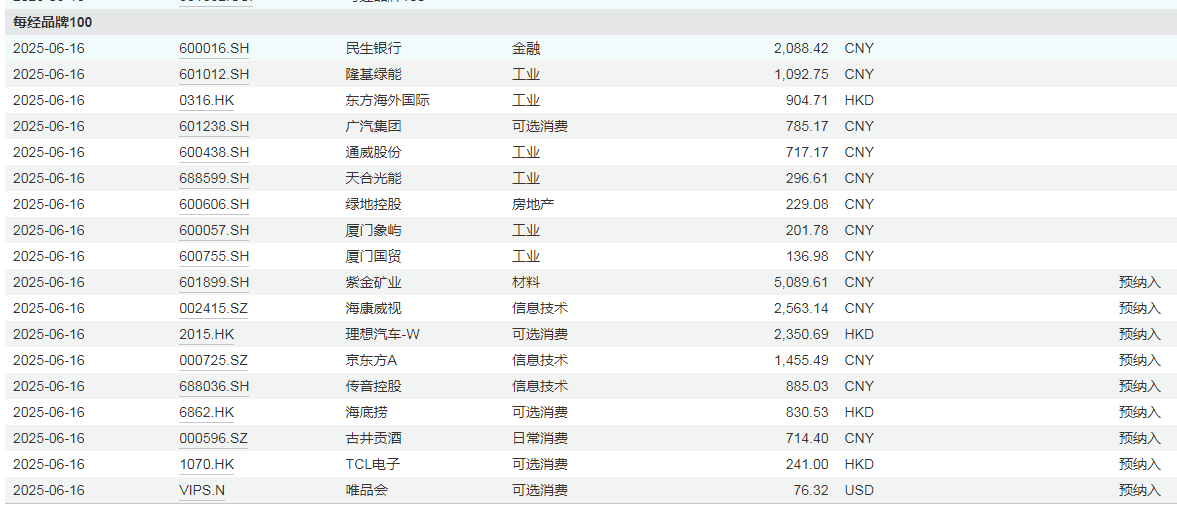
每经品牌100指数成分股“换血”,科技、消费“纳新”助力稳增长
Mei Ri Jing Ji Xin Wen· 2025-06-15 06:33
Core Viewpoint - The recent adjustment of the "Everyday Brand 100 Index" reflects a significant shift in its constituent stocks, with nine new companies being added, which is expected to support the index's continued growth [1][6]. Group 1: Index Performance - The "Everyday Brand 100 Index" has shown strong performance, achieving a 17.37% increase from May 9, 2024, to May 7, 2025, outperforming major A-share indices such as the Shanghai Composite Index and the Shenzhen Component Index [2]. - The index has consistently reached new highs, indicating strong investment elasticity and resilience against risks [2]. Group 2: Valuation Metrics - As of June 13, the index's price-to-earnings (P/E) ratio stands at 11.5 times, and the price-to-book (P/B) ratio is 1.25 times, which is competitive compared to benchmark indices like the Shanghai 50 and CSI 100 [3]. - The index's valuation is notably lower than the Hang Seng Technology Index, which has a P/E ratio of 20 times, highlighting its valuation advantage [3]. Group 3: Brand Value Performance - The total brand value of the top 100 Chinese listed companies reached 20.46 trillion CNY, marking a year-on-year increase of 14.9% [4]. - Notably, 24 Chinese companies made it to the global brand value top 100 list, with a combined brand value of 17,775.29 billion USD, reflecting a 28.4% increase from the previous year [4]. Group 4: New Constituent Stocks - The nine new companies added to the index include Zijin Mining, Hikvision, Li Auto, BOE Technology Group, Transsion Holdings, Haidilao, Gujing Distillery, TCL Electronics, and Vipshop, primarily from the consumer, information technology, and mineral resources sectors [6]. - The average revenue and net profit of the new constituent stocks are 398.19 billion CNY and 43.49 billion CNY, respectively, with revenue showing a year-on-year decline of 2.73% and net profit increasing by 8.95% [6]. Group 5: Financial Performance - The average revenue of the constituent stocks is 30.03 times that of the A-share market, and the average net profit is 42.10 times higher, indicating strong competitive and profitability capabilities [8]. - The return on assets (ROA) and return on equity (ROE) for the constituent stocks are 5.96% and 13.61%, respectively, both significantly higher than the A-share market averages [8].


想要提升收入,该选什么样的行业呢?| 螺丝钉带你读书
银行螺丝钉· 2025-06-14 13:54
Core Viewpoint - The article emphasizes the importance of selecting the right industry and job to increase income, introducing key concepts from the book "Awaken, Salaryman" [3][5]. Group 1: Choosing the Right Industry - Three key terms for selecting an industry are "long slope," "thick snow," and "dividend" [6]. - "Long slope" indicates that the industry has a long lifespan and a high ceiling, benefiting all participants [7][8]. - "Thick snow" refers to industries with high profits, where companies either have high gross margins or can mobilize significant resources [13][14]. - "Dividend" signifies that the industry is in a period of rapid growth, characterized by high overall income and profit growth, large-scale hiring, and high salaries for new graduates [20][22]. Group 2: Factors Influencing Income Levels - Income levels within the same industry depend on several factors [28]. - Supply and demand dynamics affect salary premiums during high growth periods, while mature industries may see salary stagnation [30]. - Creating unique value within the industry enhances competitive advantage and attracts employers [31]. - Industry influence, such as networking and successful case studies, is crucial for professionals in fields like law, medicine, and finance [33]. - Building a compounding model in work can lead to easier and more efficient income growth over time [35][42]. Group 3: Summary and Conclusion - Many individuals may find themselves in a chosen industry due to "sunk costs," making it challenging to switch careers [44][45]. - The article raises the question of whether it is possible to enhance income without changing industries or job directions [47].

盈信量化(首源投资)A股:低开低走,主力反手做空,下午大盘,能否旱地拔葱
Sou Hu Cai Jing· 2025-06-13 12:15
Market Overview - A-shares experienced a decline in the morning, opening lower and showing a slight drop during the session, leading to a quiet market despite increased trading volume, indicating a pattern of rising on low volume and falling on high volume [1] - The overall market was driven down by the securities sector, with a broad decline in individual stocks, resulting in an average stock price index drop of 1.43% by 10:30 AM, with over 4,500 stocks declining [3] Sector Performance - The oil sector, including the three major operators, saw a rise of 1.63%, while the precious metals sector increased by 3.68%. In contrast, the securities index fell over 1% in the morning, with insurance down by 0.53% [5] - Significant declines were noted in sectors such as new energy vehicles, liquor, food and beverages, artificial intelligence, and pharmaceuticals, primarily affecting small and mid-cap stocks [6] Technical Analysis - The morning's decline is viewed as a necessary technical adjustment, with the market needing to allow for normal corrections to avoid deeper damage to small-cap stocks [7] - The A-share index did not break below the critical support level of 3,372 points, and the average stock price index fell by 1.7%, indicating a potential for a rebound in the afternoon session [7][9] - A technical rebound is anticipated in the afternoon to repair the 60-minute trend, although it will not reverse the overall downward trend [9] Investment Strategy - Investors are advised to be cautious of exaggerated rebounds, particularly if the index rises to the 3,380-3,400 point range, as this could indicate a false signal for further declines [8] - The 3,400 point level is identified as a significant resistance point, and without substantial volume surpassing this level, it may be viewed as a bull trap [10]

时尚消费发展报告发布!港股消费ETF(159735)今日显著回调,实时成交额突破5000万元排名同指数第一
Mei Ri Jing Ji Xin Wen· 2025-06-13 03:30
Group 1 - The Hong Kong stock market opened lower on June 13, with sectors such as gold jewelry, blind boxes, cultural tourism, and dining showing strong gains. Notably, Chow Tai Fook rose over 9%, while companies like Smoore International, Nongfu Spring, Tongcheng Travel, and Pop Mart also saw upward movement [1] - The Hong Kong Consumption ETF (159735) has an average daily trading volume exceeding 72 million yuan over the past 10 trading days, indicating high market interest [1] - The first China Fashion Industry Ceremony was held in Shanghai on June 12, where the China Cultural Media Group's Fashion Research Institute released the "China Fashion Consumption Development Report." The report estimates the current market size of China's fashion consumption to be between 2 trillion and 3 trillion yuan, highlighting its role as a key driver of consumption upgrade [1] Group 2 - According to Guosen Securities, the investment value of the consumption sector is gradually becoming apparent, especially as domestic consumption becomes a crucial growth support amid a complex global economic environment [2] - The consumption sector exhibits a "smile curve" characteristic, indicating that higher added value is found at both ends of the traditional and emerging business models, while the middle segment faces transformation pressures. This trend suggests that investment opportunities are more concentrated in companies with brand strength, innovation capabilities, and digitalization [2] - The internal demand-driven nature of the consumption sector provides stronger risk resistance amid external demand fluctuations and geopolitical risks [2]
2025新一线城市大洗牌:成都杭州“争霸”,苏州无锡掉队,郑州合肥晋升
吴晓波频道· 2025-06-13 00:21
Group 1 - The core viewpoint of the article emphasizes that traditional economic indicators like GDP, housing prices, and tax revenue are no longer the key metrics for evaluating cities. Instead, factors such as consumer spending power, brand preference, commercial infrastructure maturity, hub city status, and talent attraction are more significant [2][3][12] - The 2025 New First-Tier City Charm Rankings published by Yicai evaluates 337 cities based on five categories: commercial resource aggregation, city hub status, urban activity, new economic competitiveness, and future potential [3][12] - The top 15 new first-tier cities include Chengdu, Hangzhou, Chongqing, Wuhan, Suzhou, Xi'an, Nanjing, Changsha, Zhengzhou, Tianjin, Hefei, Qingdao, Dongguan, Ningbo, and Foshan, with notable movements in rankings [3][12][30] Group 2 - The article discusses the significance of various indicators used in the rankings, such as commercial resource aggregation, which reflects a city's commercial vibrancy, and city hub status, which measures a city's connectivity and collaborative potential [8][9][10][11] - Chengdu has shown remarkable performance in urban activity, ranking just behind Shanghai and Beijing, with a notable night economy where nighttime consumption accounts for 54.6% of total spending [26][29] - Hefei has achieved a significant rise in rankings due to its rapid GDP growth and strong performance in new economic competitiveness, with a GDP of 13,507.7 billion yuan in 2024, reflecting a 6.1% year-on-year increase [40][46] Group 3 - Foshan has made a comeback in the rankings, attributed to its advancements in smart manufacturing and tourism, with a tourism revenue growth of 21.4% in 2024 [30][37] - Wuxi has dropped out of the new first-tier city rankings, facing challenges in commercial resource aggregation and urban activity, which are critical for its competitiveness [30][39] - The article highlights the upward trends of cities like Wuhan and Zhengzhou, with Wuhan reclaiming its position as the fourth new first-tier city and Zhengzhou achieving a record high in air cargo volume [53][56]

中金2025下半年展望 | 新能源车中游:基本面逐步进入改善通道,锂电新技术迎产业化向上拐点
中金点睛· 2025-06-12 23:56
Core Viewpoint - The overall price stability in the industry chain is expected in 2H25, with potential price elasticity in certain segments, supported by high operating rates of leading companies and benefits from new product premiums, indicating a recovery in fundamentals [1][3]. Demand - The demand for new energy vehicles (NEVs) is anticipated to maintain a high growth rate in 2H25, driven by policies such as trade-in incentives and a reduction in purchase tax in China, alongside a recovery in the European market due to carbon policies and subsidies [3][7]. - The domestic NEV wholesale sales in the first four months of 2025 increased by 46% year-on-year, with exports also showing strong growth, up 52% year-on-year [11]. - The demand for energy storage is expected to remain resilient, supported by declining tariffs in the U.S. and high electricity prices in Europe, which will drive commercial demand [17][19]. Industry Chain - The industry chain has reached a price bottom after significant declines in 2023-2024, with certain segments like 6F, copper foil, and iron lithium cathodes showing signs of price stabilization [3][23]. - The supply-demand structure is improving, with leading manufacturers maintaining high operating rates, while the capital expenditure in the battery and upstream materials sectors is expected to decline [25][27]. - The concentration of leading firms in the industry is increasing, with a notable improvement in the operating rates of top manufacturers [29]. New Technologies - The solid-state battery technology is expected to see accelerated industrialization in 2H25, with advancements in both semi-solid and solid-state batteries, which are crucial for applications in NEVs, eVTOLs, and robotics [4][41]. - The commercialization of semi-solid batteries is progressing, with several companies achieving significant milestones in production and testing [43]. Global Manufacturing Layout - The global manufacturing layout of the lithium battery industry is accelerating, with overseas production expected to gradually come online by the end of 2H25, driven by geopolitical factors and local supply chain demands [38][40].

中金2025下半年展望 | 新能源车中游:基本面逐步进入改善通道,锂电新技术迎产业化向上拐点
中金点睛· 2025-06-12 23:55
Core Viewpoint - The overall price stability in the industry chain is expected in 2H25, with potential price elasticity in certain segments, supported by high operating rates of leading companies and benefits from new product premiums, indicating a recovery in fundamentals [1][3]. Demand - The demand for new energy vehicles (NEVs) is anticipated to maintain high growth in China due to the old-for-new policy and the expected decline in purchase tax in 2026, while the European market is expected to recover due to carbon policies and subsidies [3][6]. - In the first four months of 2025, China's NEV wholesale sales increased by 46% year-on-year, with exports also showing strong growth, benefiting from the recognition of Chinese brands in overseas markets [7][9]. - The commercial vehicle sector in Europe is experiencing strong growth, with a 47% year-on-year increase in NEV commercial vehicle sales in the first four months of 2025, driven by various subsidies [16]. Industry Chain - After significant price declines in 2023-2024, the industry chain prices are entering a bottoming phase, with certain segments like 6F, copper foil, and iron lithium cathodes showing signs of price stabilization [3][26]. - The supply-demand structure is improving, with leading manufacturers maintaining high operating rates, indicating a potential recovery in their fundamentals [28][31]. New Technologies - The solid-state battery technology is expected to see accelerated industrialization in 2H25, driven by demand from NEVs, eVTOLs, and robotics, with significant advancements in testing and pilot production [4][45]. - The second-generation semi-solid batteries are entering a critical phase for commercialization, with various companies making progress in production and application [47][48]. Global Manufacturing Layout - The lithium battery industry chain is accelerating its global manufacturing layout, particularly in Europe and Southeast Asia, with expected production capacity coming online from late 2H25 to 2026 [41][44]. - The U.S. Inflation Reduction Act (IRA) is promoting domestic production of batteries and components, which is expected to enhance local supply capabilities and reduce reliance on foreign products [42][43].