
啤酒

Search documents
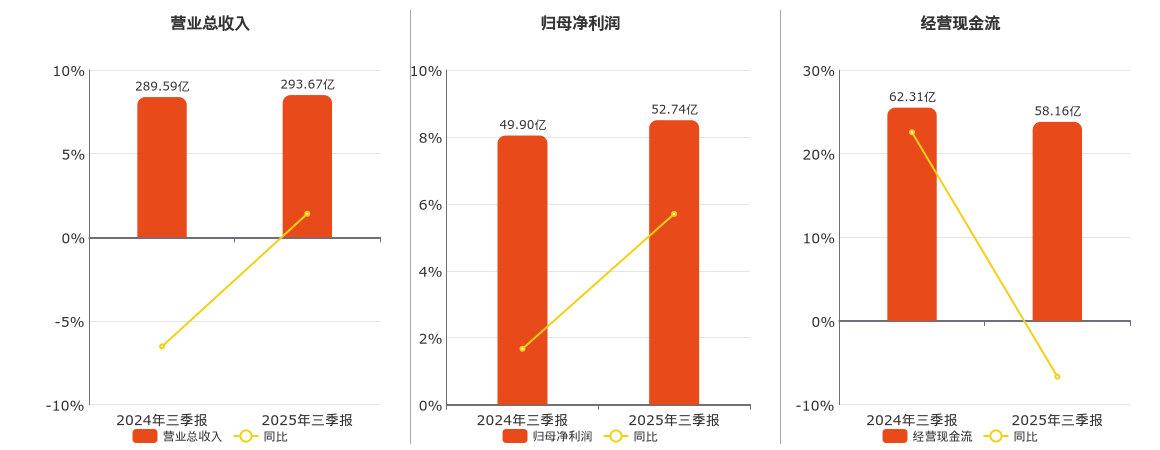
青岛啤酒(600600.SH):2025年三季报净利润为52.74亿元、同比较去年同期上涨5.70%
Xin Lang Cai Jing· 2025-10-28 02:23
Core Insights - Qingdao Beer (600600.SH) reported a total operating revenue of 29.367 billion yuan for Q3 2025, an increase of 407 million yuan compared to the same period last year, representing a year-on-year growth of 1.41% [1] - The net profit attributable to shareholders reached 5.274 billion yuan, up by 284 million yuan from the same period last year, achieving a 5-year consecutive increase with a year-on-year growth of 5.70% [1] Financial Performance - The latest operating cash flow net inflow was 5.816 billion yuan [1] - The current debt-to-asset ratio stands at 37.35%, a decrease of 3.90 percentage points from the previous quarter and a decrease of 1.76 percentage points from the same period last year [3] - The latest gross profit margin is 43.66%, an increase of 1.89 percentage points year-on-year, marking a 3-year consecutive rise [3] - The return on equity (ROE) is 16.83%, up by 0.09 percentage points compared to the same period last year [3] - The diluted earnings per share (EPS) is 3.87 yuan, an increase of 0.20 yuan year-on-year, achieving a 5-year consecutive increase with a year-on-year growth of 5.45% [3] - The total asset turnover ratio is 0.57 times, and the inventory turnover ratio is 6.11 times, which is an increase of 0.05 times year-on-year, marking a 2-year consecutive rise [3] Shareholder Structure - The number of shareholders is 98,400, with the top ten shareholders holding a total of 1.124 billion shares, accounting for 82.41% of the total share capital [3] - The largest shareholders include Hong Kong Central Clearing (Agent) Co., Ltd. with 45.0%, Qingdao Beer Group Co., Ltd. with 32.5%, and China Securities Finance Corporation with 1.17% [3]

贵州省人民政府:推荐陈华为茅台集团董事、董事长,贵州茅台董事、董事长人选;青岛啤酒、ST西发发布三季报丨酒业早参
Mei Ri Jing Ji Xin Wen· 2025-10-28 01:47
Group 1 - Guizhou Provincial Government has recommended Chen Hua as the new chairman and director of Kweichow Moutai Group and Kweichow Moutai Co., marking a significant leadership transition [1] - Zhang Deqin will no longer serve as chairman and director of both Kweichow Moutai Group and Kweichow Moutai Co., indicating a shift in management strategy [1] - The market will closely monitor the new chairman's approach to company strategy and innovation [1] Group 2 - Qingdao Beer reported a third-quarter net profit of 1.37 billion yuan, a year-on-year increase of 1.62% [2] - The company's third-quarter revenue was 8.876 billion yuan, a slight decrease of 0.17% year-on-year, reflecting ongoing competitive pressures in the industry [2] - For the first three quarters, Qingdao Beer achieved a revenue of 29.367 billion yuan, a year-on-year growth of 1.41%, and a net profit of 5.274 billion yuan, up 5.7% year-on-year [2] Group 3 - ST Xifa reported a significant increase in net profit for the first three quarters, with a year-on-year growth of 503.98% [3] - The company's revenue for the first three quarters was 325 million yuan, representing an 8.57% year-on-year increase [3] - The non-recurring net profit also saw a substantial rise of 436.90%, indicating an improvement in operational performance [3]


港股异动 | 青岛啤酒股份(00168)绩后跌超5% 前三季度归母净利同比增加5.7% 产品结构仍在提升
智通财经网· 2025-10-28 01:44
Core Viewpoint - Qingdao Beer Co., Ltd. reported a decline in stock price exceeding 5% following the release of its Q3 2025 financial results, indicating market concerns despite a slight increase in revenue and profit [1] Financial Performance - For the first three quarters of 2025, the company achieved a revenue of 29.367 billion RMB, reflecting a year-on-year increase of 1.41% [1] - The net profit attributable to shareholders reached 5.274 billion RMB, marking a year-on-year increase of 5.7% [1] - In Q3 2025, the company recorded a revenue of 8.88 billion RMB, which is a slight decrease of 0.2% year-on-year [1] - The net profit for Q3 2025 was 1.37 billion RMB, showing a year-on-year increase of 1.6% [1] Sales and Product Structure - The company's sales volume remained stable, with the average selling price (ASP) slightly pressured due to seasonal discounts [1] - In Q3 2025, sales volume and ASP changed by +0.3% and -0.5% year-on-year, respectively [1] - The main brand, Qingdao Beer, saw a sales volume increase of 4.2% year-on-year, with its market share rising by 2.2 percentage points [1] - Other brands experienced a sales volume decline of 4.8% year-on-year [1] - Sales of mid-to-high-end products increased by 6.8% year-on-year, with their market share growing by 2.6 percentage points, while sales of lower-end products decreased by 4.2% year-on-year [1]
青岛啤酒股份绩后跌超5% 前三季度归母净利同比增加5.7% 产品结构仍在提升
Zhi Tong Cai Jing· 2025-10-28 01:43
Core Viewpoint - Qingdao Beer Co., Ltd. reported a mixed performance in its Q3 2025 results, leading to a decline in stock price by over 5% following the announcement [1] Financial Performance - The company achieved a total revenue of 29.367 billion RMB, reflecting a year-on-year increase of 1.41% [1] - The net profit attributable to shareholders reached 5.274 billion RMB, marking a year-on-year growth of 5.7% [1] - In Q3 alone, revenue was 8.88 billion RMB, showing a slight decline of 0.2% year-on-year [1] - The net profit for Q3 was 1.37 billion RMB, which is a year-on-year increase of 1.6% [1] Sales and Product Structure - Sales volume remained stable, while the average selling price (ASP) was slightly pressured due to seasonal discounts [1] - In Q3 2025, sales volume and ASP changed by +0.3% and -0.5% year-on-year, respectively [1] - The main brand, Qingdao Beer, saw a sales volume increase of 4.2% year-on-year, with its market share rising by 2.2 percentage points [1] - Other brands experienced a sales volume decline of 4.8% year-on-year [1] - Sales of mid-to-high-end products increased by 6.8% year-on-year, with their market share growing by 2.6 percentage points, while sales of lower-end products decreased by 4.2% year-on-year [1]
银河证券:当前消费风格估值处于历史低位 修复空间较大
Zheng Quan Shi Bao Wang· 2025-10-28 00:37
Core Viewpoint - The report from Galaxy Securities highlights the increasing importance of consumption in China's economic structure amid slowing traditional investment growth and heightened external uncertainties, particularly for export-dependent enterprises [1] Group 1: Economic Context - Structural adjustments in the economy are leading to a slowdown in traditional investment growth [1] - Export-dependent companies are facing increased pressure due to external uncertainties [1] - Insufficient effective demand remains a prominent issue during the "14th Five-Year Plan" period [1] Group 2: Consumption Insights - The role and status of consumption in the "three drivers" of the economy are becoming more prominent [1] - The "14th Five-Year Plan" may focus on reforms in income distribution, high-quality consumption supply, and improving long-term mechanisms to stimulate consumption [1] - Current consumption style valuations are at historical lows, indicating significant potential for valuation recovery [1] Group 3: Investment Focus - Attention is drawn to sectors with valuations at historical mid-low levels and relatively strong performance metrics, including beer, feed processing, animal husbandry, white goods, and condiments [1]

中国银河证券:A股当前消费风格估值处于历史低位
Di Yi Cai Jing· 2025-10-28 00:13
Core Viewpoint - The report from China Galaxy Securities highlights the increasing importance of consumption in the economy due to structural adjustments and external uncertainties, with a focus on the "14th Five-Year Plan" to stimulate consumer demand through reforms and improved supply [1] Economic Context - Traditional investment growth is slowing down, and export-dependent companies are facing pressures due to heightened external uncertainties [1] - Insufficient effective demand remains a prominent issue during the "14th Five-Year Plan" period [1] Consumption Focus - The "14th Five-Year Plan" is expected to focus on reforms in income distribution, high-quality consumer supply, and the establishment of long-term mechanisms to promote consumption [1] - Consumption is becoming more prominent among the "three drivers" of the economy [1] Market Valuation - Current consumption style valuations in the A-share market are at historical lows, indicating significant potential for valuation recovery [1] - Key sectors to watch include beer, feed processing, animal husbandry, white goods, and condiments, particularly those with valuations at historical mid-low levels and relatively strong performance metrics [1]
青岛啤酒前三季营收微增1.41%至293.67亿,中高端以上产品销量上涨5.6%
Cai Jing Wang· 2025-10-27 17:23
Core Insights - Qingdao Beer reported a slight revenue increase of 1.41% to 29.367 billion yuan for the first three quarters of 2025 [1] - The net profit attributable to the company rose by 5.7% to 5.274 billion yuan [1] Revenue and Profit Performance - The company achieved a total product sales volume of 6.894 million kiloliters, reflecting a year-on-year growth of 1.6% [1] - The main brand, Qingdao Beer, recorded a sales volume of 3.99 million kiloliters, which is a 4.1% increase compared to the previous year [1] - Sales of mid-to-high-end products reached 2.935 million kiloliters, marking a year-on-year growth of 5.6% [1]
氪星晚报|青岛啤酒:第三季度净利润13.7亿,同比增长1.62%;宋旸已接替邵京平(James)出任京东零售平台营销中心负责人;安踏体育:三季度安踏和F...
3 6 Ke· 2025-10-27 15:08
Group 1: Meituan's Health Initiative - Meituan has launched a "Health Double Eleven" campaign featuring special medical foods and health supplements, responding to a nearly 40% increase in related search volume on its platform [1] - The campaign includes products like Ejiao and bird's nest, along with special medical foods such as Ai Er Shu and Tai Min Shu, and offers significant discount coupons to users [1] - Users purchasing special medical foods can join a community for exclusive nutritionist consultations and additional discounts [1] Group 2: Qingdao Beer Financial Performance - Qingdao Beer reported a third-quarter net profit of 1.37 billion yuan, representing a year-on-year increase of 1.62% [2] - The company's revenue for the third quarter was 8.876 billion yuan, showing a slight decline of 0.17% compared to the previous year [2] Group 3: Changchun High-tech's Clinical Trial Approval - Changchun High-tech's subsidiary, GenSci, received approval for the clinical trial application of GenSci098 injection, which has potential for treating diffuse toxic goiter [3] - This approval is expected to facilitate the clinical development of the product for the target population [3] Group 4: Kingsoft Office Financial Performance - Kingsoft Office reported a third-quarter net profit of 431 million yuan, marking a year-on-year increase of 35.42% [4] - The company's revenue for the third quarter was 1.521 billion yuan, reflecting a growth of 25.33% year-on-year [4] Group 5: Foreign Exchange and Trade Statistics - In the first three quarters, China's foreign exchange receipts and payments reached 11.6 trillion USD, setting a record for the same period [5] - The foreign exchange market transaction volume is projected to grow by 37% in 2024 compared to 2020, with foreign exchange receipts increasing by 64% over the same period [5] Group 6: Three Squirrels Financial Performance - Three Squirrels reported a third-quarter net profit of 22.27 million yuan, which is a significant decline of 56.79% year-on-year [6] - The company's revenue for the third quarter was 2.281 billion yuan, showing an increase of 8.91% compared to the previous year [6] Group 7: Hengrui Medicine Financial Performance - Hengrui Medicine's third-quarter revenue was 7.427 billion yuan, reflecting a year-on-year growth of 12.72% [6] - The net profit for the third quarter was 1.301 billion yuan, which is a 9.53% increase year-on-year [6] Group 8: Anta Sports Retail Performance - Anta Sports reported low single-digit growth in retail sales for its Anta and FILA brands in the third quarter [9] - Other brands under the company achieved a significant retail sales growth of 45-50% year-on-year [9] Group 9: National Airlines Aircraft Purchase - National Airlines announced plans to purchase six A350F cargo aircraft from Airbus, with an option for four additional aircraft [10] - The total value of the aircraft, based on the January 2024 catalog price, is approximately 4.65 billion USD per unit, with potential discounts negotiated [10] Group 10: Investment and Financing Activities - Guoyi Quantum has completed a new round of strategic financing led by Hefei Xingtai Capital, aimed at enhancing its R&D capabilities in quantum computing and related fields [10] - Song Yang has replaced Shao Jingping as the head of JD Retail's marketing center, following Shao's departure for personal reasons [7] Group 11: New Product Launch by Meituan - Meituan's LongCat team has released and open-sourced the LongCat-Video video generation model, achieving state-of-the-art results in video generation tasks [10] - The model aims to enhance capabilities in various applications, including autonomous driving and interactive business scenarios [10] Group 12: Regulatory Changes in Foreign Investment - The China Securities Regulatory Commission has introduced a green channel and simplified processes for foreign institutional investors, including sovereign funds and pension funds [11]



氪星晚报|青岛啤酒:第三季度净利润13.7亿,同比增长1.62%;宋旸已接替邵京平(James)出任京东零售平台营销中心负责人;安踏体育:三季度安踏和FILA品牌零售额同比低单位数增长
3 6 Ke· 2025-10-27 14:56
Group 1: Company Performance - Meituan's special medical food activity section launched for Double Eleven, with a nearly 40% week-on-week increase in related search volume [1] - Qingdao Beer reported a third-quarter net profit of 1.37 billion, a year-on-year increase of 1.62%, with revenue of 8.876 billion, a slight decline of 0.17% [2] - Changchun High-tech's subsidiary received approval for clinical trials of GenSci098 injection, which has potential for treating diffuse toxic goiter [3] - Kingsoft Office reported a third-quarter net profit of 431 million, a year-on-year increase of 35.42%, with revenue of 1.521 billion, up 25.33% [4] - Anta Sports reported low single-digit growth in retail sales for Anta and FILA brands in the third quarter, while other brands saw a 45-50% increase [9] - Heng Rui Pharmaceutical reported a third-quarter net profit of 1.301 billion, a year-on-year increase of 9.53%, with revenue of 7.427 billion, up 12.72% [6] - Three Squirrels reported a third-quarter net profit of 22.27 million, a year-on-year decrease of 56.79%, with revenue of 2.281 billion, up 8.91% [5] - Kangtai Biological reported a third-quarter net profit of 11.62 million, a year-on-year decrease of 93.74%, with revenue of 671 million, down 17.74% [8] Group 2: Investment and Financing - Guoyi Quantum received strategic investment from Hefei Xingtai Capital, which will enhance its R&D capabilities in quantum computing and related fields [10] - Song Yang has replaced Shao Jingping as the head of JD Retail Platform Marketing Center due to personal reasons [7] - Song Yan Power completed nearly 300 million Pre-B round financing led by Fanggu Capital, with participation from several other investors [11] Group 3: Market Trends and Economic Indicators - China's foreign exchange revenue and expenditure scale reached 11.6 trillion in the first three quarters, a historical high, with a 37% increase in trading volume compared to 2020 [5] - The China Securities Regulatory Commission has implemented a green channel and simplified processes for foreign investment from sovereign funds, international organizations, and pension charitable funds [12] Group 4: New Products - Meituan LongCat-Video was officially released and open-sourced, achieving state-of-the-art performance in video generation tasks [11]


ST西发披露2025年三季报:资金占用收回 助推归母净利润增长503.98%
Zheng Quan Shi Bao Wang· 2025-10-27 14:49
Core Viewpoint - ST Xifa reported significant growth in revenue and net profit for the first three quarters of 2025, indicating improved operational stability and profitability [1][2] Financial Performance - The company achieved a revenue of 325 million yuan, representing an 8.57% year-on-year increase [1] - The net profit attributable to shareholders reached 145 million yuan, showing a remarkable growth of 503.98% year-on-year [1] Operational Improvements - ST Xifa has been optimizing its operations and finances over the past few years, with consecutive double-digit revenue growth in 2023 and 2024 [1] - The strong sales of high-end product "3650" have contributed to the optimization of the revenue structure [1] - The establishment of online sales channels and significant achievements in expanding into external markets have opened new avenues for sustained growth [1] Debt and Financial Restructuring - The company resolved long-standing issues related to capital occupation with the assistance of its controlling shareholder, Shengbang Holdings [2] - Since becoming the controlling shareholder in 2021, Shengbang Holdings has actively helped the company recover large receivables and reduce debt, alleviating liquidity pressure [2] - By September 2025, the company completely resolved a capital occupation issue amounting to 331 million yuan, paving the way for healthy and sustainable development [2] Future Outlook - With historical issues properly addressed and continuous operational and financial optimization, ST Xifa is positioned for enhanced market competitiveness and profitability [2]