
债券市场

Search documents
构筑人民币跨境投融资“新闭环” 点心债成人民币国际化新引擎
Shang Hai Zheng Quan Bao· 2025-10-27 00:14
Core Insights - The offshore RMB bond market is steadily entering a phase of high-quality development, with the dim sum bond market expected to exceed 1.4 trillion yuan in 2024 and reach 1.5 trillion yuan by 2025, significantly up from approximately 250 billion yuan in 2021 [1] Group 1: Market Growth and Structure - The RMB offshore bond market has achieved both quantitative and qualitative growth, transitioning from a "marginal market" to a main channel for global financing [2] - The supply structure of dim sum bonds has been optimized, with local governments and leading enterprises now participating alongside central banks and financial institutions, enhancing the market ecosystem [2] - City investment enterprises became a major issuance force in 2023-2024, accounting for 28.3% of the issuance, but are expected to see a significant decline in 2025 due to stricter local debt policies [2][3] Group 2: Innovation and Product Development - Recent innovations in the dim sum bond market include breakthroughs in term structure and product design, with the Ministry of Finance increasing the issuance of offshore RMB government bonds [4] - The issuance of green offshore RMB bonds has attracted significant interest from international investors, indicating a growing trend towards sustainable finance [4] Group 3: Buyer Dynamics and Market Participation - The "buying power" in the dim sum bond market is expanding, with the inclusion of non-bank institutions such as securities firms and fund management companies, enhancing market liquidity and trading activity [5] - The low offshore RMB interest rates and the growing pool of RMB deposits in Hong Kong, Macau, and Singapore provide a solid foundation for demand expansion [5][6] Group 4: Internationalization of RMB - Dim sum bonds are becoming a crucial engine for RMB internationalization, providing a stable channel for RMB asset allocation and enhancing the currency's role as a medium of exchange [7] - The ongoing expansion of the dim sum bond market is facilitating the evolution of RMB from a trade settlement currency to an investment and reserve currency [7] Group 5: Challenges and Bottlenecks - Despite the strong growth of the dim sum bond market, challenges remain, including the need for improved investor structure, enhanced secondary market liquidity, and further product innovation [8]
债市角度学习二十届四中全会公报
Western Securities· 2025-10-26 07:10
1. Report Industry Investment Rating No industry investment rating is provided in the report. 2. Core Viewpoints of the Report - The Fourth Plenary Session of the 20th Central Committee's communiqué has a neutral short - term impact on the bond market. The bond market's volatile pattern remains unchanged. It's advisable to seize allocation and trading opportunities after adjustments [2][18]. - The "15th Five - Year Plan" is a long - term plan. It continues the economic development mainline in recent years, smoothly connects with the "14th Five - Year Plan", and the requirement for the annual economic target is consistent with the Politburo meeting in July [2]. - In the short term, the monetary policy maintains a supportive stance, the capital market is generally stable with low volatility, the broad - spectrum interest rate is still low, and it's difficult for pure - bond assets to generate significant returns. The bond market may remain volatile under various factors [2]. 3. Summaries According to the Table of Contents 3.1 Review and Outlook of the Bond Market - This week, the expectations of double - rate cuts were dashed, risk appetite increased, and new regulations were pending. The bond market fluctuated, with the 10Y and 30Y Treasury bond yields rising by 2bp and 1bp respectively [9]. - The "15th Five - Year Plan" in the Fourth Plenary Session's communiqué is a long - term plan. It emphasizes strategic opportunities coexisting with risks, focuses on economic construction for high - quality development, and deploys 12 sub - tasks. The goal of achieving the annual economic and social development target requires a Q4 GDP growth rate of over 4.6% [10][13]. 3.2 Bond Market Review 3.2.1 Capital Market - The central bank made a net injection of 1981 billion yuan this week, and capital interest rates rose. From October 20th to 24th, R001 and DR001 increased by 2bp and 0.3bp respectively compared to October 17th [22][23]. 3.2.2 Secondary Market Trends - Yields fluctuated upward this week. All key - term Treasury bond yields rose, and most term spreads narrowed. As of October 24th, the 10Y and 30Y Treasury bond yields increased by 2bp and 1bp respectively compared to October 17th [30]. 3.2.3 Bond Market Sentiment - This week, the 30Y Treasury bond turnover rate slightly declined, the 30Y - 10Y Treasury bond spread continued to narrow, the inter - bank leverage ratio dropped to 107.2%, and the exchange leverage ratio dropped to 122.3%. The median duration of medium - and long - term pure - bond funds first rose and then fell, and the divergence increased [40]. 3.2.4 Bond Supply - This week, the net financing of interest - rate bonds increased to 4972 billion yuan. The net financing of Treasury bonds and local government bonds rose, while that of policy - financial bonds decreased. The average issuance rate of inter - bank certificates of deposit rose to 1.65% [52][58]. 3.3 Economic Data - In the third quarter, the economic growth slowed, and the pattern of strong supply and weak demand in September was strengthened. Since October, automobile retail sales have been weak, while industrial production has continued to improve [62][63]. 3.4 Overseas Bond Market - The US CPI in September declined, paving the way for interest - rate cuts. French and German bond markets fell, while emerging markets mostly rose. The 10Y - 2Y US Treasury bond spread narrowed to 54bp [73][74]. 3.5 Performance of Major Asset Classes - This week, the performance of major asset classes is as follows: crude oil > live pigs > Shanghai copper > CSI 1000 > CSI 300 > convertible bonds > US dollar > rebar > Chinese - funded US dollar bonds > China bonds > Shanghai gold [3][79]. 3.6 Policy Review - Multiple financial regulatory departments held meetings to learn and implement the spirit of the Fourth Plenary Session of the 20th Central Committee, emphasizing risk prevention and support for economic development [82]. - The "15th Five - Year Plan" has clear development goals and principles, and focuses on building a modern industrial system and other aspects [83][84][85].
财经深一度丨增量扩面!债券市场“科技板”加速支持科技创新
Xin Hua Wang· 2025-10-25 08:34
Core Viewpoint - The launch of the "Technology Board" in the bond market has accelerated the support for technological innovation financing, with significant growth in the issuance of technology innovation bonds since its establishment on May 7, 2023 [1][2]. Group 1: Market Performance - From May 7 to the end of September, a total of 530 institutions issued technology innovation bonds amounting to 1,167.267 billion yuan, with 88 financial institutions contributing 319.67 billion yuan and 442 non-financial enterprises contributing 847.597 billion yuan [1]. - Approximately 280 entities in the interbank bond market have issued technology innovation bonds totaling 670 billion yuan, with nearly half of the technology enterprises issuing bonds with a maturity of 3 years or more, and equity investment institutions averaging a maturity of 5.8 years [1][2]. Group 2: Mechanism Innovation - The issuance of technology innovation bonds has been driven by innovations in disclosure requirements, rating systems, risk-sharing, and issuance mechanisms, which have reshaped the ecosystem for technology enterprises [2]. - The People's Bank of China, in collaboration with the China Securities Regulatory Commission, has created a risk-sharing tool for technology innovation bonds, providing low-cost re-lending funds to purchase these bonds and collaborating with local governments and market-based credit enhancement institutions [2]. Group 3: Rating System - Unlike traditional industry bonds that rely heavily on quantitative indicators such as total assets and net assets, the rating of technology innovation bonds requires a new rating methodology that incorporates key variables such as patent quality, R&D investment, technology maturity, industry attractiveness, and policy benefits into the rating function [3]. Group 4: Future Development - While the support for technology enterprises through technology innovation bonds has shown positive results, further development requires continuous collaboration among various stakeholders, including local governments, enterprises, investors, and intermediaries, to enhance the quality and efficiency of financing services for technological innovation [4].
债市 等待方向明朗
Qi Huo Ri Bao· 2025-10-24 16:45
Core Viewpoint - The bond market has experienced multiple shifts in trading logic this year, with long-term bond yields attempting but failing to break previous lows, leading to a noticeable upward shift in yield levels. Recent developments have prompted a recovery in the bond market due to increased liquidity and expectations of central bank bond purchases [1]. Group 1: Positive Factors - The economic landscape shows a divergence between weak realities in traditional sectors like real estate and infrastructure, and strong expectations in high-tech industries and services, impacting financing needs in the bond market [2]. - The central bank's supportive monetary policy has maintained a loose liquidity environment, with market expectations for renewed bond purchases by the central bank [2]. - The supply pressure in the bond market is expected to decrease in Q4, with a significant reduction in the remaining issuance quota for government bonds compared to Q3 [2]. Group 2: Negative Factors - Recent inflation data indicates a narrowing decline in PPI and a rise in core CPI, suggesting a potential bottoming out of inflation, although demand remains a key factor [3]. - The relative attractiveness of bonds has diminished this year, leading to a higher likelihood of new funds entering the stock market rather than the bond market, compounded by the lack of formal implementation of new fund sales regulations [3]. - The bond market faces limited downward yield space due to the combined effects of reduced asset attractiveness and low incremental funding [3].
前三季度河南省金融运行总体稳健
Sou Hu Cai Jing· 2025-10-24 00:25
Core Viewpoint - The financial operation in Henan Province is overall stable in the first three quarters of 2025, with a focus on expanding total volume, optimizing structure, and reducing costs to create a favorable monetary and financial environment for high-quality economic development [1] Financial Operation Overview - As of the end of September, the total balance of deposits in both domestic and foreign currencies reached 11.7 trillion yuan, with household deposits at 8.3 trillion yuan and non-financial enterprise deposits at 1.8 trillion yuan [2] - The total balance of loans in both domestic and foreign currencies was 9.3 trillion yuan, with household loans at 3.5 trillion yuan and loans to enterprises at 5.8 trillion yuan; new loans added in the first three quarters amounted to 408.16 billion yuan [2] - The incremental social financing scale for the first three quarters was 726.95 billion yuan [2] Structural Monetary Policy - Under the guidance of structural monetary policy tools, financial resources are increasingly directed towards key sectors, with agricultural loans growing steadily to a balance of 2.6 trillion yuan, an increase of 77.13 billion yuan since the beginning of the year [3] - Loans to the manufacturing sector increased to 664.88 billion yuan, up by 79.46 billion yuan since the start of the year [3] - Infrastructure loans reached a balance of 1.7 trillion yuan, with an increase of 52.46 billion yuan; medium and long-term loans for infrastructure stood at 1.5 trillion yuan, up by 67.13 billion yuan [3] - General consumer loans grew rapidly, reaching a balance of 724.1 billion yuan, an increase of 36.57 billion yuan since the beginning of the year [3] Cost Reduction and Interest Rates - The People's Bank of China in Henan has effectively promoted a decline in policy interest rates, leading to a decrease in comprehensive financing costs; the weighted average interest rate for new loans in September was 3.83%, down by 0.61 percentage points year-on-year [3] - The weighted average interest rate for new corporate loans was 3.31%, also down by 0.61 percentage points; for new personal housing loans, it was 3.19%, down by 0.27 percentage points [3] Policy Implementation and Financial Services - The People's Bank of China in Henan has intensified the implementation of financial policies, enhancing services for enterprises and supporting high-quality economic development [4] - The balance of technology loans reached 1.07916 trillion yuan, a year-on-year increase of 15.9% [4] - The balance of green loans was 1.03809 trillion yuan, growing by 27% year-on-year [4] Inclusive Finance and Elderly Care Finance - The number of inclusive small and micro enterprise credit accounts reached 2.427 million, a year-on-year increase of 2.0%; the balance of inclusive small and micro loans was 1.30709 trillion yuan, up by 12.6% [5] - Loans for the elderly care industry reached 7.754 billion yuan, with over 17 billion yuan in loans for consumption and elderly care projects issued [5] Digital Finance - The balance of loans for the digital economy reached 110.18 billion yuan, a year-on-year increase of 18.9% [6] Bond Financing - The balance of corporate debt financing tools reached 448.87 billion yuan, an increase of 8.6% year-on-year; 73 enterprises issued bonds in the interbank market, raising 144.02 billion yuan [7] - The balance of innovative debt financing tools reached 46.23 billion yuan, up by 64.9% year-on-year [7] Foreign Exchange Market - The foreign exchange market in Henan has shown resilience, with nearly 70 billion USD in facilitation business processed in the first three quarters [9] - The number of quality enterprises reached 462, with 12 pilot banks involved [9] Trade and New Business Models - The new international trade settlement scale reached 408 million USD, with 801 market procurement trade registered merchants [10] - The total service trade revenue was 7.893 billion USD, a year-on-year increase of 43.63% [10]
记者观察 | 债市机制优化大年:从市场运行到规则共建的考量
Sou Hu Cai Jing· 2025-10-21 12:28
Core Insights - The launch of overseas institutional bond repurchase transactions and the centralized bond lending business marks significant innovations in China's interbank bond market infrastructure, enhancing liquidity management, risk hedging, market connectivity, and institutional openness [1][18][19] Group 1: Market Innovations - The introduction of the overseas institutional bond repurchase mechanism allows foreign investors to manage their RMB bond positions more conveniently, addressing previous limitations due to the lack of a repurchase mechanism [19][20] - The centralized bond lending business, which started on October 10, aims to improve market efficiency by automating the matching of lending demands and reducing settlement risks [19][20] - The "Northbound Swap Connect" has been extended to include 30-year interest rate swaps and introduced 1-year LPR reference rate contracts, providing more comprehensive risk management tools for domestic and foreign institutions [21][22] Group 2: Risk Management Enhancements - The risk management framework in the bond market is being optimized, with new tools such as the "Northbound Swap Connect" allowing for longer-term interest rate management, which is crucial for institutions like insurance and pension funds [21][22] - Regulatory measures have been implemented to ensure a balance between openness and stability, such as setting leverage limits for overseas repurchase transactions [22][24] - The establishment of a coordinated regulatory mechanism among the People's Bank of China, the China Securities Regulatory Commission, and the State Administration of Foreign Exchange enhances the monitoring of cross-border capital transactions [24] Group 3: Market Structure and Efficiency - The innovations in the bond market are expected to solidify the "funds circulation system," facilitating both the flow of foreign capital and the activation of existing market stock [20] - The new mechanisms are designed to improve the overall trading efficiency and risk management capabilities of the bond market, promoting a more robust and orderly development [18][19] - The focus on "rule co-construction" in market openness signifies a shift from mere access to ensuring effective utilization of the market by foreign investors [23][24]

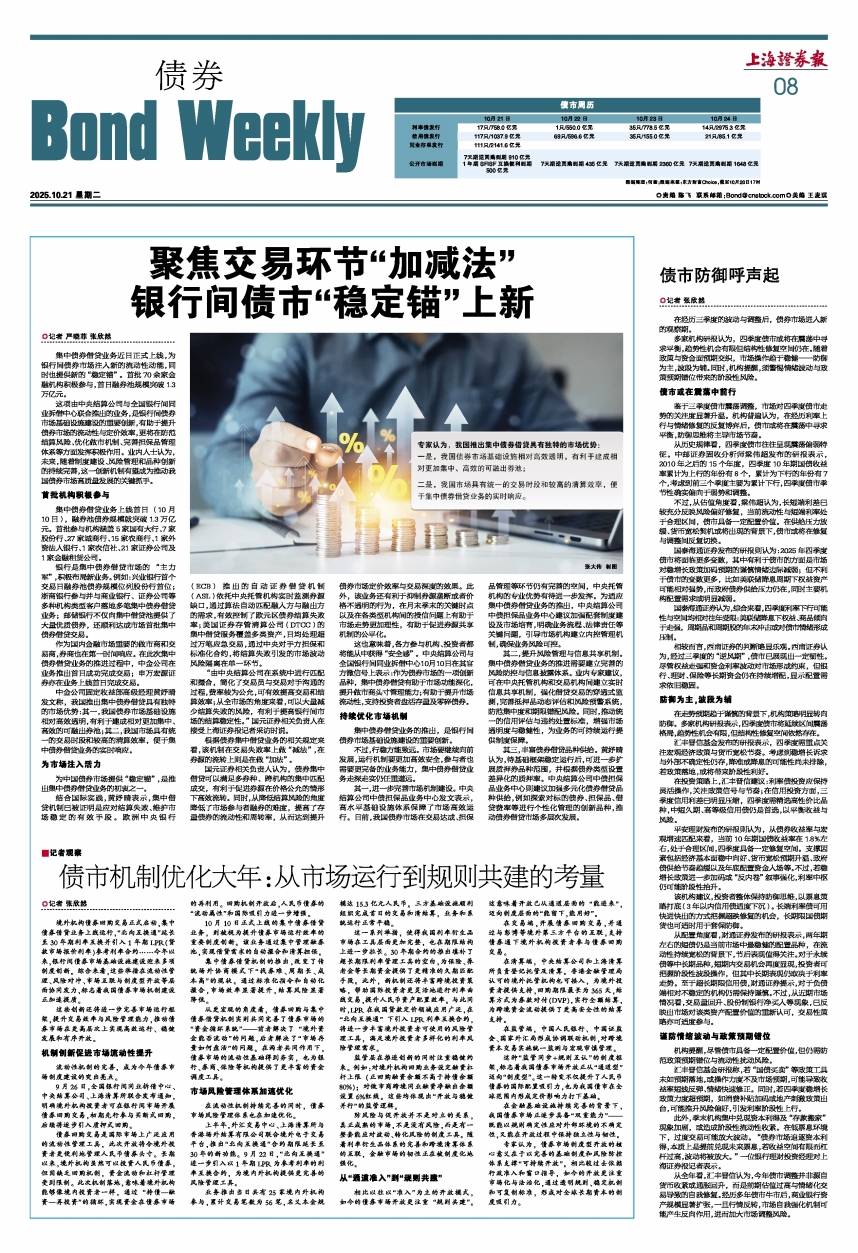
债市机制优化大年:从市场运行到规则共建的考量
Shang Hai Zheng Quan Bao· 2025-10-20 18:13
Core Viewpoint - The article discusses the significant innovations in China's bond market infrastructure, highlighting the launch of various mechanisms aimed at enhancing liquidity management, risk hedging, and market connectivity, which collectively signify an acceleration in the quality of bond market mechanisms [1][2][3]. Group 1: Mechanism Innovations - The initiation of bond repurchase transactions for foreign institutional investors marks a major step in improving liquidity management, allowing these investors to manage their RMB bond positions more effectively [2][3]. - The centralized bond lending business, launched on October 10, is seen as a crucial innovation for enhancing market efficiency by automating the matching and clearing of borrowing demands [2][3]. - Together, the bond repurchase and centralized lending mechanisms enhance the "fund circulation system" in the bond market, addressing both the flow of foreign capital and the activation of market stock [2][3]. Group 2: Risk Management System - The risk management framework in the bond market is being optimized, with the introduction of the "Northbound Swap Connect" extending to 30-year contracts and incorporating 1-year LPR as a reference rate [3][4]. - This new functionality provides a more complete set of risk management tools for domestic and foreign institutions, filling a gap in long-term interest rate management [3][4]. Group 3: Regulatory Framework - The regulatory approach emphasizes a balance between innovation and stability, with specific leverage limits set for foreign institutions engaging in repurchase transactions [4][5]. - The shift from a "channel access" model to a "rule-building" model in bond market openness indicates a more structured and sustainable approach to integrating foreign investors [5][6]. Group 4: Market Independence and Resilience - The bond market is developing a "dual capability" to respond to external uncertainties while maintaining independence and resilience during the opening process [6][7]. - The core significance of the institutional opening of the bond market lies in supporting sustainable openness through a robust foundational system and risk prevention framework [6][7].
央行:着力培育支持 科技创新的金融市场生态
Zhong Guo Zheng Quan Bao· 2025-10-19 20:16
Core Insights - The People's Bank of China emphasizes the need for a financial system tailored to the country's technological development stage, advocating for direct financing and a multi-tiered capital market to support innovation-driven growth [1][2] Group 1: Financial System Development - The development of a financial system that aligns with technological advancements is crucial for deepening supply-side structural reforms in finance [1] - The central bank aims to cultivate a financial market ecosystem that supports technological innovation, enhancing the capacity and intensity of financial support [1] Group 2: Bond Market Innovations - The introduction of the "Technology Board" in the bond market has led to significant growth in technology innovation bond financing, with approximately 670 billion yuan issued by around 280 entities in the interbank bond market [2] - The characteristics of the technology innovation bond market include a diverse range of tech enterprises, flexible issuance methods, and lower financing costs, with an average coupon rate of about 2% [2]
中国人民银行副行长邹澜 着力培育支持科技创新的金融市场生态
Shang Hai Zheng Quan Bao· 2025-10-19 18:49
Core Insights - The People's Bank of China aims to cultivate a financial market ecosystem that supports technological innovation, enhancing financial support capabilities and inviting domestic and foreign investors to participate in China's tech development [2][4] Group 1: Financial Support for Technology Innovation - Different types of technological innovation and the lifecycle stages of tech companies have varying risk characteristics and financial needs, necessitating tailored financial solutions [2] - For growth and mature-stage companies, indirect financing like bank credit can quickly respond and guide social capital towards tech sectors, while seed and early-stage companies benefit more from direct financing through capital markets [2][4] Group 2: Growth of Technology Enterprises - The number of global unicorns has increased to 1,500, with the time taken to scale operations significantly reduced, some achieving this in just four to five years [3] - Traditional bank credit struggles to provide adequate support due to mismatched risk and return, leading to reliance on equity financing such as venture capital and angel investments for rapid growth [4] Group 3: Development of Financial Systems - The support intensity and service diversity for tech SMEs have improved, with loans maintaining over 20% growth for several years, and over 2,000 "specialized, refined, unique, and innovative" companies listed on the A-share market [4] - China's bond market, now exceeding 190 trillion yuan, is the second largest globally and offers unique advantages for supporting tech innovation due to its large scale, low cost, and long duration [4][5] Group 4: Bond Market Innovations - Since the launch of the bond market "Tech Board," approximately 670 billion yuan in tech innovation bonds have been issued by around 280 entities, with diverse structures and widespread distribution across 26 provinces [5] - Nearly half of the tech companies issuing bonds have terms of three years or more, with an average bond term of 5.8 years for equity investment institutions, and an average coupon rate of about 2% [5]
存款搬家结束了吗?
Western Securities· 2025-10-19 05:31
1. Report Industry Investment Rating There is no information provided in the report regarding the industry investment rating. 2. Core Viewpoints of the Report - The slowdown of deposit relocation does not mean it has ended. Further data observation is needed as the YoY growth rate of non - bank deposits remains at a relatively high level, and there are seasonal disturbances. Asset relocation may continue due to factors such as the high economic base and trade frictions in Q4 [2][14] - The bond market is likely to remain weakly volatile. A defensive approach is recommended, with control over the duration level, and seizing allocation and trading opportunities after adjustments [3][15] 3. Summary by Relevant Catalogs 3.1 Review Summary and Bond Market Outlook - This week, the bond market showed a "first decline then rise" trend. The 10Y and 30Y Treasury bond rates changed by +0.4bp and -3bp respectively. Market sentiment was affected by factors such as US - China negotiation signals, stock market trends, and economic data [10] - Deposit relocation accelerated in July and August but slowed down in September. It is still too early to conclude that it has ended [11][14] - The bond market is expected to be weakly volatile. It is recommended to focus on defense, control the duration, and choose to allocate certificates of deposit and short - term interest - rate bonds [15] 3.2 Bond Market Review 3.2.1 Fundamentals - The central bank had a net withdrawal this week, and the capital interest rate increased. Next week, the maturity volume of reverse repurchases is less than that of the previous week [16] - The R001 and DR001 increased by 5bp and 1bp respectively compared to October 11th. The 3M certificate of deposit issuance rate first rose, then fell, and then rose again [18] 3.2.2 Secondary Market Trends - Bond yields first rose and then fell. Except for the 7Y, 20Y, and 30Y Treasury bonds, the yields of other key - term Treasury bonds increased. Most of the term spreads of Treasury bonds narrowed [26] - The spread between new and old 10Y Treasury bonds first widened and then narrowed, the spread of 10Y China Development Bank bonds widened negatively, and the spread of 30Y Treasury bonds narrowed [29][30] 3.2.3 Bond Market Sentiment - The median duration of the full - sample bond funds slightly increased. The turnover rate of ultra - long bonds increased, and the 30Y - 10Y Treasury bond spread narrowed rapidly. The inter - bank leverage ratio rose to 107.6%, and the exchange leverage ratio decreased to 122.4%. The implied tax rate of 10 - year China Development Bank bonds slightly narrowed [33] 3.2.4 Bond Supply - This week, the net financing of interest - rate bonds decreased. Next week, the issuance scale of Treasury bonds will increase, and the 10Y Treasury bond 250016.IB will be re - issued. The issuance scale of local government bonds will also increase [48][51] - The net financing of certificates of deposit increased this week, and the average issuance rate rose to 1.63% [53] 3.3 Economic Data - In September, the import and export growth rates significantly rebounded, and prices generally recovered. The YoY decline of the freight rate index slowed down in October, and industrial production improved marginally [59][60] - The YoY growth rate of non - bank deposits declined in September, and the M1 growth rate increased [60] 3.4 Overseas Bond Market - The release of key US inflation data was postponed due to the government "shutdown." The expectation of a Fed rate cut in October has increased again, mainly due to the weak employment market [69] - US bonds rose, and most emerging markets had more gains than losses [70] 3.5 Major Asset Performance - The Shanghai Gold Index performed the best, followed by Chinese - funded US dollar bonds, Chinese bonds, the US dollar, convertible bonds, Shanghai Copper, rebar, the CSI 300 Index, live pigs, the CSI 1000 Index, and crude oil [74] 3.6 Policy Review - On October 17th, multiple policies were introduced, including promoting logistics cost reduction, expanding green trade, adjusting the Hainan duty - free shopping policy, and more. These policies aim to support economic development and stabilize market expectations [77][82]