证券业

Search documents
每周大类资产配置图表精粹-20250812
Huachuang Securities· 2025-08-12 05:51
Group 1: Monetary Policy and Economic Indicators - The Federal Reserve's financial pulse growth index (FCI-G Index) for 1-year dropped to -0.4, the lowest since July last year, indicating strong monetary policy support for corporate output and employment[4] - The 3-year FCI-G Index fell to -0.7, the lowest since April 2022, suggesting that the necessity for rate cuts this fall is not as pressing as last year[4] - As of August 8, the S&P 500 index EPS growth reached 10%, significantly exceeding the expected 4%, reflecting robust U.S. economic growth[7] Group 2: Market Positioning and Speculation - Broad dollar speculative net positions shifted from short to long, with net long positions reaching 31,000 contracts, the highest since April this year[7] - The speculative net short positions in S&P 500 mini contracts decreased to 119,000, a two-month low, after a significant increase in July[10] - The overall credit standards of U.S. commercial banks marginally eased, with the percentage of banks tightening credit for large enterprises dropping from 18.5% to 9.5%[15] Group 3: European Economic Conditions - The European Central Bank has cut rates three times this year, yet broad credit and bank lending in the Eurozone have not expanded significantly, with M3 growth dropping to 3.3%, the lowest since September last year[13] - The Eurozone's non-financial corporate credit growth fell to 2.3%, indicating a need for further ECB rate cuts[13] Group 4: Risk Premium and Investment Returns - The equity risk premium (ERP) for the CSI 300 index is at 5.1%, one standard deviation above the 16-year average, suggesting potential for valuation uplift[17] - The forward arbitrage return for China's 10-year government bonds is 19 basis points, 49 basis points higher than December 2016 levels, indicating attractive returns[21] - The total return ratio of domestic stocks to bonds is 25.1, above the 16-year average, enhancing the appeal of equity assets over fixed income[29]
大类资产周报:资产配置与金融工程美联储降息预期增强,全球权益市场共振上行-20250812
Guoyuan Securities· 2025-08-12 03:42
Market Overview - The market's risk appetite has significantly improved, with the probability of a Federal Reserve rate cut in September rising to 94%[4] - The Nasdaq led the gains with an increase of 3.87%, while gold prices rose by 1.72% due to geopolitical tensions and tariffs[4] - Brent crude oil experienced a sharp decline of 4.81%[4] Asset Allocation Recommendations - Fixed Income: Favor high-grade credit bonds and adjust duration flexibly, focusing on bank and insurance sector movements[5] - Overseas Equities: Suggest long-term investment opportunities in the US tech sector, particularly AI, given the resilience of economic data[5] - Gold: Strengthened as a safe-haven asset due to geopolitical conflicts and economic slowdown, serving as a hedge against inflation[5] - A-shares: Current liquidity supports the market, but valuation pressures are evident; focus on low-valuation sectors[5] - Commodities: Overall underweight due to weak supply and demand; consider opportunities in new energy sectors[5] Risk Factors - Policy adjustment risks, market volatility risks, geopolitical shocks, economic data validation risks, and liquidity transmission risks are highlighted[6]
易方达上证科创板综合增强策略交易型开放式指数证券投资基金基金份额发售公告
Shang Hai Zheng Quan Bao· 2025-08-11 19:02
Group 1 - The fund is named "E Fund Shanghai Stock Exchange Science and Technology Innovation Board Comprehensive Enhanced Strategy ETF" and is a type of open-ended index fund [23] - The fund will be available for subscription from August 18 to August 22, 2025, with both online and offline cash subscription options [2][23] - The maximum fundraising scale for the fund is set at 2 billion RMB, excluding interest and subscription fees [5][23] Group 2 - Investors must have a Shanghai Stock Exchange A-share account or a securities investment fund account to subscribe to the fund [3][44] - The subscription fee for the fund will not exceed 0.80% of the subscribed amount [4][28] - The fund's investment objective is to pursue returns that exceed the performance benchmark while controlling the average tracking deviation and annualized tracking error [24][25] Group 3 - The fund's underlying index is the Shanghai Stock Exchange Science and Technology Innovation Board Comprehensive Index, which includes stocks listed on the Science and Technology Innovation Board [12][13] - The fund will be managed by E Fund Management Co., Ltd., with Ping An Bank as the custodian [1][64] - The fund's shares will be issued at an initial value of 1 RMB per share [23]

陶冬:对于经济是否陷入衰退,美股美债产生巨大分歧
Di Yi Cai Jing· 2025-08-11 02:45
Core Viewpoint - There is a significant divergence between the stock and bond markets regarding the future economic outlook, which is rare in recent years [1][2]. Group 1: Economic Indicators - The U.S. non-farm payroll data for July showed only 73,000 jobs added, marking the worst performance since the pandemic, leading to heightened recession concerns [1][2]. - The 5-year Treasury yield indicates a 60% recession risk, while the S&P 500 reflects only an 8% probability, and high-yield credit markets suggest a mere 6% chance of recession [2]. Group 2: Market Reactions - U.S. stocks have continued to rise, primarily driven by a few AI-themed tech giants, while the broader S&P 500 performance remains mediocre [2]. - The bond market has seen a significant influx of funds into high-yield corporate bonds, indicating a different sentiment compared to the stock market [1][2]. Group 3: Federal Reserve Policy - The Federal Reserve's interest rate policy is under strong influence from the White House, with expectations of potential rate cuts due to deteriorating employment conditions [2][4]. - The nomination of Milken to the Federal Reserve Board could increase the likelihood of a rapid resumption of rate cuts, with predictions of at least two to three cuts before January [4]. Group 4: Global Economic Context - The European Central Bank has aggressively cut rates this year, nearing neutral levels, while the U.S. may see a contrasting trend in interest rates, affecting capital flows and exchange rates [5]. - Upcoming focus includes U.S.-China trade negotiations and inflation data, which are expected to rise due to tariff impacts [5].
什么信号?又要征税了!
Sou Hu Cai Jing· 2025-08-11 01:45
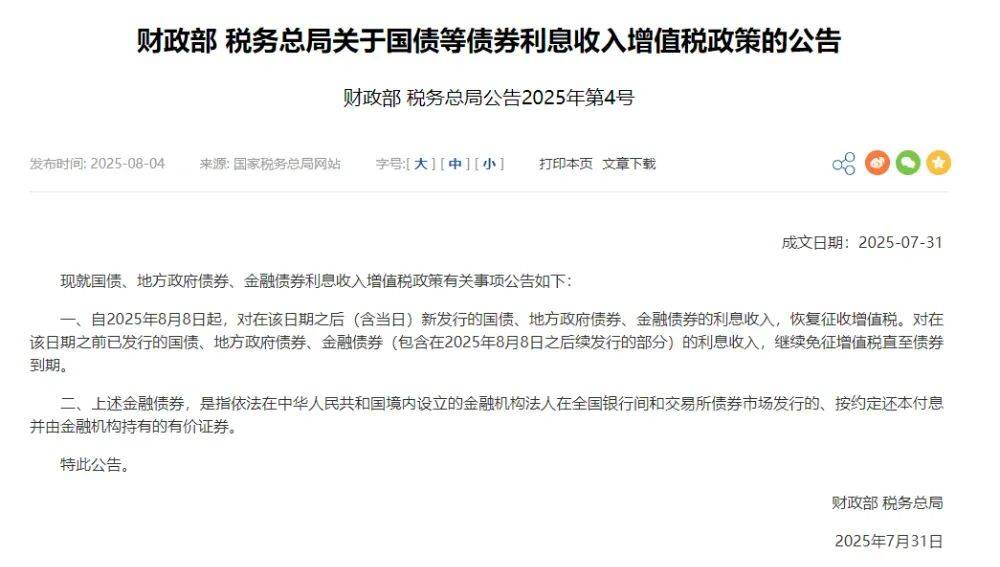
Core Viewpoint - The Chinese government will reinstate value-added tax (VAT) on interest income from newly issued government bonds, local government bonds, and financial bonds starting from August 8, 2025, while existing bonds issued before this date will remain exempt from VAT until maturity [1][3]. Group 1: Tax Policy Changes - The VAT rates are set at 6% for financial institutions (e.g., banks, insurance companies) and 3% for asset management products (e.g., public funds, brokerage asset management) [3][4]. - For example, a newly issued 1 million yuan 10-year government bond with a coupon rate of 1.7% will yield an annual interest of 17,000 yuan, leading to a tax liability of 1,020 yuan for banks and 510 yuan for public funds [4][6]. Group 2: Impact on Different Investors - The policy primarily affects institutional investors, particularly banks, which hold 70% of government debt, as they will face increased tax burdens [6][7]. - Individual investors, whose monthly interest income from government bonds is below the 100,000 yuan tax exemption threshold, will not be affected by the VAT [6][8]. Group 3: Rationale Behind the Policy - The reinstatement of VAT is aimed at addressing the overheating of the bond market, which has grown from 63 trillion yuan to 183 trillion yuan over the past decade, and to restore fairness between interest-bearing bonds and credit bonds [7][8]. - The government is also facing rising fiscal pressures, particularly due to declining land sale revenues, necessitating new tax revenues, which could amount to 34 billion yuan in the short term and potentially reach 100 billion yuan annually in the long term [7][8]. Group 4: Economic Implications - The tax on bond interest is seen as a mechanism to encourage funds to flow out of low-risk assets like government bonds and into equities, real estate, and consumption, thereby stimulating the economy [8][9]. - The policy signals potential future tax reforms, including the introduction of inheritance tax, capital gains tax, and property tax, as part of broader fiscal strategies [8][12].

【申万固收|利率】恢复买债或渐行渐近——暨6-7月流动性深度复盘与8月流动性展望
Xin Lang Cai Jing· 2025-08-11 01:39
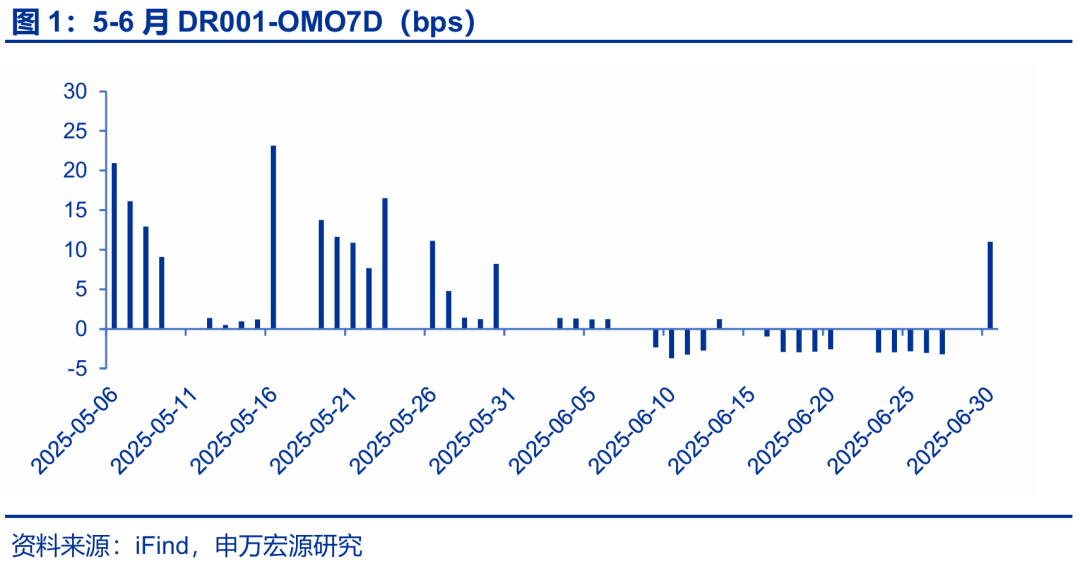
Group 1 - June liquidity was unexpectedly stable and loose, with the average DR001 at 1.39%, down 11bps from May, and 14 out of 20 working days below the policy rate [2][4] - The People's Bank of China (PBOC) conducted two unexpected reverse repos in June, totaling 10,000 billion yuan, to stabilize the market ahead of significant bond issuances [2][3] - The liquidity situation in June was supported by the arrival of 520 billion yuan in capital injections from four major banks, and the exchange rate of the US dollar against the yuan faced appreciation pressure [3][10] Group 2 - July maintained a loose liquidity stance, with the average DR001 remaining at 1.39%, but experienced significant volatility, with a range of 34bps [16][17] - The liquidity tightening in mid-July was attributed to tax payment periods and market concerns about the PBOC's stance, which were alleviated by a neutral to friendly tone from the PBOC [16][18] - The bond market's performance influenced liquidity, with a notable adjustment in the bond market during the week of July 21-25, leading to a temporary tightening of liquidity [18][21] Group 3 - August is expected to see a return to stable and loose liquidity, supported by significant government bond net supply, with estimated net financing of 1.47 trillion yuan [24][25] - The PBOC's decision to reinstate value-added tax on new bond interest income is seen as a potential negative for new bond pricing, emphasizing the importance of managing issuance costs [25][26] - The potential for the PBOC to resume bond purchases in August is being closely monitored, with several conditions indicating a possibility for such actions [32][33]
存取款超5万,需说明“来源”和“用途”?央行等三部门发文
Sou Hu Cai Jing· 2025-08-11 01:16
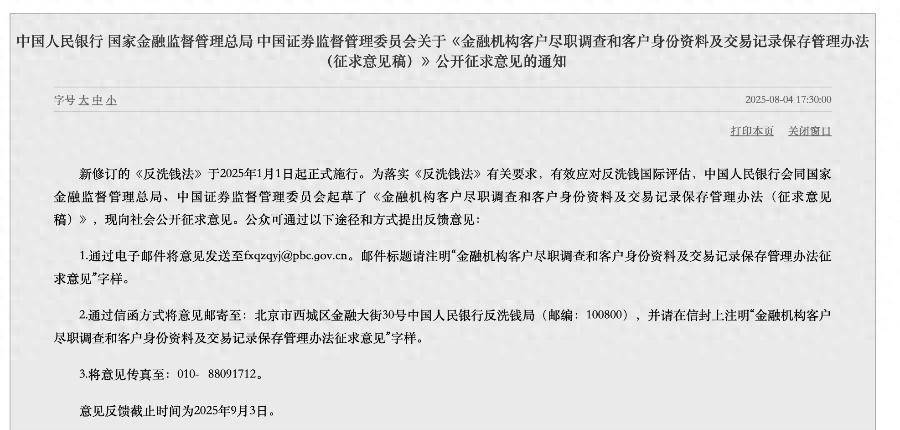
Core Viewpoint - The People's Bank of China, along with the National Financial Regulatory Administration and the China Securities Regulatory Commission, has released a draft regulation for public consultation regarding customer due diligence and the management of customer identity information and transaction records, with the consultation period running from August 4 to September 3 [1]. Group 1 - The most notable change in the new regulation is the removal of the mandatory requirement from the 2022 regulatory rules that required individuals to "understand and register the source or purpose of funds" for cash transactions exceeding 50,000 yuan [2]. - Financial institutions are still required to conduct due diligence and register basic customer identity information for one-time transactions exceeding 50,000 yuan, such as cash remittances and physical precious metal transactions, and to retain copies of valid identification documents [2]. Group 2 - The 2022 regulation regarding cash transactions over 50,000 yuan had sparked widespread social controversy, with public opinions divided on its implications [3][4]. - Some viewed the requirement as cumbersome and a potential invasion of privacy, while supporters argued it was necessary to combat money laundering and maintain financial security [4]. - The regulation was initially set to take effect on March 1, 2022, but was postponed due to "technical reasons," and related transactions continued under previous rules [4]. - The draft regulation is seen as a necessary step to implement the Anti-Money Laundering Law and prepare for an upcoming international assessment in late 2023, which will evaluate China's anti-money laundering efforts [4].
招商宏观:资产风格或将迎来拐点
Sou Hu Cai Jing· 2025-08-11 00:54
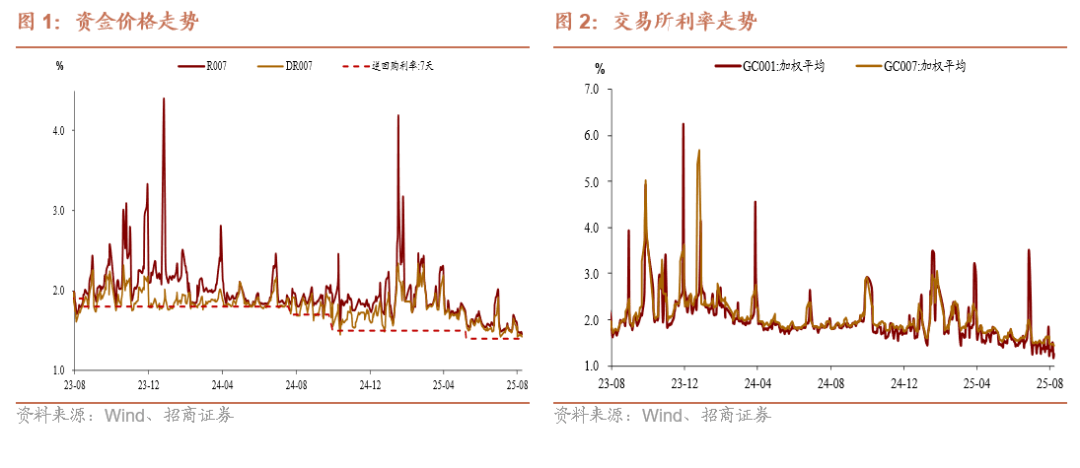
Domestic Economic Data - The first phase of anti-involution may lead to a decline in the operating rate of the midstream sector to levels seen in the past two years, with a noticeable adjustment already occurring [1][3] - Since July, the sales of commercial housing in 30 major cities have consistently been lower than last year [1][3] - The sharp drop in port throughput in the first week of August indicates the end of the export rush that began in July [1][3] Asset Market Insights - Liquidity may be approaching a short-term bottleneck, with DR007 currently at around 1.45%, indicating short-term pressure on liquidity-sensitive assets [1][3] - The market generally expects the Federal Reserve to restart interest rate cuts in the second half of the year, which may not be followed by China [1][3] - As the China-U.S. interest rate differential narrows and the PPI year-on-year bottoms out, domestic assets may shift from a barbell strategy to focus on inflation and domestic demand [1][3] Overseas Economic Developments - On August 7, Trump nominated Stephen Moore to the Federal Reserve Board, indicating a potential MAGA trend within the Fed, which could pave the way for future rate cuts [2][4] - Recent dovish statements from Federal Reserve officials suggest that if the July CPI meets market expectations, a hint of rate cuts may be given at the Jackson Hole global central bank meeting on August 21-23 [2][4] - The market has already fully priced in a 25 basis point rate cut at the September FOMC meeting [2][4] Trade and Inflation Data - In July, China's exports were valued at $321.78 billion, a year-on-year increase of 7.2%, while imports were $223.54 billion, up 4.1%, resulting in a trade deficit of $98.24 billion, which is a 14.93% increase year-on-year [9][10] - The CPI for July was flat year-on-year at 0.0%, while the PPI fell by 3.6% year-on-year, indicating ongoing deflationary pressures in the industrial sector [10] Monetary Market Overview - The overall liquidity remained loose, with the benchmark interest rate rising by approximately 0.09 basis points [12] - The average weekly value of DR001 decreased by 5.586 basis points to 1.3142%, while DR007 fell by 8.246 basis points to 1.4457% [13] - Government bond issuance pressure has significantly decreased, with a planned issuance of 351.43 billion yuan next week, down from 634 billion yuan this week [14]
熊猫债市场持续拓展
Jing Ji Ri Bao· 2025-08-10 22:02
Core Insights - Panda bonds are an important channel for offshore institutions to raise funds in RMB, with a steady increase in the number of issuers and types, including international development institutions, foreign governments, offshore financial institutions, and non-financial enterprises [1][4] - The issuance of panda bonds has seen significant growth, with a total issuance scale of 111.2 billion RMB in the interbank market this year, where foreign government institutions, international development institutions, and multinational enterprises accounted for 50% of the issuance, an increase of 27 percentage points compared to the entire year of 2024 [1] Group 1: Recent Developments - The Asian Infrastructure Investment Bank (AIIB) returned to the Chinese bond market, issuing a 2-year panda bond that raised 2 billion RMB with a coupon rate of 1.64%, achieving a record high subscription of 6.4 billion RMB, which is 3.2 times oversubscribed [2] - Morgan Stanley successfully issued a panda bond of 2 billion RMB with a 5-year term and a coupon rate of 1.98%, marking the first panda bond issued by a US-based company [2] - Hungary has become the largest foreign government issuer of panda bonds, successfully issuing 4 billion RMB in 3-year and 1 billion RMB in 5-year bonds, with coupon rates of 2.5% and 2.9% respectively [3] Group 2: Market Expansion - The panda bond market is experiencing internationalization, with participation from various foreign governments and financial institutions, including South Korea, Poland, and Egypt, which have collectively issued 35.46 billion RMB in panda bonds [4] - The continuous opening of cross-border investment and financing, along with the expansion of the RMB cross-border payment system, is expected to attract more sovereign institutions and offshore enterprises into the panda bond market, enhancing economic connectivity between China and the global economy [5]

债市“反内卷”遏制低价竞争承销新规紧抓成本“牛鼻子”
Shang Hai Zheng Quan Bao· 2025-08-10 17:40
Core Viewpoint - The China Interbank Market Dealers Association has introduced new underwriting pricing regulations to prohibit lead underwriters from participating in bond project bidding with fees below cost, aiming to address long-standing issues of vicious low-price competition in the market, particularly in the financial bond sector [2][3][7]. Summary by Relevant Sections Regulatory Changes - The new regulations require lead underwriters to refrain from bidding below cost and to regularly report detailed underwriting cost data [3][7]. - Six main measures have been established, including the creation of internal pricing management systems, reasonable cost calculations covering the entire process, and stricter penalties for low-price competition [3][4]. Market Context - The recent low-price bidding incident involving Guangfa Bank's secondary capital bond underwriting has triggered these regulatory changes, highlighting the prevalence of below-cost bidding in the market [5][6]. - The bidding results showed that some institutions quoted service fees as low as 700 yuan for a project worth 35 billion yuan, indicating a fee rate of only 0.000002% [5][6]. Industry Impact - Industry insiders view the new regulations as a critical action against "involution" in the bond underwriting market, aiming to restore a rational pricing mechanism and improve service quality [4][7]. - The regulations are expected to create a "three-way check" system among issuers, underwriters, and regulatory bodies, enhancing market discipline [3][6]. Future Outlook - While the new rules signal a positive step towards curbing below-cost competition, the effectiveness of these measures remains to be seen, especially given the complex market dynamics and the large scale of financial bonds [7][8]. - The industry currently lacks precise cost measurement methods, relying more on estimations based on previous years' data, indicating that establishing a scientifically sound cost benchmark will require further efforts [8].