新能源车

Search documents
“以旧换新”政策显效 新能源车置换热潮涌动
Zhong Guo Zheng Quan Bao· 2025-05-19 20:42
Core Insights - The "trade-in for new" policy in China is significantly boosting the automotive market, with a reported 10 million applications for subsidies, indicating strong consumer interest and activity in the sector [1][4]. Group 1: Policy Impact - The "trade-in for new" policy has led to a notable increase in consumer activity, with the Ministry of Commerce reporting over 10 million applications for subsidies, including 3.225 million applications in 2025 alone [4]. - The policy has effectively stimulated consumption growth, green transformation, and resource recycling, with over 53% of trade-ins involving new energy vehicles [4]. Group 2: Consumer Behavior - Many consumers are opting to trade in their old vehicles for new energy vehicles, with a significant number of trade-ins coming from brands like Mercedes-Benz, BMW, and Audi [3]. - Discounts and subsidies are making new energy vehicles more attractive, with some consumers reporting total savings of up to 34,000 yuan when trading in for models like the Li Auto L6Pro [2]. Group 3: Company Performance - Companies like Li Auto have seen a substantial increase in trade-in orders, with over 10,000 orders reported as of May 18, and the Li L6 model being particularly popular [5]. - Xiaopeng Motors and Leap Motor have also experienced rapid sales growth, with Xiaopeng breaking traditional seasonal sales patterns and Leap Motor increasing monthly sales from 10,000 to 40,000 units since the policy's implementation [6]. Group 4: New Product Launches - The automotive industry is actively launching new models to attract consumers, with companies like Xiaomi, Great Wall, and NIO introducing new vehicles to enhance market offerings [7]. - NIO plans to release nine new models this year, with significant promotional offers for early reservations, indicating a competitive push in the market [7].
4月经济数据表现与资产指向
2025-05-19 15:20
Summary of Key Points from the Conference Call Industry Overview - The conference call discusses the macroeconomic performance of China in April 2025, highlighting the resilience of the economy despite external pressures such as U.S. tariffs on Chinese goods [1][2]. Core Economic Insights - China's actual GDP growth in April 2025 is approximately 5.5% year-on-year, indicating strong economic fundamentals that support the annual growth target [1][2]. - The production sector continues to show robust growth, particularly in high-tech industries such as high-end equipment manufacturing, integrated circuits, industrial robots, and the new energy vehicle supply chain [1][3]. - Consumer retail sales growth is around 5% year-on-year, with notable performance in new products, although goods consumption is currently stronger than services consumption [1][5]. - The real estate sector shows signs of stabilization, with new home sales and prices stabilizing, although supply-side indicators are declining [1][6]. - Investment growth has slightly decreased, with manufacturing investment remaining resilient, but the electronics sector is impacted by tariffs [1][7]. Production Sector Analysis - The production sector maintains strong growth, with industrial value-added growth remaining above 6%, despite a slight decline due to base effects [3]. - High-tech industries are expanding, and the overall macro environment is improving, which may help mitigate the impact of U.S. tariffs [3][9]. Consumer Sector Trends - The consumer sector continues to show structural characteristics, with significant growth in new products exceeding 20% [5]. - The expectation is that service consumption will gradually become a key support for domestic demand in the second half of the year [5]. Real Estate Sector Performance - The real estate demand is stabilizing, with new home sales and prices showing a stabilizing trend, although the supply side is experiencing a downturn [6]. Investment Sector Insights - Investment growth has slightly declined due to a decrease in real estate and marginal cooling in infrastructure and manufacturing investments [7][8]. - Infrastructure investment remains strong, particularly in new infrastructure areas such as data centers and artificial intelligence [8]. Capital Market Signals - Recent financial policies indicate a continuous supportive tone, suggesting that 2025 may be a turning point for China's macroeconomic narrative [10][12]. - The cyclical factors that have suppressed China's economy and equity performance are nearing an end, with positive changes emerging in structural factors [12]. Potential Investment Opportunities - Future investment opportunities may arise from three main areas: technological breakthroughs, confirmation of economic stability, and global economic structural changes [11]. - The overall outlook suggests that despite tariff impacts, improvements in domestic demand and new trade dynamics will support economic resilience and potential revaluation in the capital market [11][12].
放过小米和雷军吧
Sou Hu Cai Jing· 2025-05-19 11:48
小米不是完美的企业,雷军不是完美的企业家,雷军太会营销,所以有些人看不惯他,这很 正常。但是,我们需要小米这样的企业一直在场,一直努力,参与行业竞争。 作者:今纶 众所周知,因为此前的一场车祸,小米陷入舆论的滔天巨浪之中,然后就是超时加班、限制马力以及碳 纤维双风道前舱盖的争议。关于后者,小米已经道歉,关于车祸,大家还在等结果。 今天,雷军又发了微博,公布"我们终于交出了第一份答卷:小米玄戒O1,采用第二代3nm工艺制程, 力争跻身第一梯队旗舰体验"。 接下来就是22日的小米发布会。 我首先说明一下:我不是米粉,我的手机、电脑、车都不是小米品牌,但是我尊重所有人选择小米产品 的权利,我尊重任何人选择任何合规合法产品的权利。 另外,我和我所在的机构没有和小米公关、品牌有任何合作,所以,不存在所谓洗白。 只是,有些事情不吐不快。 小米前段时间那起车祸,我们的表态是"等待最终调查结果再发言",因为我们既没有第一手的资料,也 不是熟悉新能源车技术的团队,因此,等是唯一靠谱的选择。 不少大V在网上讨论得热火朝天,很多网民也说得头头是道,说实话,我们很佩服,同时很困惑:你们 说的靠谱吗?也许吧。 我们这些非新能源车领域的 ...



恒生科技指数调入比亚迪,什么信号?
Jin Rong Jie· 2025-05-19 06:32
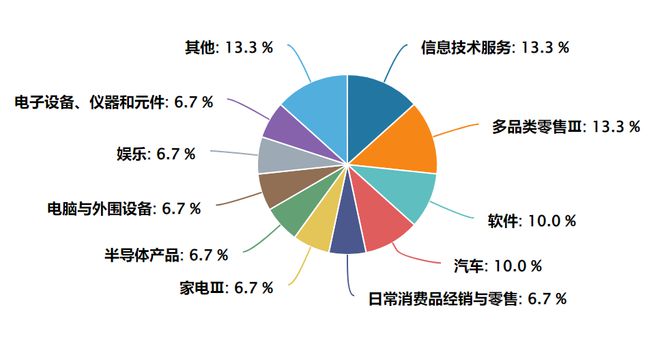
Group 1 - The Hang Seng Index Company announced the quarterly review results, removing Tencent from the Hang Seng Tech Index and adding BYD, indicating a shift towards the automotive sector within the index [1] - The current proportion of the automotive industry in the Hang Seng Tech Index is 10%, which will increase to over 20% with the inclusion of BYD and other automotive-related companies [1][3] - The Hang Seng Tech Index is expected to benefit from the growing trend of electric vehicles, as evidenced by the accelerated capital inflow into the automotive sector [3] Group 2 - The Hong Kong Tech Index has a higher exposure to the automotive sector at 16% and also includes a significant allocation to pharmaceuticals, which enhances its performance compared to the Hang Seng Tech Index [3][5] - Major tech companies in Hong Kong, such as Tencent and Alibaba, reported substantial profit growth, with Alibaba's net profit increasing by 273%, reflecting the high growth potential in the semiconductor and new energy sectors [5] - The median market capitalization of index constituents is HKD 43.2 billion, with over 50% being small and mid-cap tech leaders, indicating potential for higher earnings elasticity during the AI application phase [7] Group 3 - The Hong Kong Tech Index has shown a higher stage increase compared to the Hang Seng Tech Index, with a year-to-date increase of 23.22% versus 18.20% for the latter [8] - The Hong Kong Tech sector is characterized by low valuations, high sensitivity, and significant growth potential, making it an attractive investment opportunity [8] - The Hong Kong Tech 50 ETF is available for T+0 trading, providing a diversified investment option in internet technology, new energy vehicles, and biotechnology [9]

电力设备与新能源行业周报:输美锂电及储能系统或掀囤货潮,光伏供给侧困境反转见曙光
SINOLINK SECURITIES· 2025-05-19 03:00
Investment Rating - The report maintains a positive investment outlook on the photovoltaic and energy storage sectors, highlighting key companies such as Sungrow Power and Canadian Solar for continued recommendation [2][5]. Core Insights - The photovoltaic industry is transitioning from a state of excess supply to a more balanced market, driven by both policy support and self-initiated industry adjustments. The easing of US-China trade relations is expected to benefit large-scale energy storage [2][5]. - The wind power sector is witnessing significant contract wins, such as a €1 billion order for offshore wind foundations, indicating a robust pipeline for future projects [5][6]. - The electric grid sector is advancing with the integration of artificial intelligence, as outlined in the State Grid's white paper, which aims to enhance the digital transformation of the power industry [7][8]. Photovoltaic & Energy Storage - The photovoltaic sector is showing signs of recovery, with government policies aimed at addressing structural issues. The focus is shifting from forced interventions to voluntary industry cooperation [5]. - Key developments include the issuance of manufacturing standards by the Ministry of Industry and Information Technology and ongoing discussions about supply-side reforms [5]. - Companies to watch include Sungrow Power and Canadian Solar, which are expected to benefit from improved market conditions and technological advancements [5]. Wind Power - Major contracts, such as the €1 billion order from a European energy company, highlight the growth potential in the offshore wind market [5][6]. - The report anticipates nearly 20 GW of offshore wind projects to be tendered between 2025 and 2026, indicating a strong future demand for wind power infrastructure [5][6]. Electric Grid - The State Grid's white paper emphasizes the integration of AI in power production, which is expected to support the construction of a new type of power system [7][8]. - The upcoming high-voltage direct current projects are projected to commence in December 2025, reinforcing the growth trajectory of the electric grid sector [8]. New Energy Vehicles & Lithium Batteries - The report notes a decline in year-on-year growth for new energy vehicles, with a current growth rate of approximately 5%. However, a month-on-month increase of 30% indicates seasonal fluctuations are normal [3][9]. - The reduction of tariffs on lithium batteries is expected to boost exports to the US, with significant developments in solid-state battery technology being reported by companies like BETTERRY and Guoxuan High-Tech [3][11]. Hydrogen and Fuel Cells - The development of green liquid fuels is gaining momentum, with pilot projects being initiated in Jiangsu province to support the hydrogen economy [10][12]. - The report highlights the establishment of hydrogen highways, which are expected to facilitate the adoption of hydrogen vehicles and meet the goals set for the 14th Five-Year Plan [8][12].





港股科技ETF(513020)跌近1.5%,网罗港股互联网+医药+硬科技龙头,外资爆买港股互联网龙头
Mei Ri Jing Ji Xin Wen· 2025-05-19 02:18
Group 1 - The core viewpoint of the article highlights a decline in Hong Kong's technology sector, with significant drops in popular concepts such as automobiles, industrial machinery, computers, and robotics, while the Hong Kong Technology ETF (513020) fell nearly 1.5% [1] - Foreign capital has significantly increased its holdings in Hong Kong's internet leaders, with Bridgewater Associates reporting a purchase of over 5.4 million shares of Alibaba, marking a 21-fold increase, making it the fourth largest holding [1] - Bridgewater's total assets under management reached $21.6 billion, reflecting a quarter-over-quarter increase of 1.47% [1] Group 2 - Shenwan Hongyuan maintains a positive outlook on Hong Kong stocks compared to A-shares, suggesting that Hong Kong is at the forefront of China's asset revaluation, particularly in the AI industry chain, new consumption, and innovative pharmaceuticals [1] - The Hong Kong Technology ETF (513020) tracks the CSI Hong Kong Stock Connect Technology Index, which includes core technology sectors such as the internet, new energy vehicles, and biomedicine, representing the overall investment value of Chinese technology assets [1] - The Hong Kong Stock Connect Technology Index is more balanced in its technology sector allocation compared to the Hang Seng Technology Index, allowing for better investment opportunities in growth sectors [1]

A股分析师前瞻:“欠配板块”上涨!公募新规会如何影响市场风格?
Xuan Gu Bao· 2025-05-18 23:59
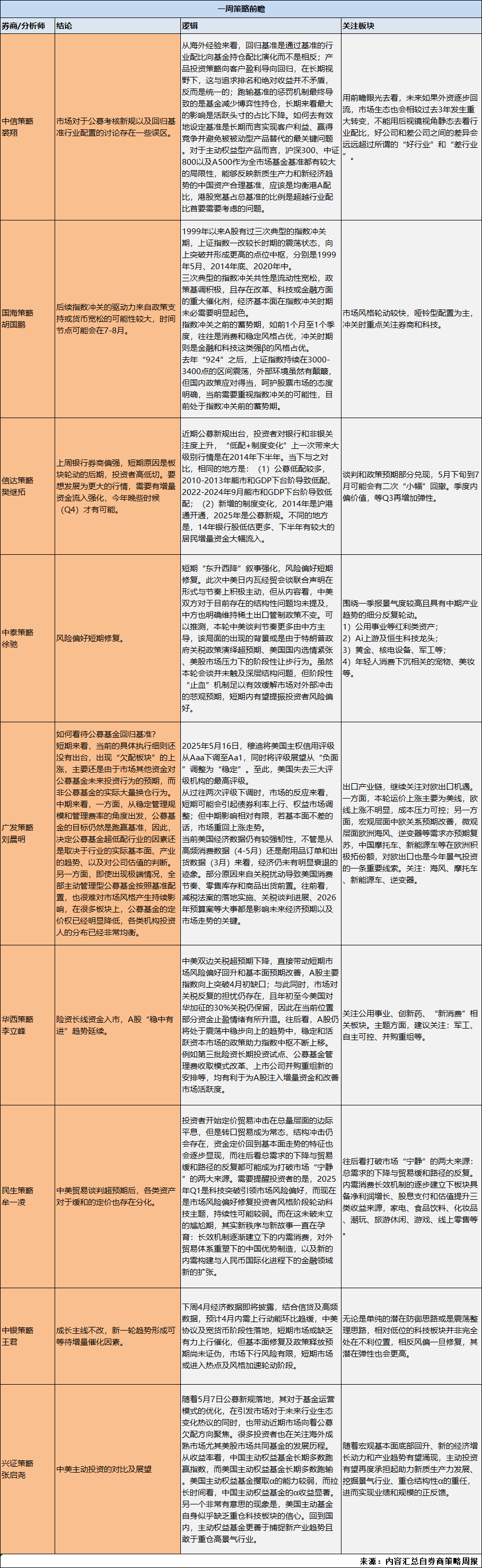
Group 1 - The current discussions among brokerages focus on the new public fund assessment regulations rather than clear predictions for index movements [1][2] - The expectation of future investment behavior by public funds is influencing the rise of "underweight sectors," rather than actual large-scale portfolio adjustments by these funds [1][3] - The market is expected to remain in a trend of steady upward movement despite concerns over fluctuating tariffs and profit-taking sentiments [1][2] Group 2 - The upcoming April economic data is anticipated to show a slowdown in domestic demand momentum, with limited upward catalysts for the market in the short term [2][5] - The market may enter a phase of accelerated rotation of hotspots and styles, with limited downside risks due to ongoing fundamental recovery and policy expectations [2][5] - The new public fund regulations are expected to optimize fund operation models, leading to discussions about future industry ecological changes [5] Group 3 - The market's risk appetite has improved due to unexpected decreases in US-China tariffs, which has positively impacted A-share indices [1][3] - The public fund's goal remains to outperform benchmarks, with decisions on sector allocations influenced by actual fundamentals and valuation judgments [1][3] - The active management of public funds is likely to evolve towards a more balanced allocation, reflecting the distribution of various institutional investors [1][3]
电力设备行业周报:Q2海风密集交付,贝特瑞发布固态电池解决方案
GOLDEN SUN SECURITIES· 2025-05-18 15:45
Investment Rating - Maintain "Buy" rating for the electric equipment industry [6] Core Views - The report highlights the ongoing decline in silicon wafer prices, with significant reductions in production rates due to weak downstream demand. The industry operating rate has dropped to approximately 55% [15][16] - The report emphasizes the importance of supply-side adjustments and the potential for price stabilization in the future, particularly focusing on companies like Xiexin Technology, Tongwei Co., and Flat Glass Group [15] - The report also discusses the growth opportunities in new technologies, recommending companies such as Aiko Solar and Juhe Materials [15] Summary by Sections New Energy Generation - **Photovoltaics**: The average transaction price for N-type G10L monocrystalline silicon wafers is 0.95 RMB/piece, with a week-on-week decline of 5.94%. The N-type G12R and G12 wafers have also seen price drops of 1.79% and 3.70%, respectively [15][16] - **Wind Power & Grid**: The report notes the commencement of wind turbine bidding for the Huaren Shantou Honghai Bay project, with a total capacity of 500MW. The report also highlights the successful installation of the first wind turbine for the 800MW offshore wind project in Jiangsu [16] - **Hydrogen Energy**: A green hydrogen project in Gansu is set to produce over 10,000 tons annually, aiming to reduce CO2 emissions by approximately 300,000 tons [17] Energy Storage - The average bidding price for energy storage systems in May is reported to be between 0.422 RMB/Wh and 2.29 RMB/Wh, with a focus on companies with high growth certainty in large-scale storage [18][23] New Energy Vehicles - The report discusses the launch of solid-state battery solutions by Better Ray, which includes high-nickel cathode materials and silicon-based anodes. The company has developed a high-performance three-dimensional framework material for solid-state batteries [27][30] - The report recommends focusing on leading companies in the lithium battery sector, such as CATL and BYD, as well as those involved in the composite materials industry [31]

输美锂电及储能系统或掀囤货潮,光伏供给侧困境反转见曙光
SINOLINK SECURITIES· 2025-05-18 14:03
Investment Rating - The report maintains a positive investment outlook on the photovoltaic and energy storage sectors, highlighting key companies such as Sungrow Power and Canadian Solar for continued recommendation [2][5]. Core Insights - The photovoltaic industry is transitioning from a state of excess supply to a more balanced market, driven by both policy support and self-initiated industry adjustments. The easing of US-China trade tensions is seen as a significant benefit for large-scale energy storage [2][5]. - In the wind energy sector, major contracts and investments are being made, indicating a robust growth trajectory for leading turbine manufacturers [5][6]. - The report emphasizes the integration of artificial intelligence in the power grid, suggesting that companies involved in grid informatization will benefit from this trend [7][8]. Summary by Relevant Sections Photovoltaic & Energy Storage - The photovoltaic sector is showing signs of recovery, with government policies aimed at resolving structural issues. The focus is shifting from forced interventions to voluntary industry cooperation [2][5]. - Key developments include the issuance of manufacturing standards by the Ministry of Industry and Information Technology and the publication of a white paper on artificial intelligence in the power sector [5][8]. - Recommended companies include Sungrow Power, Canadian Solar, and others that are expected to benefit from the easing of trade tensions and new pricing policies [5][8]. Wind Energy - Major contracts, such as a €1 billion order from a European offshore wind project, highlight the growth potential in this sector. The report anticipates nearly 20 GW of offshore wind projects to be tendered between 2025 and 2026 [5][6]. - Companies like Goldwind and Envision are expected to see improved profitability as they expand their international presence [5][6]. Electric Grid - The National Grid's white paper on artificial intelligence outlines a comprehensive plan for integrating AI into power production, which is expected to enhance operational efficiency [7][8]. - The report notes that the upcoming high-voltage direct current projects are set to commence in December 2025, indicating a significant investment phase for related companies [7][8]. New Energy Vehicles & Lithium Batteries - The report indicates a slowdown in year-on-year growth for new energy vehicles, with a current growth rate of approximately 5%. However, a month-on-month increase of 30% suggests seasonal fluctuations are normal [3][9]. - The reduction of tariffs on lithium batteries is expected to boost exports to the US, with companies like BETTERRY and Guoxuan High-Tech launching new solid-state battery products [3][11]. Hydrogen and Fuel Cells - The development of green liquid fuels is gaining momentum, with pilot projects being initiated in Jiangsu province. This is expected to create new opportunities in the hydrogen sector [10][12]. - The report highlights the importance of hydrogen highways as a key application for hydrogen vehicles, with several provinces implementing toll exemptions to promote this initiative [10][12].
宁德时代和比亚迪的大新闻
表舅是养基大户· 2025-05-18 13:30
Core Viewpoint - The article discusses significant developments regarding CATL and BYD, particularly their implications for the Hong Kong stock market and investment strategies. Group 1: CATL's Hong Kong Listing - CATL announced its listing on the Hong Kong stock exchange on May 20, which is faster than expected, completing the process in under 100 days since passing the hearing on May 6 [1][3]. - The IPO is projected to be the largest globally this year, with two cornerstone investors: Sinopec and the Kuwait Investment Authority [1][2]. - Sinopec's investment aligns with CATL's strategy to expand into the battery swapping business, leveraging Sinopec's extensive gas station network to create "energy centers" [1][2]. Group 2: BYD's Inclusion in the Hang Seng Index - BYD has been officially included in the Hang Seng Technology Index, replacing the Reading Group, which is a positive development for the company as it will attract passive investments from index funds [6][8]. - The adjustment will take effect on June 6, potentially leading to a significant increase in BYD's stock price due to foreign investment patterns [8]. - The automotive sector's representation in the Hang Seng Technology Index will exceed 20% following BYD's inclusion, indicating a strong presence of automotive companies in the index [8]. Group 3: Broader Market Trends - The article highlights three main trends: the acceleration of domestic companies going global, the rise of quality equity investments, and the competition among stock exchanges for quality listings [3]. - The recent changes in the Hang Seng Index reflect a strategic move to attract more high-quality companies from both A-shares and overseas markets [3]. - The article also notes the increasing scale of funds linked to the Hang Seng Technology Index, which currently stands at 114.6 billion, suggesting potential for further growth [9].