
传媒

Search documents
【财闻联播】9连板大牛股,最新公告!央行将开展4000亿元MLF操作
券商中国· 2025-12-24 11:49
Macroeconomic Dynamics - The People's Bank of China will conduct a 400 billion MLF operation with a one-year term to maintain ample liquidity in the banking system [2] - The National Energy Administration reported that the total electricity consumption in November increased by 6.2% year-on-year, reaching 8,356 billion kilowatt-hours [7] Regulatory Actions - Multiple departments, including the State Administration for Market Regulation, issued a plan to enhance product quality management on online trading platforms, emphasizing the need for compliance and risk management [5] - Eight departments, including the People's Bank of China, are supporting the exploration of cross-border digital RMB payment pilot programs with Singapore [6] Market Data - On December 24, A-shares saw collective gains, with the Shanghai Composite Index rising by 0.53% and the Shenzhen Component Index increasing by 0.88% [9] - The financing balance in the two markets increased by 147.95 billion, with the Shanghai Stock Exchange reporting a balance of 12,712.02 billion and the Shenzhen Stock Exchange at 12,355.06 billion [11] Company Developments - Xinhua Insurance announced the election of Yang Yu as the chairman of the board [8] - Dongfang Zhenxuan confirmed that Sun Jin, the vice president of New Oriental, will serve as the executive president [12] - Victory Energy reported a cumulative stock price increase of 135.86% over nine consecutive trading days, indicating potential abnormal trading behavior [13] - JD.com stated that its warehouse in Paris has resumed normal operations following a theft incident, clarifying discrepancies in reported loss data [15]




主力资金丨尾盘大幅加仓股出炉
Zheng Quan Shi Bao Wang· 2025-12-24 11:21
Group 1 - The electronic industry saw a net inflow of 4.916 billion yuan, leading the market [1] - The A-share market indices collectively rose, with the Shanghai Composite Index achieving six consecutive days of gains [1] - Among the 13 industries with net inflows, the power equipment and defense industries also saw significant inflows of 2.217 billion yuan and 1.233 billion yuan, respectively [1] Group 2 - A total of 45 stocks experienced net inflows exceeding 200 million yuan, with 15 stocks seeing inflows over 400 million yuan [2] - Demingli topped the list with a net inflow of 955 million yuan, driven by increasing data storage demand influenced by AI [2] - Tianji Co. reached a trading limit with a net inflow of 885 million yuan, focusing on the industrialization of lithium sulfide material preparation [2] Group 3 - At the market close, there was a net inflow of 129 million yuan, with the communication sector leading with over 500 million yuan in inflows [3] - Individual stocks such as Zhongji Xuchuang and Qingshan Paper experienced net inflows exceeding 200 million yuan [3] Group 4 - Beijing Junzheng and Wolong Electric Drive saw net outflows exceeding 100 million yuan at the market close [4] - Companies like Midea Group and Sihua Intelligent Control had net outflows exceeding 70 million yuan [5]



字节原动力大会点评:产业落地高速增长,Agent能力开放有望带动云持续高增
Orient Securities· 2025-12-24 10:42
Investment Rating - The industry investment rating is maintained as "Positive" [5] Core Insights - The report highlights the rapid growth of the industry, driven by the deployment of AI capabilities and the continuous high growth of cloud services. The release of new models with enhanced multi-modal understanding capabilities is expected to further stimulate demand [8] - The report emphasizes the significant increase in token usage, indicating deepening downstream applications. As of December, the daily token usage of the Doubao large model has surpassed 50 trillion, a 67% increase from September, positioning it as the leader in China and third globally [8] - The report notes the continuous upgrade of model capabilities, including improved multi-modal understanding, enhanced agent capabilities for complex task execution, and flexible context management, which are crucial for driving demand expansion in the AI industry [8] Investment Recommendations and Targets - The report recommends investing in technology giants with a full-stack AI approach, including Alibaba (09988, Buy) and Google (ALPHABET-A, GOOGL.O, Not Rated) [3] - It suggests focusing on multi-modal products that cater to both B2B and B2C users, with clear commercialization scenarios and high growth certainty, recommending Kuaishou (01024, Buy) and Meitu (01357, Buy) [3] - The report also highlights the importance of other companies with model capabilities and related industry chains, recommending Tencent Holdings (00700, Buy), Tongdao Liepin (06100, Not Rated), and Beisen Holdings (09669, Not Rated) [3]



日本节目被曝散播不实消息煽动对华焦虑情绪,所谓“信息源”查无此人
Xin Jing Bao· 2025-12-24 09:29
另一日媒采访该县所有县议员,他们均称未进行过相关调查,也未接受节目采访。 12月24日,日本一节目被曝散播不实消息煽动对华焦虑情绪,然而所谓"信息源"查无此人。 节目于6月20日播出,并声称"和歌山县9个水源中有7个被中国相关人士购买"。节目还称该说法的信息 源是"和歌山县县议会议员"。 节目制作人承认信息存在夸张成分,但拒绝删除或订正。 ...
策略专题:南方中证A500ETF,一键布局中国优质资产(附下载)
Xin Lang Cai Jing· 2025-12-24 00:14
Group 1 - The Shanghai Composite Index has surpassed 4000 points for the first time since August 2015, marking the end of a decade-long stagnation around 3000 points [9][42] - This breakthrough is characterized by a longer duration of over one year, indicating a healthier slow bull market compared to previous rapid rises [9][42] - The driving force behind this rise is attributed to new productivity driven by information technology, with significant contributions from sectors such as electronics, communications, and machinery [9][42] Group 2 - China's economy is experiencing a qualitative leap, supported by the accelerated release of engineering talent and continuous investment in research and innovation [13][46] - The number of STEM graduates in China is projected to be the highest globally, with a compound annual growth rate of 18.8% in the Nature Index Share from 2016 to 2024 [14][47] - China's international patent applications have increased significantly, from 30,000 in 2015 to 70,000 in 2023, maintaining the top position globally for five consecutive years [14][47] Group 3 - The A-share market is undergoing a transformation, with a significant influx of long-term capital and a shift in market ecology [26][59] - New financial regulations have removed barriers for insurance capital to enter the market, enhancing the stability and sustainability of long-term investments [29][62] - The total amount of dividends and buybacks in the A-share market has significantly exceeded net reductions, indicating a positive shift in market dynamics [27][60]
电子板块净流入超239亿元居首 龙虎榜机构抢筹多股
Zheng Quan Shi Bao Wang· 2025-12-23 18:45
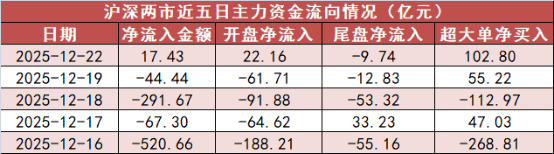
12月22日,A股市场整体上涨。 截至收盘,上证指数收报3917.36点,上涨0.69%,深证成指收报13332.73点,上涨1.47%,创业板 指收报3191.98点,上涨2.23%,北证50指数上涨0.24%。A股市场合计成交18824.11亿元,较上一交易日 增加1334.73亿元。 1. A股市场全天主力资金净流入17.43亿元 今日A股市场主力资金开盘净流入22.16亿元,尾盘净流出9.74亿元,全天净流入17.43亿元。 | | | 沪深两市近五日主力资金流向情况(亿元) | | | | --- | --- | --- | --- | --- | | 日期 | | 净流入金额 开盘净流入 | | 尾盘净流入 超大单净买入 | | 2025-12-22 | 17. 43 | 22. 16 | -9.74 | 102. 80 | | 2025-12-19 | -44. 44 | -61.71 | -12.83 | 55. 22 | | 2025-12-18 | -291.67 | -91.88 | -53. 32 | -112. 97 | | 2025-12-17 | -67. 30 | -64.62 ...

喜娜AI速递:今日财经热点要闻回顾|2025年12月23日
Xin Lang Cai Jing· 2025-12-23 11:57
Group 1 - The People's Bank of China has implemented a one-time credit repair policy to assist individuals in restoring their credit, allowing for the removal of overdue information for amounts not exceeding 10,000 yuan if debts are repaid by March 31, 2026 [2][7] - The A-share market has seen a significant increase, with major indices rising collectively, and the Shanghai Composite Index increasing by 0.69%, with a total market turnover of 1.88 trillion yuan, indicating a developing trend for the upcoming cross-year and spring market [2][7] - The precious metals market is experiencing a surge, with gold prices reaching $4,420.47 per ounce, marking a year-to-date increase of 68.05%, and silver prices also hitting historical highs, driven by expectations of interest rate cuts and geopolitical tensions [2][7] Group 2 - Kuaishou has faced automated attacks leading to the suspension of multiple live streams due to inappropriate content, prompting the platform to take immediate action and report to authorities [3][8] - Major state-owned banks have adjusted their medium- and long-term deposit products, with three-year product rates dropping to 1.5% - 1.75%, as a response to challenges in net interest margins, which may guide funds towards capital markets [3][8] - The legal situation surrounding the "Xiangyuan system" has escalated, with the actual controller being taken into criminal custody, while companies involved claim normal operations and unchanged control [3][8] Group 3 - The Nanjing Museum's management of cultural relics has come under scrutiny, leading to investigations by multiple departments, including the establishment of a working group by the National Cultural Heritage Administration [4][9] - Investor Dan Bin has shifted focus from liquor to AI, suggesting that investing in technology stocks like Google is more favorable, as he perceives challenges in the liquor sector's growth [4][10] - The recent closure policy in Hainan has stimulated consumer spending, with significant increases in sales at duty-free shops, including an 85% year-on-year growth in Sanya's duty-free city [4][10]
思美传媒:聘任王冲为公司董事会秘书
Mei Ri Jing Ji Xin Wen· 2025-12-23 11:01
截至发稿,思美传媒市值为29亿元。 每经头条(nbdtoutiao)——地产"优等生"受困20亿元到期债务,首次债务展期仍在博弈,明年还有超 百亿元公开债到期 (记者 曾健辉) 2025年1至6月份,思美传媒的营业收入构成为:商务服务业占比100.0%。 每经AI快讯,思美传媒(SZ 002712,收盘价:5.26元)12月23日晚间发布公告称,经公司董事会提 名,董事会提名委员会审核,同意聘任王冲先生为公司董事会秘书。 ...

无线传媒发生3笔大宗交易 合计成交8913.77万元
Zheng Quan Shi Bao Wang· 2025-12-23 09:43
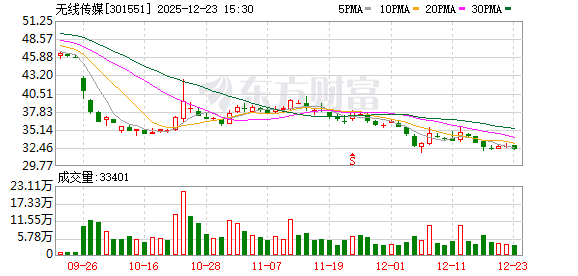
无线传媒12月23日大宗交易平台共发生3笔成交,合计成交量278.56万股,成交金额8913.77万元。以折 溢价进行统计,今日3笔大宗交易成交价相对收盘价均为折价交易。从参与大宗交易营业部来看,机构 专用席位共出现在2笔成交的买方或卖方营业部中,合计成交金额为4087.12万元,净买入4087.12万元。 进一步统计,近3个月内该股累计发生76笔大宗交易,合计成交金额为7.16亿元。 证券时报·数据宝统计显示,无线传媒今日收盘价为32.27元,下跌1.31%,日换手率为2.16%,成交额为 1.08亿元,全天主力资金净流出607.38万元,近5日该股累计下跌2.65%,近5日资金合计净流出2542.61 万元。 据天眼查APP显示,河北广电无线传媒股份有限公司成立于2009年04月24日,注册资本40001万人民 币。(数据宝) 12月23日无线传媒大宗交易一览 | 成交量 | 成交金额 | 成交价 | 相对当日收盘 | | | | --- | --- | --- | --- | --- | --- | | (万 | (万元) | 格 | 折溢价(%) | 买方营业部 | 卖方营业部 | | 股) | | ...
庞铮MCN称聚焦高智群体
Xin Lang Cai Jing· 2025-12-23 04:37
【#庞铮MCN称聚焦高智群体#】12月22日,#庞铮曾在offer7获第一# 星光大赏主持人 @庞铮zzZ 发文 回应争议:星光大赏之后所有的批评我都认真看了,没有任何理由,都诚恳接受。第一次面对真正的大 场面,经验不足,不够沉着冷静,对于嘉宾也照顾得不够周全。对贺峻霖老师必须要说声抱歉,对不 起。据悉,庞铮当前关联MCN为"又不同",该机构称其"达人聚焦高智群体的'智性恋赛道'和'情感赛 道'",运营签约《令人心动的offer6》《令人心动的offer7》职综全员选手。企查查APP显示,"又不 同"第三方平台账号认证主体(上海又不同文化传媒有限公司)成立于2020年7月,对外投资有湖南又不 同文化传媒有限公司。#庞铮对贺峻霖道歉# (来源:猛犸新闻) ...