非银金融

Search documents
【11日资金路线图】两市主力资金净流入超100亿元 电子等行业实现净流入
证券时报· 2025-09-11 11:19
今日盘后数据。 今日(9月11日),A股市场整体上涨。截至收盘,上证指数报3875.31点,上涨1.65%;深证成指报12979.89点,上涨3.36%;创业板指报3053.75点,上 涨5.15%。两市合计成交24377.19亿元,较上一交易日增加4595.96亿元。 1.两市主力资金净流入超100亿元 今日沪深两市主力资金开盘净流出124.72亿元,尾盘净流入60.54亿元,两市全天主力资金净流入103.09亿元。 | | | 沪深两市最近五个交易日主力资金流向情况(亿元) | | | | --- | --- | --- | --- | --- | | 日期 | | 净流入金额 开盘净流入 | 尾盘净流入 | 超大单净买入 | | 2025-9-11 | 103.09 | -124.72 | 60. 54 | 260. 09 | | 2025-9-10 | -12.94 | 33.44 | -19. 17 | 45. 21 | | 2025-9-9 | -505. 34 | -132.50 | -26.19 | -274. 46 | | 2025-9-8 | -291. 34 | -162. 94 | 3 ...


开源证券:港股相对A股补涨的契机或到来 建议重视互联网、消费等机会
Zhi Tong Cai Jing· 2025-09-11 08:24
Core Viewpoint - The current A-share market is entering a valuation digestion phase, while the relative advantages of the Hong Kong stock market are becoming more apparent, supported by a dovish signal from the Federal Reserve and a search for investment opportunities in AI hardware and applications [1][2][3] Group 1: Market Dynamics - The Hong Kong stock market has shown a "healthy" moderate upward trend since the "reciprocal tariffs" impact in 2025, but its relative performance compared to A-shares has weakened due to several factors [1] - The Hong Kong Monetary Authority tightened liquidity in August, with the 3-month HIBOR rising from 1.62% to 3.30%, an increase of approximately 168 basis points, and the 1-month HIBOR rising from 0.99% to 3.30%, an increase of about 230 basis points, which has pressured some leveraged financing costs [1] - The expectation of a rate cut by the Federal Reserve was postponed to September, as the non-farm employment data showed resilience, leading to a withdrawal of rate cut trades and an increase in U.S. Treasury yields, delaying the global liquidity improvement [1] Group 2: Investment Opportunities - Funds are seeking "outlets" in AI hardware and applications, with the Hong Kong internet sector positioned to benefit from this trend [2] - Alibaba is increasing its investment in self-developed AI chips, enhancing its influence in the core computing power segment, while Oracle's AI cloud business guidance exceeded expectations, indicating strong demand for AI and cloud services globally [2] - The Hong Kong internet sector is becoming increasingly attractive for capital allocation, supported by the ongoing AI-driven technology cycle [2][3] Group 3: Investment Recommendations - The report suggests focusing on the Hong Kong internet sector, consumer stocks, pharmaceuticals, and resilient non-bank financial sectors to capture dual benefits from profit elasticity and valuation recovery [3] - The overall valuation of the Hong Kong market is low, with good asset quality and increased corporate dividends and buybacks, indicating potential inflows of foreign capital as external liquidity conditions gradually ease [3]
73只股上午收盘涨停(附股)
Zheng Quan Shi Bao Wang· 2025-09-11 05:29
两市涨停股一览 截至上午收盘,上证指数报收3855.10点,上涨1.12%;深证成指收于12887.73点,上涨2.63%;创业板 指上涨4.31%;科创50指数上涨5.34%。 不含当日上市新股,今日可交易A股中,上涨个股有3360只,占比62.36%,下跌个股有1839只,平盘个 股189只。其中,收盘股价涨停的有73只,跌停股有5只。 证券时报·数据宝统计显示,涨停个股中,主板有65只,创业板3只,科创板5只。以所属行业来看,上 榜个股居前的行业有电子、建筑装饰、计算机行业,上榜个股分别有18只、8只、6只。 涨停股中,*ST荣控、*ST亚太等8只股为ST股。连续涨停天数看,首开股份已连收7个涨停板,连续涨 停板数量最多。从上午收盘涨停板封单量来看,国海证券最受资金追捧,上午收盘涨停板封单有 33760.67万股,其次是棕榈股份、东珠生态等,涨停板封单分别有9085.54万股、7180.33万股。以封单 金额计算,海光信息、中科曙光、国海证券等涨停板封单资金最多,分别有24.14亿元、23.73亿元、 16.58亿元。(数据宝) (文章来源:证券时报网) | 代码 | 简称 | 收盘价(元) | 换手率 ...


融资融券每周观察(2025.9.1-2025.9.5)
申万宏源证券上海北京西路营业部· 2025-09-11 02:51
Market Overview - The Shanghai Composite Index closed at 3812.51, down 1.18% [4] - The Shenzhen Component Index closed at 12590.56, down 0.83% [4] - Average daily trading volume in the Shanghai market was 110.61 billion yuan, a decrease of 12.1% week-on-week [4] - Average daily trading volume in the Shenzhen market was 146.15 billion yuan, a decrease of 13.7% week-on-week [4] Industry Performance - Among the Shenwan first-level industries, 9 sectors saw gains while 22 sectors experienced declines [5] - The top three performing industries were: - Power Equipment - Comprehensive - Non-ferrous Metals [5] - The bottom three performing industries were: - Defense and Military - Computer - Non-bank Financials [5] Margin Trading Overview - As of September 5, the total margin trading balance in the market increased by 25.7 billion yuan to 228.71 billion yuan [6] - The financing balance increased by 25.8 billion yuan to 227.13 billion yuan, while the securities lending balance decreased by 1 billion yuan to 15.7 billion yuan [6] Net Buying by Industry - More than half of the industries in the Shenwan classification had a positive net buying amount [7] Top Net Buying Stocks - The top ten stocks by net buying amount during the period included: - Dongfang Caifu (80.63 million yuan, Non-bank Financial) - SMIC (37.31 million yuan, Electronics) - AVIC Chengfei (30.50 million yuan, Defense and Military) [10] Top Net Buying ETFs - The top ten ETFs by net buying amount included: - Huaxia SSE Sci-Tech 50 ETF (1.96 million yuan) - Huaxia Hang Seng Tech ETF (1.19 million yuan) - Bosera CSI Convertible Bonds ETF (1.01 million yuan) [11] Market Sentiment and Trends - Recent external disturbances have led to a slight increase in risk aversion, with gold prices rising significantly due to political and economic fluctuations in Europe and the US [15] - The A-share market experienced a technical correction, with the Shanghai index showing signs of consolidation after a period of gains [15] - The market's medium-term trend remains unchanged, with continued buying momentum expected despite short-term fluctuations [15]

大幅低开!创新药全线下挫
Mei Ri Jing Ji Xin Wen· 2025-09-11 02:28
Group 1 - The core point of the news is that the Hong Kong innovative pharmaceutical sector experienced a significant decline, with major stocks dropping over 10% due to reports of potential restrictions on Chinese drugs by the Trump administration [1][2][5] - Key stocks affected include Basilea Pharmaceutica-B, Hansoh Pharmaceutical, and Kelun-B, all of which opened lower by 15%, 14.98%, and 12.97% respectively [1][2] - The decline in the innovative pharmaceutical sector also impacted related ETFs, with several Hong Kong Stock Connect innovative drug ETFs dropping over 6% in early trading [2] Group 2 - The report from The New York Times indicated that the Trump administration is drafting an executive order to impose strict limitations on Chinese pharmaceuticals, particularly experimental drugs, which contributed to the market's reaction [2] - In the U.S. market, companies like BeiGene and Zai Lab saw their stocks drop over 9% following the news [2] - Other sectors, such as technology stocks, also faced declines, with notable drops in companies like Baidu and Alibaba, while gold stocks showed some activity with gains [3] Group 3 - Looking ahead, the outlook suggests that as the A-share market enters a valuation digestion phase, expectations of U.S. Federal Reserve easing may provide marginal support for Hong Kong stock valuations [4] - The Hong Kong internet sector is highlighted for its potential due to self-developed AI chips and cloud business expansion, which could enhance earnings certainty [4] - Overall, the low valuation of Hong Kong stocks, combined with improved asset quality and increased corporate dividends and buybacks, may attract foreign capital inflows [4]
25个行业获融资净买入 28股获融资净买入额超1亿元
Zheng Quan Shi Bao Wang· 2025-09-11 01:46
Group 1 - On September 10, among the 31 first-level industries tracked by Shenwan, 25 industries experienced net financing inflows, with the electronics industry leading at a net inflow of 2.075 billion yuan [1] - Other industries with significant net financing inflows included computer, machinery equipment, media, communication, and non-bank financial sectors, each exceeding 300 million yuan in net inflows [1] Group 2 - A total of 1,865 individual stocks received net financing inflows on September 10, with 81 stocks having net inflows exceeding 50 million yuan [1] - Among these, 28 stocks had net inflows exceeding 100 million yuan, with Industrial Fulian leading at a net inflow of 729 million yuan [1] - Other notable stocks with significant net inflows included Shenghong Technology, Dongshan Precision, SMIC, Lio股份, and Top Group, each with net inflows exceeding 300 million yuan [1]





牛市整理期的市场特征——“策略周中谈”
2025-09-10 14:35
Summary of Conference Call Records Industry or Company Involved - The discussion primarily revolves around the stock market, particularly focusing on the AI computing sector, TMT (Technology, Media, and Telecommunications) sector, and various emerging industries such as renewable energy, new consumption, innovative pharmaceuticals, non-bank financials, and basic chemicals. Core Points and Arguments 1. **Market Sentiment and Trends** - Market sentiment is currently in an exuberant phase but has not peaked, similar to early 2015 and March-April 2019, indicating a potential for either a peak reversal or sideways consolidation [1][2][4] - The trading structure has deteriorated, with the AI computing sector experiencing overcrowding, while the communication and electronics sectors have seen transaction volume ratios of 99.6% and 95.6% respectively [2][5] 2. **Historical Patterns of Market Consolidation** - Historical analysis of 11 previous consolidation periods shows they typically last 1-2 months, with maximum index drawdowns of 7%-9% [3][9] - A trading volume turnover rate exceeding 2% signals overheating, with a potential for significant corrections if it reaches 3% [3][5] 3. **Investment Opportunities Post-Consolidation** - After the current consolidation phase, the market is expected to continue its upward trend, with a focus on emerging sectors such as AI computing, renewable energy, new consumption, innovative pharmaceuticals, and non-bank financials [4][19] - The AI computing sector remains a core investment theme despite recent cooling [14] 4. **Current Market Downturn Causes** - The market downturn is attributed to trading overheating and structural deterioration, with significant transaction volume in the TMT sector nearing 40% [5][6] - Investor risk appetite has decreased, contributing to market adjustments [2][5] 5. **Sector Focus and Fund Flow Trends** - Current high interest in the electric equipment and renewable energy sectors, with notable increases in transaction volume for biopharmaceuticals and consumer sectors [6] - Attention should be paid to fund flows and rotation opportunities among sectors, especially as AI computing cools down [6] 6. **Short-term Risks in TMT and AI Computing Sectors** - The TMT and AI computing sectors are not expected to face significant short-term declines, with potential for continued investment opportunities [7] - The market sentiment remains high, influenced by expectations of Federal Reserve interest rate cuts [7] 7. **Investment Strategy During Market Consolidation** - Focus on mid-cap and large-cap growth stocks, as small-cap valuations are considered too high [11][12] - Emphasis on stocks that have underperformed but show potential for recovery during the consolidation phase [12] 8. **Key Sectors for Future Investment** - Renewable energy, particularly energy storage and solid-state batteries, are highlighted as key areas for investment [15][16] - New consumption sectors are also deemed worthy of attention, especially with upcoming holidays potentially boosting consumer spending [17] 9. **Impact of Federal Reserve Rate Cuts** - Federal Reserve rate cuts are expected to benefit sectors such as innovative pharmaceuticals and precious metals, with implications for non-bank financials and technology stocks [18] Other Important but Possibly Overlooked Content - The need for a comprehensive evaluation of industry conditions, policy directions, and sector performance to ensure a robust investment portfolio during periods of market volatility [12] - The potential for significant shifts in investment focus as market conditions evolve, particularly in response to macroeconomic trends and investor sentiment [19]
关于A股市场 重要报告出炉
Zhong Guo Zheng Quan Bao· 2025-09-10 13:41
Core Viewpoint - The A-share market has experienced a significant upward trend since September 24, 2024, driven by multiple factors including policy dividends, asset allocation shifts, and geopolitical fluctuations [1][3] Group 1: Market Trends and Drivers - The report identifies three main themes driving the A-share market: "dividend assets," "technology growth," and "buyback incentives," which collectively create a strong market dynamic [3] - High dividend, low volatility sectors have become the optimal choice for balancing risk and return, with a notable increase in demand for quality assets with stable cash flows [4][6] - The average return on equity (ROE) for the coal sector reached 12.88% in 2024, while select banks maintained ROE between 15% and 18%, highlighting the stability of these sectors [6] Group 2: Sector Performance - In 2024, the dividend low volatility index rose by 17.84%, outperforming the Shanghai Composite Index's increase of 12.67% [4] - The banking sector showed a remarkable annual increase of 34.39%, while non-bank financials and telecommunications also performed well with increases of 30.17% and 28.82%, respectively [5] - The technology sector, particularly the electronic industry, is projected to see revenue growth of 17.41% and net profit growth of 27.58% in 2024, driven by AI computing and semiconductor demand [9] Group 3: Buyback and Incentive Effects - Share buybacks have shown to generate significant short-term excess returns, averaging 1.29% on the announcement day, with sustained positive effects over time [12] - Companies implementing equity incentives have experienced an average cumulative excess return of 5.52% over 200 trading days post-announcement, indicating strong market reactions to such announcements [14][16]
恒指站上26000点!波动加剧之际,港股哪些板块更值得关注?
Sou Hu Cai Jing· 2025-09-10 12:31
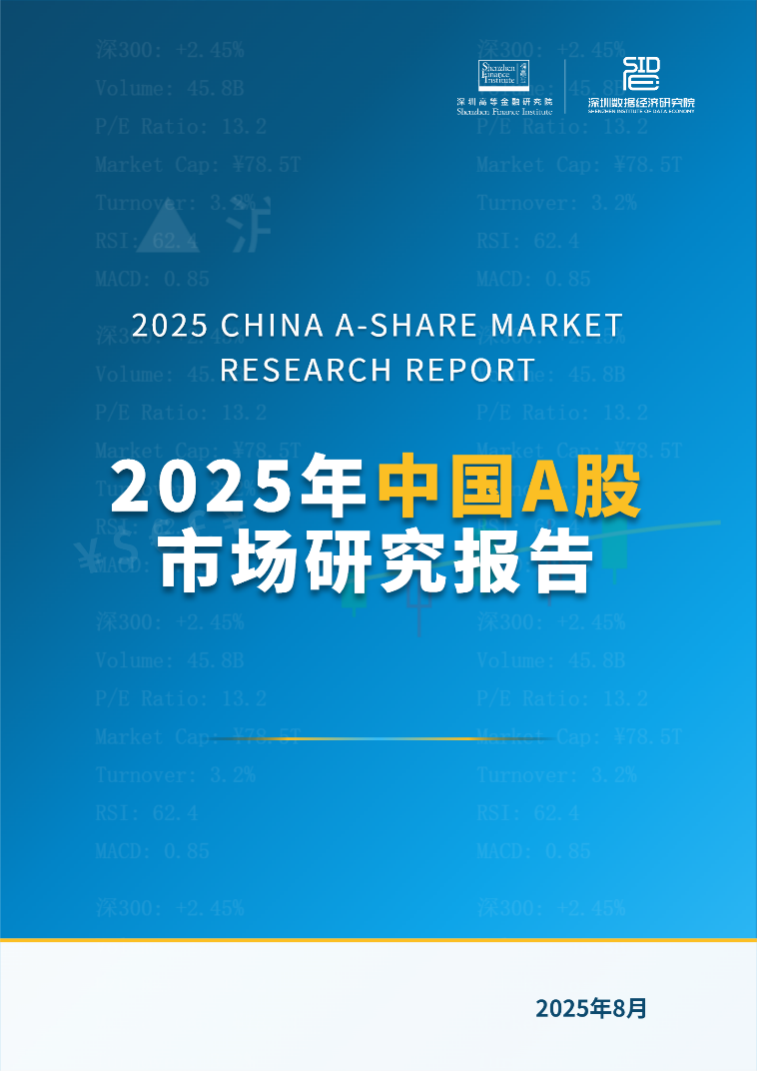
Market Performance - The Hang Seng Index has achieved a "four consecutive days of gains," surpassing 26,000 points, marking a year-to-date increase of nearly 31% [2] - The Hang Seng Tech Index has also recorded an increase of over 30% year-to-date [2] - Notable gainers among Hang Seng constituents include Lenovo Group (+4%), JD Logistics (+4%), and Sun Hung Kai Properties (+4%), while SMIC and Sunny Optical rose over 2% [2] Financial Performance - According to Galaxy Securities, total revenue for all Hong Kong stocks increased by 0.67% year-on-year in the first half of the year, while net profit attributable to shareholders grew by 3.59% [3] - The revenue growth rates for the Hang Seng Index and the Hang Seng China Enterprises Index were 2.46% and 2.59%, respectively, both showing a decline compared to the previous year's report [3] - The Hang Seng Tech Index showed a stronger performance with a revenue growth of 16.12% and a net profit growth of 19.24% in the first half of 2025 [3] Capital Flows - Continuous inflow of southbound funds has been a key driver for the rise in Hong Kong stocks, with a cumulative net inflow of HKD 979 billion from January to August [4] - The proportion of trading volume from the Stock Connect has been increasing, reaching an average of 55.9% in August [4] - Southbound funds have maintained a net inflow status into September [4] Market Outlook - Analysts from Zhongtai International suggest that the market is currently in a consolidation phase at high levels, with limited room for further valuation expansion [7] - The Chinese economy is showing signs of moderate recovery, with improving domestic demand and a more favorable export structure [7] - Investment strategies should focus on high-certainty earnings technology leaders, semiconductor, AI computing sectors, and interest-sensitive materials [7] Sector Recommendations - Citigroup has raised its year-end target for the Hang Seng Index by 7% to 26,800 points, with further increases expected in 2024 [10] - The report highlights sectors such as technology, healthcare, and insurance as key beneficiaries of China's "14th Five-Year Plan," while downgrading telecommunications and energy sectors due to slow profit growth [10] - Analysts recommend focusing on sectors with relative prosperity and policy benefits, including automotive, new consumption, innovative pharmaceuticals, and technology [8]

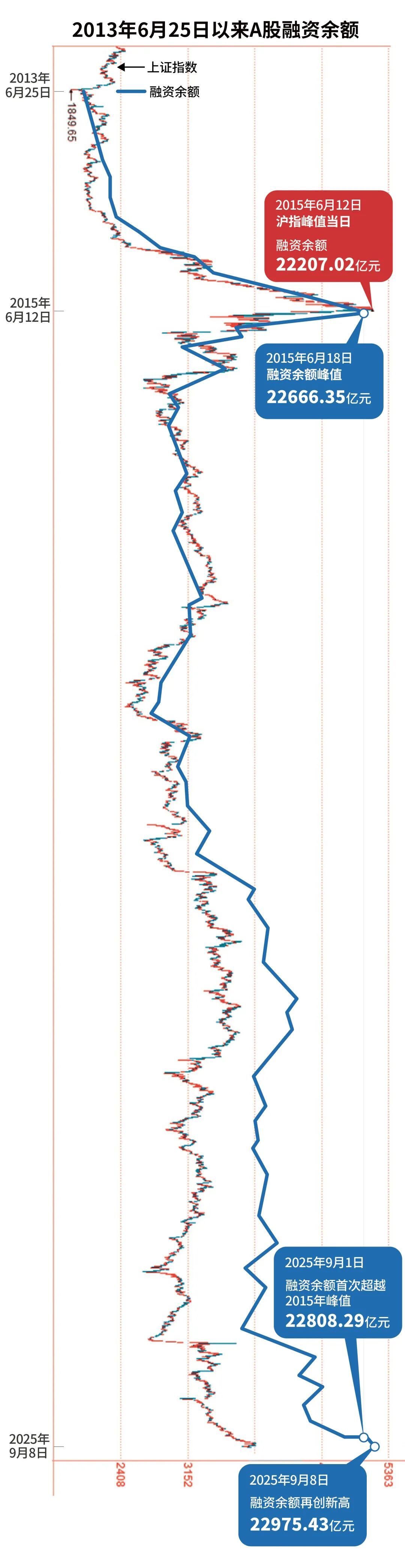
2.3万亿元!A股两融余额再创新高,超越2015年牛市峰值
Mei Ri Jing Ji Xin Wen· 2025-09-10 11:36
Core Viewpoint - The A-share margin trading balance has reached a historical high, surpassing the peak of 2015, indicating a significant increase in leverage in the market, but with different characteristics compared to the previous peak [1][5][30]. Margin Trading Data Comparison - The number of margin trading stocks has increased from 912 in 2015 to 4239 in 2025, reflecting a broader market participation [5]. - As of September 9, 2025, the margin trading balance accounted for 2.5% of the A-share market capitalization, which is significantly lower than the over 4% seen in 2015 [6][7]. - The absolute amount of margin trading is higher now, but its proportion of total trading volume is slightly lower than in 2015, indicating a more active market with a higher participation of self-funding [8][9]. Investor Participation and Debt Levels - The number of individual investors participating in margin trading has exceeded 7.6 million, with a notable increase in participation during certain trading days, although it has fluctuated recently [10][11]. - The average debt per margin trader has decreased from approximately 163.91 million in 2015 to 128.4 million in 2025, suggesting a reduction in individual leverage [12]. Sectoral Analysis of Margin Trading - The margin trading balance for the ChiNext board has significantly increased by 367% from 2015, while the balance for the CSI 300 has decreased by 39.8% [14][17]. - The current margin trading balance across various industries is notably lower than the peaks seen in 2015, with traditional sectors like finance and real estate experiencing substantial declines in margin trading balances [22][23]. Market Dynamics and Investment Logic - The current market shows a more diversified funding structure compared to 2015, with various funding sources including public and private funds, and foreign investments contributing to market dynamics [30]. - The investment logic has shifted towards a focus on performance and fundamentals, with margin funds being directed more towards growth sectors such as technology and innovation [30][31].