
造纸

Search documents
造纸轻工周报 2026/02/02-2026/02/06:顺周期布局家居、造纸及消费;关注海外包装公司业绩-20260212
Shenwan Hongyuan Securities· 2026-02-12 05:57
Investment Rating - The report indicates a positive investment outlook for the home furnishing and paper industries, with specific recommendations for companies with high dividend safety margins and growth potential [3][5]. Core Insights - The home furnishing sector is at a valuation bottom, with real estate policies expected to catalyze upward valuation movements. Industry consolidation is accelerating, and companies like Gujia Home, Sophia, and Oppein are highlighted for their strong dividend safety margins [3][5]. - In the paper industry, short-term stability in boxboard prices is noted, with an optimistic mid-term supply-demand balance expected to enhance industry profitability. Companies like Nine Dragons Paper are recognized for exceeding performance expectations [3][5]. - Bull Group is positioned for steady recovery in its traditional business due to improving real estate and consumer sentiment, while new business areas such as overseas expansion and smart lighting present growth opportunities [3][5]. - Consumer sentiment is rebounding, with a focus on personal care growth stocks like Baiya, Dengkang Dental, and Zhongshun Jierou [3][5]. Summary by Sections Home Furnishing - The home furnishing sector is experiencing a valuation bottom, with real estate policies likely to improve market sentiment and demand. The increase in second-hand housing transactions is expected to support the demand side, leading to a long-term expansion of the industry [5][6]. - The report emphasizes the acceleration of industry consolidation since 2025, with mid-tier companies exiting the market and capital entering leading firms, enhancing industry concentration [6][16]. - Companies to watch include Gujia Home, Sophia, Oppein, Mousse, and Xilinmen, which are expected to benefit from valuation recovery [5][6]. Paper Industry - The report notes that boxboard prices are stable in the short term, with an anticipated improvement in the supply-demand structure that could enhance profitability in the mid-term. Companies like Sun Paper and Nine Dragons Paper are highlighted for their strong positions [3][5]. - The report suggests monitoring the potential impact of anti-involution policies and demand changes, which could contribute to cyclical elasticity in the paper sector [7][8]. - Specific recommendations include focusing on companies with integrated supply chains and significant cost advantages, such as Sun Paper and Nine Dragons Paper [7][8]. Bull Group - The Bull Group is expected to see steady recovery in its traditional business due to improving real estate and consumer sentiment. The company is also expanding into new areas such as smart lighting and renewable energy, which are anticipated to drive growth [10][11]. - The report highlights the company's competitive advantages in product, channel, and supply chain management, which are expected to support stable growth in 2026 [10][11]. Consumer Goods - The report indicates a rebound in consumer sentiment, with a focus on personal care growth stocks. Companies like Baiya, Dengkang Dental, and Zhongshun Jierou are noted for their potential in the market [13][14].



造纸轻工周报:顺周期布局家居、造纸及消费,关注海外包装公司业绩-20260212
Shenwan Hongyuan Securities· 2026-02-12 04:16
Investment Rating - The report maintains a positive outlook on the home furnishing and paper industries, indicating potential for valuation recovery and growth opportunities [3][5]. Core Insights - The home furnishing sector is at a valuation bottom, with real estate policies expected to catalyze upward valuation movements. Industry consolidation is accelerating, with a focus on companies with high dividend safety margins such as Gujia Home, Sophia, and Oppein [3][5]. - In the paper industry, short-term stability in corrugated box prices is noted, with an optimistic mid-term supply-demand balance expected to enhance industry profitability. Companies like Nine Dragons Paper are highlighted for exceeding performance expectations [3][5]. - Bull Group is positioned for steady recovery in its traditional business due to improving real estate and consumer sentiment, while new ventures in overseas markets, smart lighting, and renewable energy are opening growth avenues [3][5]. - Consumer sentiment is rebounding, with a focus on personal care growth stocks such as Baiya, Dengkang Dental, and Zhongshun Jierou [3][5]. Summary by Sections Home Furnishing - The sector is experiencing a valuation bottom, with real estate policies likely to improve market sentiment and demand. The increase in second-hand housing transactions is expected to support home furnishing demand, leading to a long-term expansion of the industry [5][6]. - The ongoing consolidation in the industry is pushing mid-tier companies out, while capital from industrial players is entering leading home furnishing firms, enhancing market concentration [5][6]. Paper Industry - Short-term price stability in corrugated boxes is observed, with a potential mid-term improvement in supply-demand dynamics expected to boost profitability. The report emphasizes the importance of integrated supply chains and cost advantages in companies like Sun Paper and Nine Dragons Paper [7][9]. - The report suggests that the paper industry is nearing a bottom, with cost structures supporting price stability and potential for upward movement in demand [7][9]. Bull Group - The company is expected to benefit from improving real estate conditions and consumer sentiment, with traditional business lines poised for recovery. New business areas such as smart lighting and renewable energy are anticipated to contribute to growth [11][12]. Consumer Goods - The report highlights a rebound in consumer sentiment, with a focus on personal care companies that are expected to show growth potential. Companies like Baiya and Dengkang Dental are noted for their promising performance in 2026 [14][15]. Packaging Industry - The report discusses the performance of overseas packaging companies, with Ball Corporation and Amcor showing strong results. Ball's revenue for FY25 reached $13.2 billion, a 12% increase year-on-year, while Amcor's revenue for FY26H1 was $11.2 billion, a 70% increase [15][16].
乐观情绪支撑美豆,国内双粕震荡为主
Zhong Xin Qi Huo· 2026-02-12 01:45
1. Report Industry Investment Rating No relevant information provided. 2. Core Views of the Report - The agricultural market shows a mixed trend, with different commodities having various outlooks such as oscillation, oscillation - weakening, and oscillation - strengthening [1][6][7]. - For different commodities: - Oils: Narrow - range oscillation, with multiple factors affecting supply and demand, and a suggestion to consider buying hedging strategies at low - callback levels [6]. - Protein meals: Domestic double meals oscillate mainly, with international factors supporting US soybeans and domestic factors affecting the market [1][7]. - Corn: Oscillates, with industry news and emotions affecting futures, and attention to post - holiday trading and inventory replenishment rhythms [8]. - Pigs: Oscillates weakly, with supply - demand being loose, and different trends in the short, medium, and long - term [9]. - Natural rubber: Oscillates, with attention to previous high resistance, and the market influenced by capital and fundamentals [11][12]. - Synthetic rubber: Oscillates upward following natural rubber, with the mid - term bullish logic remaining unchanged [13]. - Cotton: Oscillates strongly in the medium - long term, waiting for new driving forces in the short term [14]. - Sugar: Oscillates weakly in the medium - long term, with a downward driving force due to expected oversupply [16]. - Pulp: Oscillates, with weak supply - demand before the Spring Festival and expected improvement after the festival [17]. - Double - gum paper: Oscillates weakly, with the market in a low - level oscillation during the holiday [18]. - Logs: Oscillates, with the spot being stable and the market in a range - bound operation [20]. 3. Summary by Relevant Catalogs 3.1. Market Quotes and Views 3.1.1. Oils - **View**: Oils show narrow - range oscillation. The US Department of Agriculture's February report adjusted relevant data, and the market is affected by factors such as demand expectations, biodiesel policies, and export performance. It is recommended to pay attention to buying hedging strategies at low - callback levels [6]. - **Logic**: Futures are affected by capital emotions, and the industrial end has different supply - demand situations for different oils. For example, soybeans have relatively sufficient supply, and palm oil has inventory and export issues [6]. - **Outlook**: Soybean oil, palm oil, and rapeseed oil all oscillate [6]. 3.1.2. Protein Meals - **View**: Optimistic emotions support US soybeans, and domestic double meals oscillate mainly [1][7]. - **Logic**: Internationally, the USDA's February supply - demand report is bearish, but the market has optimistic export expectations and the US biodiesel plan boosts US soybean oil. Domestically, factors such as pre - holiday capital flight, logistics stagnation, and expected post - holiday cost reduction affect the market [1][7]. - **Outlook**: Both soybean meal and rapeseed meal oscillate [1][7]. 3.1.3. Corn - **View**: Industry news disturbs the market, and corn increases positions and rises [8]. - **Logic**: Futures are affected by industry news and emotions, while the spot market is gradually entering the holiday, with stable prices and low trading volume. Attention should be paid to factors such as grain sales progress, policy grain auctions, and wheat conditions [8]. - **Outlook**: Oscillation, with attention to post - holiday trading and inventory replenishment rhythms [8]. 3.1.4. Pigs - **View**: Supply - demand is loose, and spot prices continue to weaken [9]. - **Logic**: In terms of supply, there are different situations in the short, medium, and long - term; demand shows an increase in slaughter volume; inventory shows a continuous decrease in average pig weight. The price is expected to weaken in the short - term and is affected by different production capacities in different periods [9]. - **Outlook**: Oscillation - weakening, with a potential bottom - out and recovery in the second half of 2026 [9]. 3.1.5. Natural Rubber - **View**: Pay attention to previous high resistance [11][12]. - **Logic**: The rubber price runs strongly, mainly driven by capital emotions. The short - term support is effective, and the overall is in a bullish trend. The current trading logic is mainly affected by the macro - environment, with relatively weak fundamentals but good expectations [11][12]. - **Outlook**: Oscillation, with limited fundamental variables and increasing capital attention [12]. 3.1.6. Synthetic Rubber - **View**: Follow natural rubber to oscillate upward [13]. - **Logic**: The BR market follows natural rubber to rise slightly, and the mid - term core logic is the expectation of tight supply of butadiene in the first half of 2026. The raw material market is affected by factors such as export news and downstream demand [13]. - **Outlook**: Mid - term oscillation - strengthening, with a need for adjustment in the short - term due to rapid price increase [13]. 3.1.7. Cotton - **View**: Cotton price rebounds [14]. - **Logic**: Before the Spring Festival, the fundamentals have no obvious driving force, and the cotton price is expected to oscillate within a range. After the festival, with the arrival of the traditional peak season, the terminal demand may drive the price to rise. In the medium - long term, the supply - demand is expected to be in tight balance, and the planting area in Xinjiang may decrease [14]. - **Outlook**: Oscillation - strengthening, with a suggestion to buy on dips [14]. 3.1.8. Sugar - **View**: Sugar price oscillates weakly in the medium - long term [16]. - **Logic**: The global sugar market is expected to have oversupply in the 25/26 crushing season, with major producing countries expected to increase production. The supply increase puts pressure on the price [16]. - **Outlook**: Oscillation - weakening, with a suggestion to short on rebounds [16]. 3.1.9. Pulp - **View**: Spot prices are almost stagnant, and futures fluctuate independently [17]. - **Logic**: Before the Spring Festival, the supply - demand is weak, with low demand from the terminal and downstream. After the festival, the seasonal recovery of demand may bring marginal benefits. The valuation support has weakened, and the downward space is limited [17]. - **Outlook**: Oscillation, with weak supply - demand before the festival and expected improvement after the festival [17]. 3.1.10. Double - gum Paper - **View**: Factories enter the holiday, and the market maintains low - level oscillation [18]. - **Logic**: Before the Spring Festival, the trading in the double - gum paper market ends, with stable spot prices and low - level oscillation. The industry is affected by factors such as production line operation, downstream consumption, and market demand [18]. - **Outlook**: Oscillation - weakening, with the market expected to be stagnant during the holiday and attention to the post - holiday consumption recovery [18]. 3.1.11. Logs - **View**: Spot prices are stable, and the market operates within a range [20]. - **Logic**: Before the Spring Festival, the log market trading is basically stagnant, with stable spot prices and range - bound oscillation. The market is affected by factors such as news, valuation, supply, and delivery [20]. - **Outlook**: Oscillation, with the market having no new driving force in the short - term and maintaining range - bound operation [20]. 3.2. Commodity Index - On February 11, 2026, the comprehensive index, special index (including the commodity index, commodity 20 index, and industrial product index), and plate index (agricultural product index) of CITIC Futures all showed certain changes. For example, the comprehensive index increased by 0.32%, the commodity 20 index increased by 0.27%, the industrial product index increased by 0.41%, and the agricultural product index increased by 0.34% on that day [179][180].
“双碳”政策专家电话会
2026-02-11 15:40
Summary of Conference Call on Carbon Neutrality and Chemical Industry Industry Overview - The conference focused on the chemical industry in the context of China's dual carbon goals, specifically the 14th Five-Year Plan (14th FYP) and the transition towards carbon neutrality by 2060 [1][2]. Key Points and Arguments 1. **Carbon Peak and Neutrality Goals**: - China aims to reach carbon peak by 2030 and achieve carbon neutrality by 2060, with a specific target of reducing total carbon emissions by 7% to 10% after reaching the peak [2][4]. - The transition from intensity-based targets to total emission reduction is a significant shift in policy [4][6]. 2. **Policy Implementation**: - The 14th FYP emphasizes a comprehensive green transformation across all industries, moving from energy consumption control to carbon emission control [5][6]. - A carbon emission budget mechanism will be established at provincial and municipal levels, with specific targets allocated to each region [6][7]. 3. **Inclusion of Industries in Carbon Market**: - Currently, eight major industries, including power, cement, aluminum, and steel, are included in the carbon market, which accounts for 65% of national carbon emissions [7][8]. - By 2027, additional sectors such as petrochemicals, chemicals, paper, and construction materials will be integrated into the carbon market [7][8]. 4. **Carbon Management and Monitoring**: - Companies will be required to incorporate carbon management into their operational frameworks, with carbon emissions data becoming a prerequisite for project approvals [8][9]. - A product carbon footprint database will be established to track and certify carbon emissions associated with products [9][10]. 5. **Development of Zero-Carbon Facilities**: - The government plans to establish 100 national-level zero-carbon parks by 2030, with ongoing efforts to create zero-carbon factories in high-emission industries [9][10]. 6. **Market Mechanisms and Cost Implications**: - The introduction of paid carbon allowances is anticipated, with a gradual shift from free allocation to auction-based distribution [11][12]. - The carbon market will also facilitate voluntary emission reduction projects, allowing non-regulated companies to participate [12][13]. 7. **Impact on Chemical Industry**: - The chemical industry faces significant pressure due to its reliance on coal, which constitutes over 40% of its emissions [16][17]. - The projected carbon emissions from the chemical sector are expected to increase slightly, posing challenges for compliance with future carbon reduction targets [16][17]. 8. **Technological Innovations**: - The industry is encouraged to adopt renewable resources and improve production processes to reduce carbon emissions, including the use of Carbon Capture, Utilization, and Storage (CCUS) technologies [17][18]. Additional Important Content - The transition to a carbon-neutral economy will require a comprehensive understanding of the carbon footprint across various production processes, particularly in the chemical sector [17][18]. - The government is expected to monitor and adjust carbon emission allowances based on real-time data, although the current monitoring system is still under development [45][46]. - The dual carbon goals will necessitate a balance between maintaining industrial competitiveness and achieving environmental sustainability, particularly in coal-dependent sectors [38][39]. This summary encapsulates the critical discussions and insights from the conference call regarding the implications of China's carbon neutrality goals on the chemical industry and related sectors.
PPI上行验证,继续重视涨价链
Ge Long Hui· 2026-02-11 14:09
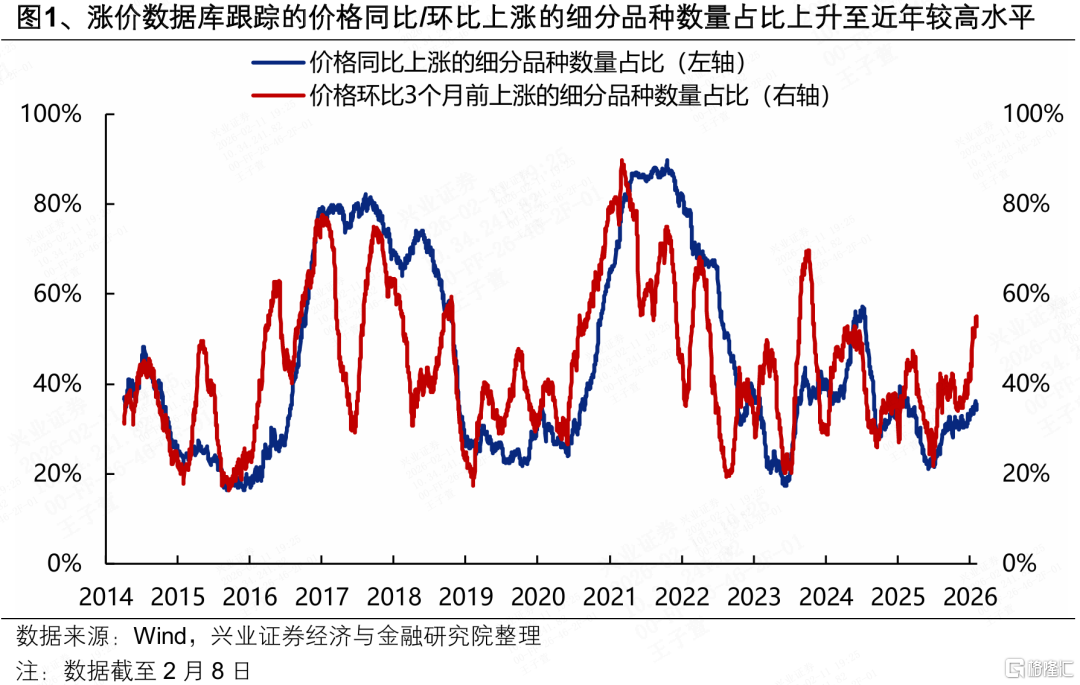
Core Viewpoint - The recovery of prices is identified as the most critical logic supporting corporate profit improvement in 2026, which may also influence market styles [1]. Price Trends and Data Analysis - The first inflation data of the year validates the momentum of price improvement, with the Producer Price Index (PPI) reaching a year-on-year high not seen since August 2024 and a month-on-month high since October 2023 [1]. - The proportion of price-increasing subcategories in the comprehensive price database has risen to a relatively high level, indicating a strong correlation with the month-on-month PPI trends [1]. - Recent price increases are characterized by a broader range and richer clues, driven by international commodity price transmission, favorable policies, and trends in the technology industry [4]. Sector-Specific Insights - The sectors with significant month-on-month PPI increases in January include non-ferrous metals, non-metallic mineral products (such as building materials), black metals, technology manufacturing, chemical fibers, and agricultural processing [4]. - The price increases in these sectors correspond with the high-frequency tracked price subcategories, indicating a robust link between input inflation and domestic price recovery [4]. Price Increase Clues - The proportion of subcategories with price increases over the past three months is at its second-highest level since 2016, only surpassed by the supply-side reform period in 2017 and the significant inflation period in 2021 [4]. - A detailed table shows various subcategories with significant price increases in January, such as oxygen pressure (62.5%), lithium concentrate (52.3%), and DRAM index (35.7%), indicating strong upward price trends across multiple sectors [6][7]. Future Outlook - The post-holiday period is seen as a critical window for validating price increases, with expectations for further price clues to emerge as the spring construction season begins and policies are implemented after the March meetings [9]. - Historical data suggests that the first quarter is typically a key period for PPI acceleration during inflation cycles, indicating a potential for sustained price increases [9]. Sector Performance Expectations - The relative performance of sectors such as TMT (Technology, Media, and Telecommunications), advanced manufacturing, and resource & infrastructure chains is expected to be strong post-Spring Festival, with higher win rates anticipated [10]. - A statistical analysis shows that industries with a positive correlation to PPI include chemicals, steel, building materials, transportation, petrochemicals, non-ferrous metals, and coal, among others [14].

银河期货造纸板块日报-20260211
Yin He Qi Huo· 2026-02-11 09:56
Group 1: Industry Investment Rating - No relevant content provided Group 2: Core Views - The pulp market continues to have a supply - demand imbalance with increasing domestic production and port inventory, while downstream demand from paper mills is weak. The offset printing paper market is in a weak balance, with increased production but a decline in downstream consumption and an increase in enterprise inventory [8][14] Group 3: Summary by Directory Part 1: Data Analysis - **Offset Printing Paper**: Spot prices of various types of offset printing paper remained unchanged on a daily and weekly basis. In the futures market, the 04 contract's closing price rose 0.44% daily, with a 1.32% weekly decline; the 05 and 06 contracts' closing prices rose 0.44% daily, with 0.98% and 0.69% weekly increases respectively. The 04 contract's trading volume increased 85.49% daily but decreased 0.98% weekly, and its open interest decreased 5.70% daily and 0.43% weekly [2] - **Pulp**: Spot prices of some pulp varieties decreased on a weekly basis. In the futures market, the 03 contract's closing price rose 0.58% daily and decreased 1.62% weekly; the 05 contract's closing price rose 0.65% daily and decreased 1.65% weekly; the 07 contract's closing price rose 0.61% daily and decreased 1.83% weekly. The 03 contract's trading volume decreased 31.56% daily and 36.32% weekly, and its open interest decreased 3.77% daily and 14.95% weekly [2] Part 2: Market Analysis Pulp - **Market Review**: Futures contracts rebounded slightly. In the spot market, the willingness of traders to sell was strong, but the enthusiasm of downstream paper enterprises to purchase pulp further declined. The prices of some grades in some markets were loose, and the prices of imported pulp were mainly stable [4] - **Important Information**: As of February 5, 2026, the inventory in China's main pulp ports was 218.2 million tons, a 0.6% increase from the previous period. The production of domestic broad - leaf pulp was 24.9 million tons, a 0.9 - million - ton increase from the previous week, and the production of chemical mechanical pulp was 23.9 million tons, a 0.2 - million - ton increase [8] - **Logic Analysis**: The pulp market has a pattern of oversupply. The supply side has increasing production and inventory, while the demand side has weak support [8] - **Trading Strategies**: For single - sided trading, use range - bound operations. Aggressive investors can lay out a small number of long positions near the previous low. For arbitrage, stay on the sidelines. Sell the SP2605 - P - 5150 option [9][10][11] Offset Printing Paper - **Market Review**: The OP2604 futures contract rebounded slightly. The double - offset paper market changed little, with a decrease in both supply and demand and stable paper prices. The prices of raw materials such as pulp and wood chips were mainly stable [13][14] - **Important Information**: The inventory of double - offset paper production enterprises was 142.2 million tons, a 1.1% increase. The production was 20.1 million tons, a 7.5% increase, and the capacity utilization rate was 51.4%, a 3.5% increase [14] - **Logic Analysis**: The supply and demand of double - offset paper are in a weak balance. The supply side has sufficient supply, while the demand side has weak consumption and an increase in enterprise inventory [14] - **Strategies**: For single - sided trading, short at high prices. For arbitrage, stay on the sidelines. Sell the OP2604 - C - 4200 option [15][16][17] Part 3: Relevant Attachments - The attachments include graphs showing the production volume of domestic pulp, pulp inventory, production profit of broad - leaf pulp, production profit of chemical mechanical pulp, production volume of double - offset paper, inventory of double - offset paper, social inventory of double - offset paper, and production profit of double - offset paper [20][22][26]
恒丰纸业:发行股份收购锦丰纸业100%股权,标的资产已过户
Xin Lang Cai Jing· 2026-02-11 08:02
恒丰纸业公告称,公司拟发行股份收购锦丰纸业100%股权,不涉及募集配套资金。截至2月,本次交易 已获恒丰集团、黑龙江省新产投集团等原则同意,通过国资备案、董事会及股东会审议、上交所审核、 证监会注册等程序。1月26日,标的公司完成工商变更登记,名称变更为四川锦丰纸业有限公司,恒丰 纸业已持有其100%股权。后续,公司需确定过渡期损益归属、发行股份支付对价、修改公司章程等, 实施不存在实质性法律障碍。 ...

国泰海通:1月造纸行业提价逐步落地 盈利进入改善通道
Zhi Tong Cai Jing· 2026-02-11 06:54
白纸板:提价函推动价格上涨,经销商补库意向弱 截至1月28日,250-400g平张白卡纸市场成交含税月均价4268元/吨,环比+0.73%,同比-0.74%。影响价 格变动主要原因系:1)成本压力缓解有限,规模纸厂继续发函促涨;2)贸易商售价与成本出现倒挂,暂以 走货降库为主,价格拉涨谨慎;3)终端订单放量有限,贸易商出货欠佳。 箱瓦纸:纸厂涨价计划未落地,盈利承压 截至1月28日,中国AA级瓦楞纸120g市场月均价2751元/吨,环比-11.60%,同比5.82%。影响价格变动 主要原因系:1)月初规模纸厂涨价函未能落实,转为保价政策并多次下调出厂价格,中小纸厂库存高 位,选择主动让利出货;2)主要原料废纸延续跌势,纸厂为规避高价原料风险,连续下调原料收购价 格,成本支撑不足;3)终端春节订单陆续放量,下游包装厂订单量增加,对瓦楞纸消耗量增加。 废纸:国废消费量下降,价格整体下跌 国泰海通发布研报称,1月进口木浆现货市场中多空因素并存、结构性差异明显导致价格走势分化。其 中阔叶浆价格上涨,白卡纸继续发布提价函,文化纸价格企稳,盈利略有承压,预计木浆市场供应先降 后增,需求跟进不足,白纸价格逐步传导,黑纸价格 ...

造纸板块震荡走高
Di Yi Cai Jing· 2026-02-11 03:39
Core Viewpoint - The stock of Kane Co. has hit the daily limit up, indicating strong market interest and positive sentiment towards the company and its peers in the paper industry [1] Group 1: Company Performance - Kane Co. has reached its daily trading limit, reflecting significant investor confidence [1] - Other companies in the paper industry, including Bohui Paper, Yueyang Forest Paper, Sun Paper, Wuzhou Special Paper, Yibin Paper, and Hengfeng Paper, have also seen their stock prices rise in response to Kane Co.'s performance [1]


岳阳林纸股价涨5.23%,南方基金旗下1只基金位居十大流通股东,持有963.7万股浮盈赚取289.11万元
Xin Lang Cai Jing· 2026-02-11 02:53
Group 1 - The core viewpoint of the news is that Yueyang Lin Paper's stock price increased by 5.23% to 6.04 CNY per share, with a trading volume of 2.32 billion CNY and a turnover rate of 2.23%, resulting in a total market capitalization of 10.616 billion CNY [1] - Yueyang Lin Paper Co., Ltd. is located in the Hunan Free Trade Zone and was established on September 28, 2000, with its listing date on May 25, 2004. The company focuses on the forestry and paper industry, extending into ecological sectors, and has developed a dual-core business model of "pulp and paper + ecology" [1] - The main revenue composition of Yueyang Lin Paper includes: printing paper (49.33%), commodity pulp (22.61%), packaging paper (14.55%), biomass power generation (3.82%), industrial paper (3.66%), municipal landscaping (2.64%), and others [1] Group 2 - From the perspective of major circulating shareholders, Southern Fund has a fund that ranks among the top ten circulating shareholders of Yueyang Lin Paper. The Southern CSI 1000 ETF (512100) entered the top ten in the third quarter, holding 9.637 million shares, accounting for 0.55% of circulating shares, with an estimated floating profit of approximately 2.8911 million CNY [2] - The Southern CSI 1000 ETF (512100) was established on September 29, 2016, with a latest scale of 78.996 billion CNY. Year-to-date returns are 8.61%, ranking 1564 out of 5569 in its category; the one-year return is 34.61%, ranking 1862 out of 4295; and the return since inception is 24.22% [2]