
交通运输

Search documents
A股晚间热点 | 国常会部署!事关数据要素市场
智通财经网· 2025-08-29 16:18
Group 1: Government Policies and Market Development - The State Council emphasizes the need to accelerate the cultivation and improvement of the data factor market, enhance the service capacity of capital factors for the real economy, and promote the coordinated development of medical policies [1] - The China Securities Regulatory Commission (CSRC) aims to consolidate the positive momentum of the capital market and deepen comprehensive reforms to enhance market attractiveness and inclusivity [2] - The Ministry of Industry and Information Technology (MIIT) has set a target for the steel industry to achieve an average annual growth of around 4% from 2025 to 2026 [7] Group 2: Company Performance and Financial Results - Huawei reported a net profit of 37.195 billion yuan for the first half of 2025, a year-on-year decrease of 32%, while revenue increased by 3.95% to 427.039 billion yuan [3] - Xinhua Insurance's Honghu Fund Phase II has nearly completed its investment, with Phase III launched in July making good progress [4] - The average daily trading volume in the Shanghai market reached 678.55 billion yuan in July, a month-on-month increase of 32.9% [5] Group 3: Market Reactions and Economic Indicators - The U.S. stock market indices fell, with Alibaba's stock rising nearly 10% after reporting a revenue of 247.65 billion yuan for Q1 2026, a 2% year-on-year increase [8] - The Indian rupee depreciated to a historical low against the dollar, influenced by concerns over tariffs and foreign capital outflows [9] - Following the dismissal of Thailand's Prime Minister, the Thai stock market index dropped by 1% [10] Group 4: Investment Opportunities and Sector Focus - Guangdong Province is accelerating the development of industries such as artificial intelligence, robotics, and integrated circuits, aiming to create new investment hotspots [12] - The AI industry is seen as a key driver of technological revolution and industrial transformation, with ongoing policy support expected to accelerate its development [12] - Companies like SMIC are planning to issue A-shares to acquire minority stakes in subsidiaries, indicating strategic growth initiatives [15]




策略日报:缩圈-20250829
Tai Ping Yang Zheng Quan· 2025-08-29 15:24
Group 1: Macro Asset Tracking - The bond market shows narrow fluctuations with a slight increase, but the risk of further declines remains high after short-term stabilization [17] - The stock market is experiencing a "shrinking circle" phenomenon, with large-cap indices outperforming small-cap indices, indicating a decrease in market risk appetite [19] - The A-share market's long-term upward trend remains intact, supported by recent policy shifts towards increased fiscal spending targeting residents [19][6] Group 2: A-Share Market Insights - The A-share market saw a trading volume of 2.83 trillion, down nearly 170 billion from the previous trading day, with around 3,200 stocks declining [19] - The market is characterized by increased volatility, suggesting that buying on dips is a better strategy than chasing highs [19] - Recent policies indicate a shift from investment-driven growth to consumer-driven growth, which is expected to support economic recovery [19] Group 3: U.S. Market Overview - The U.S. stock market indices rose, with the Nasdaq up 0.53%, Dow Jones up 0.16%, and S&P 500 up 0.32%, driven by improved GDP and employment data [25] - The U.S. second-quarter GDP growth was revised up to 3.3%, with business investment growth significantly revised from 1.9% to 5.7% [25][40] - The dovish tone from the Federal Reserve Chairman at the Jackson Hole meeting opens the door for potential rate cuts, which may boost market risk appetite [25] Group 4: Currency Market Analysis - The onshore RMB against the USD was reported at 7.1299, down 86 basis points from the previous close, indicating a potential rebound in the dollar [29] - The outlook for the dollar is expected to be weak in the short term, but the cost-effectiveness of shorting the dollar is considered low [30] Group 5: Commodity Market Trends - The Wenhua Commodity Index increased by 0.16%, with construction materials and non-ferrous metals leading the gains, while oilseeds and ferroalloys lagged [34] - The current pricing of domestic commodities remains at historical lows, suggesting that shorting commodities lacks cost-effectiveness [34] Group 6: Important Policies and News - The Ministry of Finance reported that from January to July, state-owned enterprises' total profits were 24,786.4 billion, a year-on-year decrease of 3.3% [37] - The National Development and Reform Commission emphasized the need to avoid disorderly competition in the development of "Artificial Intelligence+" [39]
28.23亿元主力资金今日撤离交通运输板块
Zheng Quan Shi Bao Wang· 2025-08-29 13:04
Market Overview - The Shanghai Composite Index rose by 0.37% on August 29, with 17 out of the 28 sectors experiencing gains, led by the comprehensive and electric equipment sectors, which increased by 3.86% and 3.12% respectively [1] - The transportation sector saw a decline of 1.69%, ranking second in terms of daily losses [1] Capital Flow Analysis - The net outflow of capital from the two markets reached 69.47 billion yuan, with 7 sectors experiencing net inflows, the electric equipment sector leading with a net inflow of 3.13 billion yuan [1] - The food and beverage sector followed with a daily increase of 2.42% and a net inflow of 1.63 billion yuan [1] Transportation Sector Performance - The transportation sector had a net outflow of 2.82 billion yuan, with 127 stocks in the sector, of which 35 rose and 87 fell [2] - The top stock in terms of net inflow was Guangshen Railway, with a net inflow of 225 million yuan, followed by Wanlin Logistics and Eastern Airlines Logistics with net inflows of 31.28 million yuan and 28.55 million yuan respectively [2] Transportation Sector Outflow Rankings - The stocks with the highest net outflows included COSCO Shipping Holdings, with a net outflow of 838.49 million yuan, and SF Express, with a net outflow of 811.67 million yuan [4] - Other notable outflows were from Daqin Railway and Yunda Holding, with net outflows of 169.80 million yuan and 159.22 million yuan respectively [4]




海峡股份:经营的海口至海安客滚运输航线涉及民生物资保障
Zheng Quan Ri Bao Wang· 2025-08-29 11:43
证券日报网讯海峡股份(002320)8月29日在互动平台回答投资者提问时表示,公司经营的海口至海安 客滚运输航线涉及民生物资保障,公司将充分考虑社会各方意见,视市场需求,适时、审慎调整船票价 格体系,如有变动,公司将及时公告。 ...

【29日资金路线图】两市主力资金净流出近530亿元 电力设备等行业实现净流入
证券时报· 2025-08-29 09:44
Core Viewpoint - The stock market showed mixed performance with the Shanghai Composite Index rising by 0.37% and the Shenzhen Component Index increasing by 0.99%, while the total trading volume decreased compared to the previous day [1]. Group 1: Market Overview - The Shanghai Composite Index closed at 3857.93 points, up 0.37% - The Shenzhen Component Index closed at 12696.15 points, up 0.99% - The ChiNext Index closed at 2890.13 points, up 2.23% - Total trading volume in both markets was 27,982.97 billion, a decrease of 1,725.05 billion from the previous trading day [1]. Group 2: Capital Flow - The net outflow of main funds in the two markets was nearly 530 billion, with an opening net outflow of 222.09 billion and a closing net outflow of 41.04 billion, totaling 527.66 billion for the day [2]. - The net outflow for the CSI 300 was 126.1 billion, while the ChiNext saw a net outflow of 161.98 billion [2][4]. Group 3: Sector Performance - The electric power equipment sector saw a net inflow of 63.62 billion, with a growth of 0.89% - The food and beverage sector had a net inflow of 46.95 billion, increasing by 1.03% - The non-ferrous metals sector recorded a net inflow of 33.88 billion, up 1.36% - The computer sector experienced the largest net outflow of 233.02 billion, declining by 1.27% - The electronics sector had a net outflow of 200.08 billion, down 1.22% [5][6]. Group 4: Institutional Focus - The top stocks with significant institutional net purchases included Wancheng Group with a net buy of 30,789.36 million, and Longyang Electronics with a net buy of 9,226.96 million [9]. - Notable stocks with strong institutional interest also included Xian Dao Intelligent and Hong Baoli, with respective net buys of 7,157.43 million and 5,466.88 million [9]. Group 5: Latest Institutional Ratings - Sichuan Chengyu received a strong buy rating from Huachuang Securities with a target price of 8, indicating a potential upside of 41.34% from its latest closing price of 5.66 [11]. - Industrial Bank was rated buy by Huatai Securities with a target price of 27.1, suggesting a 20.93% upside from its latest closing price of 22.41 [11].

化债观察之城投新增融资透视
Yuan Dong Zi Xin· 2025-08-29 09:21
Report Industry Investment Rating - Not provided in the content Core Viewpoints of the Report - Since July 2023, local government debt resolution policies have been intensively introduced, forming a "Document 35 + 6" policy system, which strictly regulates urban investment financing. Under the current refinancing environment that emphasizes both strict supervision and debt resolution, urban investment new - financing shows significant characteristics of "total volume control and structural differentiation", and the credit stratification and regional differentiation in the urban investment financing market will further intensify [2][4]. - The policy will continue to adhere to the principle of differentiated management, strictly curb new implicit debts, and support the transformation of qualified urban investment platforms. Regions with resource advantages and industrial support are expected to expand financing channels through industrial investment platforms, while regions with slow transformation and scarce resources will face severe constraints on platform financing capabilities [4]. Summary by Relevant Catalogs Urban Investment Financing Policy - Since July 2023, a "Document 35 + 6" policy system has been formed. Document 35 classifies regions and local state - owned enterprises and implements differentiated management of financing policies. The six supplementary documents further clarify measures such as controlling new government investment projects, expanding the scope of debt resolution measures, and specifying the exit path for high - risk key provinces. Overall, it comprehensively regulates urban investment financing [6]. - In March 2025, the Shanghai Stock Exchange issued Guidance Document No. 3, which added many review points for urban investment issuers, including clarifying the boundaries of urban investment entities, raising the threshold for bond issuance, and putting forward review requirements for the chaos in urban investment transformation, which is both a specific implementation of strict review and a guide for urban investment transformation [7]. - In the current urban investment financing review practice, bond issuance approval mainly relies on the list - based management, and the overall review scale is still strict. Even if the issuer is not on or has exited the "3899 list", it still needs to meet relevant regulations to issue new bonds [8]. Overview of New Urban Investment Financing - From October 2023 to July 2025, 534 urban investment entities in 28 provinces achieved new bond issuance. Economically developed provinces such as Guangdong, Jiangsu, and Zhejiang are dominant. In terms of administrative levels, prefecture - level and district - level entities are the main ones. High - rating entities (AAA and AA+) are the leading ones in new financing. The number of entities achieving new financing in the inter - bank market and the exchange market is basically the same, but there are obvious structural differences among different administrative levels [13][14][16]. - Most entities only issued 1 new bond, and those that could issue more than 3 new bonds were concentrated in AAA - rated provincial and prefecture - level entities. In terms of bond types, the scale of inter - bank products in new urban investment bonds significantly leads that of exchange products, and medium - term notes and ultra - short - term financing bills have the largest scale. New urban investment bonds are mainly public - offering bonds, and the main use of raised funds is to repay interest - bearing debts [18][22]. Overview of Entities Issuing Bonds for the First Time First - time Issuance of Urban Investment Platforms - From October 2023, among the 534 urban investment entities that achieved new financing, 69 were first - time bond issuers. They are characterized by "relatively weak credit qualifications (mainly district - level and AA+), leading number of first - time issuers in the exchange, and private - offering products as the mainstay". Different issuance venues have obvious regional preferences [34]. - Guangdong has significantly more first - time urban investment new - issuance entities than other provinces. There are three main types of regional preferences: regions with zero hidden debts, good economic foundations, and relatively loose supervision; regions with good economic foundations but large existing urban investment debts and different supervision intensities in the inter - bank and exchange markets; regions with relatively large economic volumes but heavy debt burdens, mainly achieving new issuance in the exchange [41][42]. First - time Issuance of Quasi - Urban Investment Industrial Entities - The first - time issuance of quasi - urban investment industrial entities is characterized by "mainly prefecture - level and AA+ entities, leading number of first - time issuers in the exchange, and both public - offering and private - offering products thriving". Their credit levels are generally better than those of first - time urban investment entities, and their financing channels are more diverse [47]. - These entities can be classified into three types according to business types: industrial holding, public utilities, and transportation. Industrial holding platforms account for more than 70% of the samples, and their credit qualifications are highly differentiated, which can be further divided into five sub - types [57][70].
粤开市场日报-20250829
Yuekai Securities· 2025-08-29 08:28
Market Overview - The A-share market saw most major indices closing higher today, with the Shanghai Composite Index rising by 0.37% to close at 3857.93 points, the Shenzhen Component Index increasing by 0.99% to 12696.15 points, and the ChiNext Index up by 2.23% to 2890.13 points. However, the Sci-Tech 50 Index fell by 1.71% to 1341.31 points [1][14]. - Overall, there were 1997 stocks that rose and 3305 stocks that fell, with 121 stocks remaining flat. The total trading volume in the Shanghai and Shenzhen markets was 27983 billion yuan, a decrease of 1725 billion yuan compared to the previous trading day [1]. Industry Performance - Among the Shenwan first-level industries, the leading sectors included Comprehensive, Power Equipment, Nonferrous Metals, Food & Beverage, and Pharmaceutical & Biological industries, with respective gains of 3.86%, 3.12%, 2.44%, 2.42%, and 1.42%. Conversely, the sectors that experienced declines included Household Appliances, Transportation, Computer, Communication, and Banking, with losses of 1.82%, 1.69%, 1.48%, 0.80%, and 0.76% respectively [1][14]. Concept Sector Performance - The top-performing concept sectors today included Continuous Board, Rare Earth, Power Battery, Rare Metals, CRO, Lithium Battery, Lithium Iron Phosphate Battery, Lithium Electrolyte, Baijiu, Insurance, Small Metals, New Energy Vehicles, and Beverage Manufacturing [2][11].
AI能力“非线性提升”,这被市场普遍低估!大摩:90%职业将受影响,就业结构将“根本转变”
Hua Er Jie Jian Wen· 2025-08-29 03:23
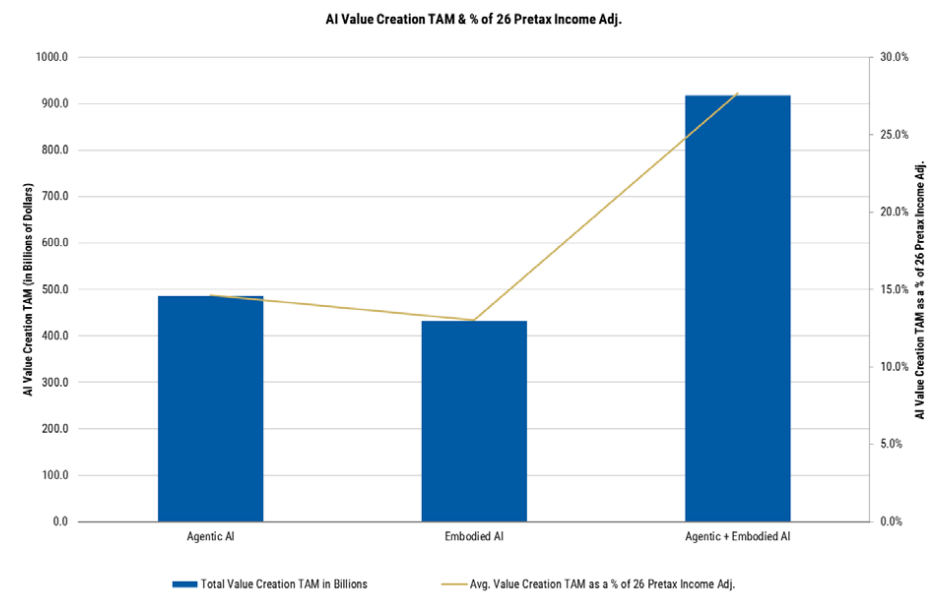
Core Insights - Morgan Stanley emphasizes that the market is significantly underestimating the speed of "non-linear" improvements in AI capabilities and their disruptive impacts [1][7] - The comprehensive adoption of AI is projected to generate approximately $920 billion in long-term benefits for S&P 500 companies, with potential market value creation ranging from $13 trillion to $16 trillion, exceeding 25% of the expected pre-tax total revenue for S&P 500 companies in 2026 [2][6] Economic Potential of AI Adoption - Morgan Stanley quantifies the economic benefits of AI adoption, predicting around $920 billion in long-term gains for S&P 500 companies and a potential market value increase of $13 trillion to $16 trillion [2][5] - This opportunity is equivalent to over 25% of the adjusted pre-tax total revenue forecast for S&P 500 companies in 2026 [2] Key Beneficiary Industries - The value creation potential from AI is expected to be most significant in essential consumer goods distribution/retail, real estate management and development, transportation, and healthcare equipment and services [8][14] - Manufacturing applications are highlighted as a major area of benefit, with a conservative estimate of value creation that does not fully account for future non-linear improvements in AI capabilities [6] Non-linear Capability Improvements - Morgan Stanley believes that the market generally underestimates the "non-linear" speed of AI capability improvements, which is crucial for generating significant alpha opportunities [7] - The report cites independent AI assessment data indicating that the length of tasks AI agents can complete has been growing exponentially, doubling approximately every seven months over the past six years [7][10] Employment Market Transformation - The report highlights that around 90% of jobs will be affected by AI automation and enhancement, leading to a fundamental restructuring of the employment market [14][16] - Historical precedents show that technological changes, like the introduction of spreadsheets, can eliminate certain jobs while creating new ones, suggesting a similar but potentially more drastic transformation due to AI [14] Job Market Trends - In sectors most impacted by AI, there has been a notable slowdown in hiring for entry-level positions, with software development jobs for 22 to 25-year-olds declining by nearly 20% from late 2022 to mid-2025 [15][16] - Customer service roles are experiencing similar downward trends, indicating a shift in job availability due to automation [15] Cost Efficiency in Manufacturing - Human-like robots are expected to further reduce costs in manufacturing, with AI-enhanced robots costing approximately $5 per hour compared to the average wage of $36 per hour for factory workers in the U.S. [18]
坚持问题导向、分类施策、降本增效 政府和社会资本合作存量项目迎新规
Jing Ji Ri Bao· 2025-08-29 01:45
Core Viewpoint - The new guidelines for PPP (Public-Private Partnership) stock projects aim to standardize construction and operation, enhance project quality and efficiency, and improve public service supply levels [1][2]. Group 1: Guidelines and Requirements - Approximately 70% of PPP stock projects have entered the operational phase, making their operational status crucial for public service quality and efficiency [2]. - The guidelines emphasize adherence to contracts, requiring local governments to fulfill payment obligations based on performance results and to include these responsibilities in budget management [2][4]. - The guidelines advocate for cost reduction and efficiency improvement, encouraging localities to streamline projects and adjust investment return indicators while promoting innovative operational models and advanced technologies [2][3]. Group 2: Project Implementation and Prioritization - For ongoing projects with physical work completed, the focus is on ensuring timely completion and realizing the benefits of prior investments, prioritizing projects with certain returns based on local economic needs [3]. - Projects not started by the end of 2024 will generally not adopt the PPP model, with alternative implementation methods suggested for necessary projects [3]. - The guidelines categorize PPP stock projects into three types: fully government-funded, feasibility gap subsidy, and user-paid projects, with the first two requiring government subsidies [3]. Group 3: Financial Management and Support - The guidelines stress the importance of local governments incorporating PPP-related expenditures into budget management and utilizing various funding sources, including special bonds and local funds, to support project operations [4]. - Local governments are urged to take responsibility for resource coordination and to implement targeted measures to ensure the stable operation of PPP stock projects [4].
PPP存量项目迎新规!不得以这些理由拖欠付费
Zhong Guo Jing Ji Wang· 2025-08-29 00:36
Core Viewpoint - The new guidelines issued by the State Council aim to standardize the construction and operation of existing Public-Private Partnership (PPP) projects, enhancing project quality and efficiency while improving public service supply levels [1][2]. Group 1: Guidelines for Existing PPP Projects - Approximately 70% of existing PPP projects have entered the operational phase, making their operational status crucial for the quality and efficiency of public service supply [2]. - The guidelines emphasize adherence to contracts, requiring local governments to fulfill their contractual obligations and manage government expenditure responsibilities within budget [2][3]. - The guidelines advocate for cost reduction and efficiency improvement, encouraging localities to streamline projects and innovate operational models to enhance professional management [2][3]. Group 2: Support for Ongoing and Future Projects - For ongoing projects that have commenced construction, the focus is on ensuring their completion and realizing the benefits of prior investments [3]. - Projects that have not started by the end of 2024 will generally not be implemented under the PPP model, with alternative models suggested for necessary projects [3]. - The guidelines categorize existing PPP projects into three types: fully government-funded projects, feasibility gap subsidy projects, and user-paid projects, with the first two requiring government subsidies [3][4]. Group 3: Financial Management and Responsibility - The guidelines stress the importance of local governments incorporating PPP-related expenditures into budget management and ensuring timely payments based on performance evaluations [4]. - Local governments are encouraged to utilize various funding sources, including special bonds and central transfers, to support the construction costs of existing projects [4]. - The guidelines call for a systematic approach from local governments, particularly at the provincial level, to take responsibility and coordinate resources effectively to support the stable operation of PPP projects [4].