
房地产

Search documents
涨停复盘:今日全市场共62只股涨停,连板股总数13只,AI应用端佳云科技20CM涨停!
Sou Hu Cai Jing· 2026-01-20 10:09
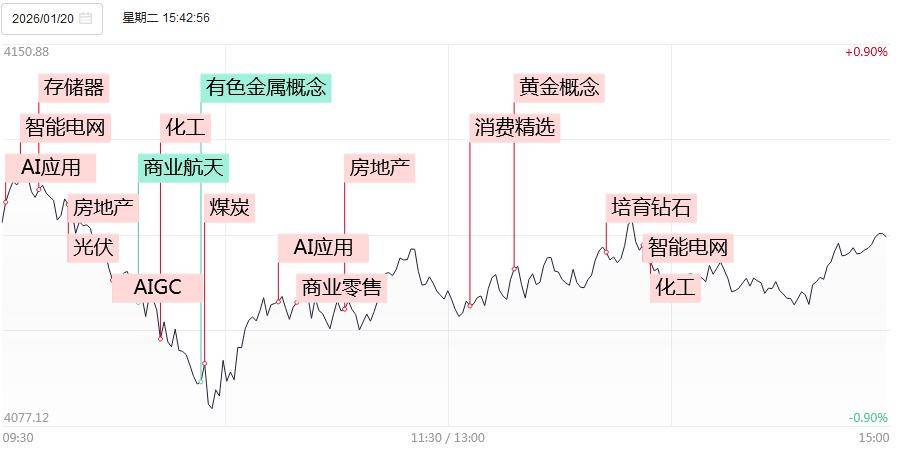
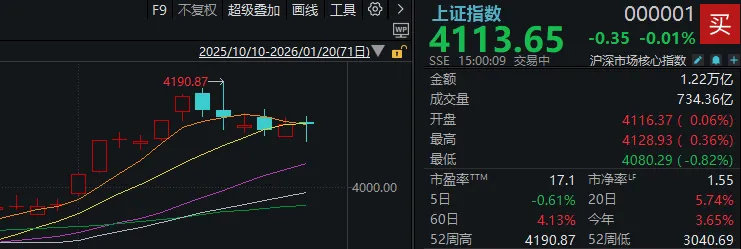
Market Overview - On January 20, all three major indices closed lower, with the ChiNext Index dropping over 2% at one point. The total trading volume in the Shanghai and Shenzhen markets reached 2.78 trillion yuan, an increase of 69.4 billion yuan compared to the previous trading day [1] - The Shanghai Composite Index fell by 0.01%, the Shenzhen Component Index decreased by 0.97%, and the ChiNext Index declined by 1.79% [1] Sector Performance - The chemical sector showed strong performance, with over ten stocks hitting the daily limit, including Hongbaoli, Shandong Heda, Weiyuan Co., and Hongqiang Co. [1] - Precious metals continued to perform well, with Hunan Silver hitting the daily limit [1] - The real estate sector was active, with stocks like Dayuecheng and City Investment Holdings also hitting the daily limit [1] - AI application stocks saw localized gains, with stocks such as Jiayun Technology, Yue Media, and Zhejiang Wenhu gaining the daily limit [1] - Conversely, sectors like computing hardware and commercial aerospace experienced significant declines, with commercial aerospace stocks collectively dropping, including Shenjian Co. facing four consecutive daily limits [1] Limit-Up and Limit-Down Analysis - A total of 53 stocks hit the daily limit across the market (excluding ST and delisted stocks), with 13 stocks achieving consecutive limit-ups [1] - Focus stocks included Jiamei Packaging, which saw a change in actual controller and achieved 16 consecutive limit-ups, and Fenglong Co., which had 15 consecutive limit-ups [1] Sector Highlights - **Chemical Sector**: Major stocks like Cangzhou Dahua and Xinxiang Chemical Fiber saw limit-ups due to factors such as TDI and caustic soda prices [10] - **Real Estate Sector**: Stocks like City Investment Holdings and Dayuecheng gained due to their involvement in real estate and affordable housing [10] - **Smart Grid Sector**: Stocks such as Senyuan Electric and Hancable achieved consecutive limit-ups driven by developments in grid equipment and data centers [10] - **AI Application Sector**: Companies like Zhejiang Wenhu and Yue Media gained due to their involvement in AI marketing and collaborations with major tech firms [10] - **Commercial Aerospace Sector**: Stocks like Hangfa Technology and Jiuding New Materials saw activity due to expectations surrounding aerospace developments [11] Related Hotspots - **Chemical Industry**: Huatai Securities indicated that the profitability of bulk chemicals is at a ten-year low, suggesting a potential upward trend as the industry approaches a dual turning point in capacity and inventory [12] - **Electric Grid**: The State Grid Corporation's fixed asset investment is projected to reach 4 trillion yuan during the 14th Five-Year Plan, a 40% increase compared to the previous plan [12] - **AI Applications**: The integration of Qianwen into Alibaba's core ecosystem marks a significant upgrade of large models from dialogue tools to task executors [12] - **Real Estate**: The Ministry of Finance and other departments announced the extension of personal income tax incentives for residents purchasing new homes until the end of 2027 [12]


2025年12月经济数据点评:总量平稳背后的结构差异
BOHAI SECURITIES· 2026-01-20 10:07
Economic Growth - In Q4 2025, the actual GDP grew by 4.5% year-on-year, matching expectations but down from 4.8% in the previous quarter[2] - The annual economic growth for 2025 was characterized by a high start and a low finish, influenced by policy timing and demand-supply dynamics[3] Industrial Production - The industrial added value in December 2025 increased by 5.2% year-on-year, slightly above the expected 5.0%[2] - High-tech manufacturing sectors showed growth rates significantly above the overall industrial average, indicating a shift in production structure[4] Consumer Spending - Retail sales of consumer goods in December 2025 grew by only 0.9% year-on-year, below the expected 1.0% and down from 1.3% in the previous month[2] - Service consumption outperformed goods consumption, with specific sectors like cultural and communication equipment showing stronger performance[5] Investment Trends - Fixed asset investment saw a cumulative year-on-year decline of 3.8% by December 2025, worse than the expected decline of 3.1%[2] - Real estate investment dropped significantly, with a year-on-year decline of 35.8%, indicating ongoing challenges in the sector[6] Future Outlook - The first quarter of 2026 is expected to see continued structural support from net exports, with potential stabilization in government-led investment projects[3] - Further policy measures are anticipated to support consumer spending and investment recovery in 2026[5][6]
如何从一二级市场联动寻找产业债交易信号?(行业篇)
Soochow Securities· 2026-01-20 09:28
Report Industry Investment Rating No information provided in the content. Core Viewpoints - The secondary - market trends of industrial bond sub - industries show a divergence in the correlation between primary and secondary markets. This divergence may be due to differences in supply among industries and differences in bond liquidity and trading popularity within each industry. If an industry has many issuing entities with strong willingness and ability to issue bonds and is in a good development trend, the probability of a synchronous resonance relationship between primary - market supply and secondary - market demand is relatively high, which can improve the accuracy of judging trading signals of narrowing spreads from daily net financing [1][14]. - Most industries have trading signals transmitted from primary - market supply to secondary - market demand, including comprehensive, non - ferrous metals, and others. Some industries show a stronger negative correlation between primary - market supply and secondary - market demand, such as comprehensive and non - ferrous metals. Some industries have a weak correlation between daily net financing and daily spreads, including communication and food and beverage [2][4]. Summary by Directory 1. Industrial Bond Sub - industries Show Divergence in Primary - Secondary Market Trend Correlation - **Research Method**: Classify industrial bond issuers by Shenwan primary industries, calculate the daily net financing and daily credit spreads of each sub - industry from January 1, 2025, to December 19, 2025, to observe the correlation between primary - market supply and secondary - market demand [12]. - **Divergence Performance**: Most industries have trading signals transmitted from primary - market supply to secondary - market demand, while some do not show this feature significantly [13]. - **Reasons for Divergence**: Differences in supply among industries are related to the number, size, and life - cycle stage of issuing entities. Differences in bond liquidity and trading popularity within industries are related to the scale of outstanding bonds, valuation levels, and event catalysts [14]. 1.1. Industries with Obvious Correlation - **Comprehensive Industry**: From January to March 2025, daily net financing decreased and daily spreads increased; from March to June, daily net financing increased and daily spreads decreased; from June to December, both were in a low - level oscillation [21]. - **Non - ferrous Metals Industry**: From January to July 2025, daily net financing increased and daily spreads decreased; from July to September, daily net financing decreased and daily spreads increased; from October to December, both were in a low - level oscillation [25]. - **Other Industries**: Similar analysis is conducted for industries such as pharmaceutical biology, social services, and others, with different trends in different time intervals [27][30][32]. - **Common Features**: These industries generally have a large scale of outstanding bonds and high institutional investor attention, which is conducive to the transmission of primary - market supply changes to secondary - market spread changes [3][87]. 1.2. Industries with General Correlation - **Industries Included**: Communication, food and beverage, and other industries have a weak correlation between daily net financing and daily spreads, and the linkage and transmission between primary - and secondary - market indicators are relatively weak [4][13]. - **Reasons**: These industries have low participation in the bond market, and their secondary - market trading demand is more affected by overall bond - market trends, industry risk premiums, and liquidity premiums. Different types of industries have specific reasons for the weak correlation [4][90][91].
两市主力资金净流出957.23亿元,电力设备行业净流出居首
Zheng Quan Shi Bao Wang· 2026-01-20 09:20
Market Overview - On January 20, the Shanghai Composite Index fell by 0.01%, the Shenzhen Component Index decreased by 0.97%, the ChiNext Index dropped by 1.79%, and the CSI 300 Index declined by 0.33% [1] - Among the tradable A-shares, 2,233 stocks rose, accounting for 40.85%, while 3,102 stocks fell [1] Capital Flow - The main capital experienced a net outflow of 95.723 billion yuan, marking the 11th consecutive trading day of net outflows [1] - The ChiNext saw a net outflow of 36.169 billion yuan, the Sci-Tech Innovation Board had a net outflow of 10.781 billion yuan, and the CSI 300 constituents experienced a net outflow of 24.880 billion yuan [1] Industry Performance - Among the 11 primary industries, 20 sectors saw gains, with the top performers being Oil & Petrochemicals and Building Materials, which rose by 1.74% and 1.71%, respectively [1] - The sectors with the largest declines included Communication and National Defense & Military Industry, which fell by 3.23% and 2.87%, respectively [1] Industry Capital Inflows - The Banking sector led with a net inflow of 1.472 billion yuan and a daily increase of 0.80%, followed by the Real Estate sector with a net inflow of 0.627 billion yuan and a daily increase of 1.55% [1] - The Electric Power Equipment sector had the largest net outflow of 19.054 billion yuan, with a daily decline of 1.84%, followed by the Electronics sector with a net outflow of 18.394 billion yuan and a decline of 1.23% [2] Individual Stock Performance - A total of 1,686 stocks experienced net inflows, with 693 stocks having inflows exceeding 10 million yuan, and 109 stocks with inflows over 100 million yuan [3] - Shanghai Electric saw the highest net inflow of 0.858 billion yuan, with a daily increase of 8.13%, followed by China Power Construction and Shanzhi Gaoke with net inflows of 0.644 billion yuan and 0.522 billion yuan, respectively [3] - The stocks with the largest net outflows included Xinyi Sheng, Zhongji Xuchuang, and Shenghong Technology, with outflows of 2.137 billion yuan, 2.068 billion yuan, and 1.858 billion yuan, respectively [3]
GDP突破140万亿,如何理解宏观增长与微观感受有“温差”?
Bei Ke Cai Jing· 2026-01-20 09:19
Economic Overview - In 2025, China's GDP reached 140 trillion yuan, marking a 5.0% increase from the previous year [4][7] - The per capita disposable income for residents was approximately 43,400 yuan, also reflecting a 5.0% growth [4][8] Employment and Income - The average urban survey unemployment rate in 2025 was 5.2%, below the target of around 5.5% [10] - The unemployment rate for urban workers aged 30-59 averaged 4.0%, which is 1.2 percentage points lower than the overall urban rate [11][12] - Per capita wage income grew by 5.3%, while per capita operating net income increased by 5.0% [9] Consumer Spending - Per capita consumer spending was about 29,500 yuan, with a nominal growth of 4.4% from the previous year [13] - Key areas of consumer spending, such as education, culture, entertainment, and healthcare, showed high growth rates [13] Structural Economic Issues - There exists a "temperature difference" between macroeconomic growth and individual experiences, attributed to structural factors and the transition between old and new economic drivers [6][15] - The growth in high-tech manufacturing (9.4%) outpaced traditional industries, contributing to the perceived economic disparity [16] Policy Recommendations - Experts suggest that government actions should focus on policy implementation to address the "temperature difference" and ensure that economic growth benefits all demographics [22][24] - The Central Economic Work Conference proposed measures to stabilize employment for key groups, such as college graduates and migrant workers, and to support the real estate market [23]

A股再度陷入调整,有这些原因
Mei Ri Jing Ji Xin Wen· 2026-01-20 09:17
Market Overview - The three major indices in the A-share market collectively declined, with the ChiNext index dropping over 2% at one point. The Shanghai Composite Index closed down 0.01%, the Shenzhen Component Index down 0.97%, and the ChiNext Index down 1.79% [1] - Over 3,100 stocks in the market experienced declines, with total trading volume reaching 2.78 trillion yuan, an increase of 694 billion yuan compared to the previous trading day [1] Sector Performance - The chemical sector showed strong performance, while precious metals continued their upward trend, and the real estate sector was active. Conversely, sectors such as computing hardware and commercial aerospace saw significant declines [1] - The average stock price across the A-share market recorded its second bearish signal for 2026, indicating a cooling trend [3] External Influences - Concerns from the U.S. stock market, particularly due to negative sentiment stemming from news related to Japan and Greenland, affected the Asia-Pacific markets [4] - Japan's Prime Minister announced the dissolution of the House of Representatives for elections, leading to a sell-off in long-term Japanese government bonds and rising yields [5] - The impending U.S. tariffs on Greenland are contributing to increasing trade tensions, which may impact demand for U.S. assets and accelerate declines in global bond prices [5] A-share Market Dynamics - The financing buy-in amount for A-shares dropped to 267.4 billion yuan on January 19, down 20.35% from the previous Friday and 40.68% from the peak of 450.8 billion yuan on January 14 [6] - There has been a significant outflow of funds from stock ETFs, with over 400 billion yuan net outflow recorded, marking the third consecutive day of substantial outflows [8] Stock Trends - The market has seen a shift in trading dynamics, with a notable cooling in aggressive short-term trading styles. The number of consecutive daily limit-up stocks has decreased from six to three [9] - Technology stocks, particularly in computing hardware and AI applications, have generally retreated, while sectors like precious metals and chemicals have shown gains [9] Policy and Industry Insights - The Ministry of Industry and Information Technology and other departments have issued guidelines to promote zero-carbon factory construction, which is expected to support the green transformation and high-quality development of the chemical industry [11] - Analysts suggest that the Chinese chemical industry may experience a revaluation due to reduced capacity expansion, potentially leading to higher dividend yields and a shift from being a cash-consuming sector to a cash-generating one [11]
2025年12月经济数据点评:总量趋稳,结构有亮点
Changjiang Securities· 2026-01-20 09:10
1. Report Industry Investment Rating - No relevant content provided. 2. Core Views of the Report - In 2025, the annual economic growth rate reached the target of 5%. Consumption and exports' contribution to GDP growth increased, while investment's contribution declined. Looking ahead to 2026, the real GDP growth rate is expected to be around 4.8%, showing a "first down then up" trend due to the high base effect. [2][7] - The bond market's pricing of the fundamentals may still exhibit an asymmetry of "being insensitive to positive news and sensitive to negative news." The view of a weak and volatile long - term bond market in the near term is maintained, and the recovery window may come later in the first quarter. [2][7] 3. Summary by Related Catalogs 3.1 2025 Economic Data Overview - The Q4 real GDP in 2025 was 4.5% year - on - year, meeting expectations, and the annual cumulative year - on - year growth rate successfully achieved the target of 5%. In December 2025, the year - on - year growth rate of industrial added value above designated size rose by 0.4 pct to 5.2%, higher than the expected 4.9%; the year - on - year growth rate of social retail sales dropped by 0.4 pct to 0.9%, lower than the expected 1.5%; the cumulative year - on - year growth rate of fixed asset investment dropped by 1.2 pct to - 3.8%, worse than the expected - 2.4%. [4] 3.2 Economic Growth Drivers - Consumption and exports' contribution to GDP growth increased to 2.6% and 1.64% respectively, while investment's contribution declined to 0.77%. There was still price pressure. The Q4 real GDP growth rate was 4.5% year - on - year, down 0.3 pct from Q3, and it declined quarter by quarter throughout the year, reaching the lowest level since 2023. The price level improved quarter by quarter, with the GDP deflator's year - on - year growth rate dropping to around - 0.67%, and the nominal GDP growth rate was 3.8% year - on - year, showing marginal improvement but remaining at a low level. [7] 3.3 Industrial Sector - In December, the industrial added value was 5.2% year - on - year, 0.4 pct higher than the previous value, and 0.49% month - on - month. The year - on - year growth rate of export delivery value turned positive to 3.2%. The service industry production index was 5% year - on - year, 0.8 pct faster than the previous month. By sector, the mining industry was a major drag, with its year - on - year growth rate dropping by 0.9 pct to 5.4%, while the manufacturing industry's year - on - year growth rate increased by 1.1 pct to 5.7%. High - end manufacturing maintained a high growth rate, with the year - on - year growth rates of pharmaceutical manufacturing, special equipment manufacturing, and computer and communication equipment manufacturing accelerating by 4.6, 3.4, and 2.6 pct respectively. The output of high - tech products such as industrial robots and integrated circuits maintained a high month - on - month growth rate. In 2025, the added value of high - tech manufacturing increased by 9.4% compared to the previous year, contributing 26.1% to the growth rate of industrial added value above designated size. [7] 3.4 Investment Sector - The decline in fixed asset investment widened. Real estate investment continued to decline due to the drag of housing prices, and infrastructure and manufacturing investment weakened overall against the backdrop of enterprises' concentrated debt repayment, debt reduction, and "anti - involution." In December, the month - on - month growth rate of fixed asset investment dropped to - 15.0%, and the month - on - month decline of private investment was about - 17.2%. Real estate investment's month - on - month decline widened to - 37.5%, the sales area decreased by 16.6% year - on - year, and the sales volume decreased by 24.2% year - on - year. The prices of commercial residential buildings in 70 large and medium - sized cities generally decreased month - on - month, and the year - on - year decline widened. The insufficient funds of real estate enterprises still restricted construction starts and completions, but the new construction area stabilized, and the cumulative year - on - year decline narrowed. Infrastructure investment continued to decline, with the month - on - month growth rate of broad - based infrastructure investment at - 15.9%, and the "crowding - out effect" of debt reduction may still have had an impact. In 2025, the cumulative year - on - year growth rate of manufacturing investment was 0.6%, but in December, the month - on - month growth rate was - 10.5%, indicating that enterprises were cautious about investment against the "anti - involution" background. The capacity utilization rate of the manufacturing industry increased from 74.1% in Q1 to 75.2% in Q4. [7] 3.5 Consumption Sector - The growth rate of social retail sales declined, and residents' income and expenditure continued to slow down. In December, the year - on - year growth rate of social retail sales dropped to 0.9%, the lowest since March 2023. The off - season effect was evident, with commodity retail (0.7%) and catering (2.2%) remaining at low levels, and the year - on - year growth rate of catering above designated size at - 1.1%. The effect of the "trade - in" subsidy may have weakened, and consumption of household appliances (- 18.7%), furniture (- 2.2%), and automobiles (- 5.0%) remained under pressure. However, the retail sales of communication equipment (20.9%) maintained a high growth rate. In Q4, the real cumulative year - on - year growth rate of residents' per capita disposable income dropped by 0.2 pct to 5%, and the year - on - year growth rate of consumption expenditure dropped by 0.3 pct to 4.4%. [7] 3.6 Outlook for 2026 - The real GDP growth rate is expected to be around 4.8% in 2026, showing a "first down then up" trend due to the high base effect. On the investment side, the Central Economic Work Conference in December last year proposed to "stabilize and reverse the decline of investment." This year, the investment growth rate is expected to stop falling and stabilize with the support of the concept of "investing in people" and "two important" projects. On the production and demand side, the transformation of old and new driving forces is accelerating, and service consumption, high - end manufacturing, and exports may maintain their resilience. [2][7]
滨江集团今日大宗交易折价成交117.49万股,成交额1150.27万元
Xin Lang Cai Jing· 2026-01-20 09:01
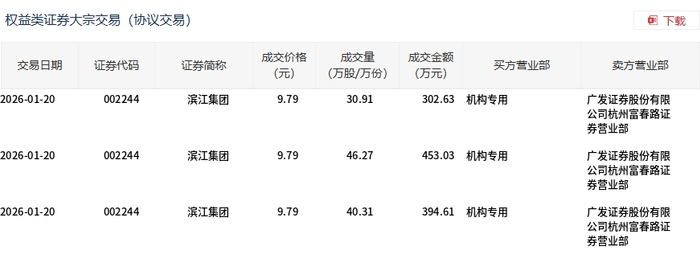
Summary of Key Points Core Viewpoint - On January 20, 2026, Binhai Group executed a block trade of 1.1749 million shares, amounting to 11.5027 million yuan, which represented 1.47% of the total trading volume for the day. The transaction price was 9.79 yuan, reflecting a discount of 10.92% compared to the market closing price of 10.99 yuan [1]. Group 1 - The block trade involved a total of 1.1749 million shares at a price of 9.79 yuan per share [1]. - The total transaction value for the block trade was 11.5027 million yuan [1]. - The transaction price was significantly lower than the market closing price, indicating a discount of 10.92% [1]. Group 2 - The trading volume for the block trade was broken down into multiple transactions, with individual volumes of 30.91 thousand shares, 46.27 thousand shares, and 40.31 thousand shares [2]. - The buyer for these transactions was identified as an institutional investor, specifically from Guotai Junan Securities [2]. - The selling brokerage was also Guotai Junan Securities, indicating a potential strategic move by the firm [2].

永泰地产(00369)发行合共555.9万股股份奖励
智通财经网· 2026-01-20 08:54
智通财经APP讯,永泰地产(00369)发布公告,于2026年1月20日,合资格人士根据本公司于2023年5月23 日采纳的股份奖励计划认购合共555.9万股股份奖励。 ...

今日14.72亿元主力资金潜入银行业
Zheng Quan Shi Bao Wang· 2026-01-20 08:49
Core Insights - The banking sector experienced the highest net inflow of capital today, amounting to 1.472 billion yuan, with a price change of 0.80% and a turnover rate of 0.30% [1][2] - The power equipment sector faced the largest net outflow of capital, totaling -19.054 billion yuan, with a price change of -1.84% and a turnover rate of 6.18% [1][2] Industry Summary - **Banking**: - Trading volume: 3.988 billion shares - Change in trading volume: +17.00% - Net capital inflow: 1.472 billion yuan [1] - **Real Estate**: - Trading volume: 6.854 billion shares - Change in trading volume: +25.38% - Net capital inflow: 0.627 billion yuan [1] - **Basic Chemicals**: - Trading volume: 9.796 billion shares - Change in trading volume: +12.23% - Net capital inflow: 0.475 billion yuan [1] - **Power Equipment**: - Trading volume: 15.534 billion shares - Change in trading volume: +1.12% - Net capital outflow: -19.054 billion yuan [2] - **Automotive**: - Trading volume: 7.013 billion shares - Change in trading volume: -1.47% - Net capital outflow: -5.259 billion yuan [2] - **Healthcare**: - Trading volume: 6.321 billion shares - Change in trading volume: +1.42% - Net capital outflow: -3.378 billion yuan [2] - **Telecommunications**: - Trading volume: 4.143 billion shares - Change in trading volume: +6.08% - Net capital outflow: -12.815 billion yuan [2]