公用事业

Search documents
招商国企改革主题混合:2025年第二季度利润534.98万元 净值增长率3.15%
Sou Hu Cai Jing· 2025-07-18 08:22
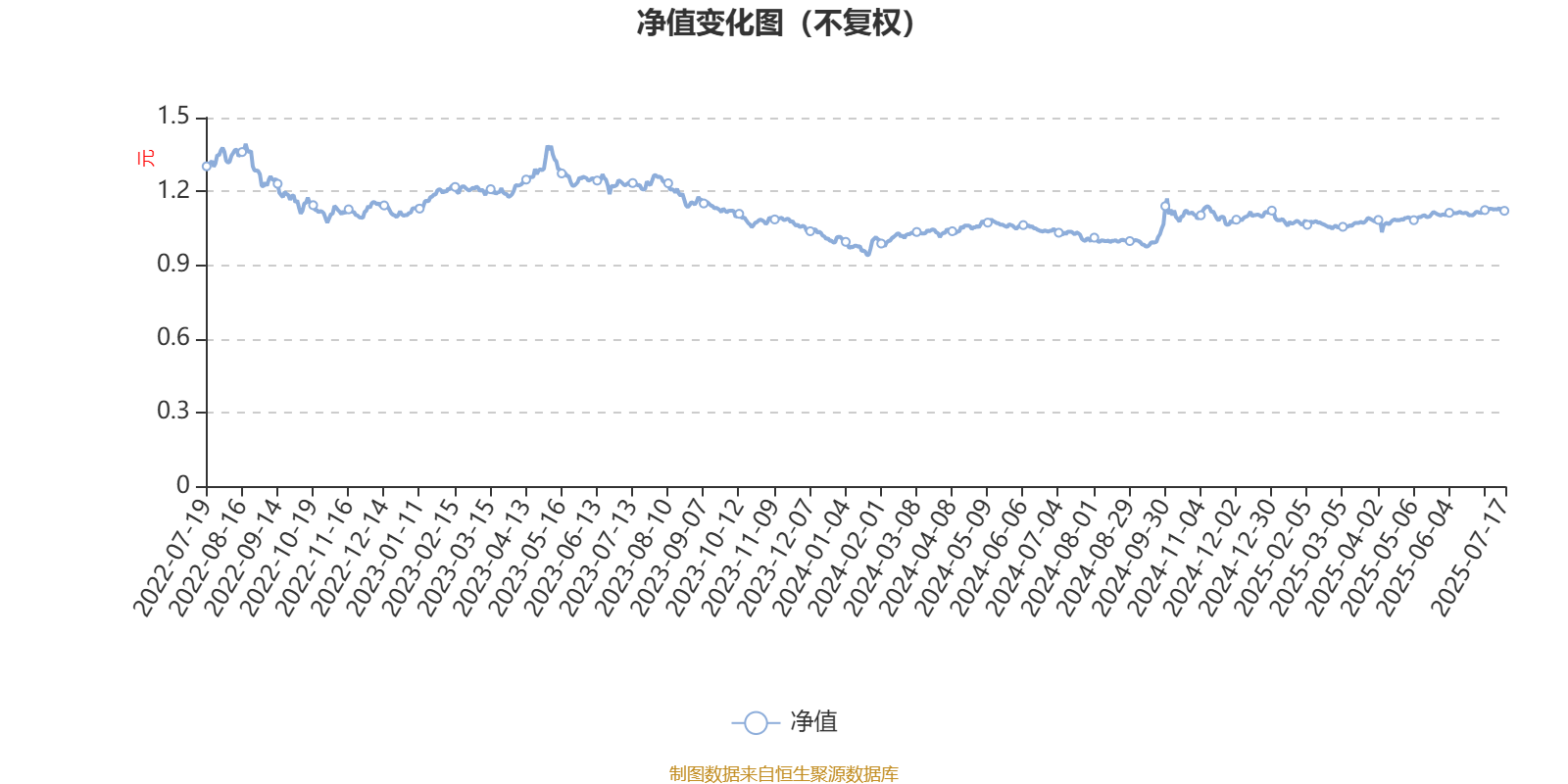
Core Insights - The AI Fund, focusing on state-owned enterprise reform, reported a profit of 5.35 million yuan for Q2 2025, with a net asset value growth rate of 3.15% [3] - As of July 17, 2025, the fund's unit net value was 1.121 yuan, and it had a total scale of 170 million yuan [3][17] - The fund manager, Wang Yu, oversees two funds, both of which have shown positive returns over the past year, with the highest growth rate being 9.37% for the state-owned enterprise reform fund [3] Fund Performance - The fund's one-year net value growth rate is 9.37%, ranking 484 out of 601 comparable funds [4] - Over the past three months, the fund's net value growth rate was 3.51%, ranking 552 out of 607 [4] - The fund's three-year net value growth rate is -11.87%, ranking 233 out of 468 [4] Risk Metrics - The fund's three-year Sharpe ratio is -0.0946, ranking 311 out of 468 comparable funds [10] - The maximum drawdown over the past three years is 32.45%, ranking 355 out of 461 [12] - The highest quarterly drawdown occurred in Q1 2020, at 24.98% [12] Investment Strategy - The fund's portfolio is concentrated in stable industries and high-quality companies, with significant overlap in high-dividend sectors such as home appliances, public utilities, light industry, and competitive chemical and machinery sectors [3] - The average stock position over the past three years was 88.1%, with a peak of 94.15% in mid-2024 and a low of 73.51% in Q3 2023 [15] Top Holdings - As of Q2 2025, the fund's top ten holdings include Zijin Mining, Jiangsu Bank, Guodian Nanjing Automation, Yuntianhua, Hangzhou Bank, Jiangzhong Pharmaceutical, Yili Group, Shanjin International, Xiyang Group, and Goldwind Technology [21]

经济与市场“背离”:全球资产配置的变局与应对
Guo Ji Jin Rong Bao· 2025-07-18 07:44
Economic Outlook - The market anticipates that tariffs will lead to economic growth slowdown and rising inflation in the coming months, but significant opportunities for long or short positions in overall duration have not been identified yet [1] - Federal Reserve Chairman Powell advocates for patience regarding interest rates, suggesting that the Fed may prioritize employment goals and consider rate cuts later in the year as inflation is expected to decline [1] - Global central banks are adopting different policies in response to regional dynamics, leading to a general divergence between the economy and the markets [1] Government Bonds - In the Eurozone, the market expects the European Central Bank to further cut rates after a 175 basis point reduction, with long-term yields facing upward risks due to signs of demand recovery and low inflation expectations [3] - Japan is experiencing inflation pressure, with nominal GDP growth exceeding 5% year-on-year, but concerns over tariffs may hinder GDP growth and market confidence [3] - Investment opportunities may arise in UK government bonds as fears of fiscal irresponsibility lead to increased term premiums, despite signs of a weakening job market [3] Equities - The company maintains a moderate overweight in global equities, expecting positive earnings growth across major regions, although valuation remains a concern due to low risk premiums indicating market over-optimism [5] - Japanese equities are favored over U.S. equities due to valuation differences and ongoing corporate governance reforms, although potential policy headwinds may limit further overweighting [5] - U.S. equities are underweighted due to high valuations and market over-reliance on a few large companies for performance, with expectations for broad earnings growth being delayed [5][6] Credit Markets - Credit spreads have tightened back to historical lows after an initial widening, with a moderate overweight in credit spreads deemed acceptable in a non-recession scenario [8] - U.S. high-yield bonds have a total return of 6%-7%, attracting investors seeking arbitrage opportunities, supported by improved credit quality and low default rates [8] Commodities - The company holds a neutral view on commodities, with gold benefiting from structural factors and geopolitical concerns, although a cautious approach to new positions is advised [10] - Oil allocation has been slightly reduced due to expectations of oversupply by year-end, presenting a potential shorting opportunity, with risks associated with significant negative spreads [10]
情绪与估值7月第2期:融资余额增加,银行估值回落
Yong Xing Zheng Quan· 2025-07-18 07:20
Group 1 - The core viewpoint indicates that during the week of July 10-16, the A-share market saw an increase in margin financing balance, with a general rise in turnover rates and trading volumes across major indices. The PE valuation percentiles for major indices mostly increased, with the CSI 1000 leading the gains [1][2][3]. Group 2 - The stock-bond yield spread increased, indicating a relatively high investment cost-effectiveness in equity investments. As of July 16, 2025, the dividend yield of the CSI 300 was 3.06%, while the 10-year government bond yield was 1.66%, resulting in a stock-bond yield of -1.40%, which is higher than the average since the beginning of 2025 by 0.30 percentage points [13][16]. - The average margin financing balance for the week was approximately 1.89 trillion yuan, an increase of 1.10% compared to the previous week. The proportion of financing purchases in total A-share trading volume rose to 10.48%, up by 0.47 percentage points [16][19]. - Major indices experienced a general increase in trading volumes, with the CSI 300 showing the largest increase of 27.81% compared to the previous week, followed by the Shanghai Composite Index with an 18.54% increase [19][20]. Group 3 - The PE valuation percentiles for major indices mostly increased, with the CSI 1000 leading with a rise of 2.7 percentage points, followed by the CSI 500 with a 1.9 percentage point increase. The PB valuation percentiles also saw a general increase, with Wind's dual innovation index rising the most by 3.0 percentage points [23][27]. - Among different styles, the consumer sector led the increase in PE valuation percentiles by 1.2 percentage points, followed by the cyclical sector with a 1.0 percentage point increase. In terms of PB valuation percentiles, the cyclical sector saw the largest increase of 13.5 percentage points [31][35]. - In terms of industry performance, the oil and petrochemical sector led the increase in PE valuation percentiles by 4.0 percentage points, while the public utilities sector saw a decline of 1.8 percentage points [45][48].
【盘中播报】45只A股封板 有色金属行业涨幅最大
Zheng Quan Shi Bao Wang· 2025-07-18 07:06
Core Viewpoint - The A-share market shows a mixed performance with a slight increase in the Shanghai Composite Index, while the non-ferrous metals sector leads the gains among various industries [2] Industry Performance - The non-ferrous metals sector experienced the highest increase of 1.66%, with a transaction volume of 806.93 billion yuan, up by 82.56% from the previous trading day [2] - The steel industry rose by 0.98%, with a transaction volume of 114.66 billion yuan, an increase of 35.33% compared to the last trading day [2] - The coal industry saw a rise of 0.84%, with a transaction volume of 68.80 billion yuan, up by 83.14% from the previous day [2] - Other notable sectors include basic chemicals and defense industry, both increasing by 0.74% [2] Stock Highlights - Leading stocks in the non-ferrous metals sector include Haixing Co., which rose by 10.03% [2] - In the steel sector, Baogang Co. increased by 5.97% [2] - Yunmei Energy in the coal sector saw a rise of 10.05% [2] - Other significant gainers include Fumiao Technology in basic chemicals, which surged by 20.02% [2]
【A 股市场大势研判】市场全天低开高走,创业板指领涨
Dongguan Securities· 2025-07-18 03:31
Market Overview - The market opened low and closed high, with the ChiNext Index leading the gains [4] - Major indices showed positive performance, with the Shanghai Composite Index up by 0.37%, Shenzhen Component Index up by 1.43%, and ChiNext Index up by 1.75% [2][4] - Over 3,500 stocks in the market rose, indicating a broad-based rally [4] Sector Performance - The top-performing sectors included Defense and Military (+2.74%), Communication (+2.41%), Electronics (+2.18%), Biomedicine (+1.77%), and Comprehensive (+1.42%) [3] - Conversely, the worst-performing sectors were Banking (-0.42%), Transportation (-0.39%), Environmental Protection (-0.26%), Public Utilities (-0.24%), and Construction Decoration (-0.19%) [3] Concept Index Highlights - The leading concept indices were Co-packaged Optics (CPO) (+3.34%), PCB Concept (+3.07%), AI Mobile (+3.01%), AI PC (+3.01%), and Recombinant Protein (+2.92%) [3] - The lagging concept indices included Gold Concept (-0.13%), Control Shares (-0.12%), Cement Concept (-0.06%), Solid Waste Treatment (-0.03%), and New Urbanization (-0.03%) [3] Future Outlook - The market is expected to continue its upward trend, with a focus on sectors such as Machinery Equipment, Consumer Goods, TMT (Technology, Media, and Telecommunications), and Financials [6] - The upcoming political bureau meeting and the Federal Reserve's interest rate decision are key events to watch [6] - The overall economic performance remains resilient, with a GDP growth of 5.3% year-on-year in the first half of the year [6] Investment Opportunities - The robotics sector is highlighted as a key area of growth, driven by advancements in AI and automation [5] - The innovative drug sector remains strong, with recent government policies favoring the procurement of established drugs while excluding innovative drugs from centralized purchasing [5] - Chinese biotech companies are seen as undervalued compared to their U.S. counterparts, presenting potential investment opportunities [5]
早盘直击 | 今日行情关注
申万宏源证券上海北京西路营业部· 2025-07-18 02:54
Core Viewpoint - The A-share market is expected to maintain a slow upward trend despite short-term fluctuations, with technology stocks playing a significant role in the rebound [1][2]. Market Outlook - The market is likely in a phase of consolidation before a breakout, with two potential paths: continuing the upward trend or consolidating before challenging previous highs [2]. - Three conditions are necessary for a direct challenge to the previous high of 3674 points: implementation of fiscal stimulus policies, continued global environment easing, and sustained increase in trading volume [2]. Sector Highlights - The A-share market in July is anticipated to be driven by event-based themes, with a high likelihood of sector rotation [3]. - Key sectors to watch include: 1. Consumer expansion and domestic demand, with a focus on dairy products, IP consumption, leisure tourism, and medical aesthetics [3]. 2. Robotics, with a shift from humanoid to quadruped and functional robots, presenting opportunities in sensors and controllers [3]. 3. Semiconductor localization, focusing on semiconductor equipment, wafer manufacturing, materials, and IC design [3]. 4. Military industry, with expectations of order recovery and signs of bottoming out in Q1 reports [3]. 5. Innovative pharmaceuticals, which are expected to see a fundamental turning point in 2025 after a period of adjustment [3]. Market Review - The A-share market showed signs of stabilization and resumed an upward trend, with the ChiNext index rising over 1.7% [4]. - More than 3500 stocks rose, indicating a positive earning effect, with leading sectors including defense, telecommunications, electronics, and pharmaceuticals [4].

主力资金动向 52.02亿元潜入计算机业
Zheng Quan Shi Bao Wang· 2025-07-17 14:09
证券时报·数据宝统计,今日有15个行业主力资金净流入,16个行业主力资金净流出。资金净流入金额 最大的行业为计算机,涨跌幅1.33%,整体换手率4.62%,成交量较前一个交易日变动3.30%,主力资金 净流量52.02亿元;今日资金净流出最大的行业为公用事业,涨跌幅-0.24%,整体换手率1.26%,成交量 较前一个交易日变动-14.47%,主力资金净流量-12.48亿元。(数据宝) 今日各行业主力资金流向一览 | 行业名 | 成交量(亿 | 成交量较昨日增减 | 换手率 | 涨跌幅 | 今日主力资金净流入(亿 | | --- | --- | --- | --- | --- | --- | | 称 | 股) | (%) | (%) | (%) | 元) | | 计算机 | 82.26 | 3.30 | 4.62 | 1.33 | 52.02 | | 电子 | 82.94 | 31.35 | 3.00 | 2.18 | 44.55 | | 国防军 工 | 28.62 | 53.48 | 2.65 | 2.74 | 28.25 | | 通信 | 33.14 | 1.05 | 1.90 | 2.41 | 19.91 ...
公用事业行业资金流出榜:C华新、韶能股份等净流出资金居前
Zheng Quan Shi Bao Wang· 2025-07-17 13:41
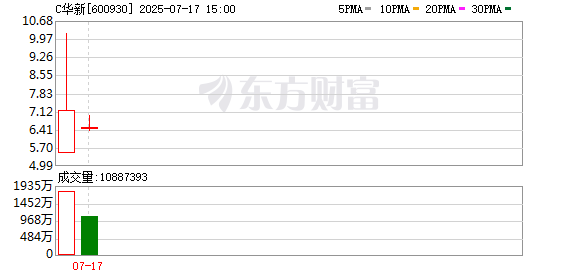
Market Overview - The Shanghai Composite Index rose by 0.37% on July 17, with 25 out of the 28 sectors experiencing gains, led by defense and military industry (up 2.74%) and communication (up 2.41%) [2] - The banking and transportation sectors saw declines of 0.42% and 0.39%, respectively, while the public utilities sector fell by 0.24% [2] Capital Flow Analysis - The net inflow of capital in the two markets was 11.662 billion yuan, with 15 sectors receiving net inflows [2] - The computer sector had the highest net inflow of 5.202 billion yuan, with a daily increase of 1.33%, followed by the electronics sector, which saw a 2.18% increase and a net inflow of 4.455 billion yuan [2] Public Utilities Sector Performance - The public utilities sector experienced a decline of 0.24%, with a net outflow of 1.248 billion yuan [3] - Out of 132 stocks in the public utilities sector, 44 stocks rose while 69 stocks fell [3] - The top three stocks with the highest net inflow in the public utilities sector were Huaguang Huaneng (net inflow of 34.38 million yuan), Leshan Electric Power (24.99 million yuan), and Jinko Technology (18.78 million yuan) [3] Public Utilities Sector Capital Inflow and Outflow - The top stocks with capital inflow included: - Huaguang Huaneng: +4.51%, 5.61% turnover, 34.38 million yuan inflow - Leshan Electric Power: +1.85%, 7.17% turnover, 24.99 million yuan inflow - Jinko Technology: 0.00%, 1.92% turnover, 18.78 million yuan inflow [4] - The top stocks with capital outflow included: - C Huaxin: -9.19%, 43.46% turnover, -281.48 million yuan outflow - Shaoneng Shares: -1.42%, 6.61% turnover, -87.48 million yuan outflow - Huayin Electric Power: -2.17%, 13.89% turnover, -87.12 million yuan outflow [5]


计算机行业今日净流入资金52.02亿元,常山北明等15股净流入资金超亿元
Zheng Quan Shi Bao Wang· 2025-07-17 12:29
Market Overview - The Shanghai Composite Index rose by 0.37% on July 17, with 25 out of 28 sectors experiencing gains, led by defense and military industry (up 2.74%) and communication (up 2.41%) [1] - The computer industry also saw an increase of 1.33% [1] Capital Flow - The net inflow of capital in the two markets was 11.662 billion yuan, with 15 sectors receiving net inflows [1] - The computer industry had the highest net inflow of 5.202 billion yuan, followed by the electronics sector with a net inflow of 4.455 billion yuan and a daily increase of 2.18% [1] Computer Industry Performance - In the computer sector, 335 stocks were tracked, with 250 stocks rising and 7 hitting the daily limit [2] - The top three stocks with the highest net inflow were Changshan Beiming (21.91 billion yuan), Runhe Software (9.27 billion yuan), and Tuowei Information (7.16 billion yuan) [2] - The sector also had 7 stocks with net outflows exceeding 100 million yuan, led by Changliang Technology, Dawi Technology, and Tianyang Technology [2][4] Top Gainers in Computer Industry - The top gainers in the computer sector included: - Changshan Beiming: +10.02%, turnover rate 15.74%, net inflow 2.1907 billion yuan - Runhe Software: +9.68%, turnover rate 16.88%, net inflow 926.5 million yuan - Tuowei Information: +5.32%, turnover rate 19.82%, net inflow 715.9 million yuan [2] Top Losers in Computer Industry - The top losers in the computer sector included: - Changliang Technology: -2.62%, turnover rate 15.43%, net outflow -275.9 million yuan - Dawi Technology: -0.22%, turnover rate 22.99%, net outflow -249.7 million yuan - Tianyang Technology: -2.41%, turnover rate 15.38%, net outflow -198.5 million yuan [4]


主力动向:7月17日特大单净流入166.28亿元
Zheng Quan Shi Bao Wang· 2025-07-17 12:27
Market Overview - The net inflow of large orders in the two markets reached 16.628 billion yuan, with 44 stocks seeing net inflows exceeding 200 million yuan, led by Changshan Beiming with a net inflow of 2.333 billion yuan [1] - The Shanghai Composite Index closed up 0.37%, with a total of 2,101 stocks experiencing net inflows and 2,633 stocks seeing net outflows [1] Industry Analysis - Among the 19 industries with net inflows, the computer sector had the highest net inflow of 5.790 billion yuan, with an index increase of 1.33%. The electronics sector followed with a net inflow of 4.318 billion yuan and a rise of 2.18% [1] - The public utilities sector experienced the largest net outflow of 809 million yuan, followed by the banking sector with a net outflow of 741 million yuan [1] Individual Stock Performance - 44 stocks had net inflows exceeding 200 million yuan, with Changshan Beiming leading at 2.333 billion yuan, followed by Jianghuai Automobile at 1.193 billion yuan [2] - Stocks with significant net inflows saw an average increase of 7.58%, outperforming the Shanghai Composite Index, with 43 stocks closing higher, including Man Kun Technology and Jin Modern, which hit the daily limit [2] - The top sectors for net inflows among individual stocks were computer, electronics, and communication, with 10, 9, and 4 stocks respectively [2] Top Net Inflow Stocks - The top stocks by net inflow include: - Changshan Beiming: 2.333 billion yuan, 10.02% increase [2] - Jianghuai Automobile: 1.193 billion yuan, 10.01% increase [2] - Runhe Software: 903 million yuan, 9.68% increase [2] - Construction Industry: 771 million yuan, 10.01% increase [2] - AVIC Shenyang Aircraft: 745 million yuan, 10.00% increase [2] Top Net Outflow Stocks - The stocks with the largest net outflows include: - ST Huatuo: 398 million yuan, -4.77% decrease [4] - Sunshine Power: 329 million yuan, -0.55% decrease [4] - Zhongdian Port: 307 million yuan, -1.21% decrease [4] - Zijin Mining: 267 million yuan, -0.37% decrease [4] - C Huaxin: 240 million yuan, -9.19% decrease [4]