
证券业

Search documents
每日债市速递 | 韩国央行维持关键利率不变
Wind万得· 2025-07-10 22:32
Group 1: Open Market Operations - The central bank conducted a 900 billion yuan 7-day reverse repurchase operation on July 10, with a fixed interest rate of 1.40%, resulting in a net injection of 328 billion yuan for the day after accounting for 572 billion yuan in reverse repos maturing [2][3] Group 2: Liquidity Conditions - Liquidity has slightly contracted, with the overnight pledged repo rate rising to 1.32% and the 7-day pledged repo rate increasing by nearly 2 basis points to 1.49% [4] Group 3: Interbank Certificates of Deposit - The latest transaction for one-year interbank certificates of deposit is around 1.62%, showing a slight increase from the previous day [7] Group 4: Bond Market Trends - Major interbank bond yields have generally risen, indicating a shift in market sentiment [9] - Government bond futures closed collectively lower, with the 30-year main contract down 0.36%, the 10-year down 0.16%, the 5-year down 0.14%, and the 2-year down 0.04% [13] Group 5: Urban Investment Bonds - Recent trends in urban investment bonds (AAA) show varying yield spreads across different maturities, reflecting market dynamics [11][12] Group 6: Key News and Developments - The National Development and Reform Commission aims to achieve new urbanization goals by 2035, focusing on high-quality development and increased investment in key areas [14] - The Ministry of Commerce responded to U.S. trade concerns, emphasizing that the issue of overcapacity lies with the EU due to insufficient R&D investment [14] - The Bank of Japan maintained its economic assessment across nine regions, noting limited impact from U.S. tariffs on exports and output [15] - The Bank of Korea kept its key interest rate at 2.50%, aligning with market expectations, while expressing concerns over fiscal imbalances [15] Group 7: Bond Market Events - Oceanwide Group is formulating a domestic credit bond resolution plan, while Longfor Group has successfully passed all 21 domestic bond restructuring proposals [16] - Demand for Japan's 20-year government bond auction fell below the 12-month average [16] - A series of negative events have been reported for various bond issuers, including downgrades in credit ratings for multiple companies [16]


大涨个股背后的共性来了
Feng Huang Wang Cai Jing· 2025-07-10 13:49
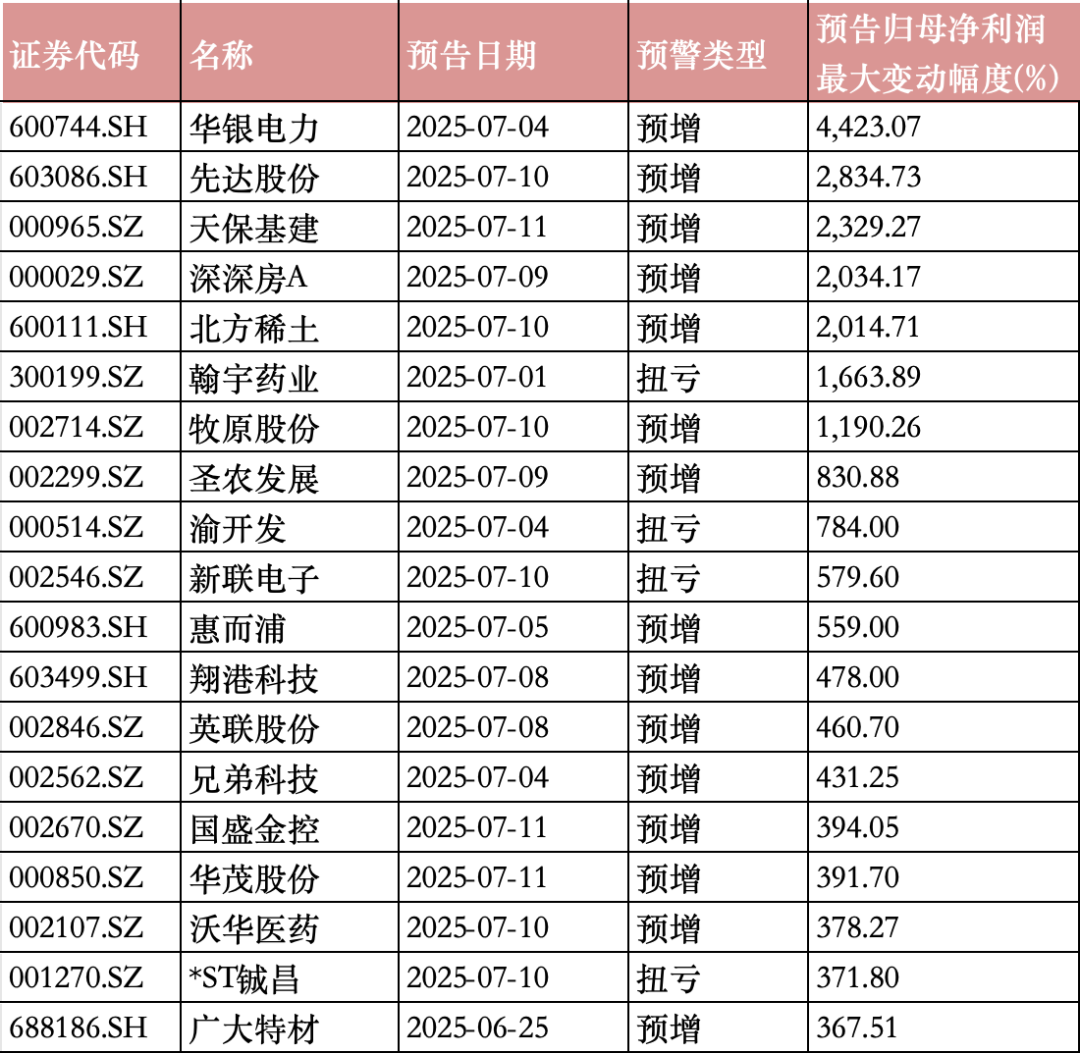
Market Overview - The Shanghai Composite Index has reached 3500 points, marking a 9-month high, with a trading volume of 1.52 trillion yuan, slightly down from 1.53 trillion yuan the previous day [1] - Large funds have not exited the market, but trading volume remains relatively low [1] Sector Performance - Real estate stocks have surged, with companies like Yuhua Development and Nanshan Holdings hitting the daily limit [2] - Bank stocks have also performed well, with major banks like ICBC and Bank of China reaching historical highs [3] Earnings Reports - Yuhua Development reported a significant increase in net profit, with a year-on-year growth of 632% to 784% [7] - Northern Rare Earth announced a staggering net profit increase of 1882.54% to 2014.71% [8] - Hongyuan Power, which has seen a price increase of over 84% in 8 trading days, reported a net profit growth of 3600.7% to 4423.07% [10] - Red Tower Securities reported a net profit increase of 45% to 55% [9] Market Trends - The strong performance of these sectors and stocks is supported by their earnings, indicating a potential shift in capital from previously overheated sectors to those with lower valuations and solid earnings [11] - Over 200 listed companies have reported earnings, with more than 60% showing positive net profit growth [12] - The majority of companies with earnings growth are from the computer, communication, and electronic equipment manufacturing industries, as well as the chemical and pharmaceutical sectors [13] Earnings Forecasts - A list of companies with significant expected profit increases includes Huayin Power (4423.07%), Xian Da Co. (2834.73%), and Tianbao Infrastructure (2329.27%) [15] - Conversely, companies like Sanmu Group and Shangwei Co. are expected to report losses, with declines of -1721.03% and -1263.41% respectively [16]
海外札记:大美丽法案”市场冲击或有限
Orient Securities· 2025-07-10 07:51
Group 1: Short-term Impact of the "Great Beauty Act" - The "Great Beauty Act" is expected to have limited short-term market impact due to prior market adjustments over the past two months, with bond yields already reflecting the anticipated changes[6] - The act was passed with a narrow margin of 218 votes in favor and 214 against, and signed into law on July 4, 2025[9] - Concerns about a large-scale fiscal expansion causing market turmoil are mitigated by the expectation that upcoming debt issuance will primarily rely on short-term bonds, stabilizing long-term bond supply[6] Group 2: Long-term Implications of the "Great Beauty Act" - The act is projected to increase the deficit by approximately $4.1 trillion over the next decade, with tax cuts estimated at $4.5 trillion and spending cuts at $1.4 trillion[12] - The Congressional Budget Office (CBO) predicts that the act will raise the deficit rate to between 6.4% and 7.1% over the next five years, reflecting a structural shift in fiscal policy[30] - The act's long-term significance lies in its potential to reshape market perceptions of the U.S. fiscal cycle, establishing a "new normal" for deficit levels rather than reverting to historical averages[30] Group 3: Economic Growth Projections - Neutral institutions forecast that the act will contribute an additional economic growth of between -0.1% and 1.1% over the next decade, indicating a modest impact on overall economic performance[23] - The act's primary policies are extensions of existing measures, suggesting minimal marginal changes to the economic landscape[27] - Historical data shows that previous tax reforms had limited effects on corporate investment, indicating skepticism about the act's ability to drive significant economic growth[29]
韩国央行按兵不动!维持利率在2.5%不变,房价上涨和关税成为焦点
智通财经网· 2025-07-10 03:20
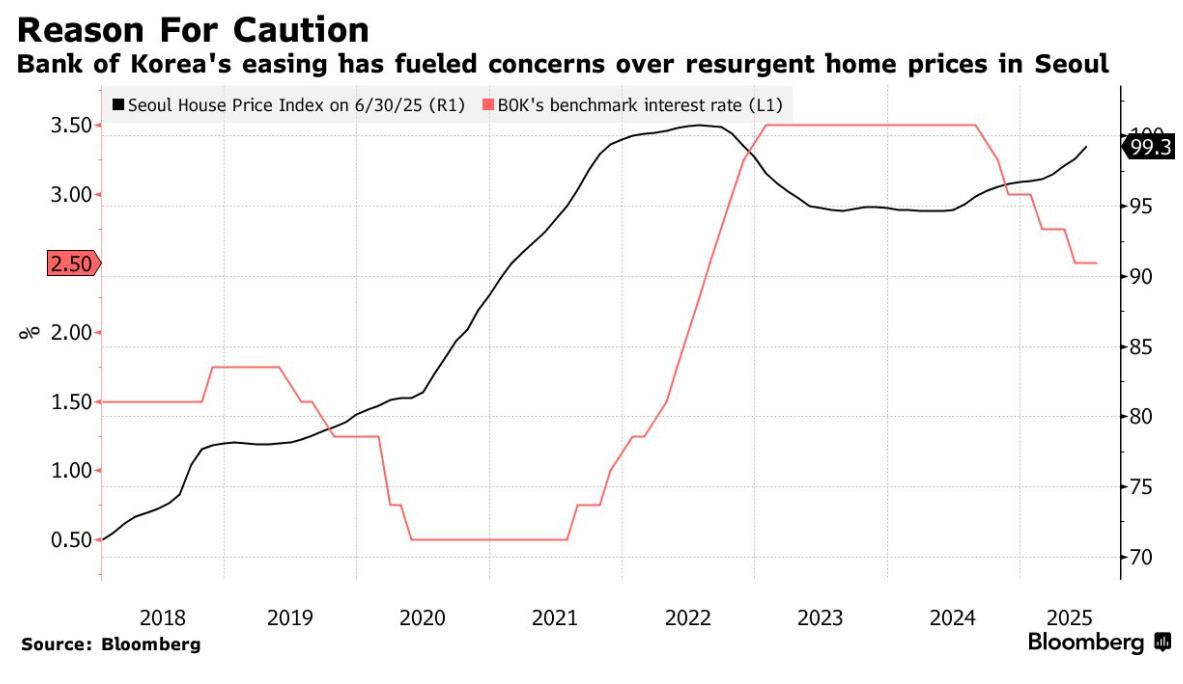
Core Viewpoint - The Bank of Korea has decided to maintain the benchmark interest rate at 2.5% amid rising housing prices and economic threats from U.S. tariffs, indicating a cautious approach to monetary policy while monitoring the effects of previous easing measures [1][4]. Group 1: Monetary Policy Decisions - The Bank of Korea has kept the 7-day repurchase rate unchanged at 2.5%, aligning with the expectations of 19 surveyed economists [1]. - The central bank has lowered interest rates twice this year and four times in the last quarter of the previous year, reflecting concerns over rapid easing potentially leading to a real estate boom similar to the post-pandemic period [1][4]. - Economists anticipate a possible rate cut in August, suggesting that fiscal expansion may necessitate policy coordination [4]. Group 2: Economic Challenges - One of the most pressing challenges for the South Korean economy is managing the impact of U.S. tariffs, with a comprehensive tariff on Korean goods set to increase to 25% on August 1 [4]. - Specific tariffs on the automotive and steel industries continue to pose significant obstacles to economic growth [4]. - The central bank is expected to remain vigilant regarding trade developments while monitoring the real estate market [4]. Group 3: Housing Market Dynamics - Recent months have seen a surge in mortgage growth, with June recording the largest increase in housing loans in nine months [5]. - The housing price expectation index rose to its highest level since October 2021, indicating a potential resurgence in the real estate market [5]. - The government has introduced new regulations to limit the maximum mortgage amounts in the Seoul metropolitan area, though the effectiveness of these measures in curbing household borrowing risks remains uncertain [5].
ETF日报:央行有望在四季度进一步降息10BP,7天逆回购利率降至1.3%,或进一步打开债市空间,可关注国债ETF
Xin Lang Ji Jin· 2025-07-09 14:33
Market Overview - The A-share market experienced a pullback after briefly surpassing the 3500-point mark, with the Shanghai Composite Index closing down 0.13% at 3493.05 points [1] - The total trading volume in the Shanghai and Shenzhen markets reached 1.51 trillion, an increase of 51.2 billion compared to the previous trading day [1] - The market showed mixed performance across sectors, with innovative drugs, pharmaceuticals, gaming, film, and coal leading gains, while gold stocks, non-ferrous metals, and chips lagged [1] Economic Indicators - In June, China's CPI turned positive at 0.10% year-on-year, with core CPI at 0.70%, influenced by seasonal weather and rising oil prices [3] - The decline in food prices was noted at 0.3% year-on-year, with beef prices increasing by 2.7% after 28 months of decline, while pork prices fell by 8.5% [3] - Domestic consumption policies have supported prices in the automotive and home appliance sectors [3] Monetary Policy Outlook - Due to ongoing consumer confidence issues and international trade risks, China's CPI and PPI face significant pressure, with potential for a 10 basis point rate cut by the central bank in Q4 [4] - This could open up more space in the bond market, with investors advised to focus on government bond ETFs [4] International Developments - The "Big Beautiful" Act signed by Trump on July 4th expands the U.S. fiscal deficit, potentially supporting U.S. economic growth and impacting various sectors differently [5] - Traditional energy, manufacturing, real estate, military, and agriculture sectors may benefit from tax advantages, while clean energy and healthcare may face reduced incentives [5] Copper Market Dynamics - The new 50% tariff on copper imports to the U.S. announced by Trump has led to significant fluctuations in copper prices, with U.S. copper prices rising sharply [6][10] - The current trading environment for copper is characterized by a contango structure in COMEX and a backwardation structure in LME, influenced by inventory levels and tariff expectations [10] - The anticipated tariff may reduce demand for U.S. copper, as significant stockpiling has already occurred, potentially leading to a decline in price differentials [10] Investment Recommendations - Investors are encouraged to consider opportunities in the 60 ETF (159881) and mining ETF (561330) as potential low-entry points in the current market environment [10]
金十整理:大限推迟,铜关税如“夜半惊雷”,特朗普让市场在“麻木”和“不确定”间反复横跳
news flash· 2025-07-09 12:25
Group 1 - The core viewpoint is that Trump's tariffs have lost their market impact, and the delay in tariff deadlines is seen as a negotiation tactic rather than a genuine policy change [1][2][3] - Analysts suggest that the market is becoming numb to the erratic policies of the Trump administration, leading to a potential oversight of the risks associated with industry tariffs [1][3] - The extension of the tariff deadline until August 1 has led traders to believe that the likelihood of sudden tariff imposition is decreasing, reinforcing the view that Trump is committed to reaching a trade agreement [1][3] Group 2 - The uncertainty surrounding tariffs has paralyzed decision-making for companies trying to adapt to the changing tariff landscape, as executives are working to adjust supply chains and cost structures to avoid price increases [3] - Market sentiment remains cautious due to ongoing uncertainty, with analysts indicating that the market may become more volatile leading up to August 1 due to increased trade-related headlines [3]
【财闻联播】7天6板牛股,紧急提示风险!部分航线登机只需提前15分钟了
券商中国· 2025-07-09 11:09
Macro Dynamics - China's Ministry of Foreign Affairs responded to Germany's claim that the Chinese military aimed a laser at a German aircraft, stating that the information is inconsistent with China's understanding of the facts [2] - The National Bureau of Statistics reported that in June 2025, the industrial producer price index decreased by 3.6% year-on-year and 0.4% month-on-month [3] - The National Development and Reform Commission announced that 402 new drugs have been added to the national medical insurance drug list since the 14th Five-Year Plan began [4] Financial Institutions - BNP Paribas completed the acquisition of AXA Investment Managers, integrating it into its group, managing over €1.5 trillion in assets post-acquisition [9] Market Data - The Shanghai Composite Index fell by 0.13% on July 9, with a total market turnover of approximately ¥1505.19 billion [13] - The financing balance of the two markets increased by ¥5.48 billion, reaching a total of ¥1845.97 billion [14] Company Dynamics - Hongta Securities expects a net profit of ¥651 million to ¥696 million for the first half of 2025, representing a year-on-year growth of 45% to 55% [11] - Hainan Province's former transportation investment chairman was prosecuted for bribery, indicating potential governance issues within state-owned enterprises [18] - BYD announced comprehensive coverage for users of its "Heavenly Eye" vehicles in smart parking scenarios, with over 1 million units in circulation [19] - Huaxi Biological passed the FDA's cGMP inspection with zero defects, indicating strong compliance in its production processes [21] - Northern Rare Earth expects a net profit of ¥900 million to ¥960 million for the first half of 2025, a year-on-year increase of 1882.54% to 2014.71% [22]


A股尾盘翻绿,大金融强势,恒科指跌2%,恒瑞医药涨超12%
Hua Er Jie Jian Wen· 2025-07-09 07:09
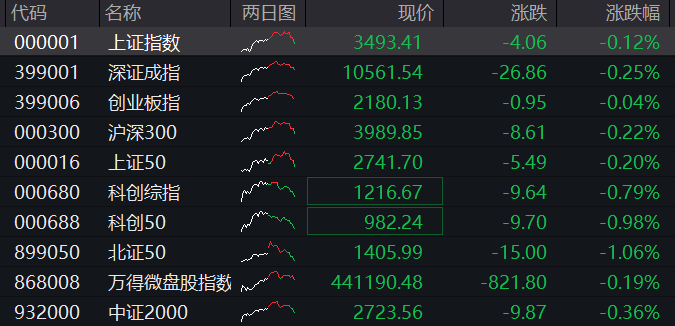
Market Overview - A-shares ended lower with the Shanghai Composite Index falling below 3500 points, closing at 3493.41, down 0.12% [1][2] - The Shenzhen Component Index decreased by 0.25% to 10561.54, while the ChiNext Index saw a slight decline of 0.04% to 2180.13 [2][7] - The Hong Kong market continued its downward trend, with the Hang Seng Index dropping 1.29% to 23836.86 and the Hang Seng Tech Index falling 2.01% to 5218.87 [3][6] Sector Performance - The financial sector showed strength, with major banks and securities firms like Industrial and Commercial Bank of China and Postal Savings Bank reaching new highs [23][37] - The pharmaceutical sector experienced a notable rise, particularly with Heng Rui Medicine, which surged over 12% after receiving clinical trial approvals for two drugs [1][14] - The commodity market saw a rapid increase in black commodities, with polysilicon prices rising significantly by nearly 5% [4][10] Bond Market - The bond market showed mixed results, with the 30-year treasury futures contract rising by 0.06% while the 2-year contract fell by 0.01% [4][6] Individual Stock Highlights - Heng Rui Medicine's stock price increased by 9.8%, reaching a new high since its listing, following positive news regarding drug approvals [16][14] - Ningde Times saw a significant rise of over 8%, reaching a historical high, driven by its entry into the robotics sector [19] - The stock of Upwind New Materials surged by 20.05% on its first trading day after resuming trading, following a major acquisition announcement [25][27] Investment Trends - The market is shifting from defensive banking stocks to more aggressive sectors like technology and photovoltaics, indicating a potential for further growth if trading volumes stabilize above 1.6 trillion yuan [24]

李迅雷最新分享:讲透大国债务的本质,也讲清资产配置的方向……
聪明投资者· 2025-07-09 06:03
Core Viewpoints - The debt issue of a country is related to its economic development level, with developed countries having higher average debt ratios than developing countries due to the costs associated with development [1][18] - Despite the weakening of the dollar, it remains a strong currency, and the U.S. and Japan have significant debt issues but still possess resilience and coping mechanisms [1][31][34] - China faces noticeable debt pressure but has distinct advantages, and there is no need for excessive concern regarding government credit [1][42] Debt Research Perspective - Long-term perspectives are essential in debt research, as historical analysis can provide insights into future economic directions and asset allocation [6][7] - The growth of government debt is often linked to major international events, such as the 2008 financial crisis and the COVID-19 pandemic, which necessitated increased government borrowing to maintain stability [7][8][9] Global Debt Landscape - Countries are experiencing significant debt pressures, but they also have advantages and resilience, allowing for investment opportunities amidst crises [3][22] - The U.S. government debt is approximately $36 trillion, with annual interest payments reaching $1 trillion, raising concerns about liquidity and the ability to refinance [23][24] China's Debt Structure - China's debt structure is unique, with a strong central government and significant state-owned assets, leading to a relatively strong repayment capacity despite high overall leverage [37][40][42] - Local government debt is a concern, particularly due to hidden debts and the reliance on investment for economic growth, which needs to be addressed for sustainable development [44][45][48] Investment Opportunities - In a high-debt environment, investors should look for opportunities during market downturns, as government interventions often stabilize markets [58][60] - Gold is viewed as a long-term investment with upward trends expected due to ongoing global issues and uncertainties [62][61] Economic Outlook - The Chinese economy is expected to maintain a growth rate above 5%, supported by consumption and investment policies, despite potential downward pressures in the latter half of the year [63][70][72] - The Hong Kong stock market is anticipated to perform well, with narrowing valuation gaps between A-shares and H-shares, indicating a more mature investment environment [76][78][79]
C50风向指数调查:7月同业存单利率中枢或延续下行 短期内重启国债买卖必要性降低
news flash· 2025-07-09 04:19
Core Viewpoint - The latest C50 Wind Direction Index survey indicates that the central rate of interbank certificates of deposit (CDs) may continue to decline in July, and the necessity to restart government bond trading in the short term is reduced [1] Group 1: Market Liquidity Outlook - The survey involved 20 market institutions, with 12 expressing an optimistic view on the overall liquidity in July, indicating no liquidity gap [1] - Six institutions assessed the liquidity as neutral, estimating a liquidity gap of less than 1 trillion yuan [1] - Two institutions predicted a potential tightening phase, with a liquidity gap ranging from 1 trillion to 2.06 trillion yuan [1] Group 2: Interest Rate and Bond Market Expectations - Multiple market institutions anticipate that the central rate of interbank CDs may continue to decline in July [1] - The resumption of central bank bond purchases is expected to take time, as the market adjusts to the influx of incremental funds from insurance, wealth management, and banks [1] - A bullish trend in the bond market is anticipated, suggesting that early positioning in potential investment varieties for incremental funds may be a favorable strategy [1]