
债券

Search documents
市场缩量调整,聚焦攻防均衡丨周度量化观察
申万宏源证券上海北京西路营业部· 2026-02-09 02:10
Market Overview - This week, the A-share market experienced a comprehensive pullback, with the Shanghai Composite Index down by 1.27%, the CSI 300 down by 1.33%, and the ChiNext Index down by 3.28%. The average daily trading volume in the Shanghai and Shenzhen markets significantly decreased to around 2.3 trillion yuan [2][11][15]. - In the bond market, the overall performance was strong, supported by a stable funding environment maintained by the central bank. The January PMI data fell below the growth line, which is favorable for the bond market [3][31]. Equity Market - The decline in A-shares was primarily driven by a shift in expectations regarding the Federal Reserve's policy, which triggered a significant pullback in precious metals and led to profit-taking in popular sectors ahead of the Spring Festival. The nomination of hawkish candidate Waller as Fed Chair strengthened the dollar, suppressing risk appetite and dragging down cyclical stocks [6][9]. - The investment strategy emphasizes a balanced approach, advocating for low buying and avoiding high chasing. Long-term trends in sectors such as defense, resources, finance, and supply chains are highlighted as areas of potential growth [6][9]. Bond Market - The market is expected to remain volatile in the short term, with favorable factors including the central bank's support for the funding environment. However, the anticipated supply of government bonds poses a challenge. The recommendation is to focus on medium to short-term bond strategies rather than excessive speculation on long-term bonds [7][31]. Commodity Market - The gold market experienced significant volatility, with COMEX gold prices dropping sharply by 8.92% due to a combination of factors, including hawkish expectations from the Fed, profit-taking by bulls, and a sharp decline in silver prices [4][36]. - The short-term outlook for gold suggests potential fluctuations within the current range, with a focus on upcoming U.S. non-farm payroll data and Fed officials' statements. Long-term gold investment remains solid as a core asset [8][40]. Overseas Market - The U.S. economy remains strong, with favorable credit cycle expectations. However, the market is at a relatively high level, and factors such as unclear policy outlooks and declining risk appetite may lead to increased volatility. The AI industry trend is still ongoing, and traditional cycles are expected to recover [9][39].


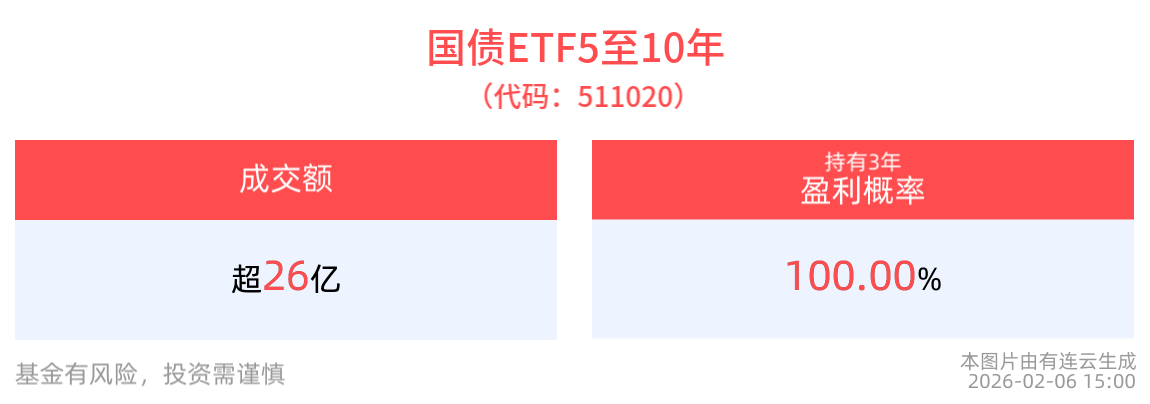
成交额超26亿元,国债ETF5至10年(511020)历史持有3年盈利概率为100.00%
Sou Hu Cai Jing· 2026-02-09 01:59
Group 1 - Institutions remain bullish on long-term bonds, driven by allocation despite net selling by brokers and funds of over 108.6 billion yuan in ultra-long-term bonds (maturity over 20 years) from January 1 to February 6, compared to a net sell of only 5.7 billion yuan in the same period last year [1] - Insurance funds net purchased 120.6 billion yuan of ultra-long-term bonds, while city and rural commercial banks net bought 50 billion yuan, showing a significant increase of 55.4 billion yuan and 68.8 billion yuan year-on-year respectively [1] - The steepening yield curve and declining funding costs for city and rural commercial banks enhance the incentive to allocate government bonds, with expectations that the cost of liabilities for these banks will drop below 1.6% in Q1 2026 [1] Group 2 - From November 20, 2025, to February 6, 2026, brokers, funds, and pension funds collectively net sold 354.8 billion yuan of ultra-long-term bonds, indicating a preference for mid- to short-term bonds [2] - The positive impact of rising stock markets on ultra-long-term bonds has significantly diminished, and if market expectations for stocks decline, there may be a rebound in ultra-long-term bond purchases, potentially driving the 30-year government bond yield down significantly [2] - Institutions predict that the 10-year government bond yield will break 1.80% and trend towards 1.75%, while the 30-year government bond yield may return below 2.2% [2] Group 3 - As of February 6, 2026, the active bond index for 5-10 year government bonds rose by 0.06%, with the corresponding ETF also increasing by 0.06% to a latest price of 116.01 yuan [4] - The liquidity of the 5-10 year government bond ETF was active, with a turnover of 227.23% and a transaction volume of 2.674 billion yuan, indicating strong market activity [4] - The ETF's management fee is 0.15% and the custody fee is 0.05%, with a tracking error of 0.024% over the past three months, closely following the active bond index [4]
中国加速抛售美债,美专家:中国用了新的抛售方式,根本无法干预
Sou Hu Cai Jing· 2026-02-08 22:39
2026年1月15日,美财政部公布了2025年11月世界各国持美债状况,日本和英国成了最大"债主",中国 则大量抛出美债至6826亿美元,相较于巅峰时期的1.3万亿几乎对半砍! 美专家分析,中国这次抛售用的是一种"我们没法阻止的新方式",美国想干预于也无济于事,那么,中 国为何会大量抛售美债?这背后是金融操作,还是另有深意? 要说中国为什么要减持美债,得从美国自身说起,眼下的美国财政状况,说好听点是"吃紧",说难听点 就是"快吃不上饭了"。 全球都在买,中国却不抛售 美债市场现在的情况有点像全球性的"抢购会",日本买得起劲,英国也不手软,就连加拿大和挪威都在 往里冲。 根据2025年11月的数据,全球美债总持仓已经飙到了9.36万亿美元,创了历史新高,日本一个国家就拿 了1.2万亿,英国也有将近8100亿。 这些国家为什么热情高涨?道理很简单:美元流动性强,美国金融市场深,政治盟友之间互相投桃报 李,再加上有避险需求,买点美债是符合传统逻辑的。 可偏偏在这时候,中国却在往回收,11月再一次减持61亿美元,持仓降到了6826亿,连2008年金融危机 时候的水平都跌破了。 如果拉长时间看,自从2013年中国持仓达 ...
债券周报 20260208:股债跷板“失灵”的再讨论-20260208
Huachuang Securities· 2026-02-08 15:30
1. Report Industry Investment Rating The provided content does not mention the industry investment rating. 2. Core Viewpoints of the Report - The stock - bond seesaw effect has generally strengthened since 2025, but there are periods of weakening. The restoration of the stock - bond seesaw effect requires the continuous strengthening of the pricing factors of stocks or bonds. The market trends of the stock and bond markets have their own dominant factors, and the stock - bond seesaw is not the only pricing factor for bonds [3][43][46]. - The bond market strategy is to hold bonds during the holiday and appropriately increase the account's income elasticity. The report is optimistic about the future market and suggests starting to prepare for the whole - year trading market, shifting from a configuration - oriented to a trading - oriented approach [48][52]. - In the first week of February, the bond market strengthened with oscillations due to the weakening of the equity market and the central bank's support. The 30 - 10y spread of treasury bonds has compression potential, and there are opportunities in long - term credit bonds [7][72][77]. 3. Summary by Directory 3.1 Stock - Bond Seesaw "Failure" Re - discussion - **Overall Strengthening of the Stock - Bond Seesaw Effect in 2025**: The strengthening is mainly due to the significant boost in market risk appetite by the strong performance of the equity market and the significant widening of the stock - bond price ratio. For example, from September 2024 to October 2025, the share of open - ended bond funds decreased by 3.18%, while that of open - ended stock funds increased by 22.92%. As of February 2026, the margin trading balance in the Shanghai and Shenzhen stock markets reached 2.67 trillion yuan [10][14][15]. - **Weakening of the Stock - Bond Seesaw Effect in Some Windows**: There are two situations: stock - bond co - rising and stock - bond co - falling. Stock - bond co - rising occurs when the bond market has clear bullish factors (mostly related to easing expectations), and the yield is in a downward channel. Stock - bond co - falling is mostly related to the redemption of "fixed - income +" products. For example, in November 2025 and February 2026, the redemption of "fixed - income +" products led to an increase in bond yields [22][32]. - **End of the Stock - Bond Seesaw "Failure"**: The restoration of the stock - bond seesaw effect is driven by different factors, such as the "anti - involution" logic in July 2025 leading to the bond market following the adjustment, and the early "spring rally" in the equity market and the cooling of the bond market's easing expectations in late December 2025 - early January 2026 [41]. - **Summary**: The "failure" of the stock - bond seesaw is more common after the bond market's cost - performance returns. To restore the seesaw effect, the pricing factors of stocks or bonds need to be continuously strengthened. The subsequent trend of the "failure" during the "fixed - income +" redemption stage after the stock market decline needs to be observed [43][46]. 3.2 Bond Market Strategy - **Under - expected Bond Market Gains after the Decline in Risk Appetite**: The bond market gains were under - expected due to the redemption of "fixed - income +" funds and the lack of a clear trading theme in the short - term bond market [48]. - **Optimistic Outlook for the Future Market**: The central bank's pre - holiday capital injection is relatively active, and the capital fluctuation pressure is controllable. However, the institutions' cross - holiday capital arrangements are relatively late, and short - term frictions in the last week need attention. The power of allocation - type funds is relatively strong, and the pricing influence of the equity market on bonds is weakened. The bond market yield is still in the cost - performance range [52][61][66]. - **Operation Suggestions**: Continue to layout convex - type varieties, conduct spread mining according to the convex points. Focus on 5y China Development Bank bonds in the short - term, 8y Export - Import Bank of China bonds and 10y local government bonds in the medium - term. Insurance funds can configure long - term local government bonds at high yield fluctuations. It is recommended to hold bonds during the holiday and appropriately increase the account's elasticity, and layout long - term offensive varieties with good liquidity [69][72]. 3.3 Interest - Rate Bond Market Review - **Market Performance**: In the first week of February, the equity market was weak, and the bond market strengthened with oscillations. The 10y treasury bond yield was blocked at 1.80% multiple times, and the 30y treasury bond led the rise, driving the compression of the 30 - 10y spread. The 1y treasury bond active bond yield rose 2BP to 1.3100%, the 10y treasury bond active bond yield fell 0.8BP to 1.8020%, and the 30y treasury bond yield fell 3.45BP to 2.2255% [7]. - **Funding Situation**: The central bank's net withdrawal of funds was 656 billion yuan this week, and the funding situation was generally loose. The 1y inter - bank certificate of deposit issuance price of national joint - stock banks fell to 1.58%, and the weighted price of DR007 fell to 1.4613% [8]. - **Primary Issuance**: The net financing of policy - financial bonds decreased, while the net financing of treasury bonds, local government bonds, and inter - bank certificates of deposit increased [92]. - **Benchmark Changes**: The term spreads of treasury bonds and China Development Bank bonds both narrowed. The short - end yields of treasury bonds rose 2.08BP, and the long - end yields fell 0.1BP. The short - end yields of China Development Bank bonds fell 1.32BP, and the long - end yields fell 2.2BP [89].
债市可以继续看涨吗
Guolian Minsheng Securities· 2026-02-08 14:53
Group 1 - The bond market is experiencing a bullish trend, with the 10-year government bond yield fluctuating around 1.8% after a decline to this level on January 28. Recent movements indicate a gradual decrease in yields for long-term government bonds and government-backed securities [7][11][39] - Investors are advised to focus on three key questions regarding the potential for further yield declines: the extent of the rebound in yields, the possibility of further declines in the 10-year government bond yield, and the outlook for perpetual bonds [7][11][39] - The current spread between the 30-year and 10-year government bonds is approximately 42-43 basis points, with expectations that the 30-year yield could decline to around 2.2% if the 10-year yield remains stable at 1.8% [7][11][39] Group 2 - The report suggests that the 10-year government bond yield may face strong resistance at the 1.8% level, requiring significant positive stimuli to break below this threshold. Factors to monitor include potential interest rate cuts by the central bank and economic pressures affecting risk assets [12][41] - The sentiment around perpetual bonds has improved, with yields declining due to increased liquidity and positive market sentiment. However, the absolute returns on these bonds are currently limited [12][41] - The report outlines five strategies for bond selection, including focusing on high-frequency trading opportunities, long-term government bonds, and specific government-backed securities based on yield spreads [16][39] Group 3 - The bond market's overall sentiment remains strong, with a lack of significant negative factors currently impacting trading opportunities. The recent decline in overnight funding rates has further bolstered investor optimism [19][30] - The report indicates that the valuation of bonds is relatively attractive compared to other asset classes, with the current yield levels not appearing overly high [30][31] - The analysis of institutional holding costs shows that the average cost for funds holding 10-year government bonds is around 1.83%, indicating slight profitability for these institutions [22][30]
箱体待突破
HUAXI Securities· 2026-02-08 14:19
Market Overview - From late January to early February, significant global events disrupted asset pricing, leading to fluctuations in gold and silver prices, and a notable decline of 2.48% in the Shanghai Composite Index on February 2[20] - The domestic bond market saw a window for growth, with the yield on 30-year government bonds decreasing by 4 basis points (bp) to 2.22%[20] Bond Market Characteristics - The current bond market is characterized by three main features: a decline in risk appetite, ample liquidity, and favorable supply-demand dynamics[2] - Risk appetite has weakened, with the performance of risk assets declining compared to mid-December to mid-January, leading to a shift of funds back to fixed income[2] - Despite an increase in bond supply in February, demand remains strong, with government bonds seeing good subscription rates and a high coverage ratio of over 12 times for some issuances[2] Inflation Concerns - Inflation remains a key concern, with January's Producer Price Index (PPI) expected to show a month-on-month increase of approximately 0.3%, driven by rising commodity prices[3] - The Consumer Price Index (CPI) is anticipated to rebound significantly in February due to the effects of the Spring Festival, with both year-on-year and month-on-month growth expected to rise[3] Yield Dynamics - The 10-year government bond yield is currently stable at around 1.80%, indicating resistance to a systemic decline in interest rates[20] - The yield spread between 30-year and 10-year government bonds has compressed from 48bp to 44bp, driven by buying interest from funds and smaller banks[4] Risk Factors - Potential risks include unexpected adjustments in monetary policy, liquidity changes, and fiscal policy shifts that could impact market stability[5]
固定收益定期:持债过节
GOLDEN SUN SECURITIES· 2026-02-08 11:38
Report Industry Investment Rating - Not provided in the content Core Viewpoints - The report recommends holding bonds during the Spring Festival. The current fundamental situation provides background support for the bond market, with continued loose liquidity, potential further decline in short - term interest rates, limited post - festival bond supply pressure, stronger market allocation power, and limited impact of the stock market on the bond market due to the low duration of trading institutions. If trading institutions increase leverage, it will further boost the bond market. The overall market trend is in a gradual recovery, and the dumbbell strategy is relatively more advantageous [1][5][21] Summary by Related Content 1. Current Bond Market Performance - This week, the bond market continued to recover, with long - term bonds performing more prominently. Interest rates across all tenors declined. The yields of 10 - year and 30 - year treasury bonds decreased by 0.1bps and 3.8bps respectively to 1.81% and 2.25%. The yields of 3 - year and 5 - year secondary capital bonds dropped by 1.6bps and 1.8bps respectively, and the 1 - year AAA certificate of deposit (CD) rate broke through 1.6%, falling 1bps to 1.59%. The dumbbell strategy recommended earlier achieved better returns [1][9] 2. Reasons for Recommending Holding Bonds During the Spring Festival 2.1 Loose liquidity will continue - The current liquidity remains stably loose, which is beneficial for the leverage strategy. Overnight funds are around 1.4%, and the 7 - day repurchase rate is around 1.4% - 1.5%. This is not due to increased central bank capital injection but rather weak financing demand and capital supplementation from other channels such as fiscal deposits. After the Spring Festival, funds tend to be even looser [1][10] - The loose funds will protect the bond market and may drive interest rates to decline from short - term to long - term. As funds remain loose, the CD rate may further decline to 1.5% - 1.55%. The current steep curve means that a decline in short - term interest rates will enhance the cost - effectiveness of long - term bonds and drive down long - term interest rates. The spread between the 10 - year treasury bond and the 1 - year CD is over 20bps, the highest since the second half of 2023 [2][13] 2.2 Limited post - festival market supply pressure and high bank allocation demand - In the first five weeks of this year, government bond net financing was about 2 trillion. If the first - quarter net financing is the same as last year at about 4.1 trillion, the net financing in the five weeks after the festival until the end of the quarter will also be about 2 trillion, with a weekly average similar to that before the festival. Since credit is more concentrated in January, post - festival bank and other institutional allocation needs are stronger [3][14] - Bank liability costs are continuously decreasing, alleviating the pressure on net interest margins. The scale of bonds with high floating profits bought before the second half of 2024 has decreased after realizing floating profits last year, reducing the space and demand for banks to realize floating profits and thus lowering the risk in the second half of the quarter for the bond market [3][14] 2.3 Limited pressure from other capital markets on the bond market and potential new driving forces - Although the rise of other capital markets may impact the bond market, the impact is mainly through trading institutions such as funds and securities firms. The duration of these institutions has dropped to a low level. The duration of medium - and long - term public offering interest - rate bond funds decreased to 3.35 years at the end of 2025, lower than the 3.45 years at the end of 2024, which means limited continued adjustment pressure on the bond market [4][16] - If the market continues to strengthen, the leverage - increasing demand of funds and securities firms may become a new driving force for the bond market to strengthen [4][16] 3. Overall Market Trend and Strategy - The overall market trend is in a gradual recovery process. The dumbbell strategy is relatively more advantageous. Since the duration of allocation - type institutions is relatively high, the market direction is mainly determined by them. With the continuous decline of their liability costs, the cost - effectiveness of bonds as allocation assets has increased. The stable liabilities and insufficient real - economy financing demand lead to asset scarcity, enabling allocation - type institutions to continue increasing their bond holdings. Trading institutions mainly affect the speed of market recovery. If they quickly increase their positions, it will accelerate the decline of interest rates [6][21]
走在债市曲线之前系列报告(十四):从曲线与成交看地方债投资价值(上)
Changjiang Securities· 2026-02-08 09:00
固定收益丨深度报告 [Table_Title] 从曲线与成交看地方债投资价值(上) ——走在债市曲线之前系列报告(十四) %% %% %% %% research.95579.com 1 丨证券研究报告丨 报告要点 [Table_Summary] 地方债估值收益率受剩余期限、债券类型、特殊条款等多因素影响。地方债具备的防御属性使 其在 2025 年收益率震荡上行的市场行情中表现稳健。且地方债持有收益胜率保持稳定。各地 区发行以及存量地方债的期限结构存在相似性,地方债存量结构中以十年期居多。而新增专项 债债券类型发行占比相对较高。增值税差异导致新老券收益率受地区、期限影响而存在差异。 地方债提前兑付现象通常会为债券持有人带来资本利得。 分析师及联系人 [Table_Author] 赵增辉 赖逸儒 SAC:S0490524080003 SAC:S0490524120005 SFC:BVN394 SFC:BVZ968 请阅读最后评级说明和重要声明 2 / 20 %% %% %% %% research.95579.com 2 [Table_Title 从曲线与成交看地方债投资价值(上) 2] ——走在债市曲线之前系 ...
利率市场趋势定量跟踪20260206:利率价量择时观点维持看多-20260208
CMS· 2026-02-08 07:09
证券研究报告 | 金融工程 2026 年 2 月 8 日 利率价量择时观点维持看多 ——利率市场趋势定量跟踪 20260206 利率市场结构变化 - 10 年期国债到期收益率录得 1.81%,相对上周下降 0.1BP。当前 利率水平、期限和凸性结构读数分别为 1.56%、0.49%、-0.02%, 从均值回归视角看,目前处于水平结构点位较低、期限结构点位 中性偏低、凸性结构点位偏低的状态。 利率价量周期择时信号:5 年期看多、10 年期看多、30 年期看多 美债价量周期择时信号:看多 - 基于美国市场 10 年期国债 YTM 数据判断的多周期择时信号为: 长周期向下突破、中周期向下突破、短周期无信号。综合来看, 当前合计下行突破 2 票、上行突破 0 票,最终信号的综合评分结 果为看多。 国内利率价量多周期择时策略表现 - 自 2024 年底以来,基于 5/10/30 年期国债 YTM 价量趋势的交易策 略年化收益率分别为 2.27%、2.53%、2.69%,最大回撤为 0.69%、 0.94%、1.71%,收益回撤比为 3.85、4.37、2.93,相对业绩基准的 超额收益率为 0.65%、1.05%、1. ...
债市策略思考:春节前各市场主要矛盾分析
ZHESHANG SECURITIES· 2026-02-07 08:42
Core Insights - The bond market has shown a narrow fluctuation trend, indicating a relatively weak bullish sentiment among investors, suggesting a cautious approach to investment in the near term [1][2] - The correlation between the domestic equity market and commodity prices, particularly silver, has intensified, with silver price movements acting as a barometer for equity market trends [10][12] - The upcoming Chinese New Year holiday may reduce investors' willingness to hold positions, leading to a more defensive investment strategy [16] Group 1: Bond Market Analysis - The 10-year government bond yield has remained stable within a narrow range of 1.80% to 1.90%, reflecting a lack of strong trading direction and investor sentiment [2][21] - Recent monetary policy actions, such as the central bank's net purchase of 100 billion yuan in government bonds in January, have increased liquidity but have not significantly boosted bond market performance [23][27] - The bond market is expected to remain cautious, with potential for further movement contingent on substantial positive developments in monetary policy or market conditions [27] Group 2: Equity and Commodity Market Dynamics - The domestic equity market has shown a strong correlation with silver prices, with significant price drops in silver leading to declines in the equity market [10][12] - The silver market has experienced substantial gains, with a peak price of $115.87 per ounce on January 29, representing a 105.45% increase since late November 2025, indicating a buildup of bullish sentiment [12][16] - The volatility in silver prices during the holiday period may amplify uncertainties for investors, impacting their trading decisions [16] Group 3: Market Sentiment and Investor Behavior - Investor sentiment appears to be cautious, with a tendency to avoid aggressive positions ahead of the holiday, suggesting a preference for flexibility and defensive strategies [16] - The interplay between equity and commodity markets reflects broader market sentiment, with fluctuations in silver prices directly influencing equity market movements [10][12] - The overall market environment remains uncertain, with investors likely to adopt a "watch and wait" approach until clearer signals emerge [27]