
券商

Search documents
非银周报:券商经营环境进一步改善,保险基本面维持向上,强烈推荐非银板块-20260208
SINOLINK SECURITIES· 2026-02-08 13:41
证券板块 券商经营环境进一步改善。交易活跃背景下业绩有望延续高增,上交所数据显示,2026 年 1 月 A 股新开户 491.58 万 户,环比增长 89%,同比 2025 年 1 月的 157.0 万户增长 213%;1 月日均股基成交额同比增长 157%至 3.6 万亿元,日 均两融余额同比增长 47%至 2.7 万亿元,IPO 向常态化恢复。预计交易层面 ETF 净流出将缓解、再融资影响可控,券 商的压制因素逐步解除,当前估值性价比极高。当前板块 PB(LF)估值 1.36 倍,处于十年 34%分位数。 投资建议:建议关注三条主线:(1)强烈推荐估值及业绩错配程度较大的优质券商,重点关注国泰海通;建议关注 AH 溢价率较高、有收并购主题的券商;建议关注短期受益于科技股上市的券商。(2)四川双马:科技赛道占优,创投业 务有望受益,布局基因治疗赛道新标的,深化生物医药产业链。公司管理基金的已投项目:屹唐股份、西安奕材、沐 曦股份(科创板已上市)、奕斯伟计算以及群核科技(港交所 IPO 申报)、邦德激光、丽豪半导体等上市进程加快;公 司参投基金已投:傅利叶已完成多轮融资,奇瑞汽车港交所已上市,慧算账向港交所递 ...
非银金融行业周报:新年新开户数亮眼,中国平安再次增持中国人寿(H)-20260208
Shenwan Hongyuan Securities· 2026-02-08 13:39
Investment Rating - The report maintains a positive outlook on the non-bank financial sector, indicating an "Overweight" rating for the industry [4][48]. Core Insights - The report highlights a significant increase in new account openings, with 4.9158 million new accounts in January 2026, representing a year-over-year increase of 213% and a quarter-over-quarter increase of 89% [4]. - The report emphasizes the ongoing shift of funds from traditional banks to capital markets and non-bank financial institutions, driven by the expiration of 70 trillion yuan in one-year or longer deposits and a decline in net interest margins [4]. - The report discusses the need for China's financial sector to transition from being large to strong, focusing on mergers and acquisitions as a core growth engine for brokerages [4]. - The report notes that the international business landscape for brokerages is expanding due to the deepening process of RMB internationalization and the demand for cross-border wealth management and investment banking services [4]. - The report mentions that Ping An Group has increased its stake in China Life (H) multiple times, reflecting a strong confidence in the insurance sector [4][12]. Summary by Sections Market Review - The Shanghai Composite Index closed at 4,643.60 with a decline of 1.33%, while the non-bank index closed at 2,030.92 with a decline of 0.60% [8]. - The brokerage, insurance, and diversified financial indices reported declines of 0.65%, 0.71%, and an increase of 0.43%, respectively [8]. Non-Bank Industry News and Key Announcements - The report outlines regulatory updates regarding virtual currencies and asset tokenization, indicating a tightening of oversight in these areas [10]. - Ping An Group's recent acquisitions of shares in China Life (H) are detailed, showcasing a strategic investment approach [12]. - Huatai Securities plans to issue 10 billion HKD in zero-coupon convertible bonds to support overseas business development [14]. Investment Analysis Recommendations - The report suggests focusing on brokerages with strong comprehensive capabilities, recommending stocks such as Guotai Junan A+H, GF Securities A+H, and CITIC Securities A+H [4]. - For insurance, the report recommends China Life (H), New China Life, Ping An, China Pacific Insurance, and China Property & Casualty Insurance, highlighting the systemic value reassessment opportunities in the insurance sector [4].






投资银行业与经纪业:轮动对比视角复盘,当前非银子行业如何择时选股?
Changjiang Securities· 2026-02-08 11:58
Investment Rating - The report maintains a "Positive" investment rating for the non-bank sector [14]. Core Insights - The report analyzes the performance of insurance and brokerage sectors during historical bull markets in A-shares, highlighting their relative performance and the impact of different market types on their returns [3][17]. - It suggests that the current valuation of the non-bank sector has entered a cost-effective allocation range, recommending a focus on high-elasticity insurance and financial IT stocks while timing investments according to policy and regulatory rhythms [3][9]. Summary by Sections Historical Performance Analysis - Insurance and brokerage sectors have shown certain elastic characteristics during past bull markets, with both sectors achieving relative excess returns in three out of six analyzed bull market cycles [17]. - In different types of bull markets, brokerage firms tend to outperform insurance companies in leverage-driven or rapid bull markets, while insurance performs better in slow or value-driven bull markets [8][18]. - The report notes that brokerage firms often lead in performance at the beginning of bull markets, while insurance companies show resilience throughout the early stages and may gain momentum in the latter stages as interest rates and investment returns improve [8][18]. Current Market Outlook - Since 2025, there has been a notable divergence in performance between insurance and brokerage sectors, reflecting a preference for a structural "slow bull" market in the current cycle [9]. - The current price-to-book (PB) ratio for the securities sector has adjusted to 1.44x, placing it at the 24th percentile since 2012, while the average price-to-earnings value (PEV) for the insurance sector is at the 37.5th percentile [9]. - The report emphasizes that the current market correction presents a favorable time for quality allocations in the sector, with insurance companies expected to see a significant upward trend in return on equity (ROE) driven by improved liability cost management and asset allocation strategies [9][10]. Stock Recommendations - The report recommends stocks that are likely to benefit from the slow bull market, including major life insurance companies such as Xinhua Insurance, China Life, Ping An, and China Pacific Insurance, as well as brokerage and financial IT firms like Jiufang Zhitu, Zhinan Zhen, Tonghuashun, Dongfang Caifu, CICC, Dongfang Securities, and Guotai Junan [10].

和讯投顾徐梦婧:这个春节应该持股还是持币?
Sou Hu Cai Jing· 2026-02-08 09:04
Core Insights - The article discusses the impact of recent market movements and regulatory news on investment strategies, particularly focusing on the technology and AI sectors [1] Market Performance - U.S. stock markets experienced a significant rise, driven by two main factors: the Federal Reserve's reassuring policy signals and a strong rebound in the AI sector, alleviating previous concerns about the AI narrative [1] - The Nasdaq China Financial Index surged by 3.71%, while the A50 Index increased by over 1%, indicating a positive outlook for the A-share market on the following Monday, especially in the AI sector [1] Regulatory Environment - Eight government departments in China have clarified that virtual currency-related activities are illegal financial activities, leading to a comprehensive ban within the country. This will negatively impact sectors related to blockchain, virtual currencies, and Web3 [1] - The crackdown on these speculative sectors is expected to redirect funds towards regulated institutions such as banks, brokerages, and public funds, enhancing the attractiveness of formal channels [1] Gold Market - The People's Bank of China has increased its gold holdings for 15 consecutive months, with foreign exchange reserves reaching a nearly 10-year high, providing long-term support for gold prices [1] Investment Strategy - It is suggested that if the A-share market rises significantly before the Spring Festival, investors should consider reducing positions to lock in profits, given the extended holiday period and potential risks [1] - The recommendation is to adopt a strategy of high selling and low buying within a fluctuating market, especially in light of geopolitical tensions, such as the return of a U.S. aircraft carrier to the Middle East [1]
港股午评:恒指跌1.13%,科技金融低迷,千问完成超百万单奶茶,茶饮料股拉升
Ge Long Hui· 2026-02-06 04:08
Market Overview - The Hong Kong stock market experienced a significant decline in early trading, influenced by the drop in U.S. tech stocks and risk assets such as gold, silver, and Bitcoin [1] - The Hang Seng Index fell by 1.13%, while the Hang Seng China Enterprises Index and the Hang Seng Tech Index decreased by 0.52% and 0.47% respectively [1] Sector Performance - Major technology stocks, which serve as market indicators, showed poor performance with Alibaba, JD.com, and NetEase each dropping over 2% [1] - Cryptocurrency-related stocks faced the largest declines, and the financial sector, including insurance and Chinese brokerage firms, also performed poorly [1] - Gold stocks led the decline in the non-ferrous metals sector [1] Notable Company Developments - Alibaba's "Qianwen" event achieved over one million orders for milk tea, contributing to a rise in beverage stocks [1] - Gu Ming reached a historical high, with other brands like Hu Shang Aqi and Mixue Group also seeing gains [1] - The electric vehicle sector showed strength, with NIO achieving its first profitable quarter, leading to a surge of over 7% in its stock price [1]
英大证券晨会纪要-20260206
British Securities· 2026-02-06 02:01
Core Insights - The report indicates a cautious market sentiment ahead of the holiday, with a focus on dividend and undervalued stocks, while post-holiday attention will shift to quality growth stocks [2][3][9] Market Overview - On Thursday, the three major indices in the A-share market experienced a volume contraction and adjustment, with the precious metals sector leading the decline, while the consumer sector, represented by liquor and tourism, showed strong performance [4][8] - The banking sector performed well, contributing to market stability alongside other heavyweight stocks, indicating that the market adjustment is not a systemic risk release but rather a structural rebalancing [2][8] Short-term Outlook - As the Spring Festival approaches, risk-averse sentiment is expected to increase, making it difficult for the market to establish a trend, with opportunities likely to arise from rapid individual stock trading and structural rotation [3][9] - The market style is anticipated to follow a "stability before the festival, rebound after" pattern, with a focus on dividend and undervalued large-cap stocks before the holiday, and a shift towards small-cap growth and sectors with clear industrial catalysts after [3][9] Investment Strategy - Investors are advised to balance stability and flexibility in their strategies, focusing on dividend stocks for their recovery potential before the holiday, while preparing for post-holiday opportunities in quality growth stocks that may benefit from policy catalysts and industrial trends [3][9] - The report emphasizes the importance of timing in the current volatile market, suggesting that investors should be ready to adapt to changing market rhythms [3][9] Sector Analysis - The consumer sector, particularly tourism, beauty care, and food and beverage, has been active, supported by government policies aimed at stimulating consumption and shifting macroeconomic focus towards consumer-driven growth [7][8] - The report highlights three key areas for investment within the consumer sector: structural tracks aligned with demographic trends, service consumption upgrades, and safety lines in agriculture and food security [7][8]
股市缩量调整,债市震荡?强
Zhong Xin Qi Huo· 2026-02-06 01:32
Report Industry Investment Rating - The outlook for stock index futures is "shockingly strong" [6] - The outlook for stock index options is "shock" [6] - The outlook for treasury bond futures is "shock" [7] Core Viewpoints - Stock index futures: The stock market closed down on low volume, and the consumer sector showed seasonal strength. Before the Spring Festival, it is advisable to buy IM long positions at low prices to wait for an opportunity to attack [1][6] - Stock index options: Implied volatility showed a divergent trend, indicating a range - bound trading sentiment. It is recommended to hold a covered strategy to increase returns [2][6] - Treasury bond futures: Treasury bond futures rose across the board. In the short term, arbitrage trading is the main strategy, and attention should be paid to the opportunity for the spread between 30 - year and 10 - year treasury bonds to converge [3][7] Summary by Directory 1. Market Views Stock index futures - The Shanghai Composite Index closed down on Thursday with further significant volume contraction. Before the Spring Festival, low - level consumer stocks such as film, beauty care, tourism, and food retail strengthened, while sectors like computing power hardware and space photovoltaics declined. AMD's earnings decline in the US stock market affected the A - share computing power chain. Historically, value dividends are dominant before the Spring Festival, and small - cap growth stocks have a high winning rate after the long holiday. It is advisable to hold IM long positions or ChiNext and STAR Market ETFs [6] Stock index options - On Thursday, the underlying assets fluctuated and adjusted, with the large - cap style stronger than the small - cap style. The total trading volume of financial options was 1.039 billion yuan, a 5.2% increase from Wednesday. The implied volatility of different options showed a divergent trend, and sentiment indicators suggested a range - bound trading sentiment. It is recommended to hold a covered strategy [6] Treasury bond futures - Treasury bond futures rose across the board. The long - term treasury bond yield declined, and the short - term yield remained flat, making the yield curve flatter. The central bank provided continuous liquidity support, and the market sentiment was optimistic. The bond market may maintain a range - bound pattern before the "Two Sessions". It is recommended to focus on arbitrage opportunities [7] 2. Derivatives Market Monitoring - The content only lists the sub - items of stock index futures data, stock index option data, and treasury bond futures data, without specific data content, so no further summary is made [9][13][25]
内资加码助力恒指稳住阵脚 空头活跃度短线攀升
Xin Lang Cai Jing· 2026-02-05 13:42
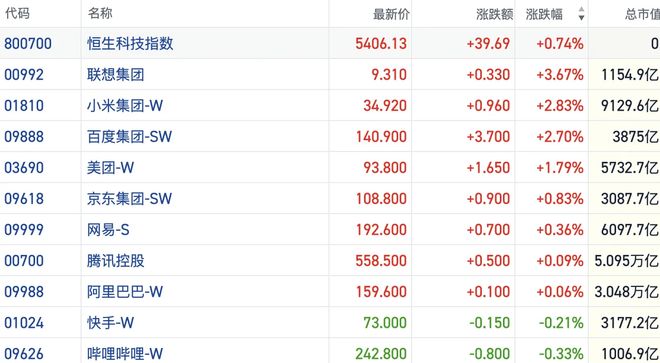
Core Viewpoint - The Hong Kong stock market showed signs of recovery with major indices turning positive, supported by domestic capital inflows and a mixed performance across sectors, particularly in technology and traditional industries [1][4]. Group 1: Market Performance - The Hang Seng Technology Index reached a new low during the day but closed up by 0.74% at 5406.13 points [2] - The Hang Seng Index and the National Enterprises Index increased by 0.14% and 0.5%, respectively [1] - Major tech stocks such as Xiaomi and Baidu rose nearly 3%, while Meituan increased by nearly 2% [1] Group 2: Sector Movements - Consumer sectors including dining, dairy, and beer stocks collectively rose, while telecommunications, biomedicine, home appliances, automotive, banking, and brokerage stocks also strengthened [2] - In contrast, sectors like gold and non-ferrous metals experienced downward volatility, with semiconductor and AI-related industries undergoing continued adjustments [3] Group 3: Trading Activity - The total trading volume for the Hang Seng Index reached 315.11 billion HKD, indicating a certain level of market activity [4] - Southbound capital saw a net purchase of nearly 25 billion HKD, becoming a key driver for market support [4] - Short selling reached a record high of 40.17 billion HKD, accounting for 12.75% of the trading volume, indicating ongoing market volatility [4] Group 4: Investment Trends - There is a notable shift in market focus from high-tech sectors like AI to more traditional industries [4] - Hedge funds are reportedly increasing short positions in software stocks, contributing to a significant sell-off in that sector [6] - Goldman Sachs forecasts a 3% appreciation in the nominal effective exchange rate of the RMB, which may benefit cyclical traditional industries [6] Group 5: Future Outlook - Analysts expect the market to maintain a volatile trend, with potential rotation in investment styles and themes [8] - The current valuation expansion space for Hong Kong stocks is limited, with earnings performance likely to dictate market trends [8] - A "technology + dividend" strategy remains effective in the short term, with an emphasis on defensive sectors such as banking, insurance, telecommunications, and utilities [8]

缩量调整
第一财经· 2026-02-05 11:08
Market Overview - The three major A-share indices collectively retreated, with the Shanghai Composite Index showing resilience due to the banking and brokerage sectors, while the Shenzhen Component Index experienced fluctuations without clear rebound momentum. The ChiNext Index was notably affected by adjustments in technology growth stocks [4]. Market Performance - A total of 1,616 stocks rose, while 375 stocks fell, indicating a market with more declines than gains and significant structural differentiation [5]. - Consumer-related sectors such as film and television, retail, and tourism hotels saw a surge in stock prices, while low-valuation, high-dividend stocks like banks, liquor, and pharmaceuticals demonstrated defensive performance, with some even reaching new highs. In contrast, previously popular sectors like precious metals, photovoltaics, and semiconductors underwent significant adjustments [6]. Trading Volume - The total trading volume of the two markets was 1.8 trillion yuan, down 12.29%, reflecting a contraction in trading activity as pre-holiday risk aversion and cautious sentiment increased. Funds shifted from growth to value sectors, with defensive sectors becoming a "safe haven" for capital, leading to lower trading activity in these areas [7]. Fund Flows - There was a net outflow of 36.672 billion yuan from institutional funds, while retail investors saw a net inflow [8]. - Institutions adjusted their portfolios defensively, favoring sectors such as cultural media, food and beverage, banking, beauty care, and commercial retail, while reducing holdings in power equipment, non-ferrous metals, electronics, computing hardware, and new energy vehicles. Retail investors aligned with institutional preferences, showing a preference for defensive sectors like consumer goods and pharmaceuticals, while avoiding high-volatility sectors like new energy and semiconductors [9]. Investor Sentiment - The sentiment among retail investors was reported at 75.85%, indicating a relatively optimistic outlook [10]. - The average position of investors showed that 54.94% were fully invested, with 30.57% increasing their positions and 14.49% reducing them [14][21].

恒生指数上涨0.14% 恒生科技指数上涨0.74%
Xin Lang Cai Jing· 2026-02-05 11:03
Market Overview - The Hong Kong stock market opened lower but closed higher, with the Hang Seng Index rising by 0.14% to 26,885.24 points, the Hang Seng Tech Index increasing by 0.74% to 5,406.13 points, and the National Enterprises Index up by 0.50% to 9,093.34 points [1] - The Hang Seng Index opened at 26,627.95 points, down by 219.37 points, but later recovered to close up by 37.92 points, with total trading volume exceeding 315.1 billion HKD [1] - The southbound trading under the Stock Connect saw a net inflow of over 24.9 billion HKD [1] Sector Performance - New consumption, new energy vehicle companies, banks, brokerages, and airlines generally saw gains, while sectors such as chips, technology, and wind power experienced mixed results [1] - Declines were noted in sectors including gold, non-ferrous metals, commercial aerospace, oil and gas, real estate, and coal [1] Individual Stock Movements - Pop Mart increased by 2.19%, while SMIC decreased by 1.89% [1] - Meituan rose by 1.79%, and China Life fell by 2.73% [1] - Zijin Mining dropped by 4.76%, Baidu Group increased by 2.70%, and Trip.com fell by 0.53% [1] - Ganfeng Lithium decreased by 6.60%, CATL fell by 1.93%, and Xpeng Motors rose by 1.13% [1] - Industrial and Commercial Bank of China increased by 0.47%, and China Merchants Securities rose by 1.59% [1] - SenseTime fell by 0.42%, and China Petroleum & Chemical Corporation decreased by 0.66% [1] Top Traded Stocks - Tencent Holdings rose by 0.09% with a trading volume exceeding 43.4 billion HKD [2] - Alibaba increased by 0.06% with a trading volume over 14 billion HKD [2] - Xiaomi Group saw a rise of 2.83% with a trading volume exceeding 6.9 billion HKD [2]