
消费品制造业

Search documents
国际机构看好中国经济前景
Ren Min Ri Bao Hai Wai Ban· 2025-07-08 02:09
Core Viewpoint - International institutions are raising their economic growth forecasts for China, highlighting the resilience and vitality of the Chinese economy as a reflection of policy effectiveness, market performance, and growth potential [1][2][3]. Economic Growth Resilience - Goldman Sachs predicts China's GDP growth rate for the first half of this year to reach 5.2%, with further upward potential, having raised its 2025 GDP growth forecast by 0.6 percentage points [2]. - Morgan Stanley and Deutsche Bank have also adjusted their GDP growth forecasts for the next two years, increasing them by 0.3 and 0.2 percentage points respectively [2]. - The shift from export-driven growth to policy-driven domestic demand is becoming evident, particularly with the impact of consumption policies [2][5]. Emerging Sector Development Potential - Foreign institutions emphasize the potential in technology innovation and market opportunities, with China positioned to lead in global high-tech competition, particularly in artificial intelligence [4]. - The strong resilience of the Chinese market is attracting global enterprises, as they plan to increase trade and manufacturing in China despite uncertainties in international trade [4]. Positive Changes in Consumption - The retail sector shows resilience, with significant growth in categories like home appliances and communication equipment, driven by consumption policies [5]. - The increase in retail sales in May, particularly in specific categories, contributed 1.9 percentage points to the total retail sales growth [5]. Sustained Economic Development - Recent economic indicators, such as the manufacturing PMI and logistics index, signal a positive trend in the Chinese economy [6]. - The Chinese government is expected to continue its moderately loose monetary policy and accelerate fiscal spending to boost domestic demand [7]. - The focus on expanding domestic demand and improving living standards is seen as crucial for activating the economy's internal momentum [7].
6月PMI数据点评:强在中游
Huachuang Securities· 2025-07-01 07:46
Group 1: PMI Data Overview - The manufacturing PMI for June is 49.7%, up from 49.5% in May[2] - The production index is at 51.0%, an increase of 0.3 percentage points from the previous value of 50.7%[2] - The new orders index stands at 50.2%, rising from 49.8%[2] Group 2: Sector Performance - The equipment manufacturing PMI is the highest at 51.4%, up 1.8 percentage points from April's 49.6%[4] - The construction industry business activity index is at 52.8%, an increase of 1.8 percentage points from the previous month[14] - The service industry business activity index is slightly down at 50.1%, a decrease of 0.1 percentage points[14] Group 3: Price and Inventory Trends - The PMI factory price index is at 46.2%, remaining below the neutral line for 13 consecutive months[4] - The inventory index has improved, with the purchasing index at 50.2%, up from 47.6%[3] - The comprehensive PMI output index is at 50.7%, reflecting a 0.3 percentage point increase from the previous month[15] Group 4: External Trade and Expectations - New export orders index is at 47.7%, a slight increase from 47.5%[3] - The manufacturing production expectation index is at 52.0%, down from 52.5%[14] - The construction industry business activity expectation index is at 53.9%, up from 52.4%[14]
6月PMI数据点评:需求重回扩张区间
Tai Ping Yang Zheng Quan· 2025-07-01 02:42
Group 1: Manufacturing PMI Insights - China's June official manufacturing PMI is 49.7, matching expectations and up from 49.5 in May, indicating a marginal improvement[4] - The production index rose to 51.0, up 0.3 percentage points from the previous month, signaling recovery in production activities[9] - New orders index increased to 50.2, up 0.4 percentage points, marking a return to the expansion zone after two months below the threshold[9] - The PMI for large enterprises is 51.2, up 0.5 percentage points, while medium-sized enterprises improved to 48.6, up 1.1 percentage points[13] Group 2: Non-Manufacturing Sector Performance - The non-manufacturing PMI for June is 50.5, up 0.2 percentage points, indicating continued expansion[19] - The construction activity index rose to 52.8, up 1.8 percentage points, driven by infrastructure investments[25] - The service sector index is at 50.1, slightly down by 0.1 percentage points, reflecting seasonal adjustments in travel-related services[22] Group 3: Price and Demand Dynamics - The raw material purchase price index is at 48.4, and the factory price index is at 46.2, both showing a 1.5 percentage point increase from the previous month[16] - New export orders index is at 47.7, up 0.2 percentage points, while the import index is at 47.8, up 0.7 percentage points, indicating a slight recovery in external demand[9]
制造业PMI连续两月回升 上半年我国经济运行稳中向好
Yang Shi Xin Wen Ke Hu Duan· 2025-06-30 08:11
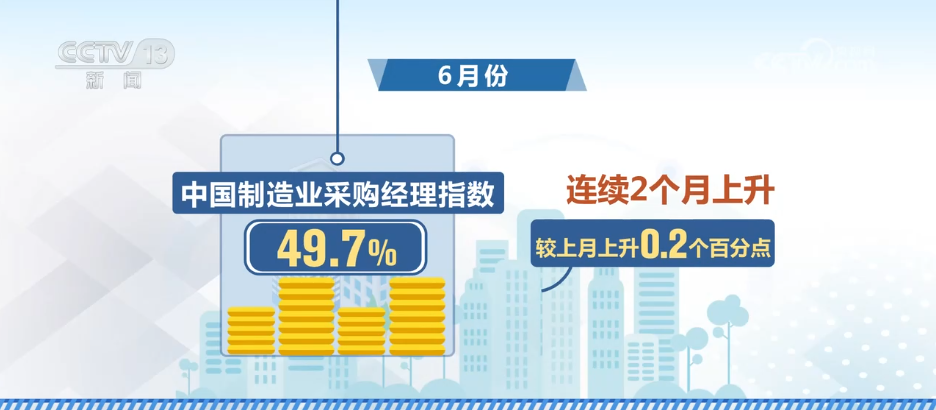
Group 1 - The core viewpoint of the article indicates that China's manufacturing purchasing managers' index (PMI) has shown continuous improvement, with a reading of 49.7% in June, up 0.2 percentage points from the previous month, marking two consecutive months of increase [1][25] - In June, 11 out of 21 surveyed industries were in the expansion zone, an increase of 4 from the previous month, indicating an overall improvement in manufacturing sentiment [2][25] - The new orders index returned to the expansion zone at 50.2%, after being below 50% for two months, reflecting a recovery in market demand [4][25] Group 2 - The equipment manufacturing PMI was 51.4%, up 0.2 percentage points, with both production and new orders indices above 53%, indicating strong performance in this sector [9] - The consumer goods manufacturing PMI rose to 50.4%, up 0.2 percentage points, showing stable growth in this area [13] - Large enterprises continued to expand, with their PMI at 51.2%, up 0.5 percentage points, while medium-sized enterprises also saw a recovery, with their PMI increasing by 1.1 percentage points [15][13] Group 3 - The non-manufacturing business activity index rose to 50.5%, up 0.2 percentage points, indicating continued expansion in the non-manufacturing sector [18] - The construction industry business activity index increased to 52.8%, up 1.8 percentage points, reflecting a recovery in construction activities, particularly in infrastructure projects [22][24] - Overall, the purchasing managers' index serves as an important leading indicator of macroeconomic trends, showing a resilient economic performance in the first half of the year despite fluctuations [25][29]


2025年6月PMI点评:外部扰动减弱,内生动能修复
EBSCN· 2025-06-30 07:43
Manufacturing Sector - The manufacturing PMI for June 2025 is 49.7%, up from 49.5% in May, aligning with market expectations[2] - The production index increased by 0.3 percentage points to 51.0%, while the new orders index rose by 0.4 percentage points to 50.2%[5] - Large and medium enterprises showed improved sentiment, with large enterprises' PMI rising to 51.2% and medium enterprises' PMI to 48.6%, while small enterprises' PMI fell to 47.3%[5] Economic Recovery Indicators - External disturbances have weakened, leading to a recovery in new export orders, which continue to rise[3] - High-energy-consuming industries are stabilizing, with their PMI increasing by 0.8 percentage points to 47.8%[15] - The service sector's business activity index slightly decreased to 50.1%, primarily due to the end of holiday effects, but remains in the expansion zone[27] Price and Inventory Trends - The raw material purchase price index rose to 48.4%, and the factory price index increased to 46.2%, both recovering from previous declines[23] - The raw material inventory index increased by 0.6 percentage points to 48.0%, indicating improved production activity[23] Construction Sector - The construction sector's business activity index rose significantly to 52.8%, reflecting a positive trend in housing construction activities[32] - The government is implementing policies to stabilize the real estate market, which is expected to further improve supply-demand dynamics[33]
透过6月份经济数据看亮点:49.7%,连升两月!制造业景气水平持续改善
Yang Shi Wang· 2025-06-30 06:21
Core Viewpoint - The manufacturing sector in China shows signs of improvement, with the Purchasing Managers' Index (PMI) for June rising to 49.7%, marking a 0.2 percentage point increase from the previous month, indicating a continuous upward trend for two consecutive months [1] Manufacturing Sector Summary - The PMI for the equipment manufacturing industry reached 51.4%, up 0.2 percentage points from last month, with both production and new orders indices above 53% [5] - The high-tech manufacturing PMI stood at 50.9%, remaining stable compared to last month, with production and new orders indices around 52% [5] - The consumer goods manufacturing PMI increased to 50.4%, a rise of 0.2 percentage points, reflecting steady growth [7] - The basic raw materials industry PMI rose by 0.8 percentage points, ending a three-month decline [7] Enterprise Type Analysis - Large enterprises continued to expand, with their PMI at 51.2%, an increase of 0.5 percentage points from last month, indicating significant support for the overall manufacturing sector [9] - The PMI for medium-sized enterprises increased by 1.1 percentage points, ending a two-month downward trend, with new orders index rising over 4 percentage points, showing a notable recovery in demand [11] Non-Manufacturing Sector Summary - The non-manufacturing business activity index for June was 50.5%, a slight increase of 0.2 percentage points, indicating continued expansion [11] - The service industry business activity index was 50.1%, showing stability in the sector [11] - The construction industry business activity index rose to 52.8%, up 1.8 percentage points, indicating a recovery in activity levels [11] - The civil engineering construction index was at 56.7%, remaining above 55% for three consecutive months, suggesting rapid progress in infrastructure projects [11] - Investment-related activities in the construction sector have shown significant recovery, supported by the expansion of special bond investments [11]
中国盈利系列十一:工企盈利承压
Hua Tai Qi Huo· 2025-06-30 05:54
1. Report Industry Investment Rating - No relevant information provided 2. Core Views of the Report - **Revenue Pressure Remains**: From January to May 2025, the total profit of industrial enterprises above the designated size was 2.72 trillion yuan, a year - on - year decrease of 1.1% (turning negative from +1.4% in January - April). This was mainly affected by demand - price weakness, short - term base effects, and a sharp decline in single - month growth. Positive signals include a 2.7% year - on - year increase in operating income and a 1.1% growth in gross profit. The equipment manufacturing industry's profit increased by 7.2%, contributing over 40%. However, inventory pressure persisted, with a 3.5% increase in finished - product inventory at the end of May and longer turnover and accounts - receivable collection days [3]. - **Structural Differentiation Intensifies**: In the equipment manufacturing industry, electronics, electrical machinery, and general equipment benefited from "two new" policies, while railway, ship, aerospace equipment was driven by high - end orders. In the consumer goods manufacturing industry, there was significant internal differentiation. Upstream industries were deeply adjusted, and the profit of the automotive manufacturing industry decreased. Private enterprises' profit increased by 3.4%, outperforming state - owned enterprises [4]. 3. Summary by Relevant Catalog 3.1 Overall Profit Situation - From January to May 2025, the total profit of industrial enterprises above the designated size was 27204.3 billion yuan, a year - on - year decrease of 1.1% due to multiple factors such as insufficient demand, falling industrial product prices, and short - term factor fluctuations. The high base of investment income in the same period last year pulled down the profit growth rate by 1.7 percentage points [2][3][29]. - The gross profit and operating income of industrial enterprises increased. The gross profit increased by 1.1% year - on - year, driving the profit growth of all industrial enterprises above the designated size by 3.0 percentage points. The operating income increased by 2.7% year - on - year, creating favorable conditions for future profit recovery [29]. 3.2 Industry Structure - **Equipment Manufacturing Industry**: From January to May, the profit of the equipment manufacturing industry increased by 7.2% year - on - year, driving the profit growth of all industrial enterprises above the designated size by 2.4 percentage points. Seven out of eight industries in equipment manufacturing saw profit growth, with electronics, electrical machinery, and general equipment growing by over 10% [3][30]. - **"Three - Aviation" Industries**: From January to May, the "three - aviation" industries (aerospace, aviation, and navigation) drove the profit of the railway, ship, and aerospace industry to increase by 56.0% year - on - year. Industries such as aircraft manufacturing, spacecraft and launch vehicle manufacturing, and related equipment manufacturing also had significant profit growth [30]. - **Consumer Goods Manufacturing Industry**: There was significant internal differentiation. The profit of the agricultural and sideline food processing industry increased by 38.2%, while the textile and chemical fiber industries were under pressure [4]. - **Upstream Industries**: The profit of coal mining and ferrous metal ore mining decreased significantly, with year - on - year declines of 50.6% and 45.6% respectively [4]. - **Automotive Manufacturing Industry**: The profit decreased by 11.9% year - on - year, and the new - energy transformation could not offset the decline of fuel - powered vehicles [4]. 3.3 Enterprise Types - Private enterprises' profit increased by 3.4% year - on - year, significantly better than state - owned holding enterprises, which had a 7.4% year - on - year decline, highlighting the operational resilience of private enterprises [4]. - Foreign - invested and Hong Kong, Macao, and Taiwan - invested enterprises' profit increased by 0.3% year - on - year, higher than the average level of all industrial enterprises above the designated size [33].
产能和库存周期有望触底回升,企业盈利修复动能增强
Haitong Securities International· 2025-06-26 11:05
Group 1 - The capacity and inventory cycles are expected to bottom out and recover, enhancing the momentum of enterprise profit recovery [1][6][53] - The current capacity cycle has been in a downward trend since the second half of 2021 and is nearing its end, while the inventory cycle is also expected to transition from a bottoming phase to a replenishment phase within the year [1][2][11] - The recovery of the capacity cycle is typically driven by strong fiscal support policies, as seen in previous cycles [8][14] Group 2 - The downstream capacity cycle is approaching a turning point, with upstream capacity utilization still declining and the mining industry requiring more time for capacity reduction [2][15] - The inventory cycle shows significant differentiation across upstream, midstream, and downstream sectors, primarily due to varying demand improvements [2][15] - Demand improvements are concentrated in sectors with strong policy support, emerging industries, and export-oriented industries, while traditional sectors like real estate remain weak [15][16] Group 3 - The manufacturing sector is currently in a dual bottom phase for both capacity and inventory cycles, with the manufacturing capital expenditure declining significantly since its peak in 2021 [14][40] - The industrial sector is experiencing a passive destocking phase, with inventory levels expected to gradually recover as revenue growth improves [14][17] - The midstream equipment manufacturing sector is showing signs of recovery, driven by policy support and increased consumer demand for electronics and vehicles [30][37] Group 4 - The downstream consumer manufacturing sector is also in a destocking phase, with revenue growth rebounding since the beginning of 2024 [40][48] - Specific industries within the downstream sector, such as agricultural and food processing, are entering active replenishment phases, indicating a positive outlook for inventory levels [48][49] - The overall economic recovery will depend on the strength of consumer and investment demand, which will gradually transmit to the production side [53]
解读5月份工业生产数据:工业生产保持较快增长 高质量发展稳步推进
Zhong Guo Chan Ye Jing Ji Xin Xi Wang· 2025-06-22 22:22
Core Insights - Industrial production in May showed a robust growth trend, with a year-on-year increase of 5.8% in the added value of large-scale industries, and a month-on-month increase of 0.61% after seasonal adjustments [1] - The equipment manufacturing sector significantly contributed to industrial growth, with a year-on-year increase of 9.0%, accounting for 54.3% of the total industrial production growth [2] - High-tech manufacturing continued to drive quality development, with a year-on-year increase of 8.6% in added value, contributing 1.4 percentage points to overall industrial growth [3] Industrial Production Overview - In May, 35 out of 41 major industrial sectors reported year-on-year growth, resulting in a growth coverage of 85.4% [1] - Cumulatively, from January to May, the added value of large-scale industries increased by 6.3% year-on-year [1] Equipment Manufacturing Sector - The equipment manufacturing sector's added value growth of 9.0% was higher than the overall industrial growth by 3.2 percentage points, maintaining a share of 36.7% of total industrial output [2] - The automotive industry experienced a significant increase of 11.6% in added value, with other sectors like aerospace and electrical machinery also showing strong growth [2] Consumer Goods Manufacturing - The consumer goods manufacturing sector saw a year-on-year increase of 2.5%, with 10 out of 13 major categories reporting growth [2] - Notable growth was observed in sectors such as cultural and educational products, chemical fibers, and agricultural by-products, with respective increases of 10.1%, 6.1%, and 7.6% [2] High-Tech and Intelligent Manufacturing - High-tech manufacturing's added value increased by 8.6%, with significant contributions from sectors like aircraft manufacturing and electronic components [3] - The digital product manufacturing sector also showed strong growth, with a 9.1% increase in added value, driven by smart devices and electronic components [3] Green Manufacturing Trends - The production of new energy vehicles and related products saw remarkable growth, with increases of 31.7% for vehicles and 52.5% for lithium-ion batteries [3] - The supply of green materials also improved, with high-performance chemical fibers increasing by 92.2% [3] Policy Impact - The "two new" policies have effectively stimulated consumption, leading to significant growth in sectors such as motor manufacturing and shipbuilding [4] - The implementation of vehicle replacement subsidies contributed to an 11.3% increase in automotive production [4]
5月经济运行总体平稳 消费市场延续向好势头
Zhong Guo Zheng Quan Bao· 2025-06-16 20:35
Economic Overview - In May, the industrial added value above designated size increased by 5.8% year-on-year, while the total retail sales of consumer goods grew by 6.4% year-on-year, indicating a stable economic performance [1][4] - From January to May, fixed asset investment (excluding rural households) rose by 3.7% year-on-year, reflecting ongoing economic resilience and vitality [1] Consumer Market Dynamics - The retail sales growth in May accelerated by 1.3 percentage points compared to the previous month, reaching the highest monthly level since 2024 [2] - The "old-for-new" consumption policy and the "618" e-commerce promotion significantly boosted consumer spending, with specific categories like home appliances and communication equipment seeing substantial growth [2] - The service retail sector also showed positive trends, with a 5.2% increase from January to May, indicating a recovery in consumer services [2] Industrial Production Insights - In May, 35 out of 41 major industries reported year-on-year growth in added value, showcasing a broad-based industrial recovery [4] - The equipment manufacturing and high-tech manufacturing sectors grew by 9.0% and 8.6% respectively, outpacing overall industrial growth [4] - Notable increases were observed in the production of smart drones and industrial robots, with growth rates of 85.9% and 35.5% respectively, highlighting advancements in industrial automation [4] Policy and Future Outlook - The government emphasizes the importance of expanding domestic demand and strengthening the domestic circulation to ensure sustainable economic growth [1][6] - There is a strong expectation for continued monetary easing and fiscal support measures aimed at stimulating consumption and stabilizing the real estate market [6]