
消费者服务

Search documents
中证1000可选消费指数报4595.61点,前十大权重包含万辰集团等
Jin Rong Jie· 2025-07-15 08:49
Group 1 - The core index of the A-share market, the CSI 1000 Consumer Discretionary Index, closed at 4595.61 points, showing mixed performance among the three major indices [1] - The CSI 1000 Consumer Discretionary Index has increased by 2.41% in the past month, 5.35% in the past three months, and 4.51% year-to-date [2] - The CSI 1000 index series selects liquid and representative securities from each industry to form 10 industry indices, providing investors with diversified investment options [2] Group 2 - The top ten holdings of the CSI 1000 Consumer Discretionary Index include: Silver Wheel Holdings (3.34%), Longxin General (2.85%), Shuanglin Shares (2.65%), Qianli Technology (2.61%), Wancheng Group (2.53%), Fulim Precision (2.27%), Kids Wang (1.93%), Weifu High-Tech (1.92%), Huamao Technology (1.86%), and Jihua Group (1.80%) [2] - The market capitalization distribution of the CSI 1000 Consumer Discretionary Index shows that the Shenzhen Stock Exchange accounts for 60.41%, while the Shanghai Stock Exchange accounts for 39.59% [2] - The industry composition of the CSI 1000 Consumer Discretionary Index includes: Passenger vehicles and parts (54.82%), Durable consumer goods (15.94%), Retail (14.06%), Textiles, clothing, and jewelry (10.36%), and Consumer services (4.82%) [2] Group 3 - The index sample is adjusted every six months, with adjustments implemented on the next trading day after the second Friday of June and December each year [3] - In special circumstances, the index may undergo temporary adjustments, such as when a sample company is delisted or undergoes mergers, acquisitions, or splits [3] - When the CSI 1000 index adjusts its samples, the corresponding adjustments will also be made to the CSI 1000 industry indices [3]
中证沪港深互联互通休闲指数报7122.06点,前十大权重包含五粮液等
Jin Rong Jie· 2025-07-14 08:18
据了解,"中证沪港深主题指数系列基于中证沪港深互联互通综合指数样本和中证沪港深 500 指数样 本,同时结合中证行业分类的主题定义,选取相应主题指数样本,从多种主题投资的角度反映了在沪港 深三地上市的互联互通范围内证券的整体表现。"该指数以2004年12月31日为基日,以1000.0点为基 点。 金融界7月14日消息,A股三大指数收盘涨跌不一,中证沪港深互联互通休闲指数 (沪港深通休闲, H30560)报7122.06点。 数据统计显示,中证沪港深互联互通休闲指数近一个月下跌0.16%,近三个月上涨1.62%,年至今上涨 1.65%。 从指数持仓来看,中证沪港深互联互通休闲指数十大权重分别为:贵州茅台(9.61%)、腾讯控股 (9.57%)、美团-W(8.07%)、五粮液(7.18%)、快手-W(5.16%)、百胜中国(3.84%)、泸州老 窖(2.61%)、山西汾酒(2.58%)、银河娱乐(2.29%)、哔哩哔哩-W(1.36%)。 从中证沪港深互联互通休闲指数持仓的市场板块来看,香港证券交易所占比42.95%、深圳证券交易所 占比32.22%、上海证券交易所占比24.83%。 从中证沪港深互联互通休闲指数 ...





中证中国内地企业全球可选消费综合指数报4944.28点,前十大权重包含格力电器等
Jin Rong Jie· 2025-07-09 08:10
Group 1 - The core index, the CN Consumer Comprehensive Index, closed at 4944.28 points, showing a decline of 3.24% over the past month, an increase of 8.69% over the past three months, and a year-to-date increase of 6.17% [1] - The top ten holdings in the CN Consumer Comprehensive Index include Alibaba (18.38%), Meituan-W (6.71%), Pinduoduo (6.5%), BYD Company (4.13%), Midea Group (3.61%), JD.com (3.36%), BYD (3.01%), Trip.com (2.91%), Gree Electric Appliances (2.1%), and Pop Mart (1.93%) [1] Group 2 - The market share of the CN Consumer Comprehensive Index holdings is distributed as follows: Shenzhen Stock Exchange (23.30%), New York Stock Exchange (23.12%), Hong Kong Stock Exchange (21.33%), Shanghai Stock Exchange (16.32%), Nasdaq Global Select Market (15.52%), Nasdaq Stock Market (0.21%), Beijing Stock Exchange (0.15%), and Nasdaq Capital Market (0.05%) [2] - The industry composition of the CN Consumer Comprehensive Index holdings includes Passenger Cars and Parts (26.12%), Durable Goods (16.44%), Consumer Services (9.23%), Textiles, Apparel, and Jewelry (5.58%), and Retail (3.73%) [2] Group 3 - The index sample is adjusted biannually, with adjustments implemented on the next trading day following the second Friday of June and December. Temporary adjustments may occur under special circumstances [3] - When the CN Consumer Comprehensive Index undergoes sample adjustments, the corresponding index samples will also be adjusted. Events such as delisting, mergers, or changes in industry classification will lead to necessary adjustments [3]






还有哪些行业兼具高景气和性价比?
HTSC· 2025-07-06 08:40
Group 1 - The report highlights sectors with high growth potential and cost-effectiveness, including financials, consumer staples, and technology hardware, with a focus on service consumption and software services in the medium term [1] - The report indicates that the EPS of Chinese listed companies is expected to rise for the third consecutive year in 2025, with a significant rebound in market performance anticipated following improvements in EPS expectations [2][3] - The report emphasizes that the correlation between EPS growth and nominal economic growth is strong, suggesting that structural changes in the stock market and improvements in corporate profitability are crucial for capturing market opportunities [3] Group 2 - The report identifies consumer services, durable goods, and technology hardware as sectors with high ROE levels that are likely to improve further, indicating strong investment potential [7][18] - It notes that sectors such as software services, consumer staples, and household products maintain high levels of cost-effectiveness, while technology hardware and durable goods are not significantly overvalued [7][20] - The report provides a comparative analysis of PEG ratios, indicating that sectors like diversified finance, materials, and durable goods have PEG levels below 1, suggesting attractive valuations [20][23] Group 3 - The report discusses the importance of earnings performance in the context of upcoming earnings disclosures, highlighting that sectors with improved economic conditions provide a solid foundation for market performance [4] - It mentions that the Hong Kong market's liquidity is primarily driven by capital inflows, which are influenced by the market's comparative advantages [3] - The report outlines that the valuation levels of Hong Kong stocks remain attractive compared to global markets, with a current forward PE of around 10x [53][47]
中金公司 风格偏向小盘成长
中金· 2025-07-02 15:49
Investment Rating - The report indicates a positive outlook for small-cap growth style in July, with a recommendation for sectors such as consumer services, real estate, and textiles to perform well in the short term [1][5][10] Core Insights - The macroeconomic indicators show a mixed impact on different asset classes, with PPI underperforming and CPI exceeding expectations negatively affecting the stock market, while industrial value-added and PMI exceeding expectations positively influence the commodity market [1][3] - The report highlights a bullish signal for the stock market based on timing indicators, suggesting a potential upward trend, while the bond market shows signs of overheating risk [1][4] - The report emphasizes the importance of sector rotation strategies, recommending industries that may outperform in the current fast rotation environment [1][5] Summary by Sections Macroeconomic Analysis - The report notes that the latest PPI data was below expectations, while CPI has exceeded expectations for two consecutive months, leading to a negative impact on the stock market [3] - Industrial value-added has exceeded expectations for three consecutive months, along with a favorable exchange rate and PMI, positively impacting the commodity market [3] Timing Indicators - Three indicators triggered bullish signals for the stock market, while three bearish signals were noted for the bond market, indicating potential upward movement for stocks and caution for bonds [3][4] Sector Rotation Strategy - Recommended sectors for July include comprehensive, light manufacturing, real estate, building materials, consumer services, and textiles, which are expected to perform well in the short term [1][5] Style Analysis - The report indicates that small-cap growth style is expected to outperform in July, with a notable shift towards growth style over value style [6][7] - The report highlights that the sentiment and market conditions favor growth style, with a total score of 1.32 indicating a strong preference for growth [7] Quantitative Strategy Performance - The report details that small-cap strategies have outperformed major small-cap indices, with specific strategies yielding returns of 11.4% and 9.6% [8][9] - The growth-oriented strategies have shown significant returns, with one strategy yielding 9.4% in June and over 22% in the first half of the year [9] Market Outlook for July - The report maintains a positive outlook for July, suggesting that both growth-oriented and small-cap strategies still present opportunities despite some valuation concerns [10]

二季度港股定价权有何变化
GUOTAI HAITONG SECURITIES· 2025-07-02 12:17
Core Insights - Since the second quarter, southbound capital has continued to flow into Hong Kong stocks, with a cumulative net inflow of HKD 292.5 billion in Q2, leading to a historical high in the market value share of southbound holdings in Hong Kong stocks [3][6] - The proportion of Hong Kong Stock Connect holdings increased from 19.0% at the end of Q1 to 20.7% at the end of Q2, while the foreign capital share decreased from 62.8% to 60.4% [3][6] - From a stock perspective, foreign capital still dominates most sub-sectors in Hong Kong stocks, but with the inflow of southbound capital, the marginal pricing power of southbound investors is significantly increasing in sectors such as consumer services, household products, automotive, commercial services, durable consumption, biopharmaceuticals, medical device services, energy, and banking [3][6] Industry Analysis - The report highlights that the southbound capital's marginal pricing power is notably rising in various sectors, including consumer services, household products, automotive, commercial services, durable consumption, biopharmaceuticals, medical device services, energy, and banking [3][6][13] - The data indicates that foreign capital still holds a dominant position in most sub-sectors of Hong Kong stocks, but the increasing southbound capital is changing the dynamics of pricing power in these industries [3][6][12]
中信期货晨报:市场情绪偏暖,商品多数上涨-20250627
Zhong Xin Qi Huo· 2025-06-27 03:21
1. Report Industry Investment Rating - No relevant information provided in the report. 2. Core Viewpoints of the Report - The domestic economy maintains a stable pattern, with domestic assets presenting mainly structural opportunities. The policy - driven logic will be strengthened in the second half of the year. Overseas geopolitical risks may intensify short - term market fluctuations and disrupt risk preferences. In the long run, the weak US dollar pattern continues. Attention should be paid to non - US dollar assets and strategic allocation of resources such as gold [7]. 3. Summary by Relevant Catalogs 3.1 Macro Highlights - **Overseas Macro**: In June, the Fed kept the federal funds rate target range unchanged at 4.25% - 4.50%, with a more cautious outlook on下半年 rate cuts. US economic data in May was weak, and the economic recovery is limited by geopolitical risks and trade uncertainties. Rising oil prices may prompt the Fed to send hawkish signals [7]. - **Domestic Macro**: The Lujiazui Financial Forum announced multiple financial support policies, strengthening policy expectations for the second half of the year. In May, fixed - asset investment expanded, manufacturing investment grew rapidly, and the service industry accelerated. Industrial and consumer data also showed positive growth [7]. - **Asset Views**: Domestic assets offer structural opportunities, driven by policies in the second half of the year. Overseas geopolitical risks may cause short - term market fluctuations, while the long - term weak US dollar pattern persists. Attention should be paid to non - US dollar assets and strategic allocation of gold [7]. 3.2 Viewpoint Highlights 3.2.1 Financial Sector - **Stock Index Futures**: Funds are releasing congestion, and the market is expected to fluctuate. Key points to watch include end - of - day stock stampedes and deterioration of US dollar liquidity [8]. - **Stock Index Options**: Sellers should wait for the inflection point of declining volatility, and the market is expected to fluctuate. The continuous deterioration of option liquidity is a concern [8]. - **Treasury Bond Futures**: The bullish sentiment in the bond market has declined, and the market is expected to fluctuate. Attention should be paid to unexpected changes in tariffs, supply, and monetary easing [8]. 3.2.2 Precious Metals - **Gold/Silver**: Due to better - than - expected progress in Sino - US negotiations, precious metals will continue to adjust in the short term. Key points include Trump's tariff policy and the Fed's monetary policy, and the market is expected to fluctuate [8]. 3.2.3 Shipping - **Container Shipping to Europe**: Attention should be paid to the game between peak - season expectations and price - increase implementation. The market is expected to fluctuate, and key points include tariff policies and shipping companies' pricing strategies [8]. 3.2.4 Black Building Materials - **Steel Products**: The macro sentiment has improved, but contradictions are accumulating. The market is expected to fluctuate, and key points include the progress of special bond issuance, steel exports, and molten iron production [8]. - **Iron Ore**: Molten iron production has slightly increased, and prices are fluctuating. Key points include overseas mine production and shipping, domestic molten iron production, weather, port ore inventory, and policy dynamics [8]. - **Coke**: Pessimistic sentiment has faded, and prices are stable. Key points include steel mill production, coking costs, and macro sentiment [8]. - **Coking Coal**: Transaction volume has improved, but confidence is still insufficient. Key points include steel mill production, coal mine safety inspections, and macro sentiment [8]. - **Silicon Iron**: Cost expectations have improved, and the market performance is strong. Key points include raw material costs and steel procurement [8]. - **Manganese Silicon**: Cost disturbances have emerged again, and the market performance is strong. Key points include cost prices and overseas quotes [8]. - **Glass**: Supply disturbances have affected sentiment, and production and sales have weakened. The key point is spot production and sales [8]. - **Soda Ash**: Intermediate inventory has decreased, and the market is under pressure. The key point is soda ash inventory, and the market is expected to decline with fluctuations [8]. 3.2.5 Non - ferrous Metals and New Materials - **Copper**: The US dollar index is weak, and copper prices are at a high level. Key points include supply disturbances, unexpected domestic policies, less - than - expected dovishness of the Fed, and less - than - expected recovery of domestic demand [8]. - **Alumina**: The number of warehouse receipts is low, and the alumina market has risen. Key points include unexpected delays in ore resumption, excessive electrolytic aluminum resumption, and extreme sector trends [8]. - **Aluminum**: Low inventory and high premiums have pushed up aluminum prices. Key points include macro risks, supply disturbances, and less - than - expected demand [8]. - **Zinc**: The supply - demand surplus pattern remains unchanged, and attention should be paid to short - selling opportunities. Key points include macro - turning risks and unexpected recovery of zinc ore supply. The market is expected to decline with fluctuations [8]. - **Lead**: Cost support has strengthened again, and the downside of lead prices is limited. Key points include supply - side disturbances and slowdown in battery exports [8]. - **Nickel**: Supply and demand are under pressure, and nickel prices are expected to be weak in the short term. Key points include unexpected macro and geopolitical changes, Indonesian policy risks, and insufficient supply release [8]. - **Stainless Steel**: Nickel - iron prices continue to decline, and the market is expected to fluctuate. Key points include Indonesian policy risks and unexpected demand growth [8]. - **Tin**: Spot transactions are dull, and tin prices are fluctuating. Key points include expectations of Wa State's resumption of production and demand improvement [8]. - **Industrial Silicon**: Supply is continuously increasing, and silicon prices are under pressure. Key points include unexpected supply cuts and unexpected photovoltaic installations [8]. - **Lithium Carbonate**: Warehouse receipts have significantly decreased, and price fluctuations should be watched out for. Key points include less - than - expected demand, supply disturbances, and new technological breakthroughs [8]. 3.2.6 Energy and Chemicals - **Crude Oil**: US inventory pressure has eased, and short - term geopolitical disturbances should be watched. The market is expected to decline with fluctuations. Key points include OPEC+ production policies and Middle East geopolitical situations [10]. - **LPG**: Geopolitical tensions have eased, and the market is weakly fluctuating. Key points include cost developments of crude oil and overseas propane [10]. - **Asphalt**: The expectation of increased production is strong, and asphalt prices are expected to follow crude oil down. The market is expected to decline with fluctuations, and the key point is unexpected demand [10]. - **High - Sulfur Fuel Oil**: Israel has resumed gas field production, and fuel oil prices may continue to be under pressure. The market is expected to decline with fluctuations, and key points include crude oil and natural gas prices [10]. - **Low - Sulfur Fuel Oil**: Low - sulfur fuel oil prices are expected to follow crude oil down. The market is expected to decline with fluctuations, and key points include crude oil and natural gas prices [10]. - **Methanol**: Tensions between Iran and Israel have eased, and the market is fluctuating. Key points include macro - energy and upstream - downstream device dynamics [10]. - **Urea**: Exports are used to balance domestic supply - demand differences, and the market may be slightly stronger in the short term. The market is expected to rise with fluctuations. Key points include market transactions, policy trends, and demand fulfillment [10]. - **Ethylene Glycol**: Rising ethylene prices have boosted ethylene derivatives, and the market is expected to fluctuate and adjust. The key point is ethylene glycol terminal demand [10]. - **PX**: Supply is tight, and geopolitical developments should be watched. The market is expected to fluctuate. Key points include crude oil fluctuations and downstream device abnormalities [10]. - **PTA**: Supply - demand has weakened marginally, but the current situation is okay and costs are strong. The market is expected to fluctuate. The key point is polyester production [10]. - **Short - Fiber**: The short - fiber industry is healthy, and spot processing fees have slightly increased. The market is expected to rise with fluctuations. The key point is terminal textile and clothing exports [10]. - **Bottle Chips**: The market follows raw materials, and the industry is waiting for production cuts. The market is expected to fluctuate. The key point is future bottle - chip start - up [10]. - **PP**: Crude oil prices have fallen, and the market is fluctuating. Key points include crude oil prices and domestic and overseas macro - situations [10]. - **Plastic**: Geopolitical premiums have declined, and the market is fluctuating. Key points include crude oil prices and domestic and overseas macro - situations [10]. - **Styrene**: Geopolitical tensions have cooled down, and the market is expected to decline. The market is expected to decline with fluctuations. Key points include crude oil prices, macro - policies, and device dynamics [10]. - **PVC**: With low valuation and weak supply - demand, the market is fluctuating. Key points include expectations, costs, and supply [10]. - **Caustic Soda**: Dynamic costs have increased, and the market is temporarily fluctuating. Key points include market sentiment, start - up, and demand [10]. - **Oils and Fats**: The sustainability of the rebound should be watched, and the weather in US soybean - producing areas is good. The market is expected to fluctuate. Key points include South American soybean harvest, US soybean planting, and Malaysian palm oil production and demand data [10]. - **Protein Meal**: The expectation of soybean meal imports has hit the market, and the support at the bottom should be watched. The market is expected to fluctuate. Key points include US soybean area and weather, domestic demand, macro - situation, and Sino - US and Sino - Canadian trade wars [10]. - **Corn/Starch**: The market is fluctuating, and spot prices are still firm. Key points include less - than - expected demand, macro - situation, and weather [10]. - **Pigs**: Upstream price - holding sentiment is strong, and demand is in the off - season. The market is expected to fluctuate. Key points include breeding sentiment, epidemics, and policies [10]. 3.2.7 Agriculture - **Rubber**: A warm macro - environment has driven up rubber prices. The market is expected to fluctuate. Key points include production - area weather, raw material prices, and macro - changes [10]. - **Synthetic Rubber**: The market's follow - up increase is limited. The key point is significant crude oil price fluctuations [10]. - **Pulp**: The weak trend remains unchanged. The market is expected to decline with fluctuations. Key points include macro - economic changes and fluctuations in US - dollar - denominated quotes [10]. - **Cotton**: Cotton prices continue to rebound with increased positions. The market is expected to fluctuate. Key points include demand and output [10]. - **Sugar**: The domestic and international markets are differentiated, and the domestic market is rebounding with fluctuations. The key point is abnormal weather [10]. - **Logs**: There are no obvious fundamental contradictions, and the market is expected to fluctuate in the short term. Key points include shipment volume and dispatch volume [10].
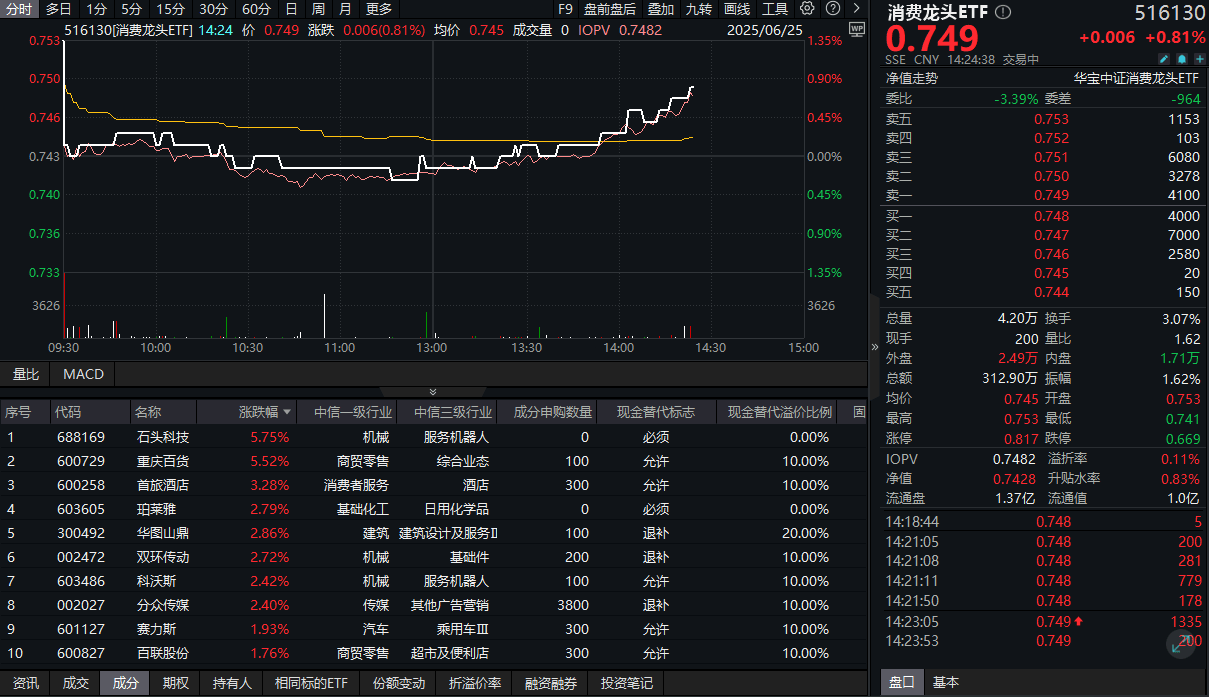
提振消费再出政策利好!大消费反攻,消费龙头ETF午后翻红!布局时机已至?
Sou Hu Cai Jing· 2025-06-25 06:46
Group 1 - The core viewpoint of the news highlights a strong rebound in the consumer sector, particularly through the Consumer Leader ETF (516130), which saw a price increase of 0.81% [1] - The leading stocks in various consumer segments, such as machinery, retail, and consumer services, experienced significant gains, with Stone Technology and Chongqing Department Store both rising over 5% [1] - The People's Bank of China and six other departments issued guidelines to support and expand consumption, proposing 19 key measures to enhance consumer capacity and optimize the consumption environment [1][3] Group 2 - There is an increasing focus on consumption from higher authorities, with favorable policies emerging to boost the consumer sector, indicating a potential trend in the market [3] - The Consumer Leader ETF's underlying index has a price-to-earnings ratio of 17.26, which is at a low point compared to the past decade, suggesting a favorable long-term investment opportunity [3] - Analysts predict that consumption will be a significant driver of economic growth in 2025, with ongoing policy support expected to create new dynamics and scenarios in the consumer market [3]


中证500可选消费指数报3777.31点,前十大权重包含麦格米特等
Jin Rong Jie· 2025-06-17 08:13
Group 1 - The CSI 500 Consumer Discretionary Index has experienced a decline of 5.34% over the past month, 11.66% over the past three months, and 3.10% year-to-date [2][3] - The index is composed of various sectors categorized into 11 primary industries, 35 secondary industries, and over 90 tertiary industries, providing a comprehensive analysis tool for investors [2] - The top ten weighted stocks in the CSI 500 Consumer Discretionary Index include Sichuan Changhong (6.98%), Ninebot (6.47%), Wanfeng Aowei (4.58%), and others [2] Group 2 - The market capitalization distribution of the CSI 500 Consumer Discretionary Index shows that the Shanghai Stock Exchange accounts for 62.26% and the Shenzhen Stock Exchange accounts for 37.74% [2] - The industry composition of the index includes Passenger Cars and Parts (35.25%), Durable Consumer Goods (33.93%), Textiles, Apparel, and Jewelry (11.01%), Retail (10.46%), and Consumer Services (9.35%) [3] - The index samples are adjusted biannually, with adjustments occurring on the next trading day after the second Friday of June and December [3]



预警!高位板块崩塌,聪明钱正涌向这些洼地
Sou Hu Cai Jing· 2025-06-17 04:34
Market Overview - A-shares and Hong Kong stocks exhibited a narrow fluctuation pattern, with major indices showing muted performance [1] - A-share market saw the Shanghai Composite Index slightly down by 0.19% to 3382.14 points, while the Shenzhen Component remained flat and the ChiNext Index fell by 0.14% [1] - Hong Kong's Hang Seng Index dipped by 0.13% to 24028.83 points, with the Hang Seng Tech Index and the China Enterprises Index also experiencing slight declines [1] Industry Performance - A-shares displayed a clear rotation in technology themes, driven by a significant overnight surge of over 283% in brain-computer interface concepts in the US market [2] - The stablecoin concept remained active due to expectations of major policy announcements in Hong Kong, while the solid-state battery sector gained traction ahead of an industry forum [2] - In contrast, the healthcare sector in Hong Kong faced pressure, with some pharmaceutical companies experiencing volatility due to new drug development progress [2] - The durable goods and consumer services sectors also showed weakness, while the industrial sector saw strength, particularly among leading optical technology firms [2] Driving Factors - The structural market dynamics in A-shares are influenced by three main factors: external market sentiment, policy and event catalysts, and capital rotation strategies [2] - The healthcare sector's adjustments in Hong Kong are linked to individual company events and market sentiment fluctuations, while the industrial sector benefits from domestic growth-supporting policies [2] Future Outlook - The macro environment and policy direction remain critical, with steady growth in industrial output and consumption providing fundamental support for the market [3] - The People's Bank of China has conducted two reverse repurchase operations this month, injecting a net of 200 billion yuan into the market, indicating a generally ample liquidity environment [3] - Short-term market trends may continue to exhibit oscillatory dynamics, with high-position themes in A-shares facing increased volatility and the healthcare sector in Hong Kong under valuation pressure [3] - Key areas for mid-term investment focus include AI computing power, solid-state batteries, and commercial aerospace, as these sectors are viewed as priorities for institutional investment [3] - The evolution of core market contradictions, such as the timing of Federal Reserve policy shifts and developments in the domestic real estate market, will significantly influence mid-term market direction [3]