钢铁业

Search documents
韩国刚划下红线,美国来了个“下马威”!美财长放韩国鸽子,李在明对华加税,韩国开始选边站?
Sou Hu Cai Jing· 2025-07-28 12:46
Group 1 - The postponement of the "2+2" tariff negotiations between South Korea and the U.S. adds uncertainty to the already tense South Korea-U.S. relations, highlighting South Korea's difficult position in the complex international landscape [1] - South Korea is under pressure due to the U.S. imposing a tariff deadline of August 1, with the country eager to avoid a 25% comprehensive tariff, especially as Japan has already reached a tariff agreement with the U.S. [1] - South Korea has set two "red lines" in negotiations: not opening the rice and beef markets, as its grain self-sufficiency rate is low, with only 19.5% from 2021 to 2023, and zero self-sufficiency in wheat and corn [1] Group 2 - In 2024, South Korea imported $2.22 billion worth of U.S. beef, making it a major importer, but the U.S. is pushing to lift the ban on U.S. beef imports over 30 months, facing strong opposition from the South Korean agricultural sector [3] - South Korea's recent diplomatic interactions with the U.S. have seen multiple cancellations of meetings, indicating U.S. dissatisfaction with South Korea's proposals and an attempt to assert dominance in the bilateral relationship [3] Group 3 - On July 25, South Korea's Ministry of Trade announced a request for anti-dumping duties of 28.16% to 33.57% on carbon steel and hot-rolled steel from China, which raises questions about its timing amid ongoing U.S. tariff negotiations [5] - This anti-dumping investigation was initiated earlier in the year, but its announcement during critical negotiations suggests a strategic move to appease the U.S. while deflecting responsibility from the current government [5] Group 4 - South Korea is navigating a complex geopolitical environment, heavily reliant on U.S. military protection while also depending on China as its largest trading partner, with trade volumes exceeding $300 billion in 2024 [6] - The current administration appears to be leaning towards the U.S., as evidenced by recent actions such as rejecting China's invitation to a military parade and imposing tariffs on Chinese steel, signaling a shift in diplomatic posture [8] Group 5 - Over-reliance on the U.S. could jeopardize South Korea's relationship with China, which is crucial for its economic development, as many industries depend on Chinese raw materials [8] - The imposition of tariffs on Chinese steel may lead to increased costs for South Korean industries, potentially escalating trade tensions and undermining established economic cooperation [8]

国际金融市场早知道:7月28日
Xin Hua Cai Jing· 2025-07-28 05:49
Group 1 - The G20 Development Ministers' Meeting is held in Mpumalanga, South Africa, focusing on enhancing social protection and combating illicit financial flows [1] - President Trump announces a new trade agreement with the EU, imposing a 15% tariff on EU goods entering the US, while key areas like steel, aluminum, chips, and spirits remain unresolved [2] - The European Central Bank's council member states there is little reason to further lower interest rates unless the economy faces significant shocks [2] Group 2 - The Russian Central Bank lowers its benchmark interest rate from 20% to 18%, maintaining a tight monetary policy until inflation returns to target levels by 2026 [3] - US durable goods orders fell by 9.3% in June, the largest decline since April 2020, with core durable goods orders unexpectedly dropping by 0.7% [3] - The US stock market sees record margin account borrowing exceeding $1 trillion for the first time [3] Group 3 - The Dow Jones Industrial Average rises by 0.47% to 44,901.92 points, with the S&P 500 and Nasdaq Composite reaching new historical highs [4] - COMEX gold futures decline by 1.04% to $3,338.50 per ounce, while silver futures drop by 2.29% to $38.33 per ounce [4] Group 4 - US oil futures decrease by 1.45% to $65.07 per barrel, and Brent crude futures fall by 1.11% to $67.60 per barrel [5] - The 2-year US Treasury yield rises by 0.91 basis points, while the 10-year yield decreases by 0.99 basis points to 4.388% [5] Group 5 - The US dollar index increases by 0.19% to 97.67, with various currency pairs showing mixed performance against the dollar [6]
深夜,关税大消息!
天天基金网· 2025-07-28 05:12
Core Viewpoint - The U.S. Secretary of Commerce, Wilbur Ross, confirmed that the deadline for imposing tariffs on trade partners is set for August 1, with no extensions or grace periods [2] Group 1: Tariff Implementation - The tariffs will officially take effect on August 1, and customs will begin collecting them [2] - A few countries have reached agreements with the Trump administration, resulting in tariff levels higher than the new 10% baseline but lower than the threatened higher rates [2] Group 2: U.S.-EU Trade Negotiations - Ursula von der Leyen, President of the European Commission, is scheduled to meet with President Trump to negotiate a trade agreement before the August 1 deadline, or face tariffs up to 30% on EU exports to the U.S. [6][7] - The outcome of the negotiations largely depends on Trump's decisions, as he has previously altered terms at the last minute [7] - The EU is proposing a 15% tariff cap on most trade with the U.S., with certain exemptions for specific products [7][8] Group 3: Business Delegation to China - A high-level U.S. business delegation is set to visit China, organized by the U.S.-China Business Council, to potentially restart commercial negotiations [4][5] - The delegation will include executives from Boeing and the U.S.-China Business Council, indicating a significant engagement in trade discussions [3][4]
加拿大讨好特朗普对华加税,中方订单给澳洲
Sou Hu Cai Jing· 2025-07-26 00:26
Group 1 - The Canadian government imposed a 25% punitive tariff on steel containing Chinese components, a move seen as a response to U.S. tariffs on Canadian steel and aluminum products [1][3] - The Canadian steel industry has experienced a 30% drop in production due to these tariffs, while the government has chosen to target China instead of confronting the U.S. directly [3] - The policy disproportionately affects China, with all countries that have free trade agreements with the U.S. being exempt from these tariffs, leading to criticism from trade experts [3] Group 2 - In retaliation, China placed a significant order worth $3.7 billion with Australia, including 150,000 tons of canola seeds, which directly impacts Canada's economy [4][6] - Canada previously exported 4 million tons of canola seeds to China annually, but exports have now plummeted to a mere 0.03%, causing a 12% drop in canola prices and the closure of seven oilseed processing plants [6] - The situation has led to widespread discontent among Canadian farmers, with protests against the government's policies and a report highlighting a loss of CAD 9 billion in business due to short-sighted political decisions [8][6] Group 3 - Australia is benefiting from the situation, with its agricultural sector thriving as it secures new agreements with China, including the re-entry of previously banned products like Australian wine [6][4] - The Canadian government faces backlash from its citizens, with political leaders criticizing the decision to sacrifice farmers' livelihoods for U.S. favor [8] - The stark contrast between the economic conditions in Canada and Australia is evident, with Canadian ports experiencing a backlog of containers while Australian ports are bustling with activity [8][6]
协同传统产业和新兴产业发展,深化“两个创新”融合——从产业“聚变”看江苏经济活力与韧性
Xin Hua Ri Bao· 2025-07-25 23:49
Group 1: Economic Growth and Industrial Performance - Jiangsu province's industrial added value increased by 7.4% year-on-year in the first half of the year, with strategic emerging industries accounting for 42.1% of the total industrial output, up 0.5 percentage points from last year [1] - High-tech industries' output accounted for 51.8% of the province's total industrial output, reflecting a 0.4 percentage point increase from the first quarter [2] - Traditional industries remain significant, with manufacturing investment growing by 0.5%, particularly in automotive (21.6%), textiles (26.9%), and rubber and plastics (11.2%) [5] Group 2: Emerging Industries and Innovation - The number of high-tech enterprises in Jiangsu accounted for 36.3% of the province's industrial enterprises, generating 73.6% of the high-tech industry output [2] - Jiangsu is positioning itself as a leader in low-altitude economy, with over 30 companies in the drone manufacturing sector and a significant increase in drone take-off and landing sites [4] - The province has seen a surge in innovative pharmaceuticals, with 11 new drugs approved for market, ranking first in the country [8] Group 3: Technological Advancements and Digital Economy - Jiangsu has established 1,808 advanced intelligent factories, with significant growth in high-tech manufacturing and equipment manufacturing [7] - The province is actively exploring the integration of digital economy and traditional industries, with a 7.9% increase in the core digital economy industries' sales [9] - A total of 41 strategic emerging industry funds have been established, with a total scale exceeding 100 billion yuan, enhancing capital capabilities across the province [9][10]
A股三大股指震荡走高,沪指站上3600点:大金融稳步走强,超4300股收涨
Sou Hu Cai Jing· 2025-07-24 07:27
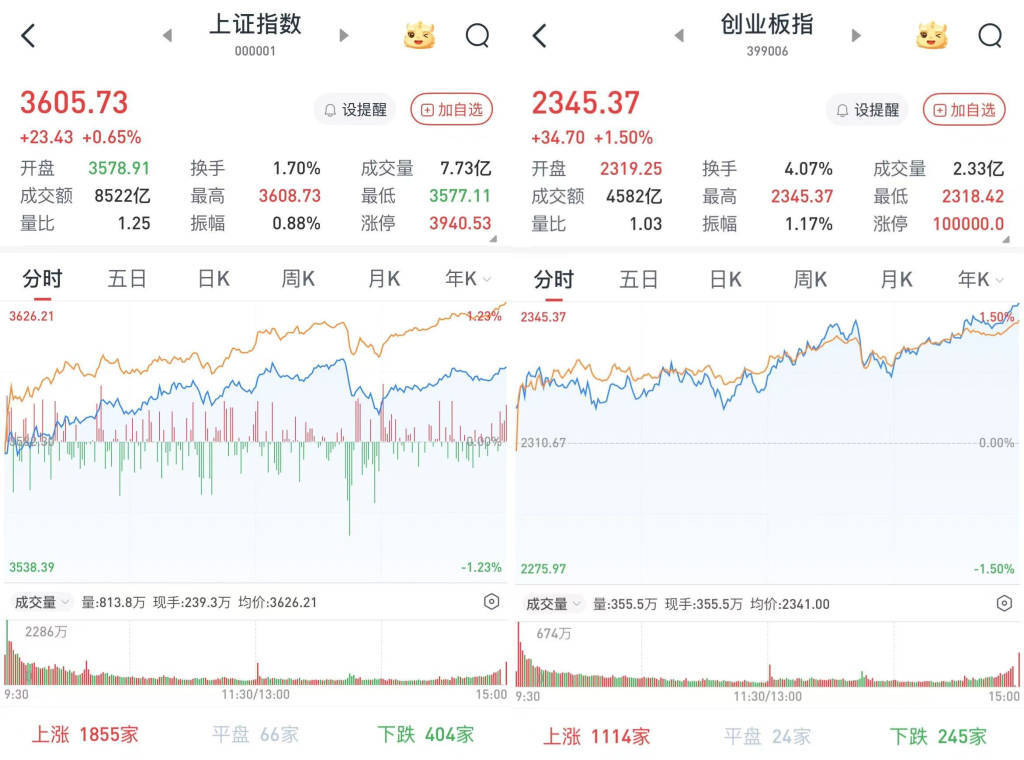
Market Overview - The A-share market showed mixed performance on July 24, with the Shanghai Composite Index breaking the 3600-point mark during the session [1] - By the close, the Shanghai Composite Index rose by 0.65% to 3605.73 points, the Sci-Tech Innovation 50 Index increased by 1.17% to 1032.84 points, the Shenzhen Component Index gained 1.21% to 11193.06 points, and the ChiNext Index climbed 1.5% to 2345.37 points [3] Trading Activity - A total of 4391 stocks rose while 911 stocks fell, with 113 stocks remaining flat across the two exchanges and the Beijing Stock Exchange [4] - The total trading volume for the two exchanges was 184.47 billion yuan, a decrease of 19.9 billion yuan from the previous trading day [4] Sector Performance - The steel sector showed strong performance, with stocks like Baogang Co. and Hainan Mining hitting the daily limit, while other steel stocks rose over 3% [5] - The retail sector also performed well, with companies like China Duty Free and Bubugao reaching the daily limit, and several others increasing by over 3% [5] - The non-ferrous metals sector was notable, with stocks such as Longmag Technology and Tibet Mining hitting the daily limit or rising over 10% [5] - Conversely, banking stocks underperformed, with several banks declining over 2% [5] Market Sentiment and Future Outlook - Financial analysts suggest that the market is currently experiencing structural rotation opportunities, with a focus on old infrastructure and technology sectors [8] - The market is showing resilience to negative news and responding positively to favorable news, indicating a potential for a sustained upward trend [8] - There is a bullish sentiment in the market, although some analysts caution about the possibility of short-term adjustments following recent gains [8]
大资金持续发力!新一轮举牌潮进行中
券商中国· 2025-07-24 03:30
Core Viewpoint - The recent surge in insurance capital's stock acquisitions, marking a new wave of investment activity, reflects a strategic shift in asset allocation and operational adjustments in response to the evolving economic landscape [2][18][19]. Group 1: Insurance Capital Activity - Insurance companies have initiated a record 21 stock acquisitions as of July 22, surpassing the total for 2021-2023 and setting a five-year high [2][10]. - The latest acquisitions include significant purchases by Zhongyin Life and Taikang Life, with Zhongyin acquiring 726,000 shares of Green Power Environmental, reaching a 5.0722% stake [7][6]. - The trend of stock acquisitions has been consistent, with four instances occurring in July alone, indicating a robust interest from various insurance firms [5][6]. Group 2: Investment Strategy and Market Conditions - The current investment strategy emphasizes high-dividend stocks and long-term equity investments, driven by a low-interest-rate environment and new financial regulations [11][18]. - The insurance sector is increasingly focusing on stable, high-yield investments to enhance returns, with a notable shift towards equities as a means to navigate low returns from traditional fixed-income assets [18][19]. - The ongoing policy support for long-term investments is expected to further expand the space for equity asset allocation among insurance companies [19][22]. Group 3: Historical Context and Future Outlook - This marks the third wave of stock acquisitions in the past decade, with previous surges occurring in 2015 and 2020, indicating a cyclical pattern in investment behavior [8][9]. - Although the current annual acquisition count has not yet surpassed the previous waves, the duration and total volume of acquisitions since 2024 have already exceeded the second wave [9]. - The focus on banking stocks remains prominent, with significant investments in major banks, reflecting their stable operations and attractive dividend yields [12][10].

国泰君安期货商品研究晨报-20250723
Guo Tai Jun An Qi Huo· 2025-07-23 02:13
Report Industry Investment Ratings No investment ratings for the industry are provided in the report. Core Views The report presents the price trends and outlooks for various commodities on July 23, 2025. Different commodities are expected to have different trends, including upward, downward, and sideways movements, influenced by factors such as macro - economic conditions, supply - demand relationships, and policy expectations [2][4]. Summary by Commodity Precious Metals - **Gold**: Expected to move upward in a sideways manner, with a trend strength of 1 [2][7][8]. - **Silver**: Expected to break through and move upward, with a trend strength of 1 [2][7][8]. Base Metals - **Copper**: Domestic spot prices are firm, providing support for the price, with a trend strength of 1 [2][10][12]. - **Zinc**: Expected to have small - scale sideways movements, with a trend strength of 0 [2][13][14]. - **Lead**: There are still expected supply - demand contradictions, and the price has support, with a trend strength of 0 [2][16][17]. - **Tin**: The price is weakening, with a trend strength of - 1 [2][19][22]. - **Aluminum**: Expected to move sideways within a range, with a trend strength of 0; Alumina is expected to move upward in a sideways manner, with a trend strength of 1; Cast aluminum alloy follows the trend of electrolytic aluminum, with a trend strength of 0 [2][23][25]. - **Nickel**: Macro - economic sentiment boosts expectations, but reality limits the upside potential, with a trend strength of 0; Stainless steel is mainly influenced by macro - economic sentiment at the margin, and fundamentals determine the upside potential, with a trend strength of 0 [2][26][30]. Energy and Chemicals - **Carbonate Lithium**: The commodity sentiment is positive, and it is expected to move strongly in a sideways manner, with a trend strength of 1 [2][31][33]. - **Industrial Silicon**: Market sentiment is high, and attention should be paid to the risk of reaching the daily limit; the trend strength is 2. - **Polysilicon**: Policy expectations are getting stronger, and the price is unlikely to fall, with a trend strength of 1 [2][34][36]. - **Iron Ore**: Supported by macro - economic expectations, it is expected to move strongly in a sideways manner, with a trend strength of 0 [2][37]. - **Rebar and Hot - Rolled Coil**: Driven by macro - economic sentiment, they are expected to move strongly in a sideways manner, with a trend strength of 1 for both [2][41][44]. - **Silicon Ferrosilicon and Manganese Silico - Manganese**: Driven by the macro - economic market, they are expected to move strongly in a sideways manner, with a trend strength of 1 for both [2][46][48]. - **Coke**: The second - round price increase has been implemented, and it is expected to move strongly in a sideways manner, with a trend strength of 1; Coking coal is restricted by supply - policy expectations, and it is expected to move strongly in a sideways manner, with a trend strength of 1 [2][50][52]. - **Steam Coal**: Daily consumption is recovering, and the price is expected to stabilize in a sideways manner, with a trend strength of 0 [2][54][57]. Agricultural and Livestock Products - **Palm Oil**: Boosted by macro - economic factors, but caution should be exercised regarding sentiment reversal. - **Soybean Oil**: Follows the trend of the oilseed sector but is relatively weak among varieties. - **Soybean Meal**: Market sentiment is strong, and the price is expected to move strongly in a sideways manner. - **Soybean No. 1**: Technically, it is expected to move strongly in a sideways manner. - **Corn**: Expected to move sideways. - **Sugar**: Expected to have narrow - range consolidation. - **Cotton**: Attention should be paid to changes in market sentiment. - **Egg**: The peak season arrives first, and the sentiment for culling hens decreases. - **Live Pig**: Macro - economic sentiment is strong, waiting for verification at the end of the month. - **Peanut**: Expected to move sideways [4]. Others - **Log**: Expected to have repeated sideways movements [2][58].
20万吨油菜籽运往中国,加拿大财路被断,这才明白了中国的底气
Sou Hu Cai Jing· 2025-07-22 23:18
Group 1 - Canada has imposed a 25% tariff on Chinese steel, which has led to a loss of market share, while Australia is set to secure a new canola trade agreement with China, marking the end of years of trade freeze [1][11][15] - China's canola seed inventory has reached a low point, and Australia's nearshore supply capability allows for quick delivery to China, filling the gap left by Canada [3][23] - Canada's agricultural sector is facing severe drought, and the loss of canola exports to China exacerbates its economic challenges [11][29] Group 2 - Canada's actions appear to be a strategic move to appease the U.S., but this has resulted in economic isolation and a loss of significant agricultural contracts with China [7][15] - In contrast, Australia has shifted its approach under the Albanese government, focusing on national interests and re-establishing trade relations with China, leading to the removal of over 20 billion AUD in trade barriers [19][21] - The geographical advantage of Australia allows for faster shipping times to China compared to Canada, making Australian canola more competitive [23][31] Group 3 - China's market power and diversified supply sources, including increased imports from Russia and Kazakhstan, provide it with strong bargaining leverage in international trade [27][29] - China's domestic agricultural production is improving, ensuring stability in its supply chain despite external pressures [29][32] - The evolving agricultural trade landscape indicates a shift towards greater autonomy and diversification for China, allowing it to maintain control over its economic strategies [32]

加拿大对华关税自捅刀,37亿订单飞澳,加拿大经济要崩?
Sou Hu Cai Jing· 2025-07-22 21:21
Group 1 - Canadian Prime Minister Mark Carney announced a 25% tariff on Chinese steel, aiming to protect the domestic steel industry amid rising U.S. tariffs [1][3] - Carney's decision is seen as a move to appease the domestic steel industry while risking the agricultural sector, which heavily relies on China for exports [3][4] - The Canadian steel industry is significantly dependent on the U.S. market, with 90% of its exports going there, while the agricultural sector relies on China for 70% of canola seed exports [3][5] Group 2 - The tariff policy exhibits a double standard, as Canada grants exemptions to U.S. and Mexican imports while imposing higher tariffs on Chinese goods [5][6] - Canadian steel companies express concerns that the tariffs will not significantly impact Chinese imports, as they only account for 8% of total imports, potentially leading to higher prices for consumers [6][8] - The Canadian government’s $1 billion fund for the steel industry is viewed as insufficient compared to the estimated $4.5 billion loss in the agricultural sector due to retaliatory tariffs from China [8][9] Group 3 - Chinese companies are adapting by utilizing transshipment routes to circumvent tariffs, significantly reducing their costs [6][7] - The Canadian construction industry is already feeling the impact of rising steel prices, with costs increasing by 15% following the tariff announcement [6][9] - The overall economic strategy of Canada under Carney is criticized for being overly reliant on a single market, leading to vulnerabilities in both the steel and agricultural sectors [8][10] Group 4 - The global trade environment is increasingly characterized by protectionism, which is detrimental to consumers and businesses alike, as evidenced by rising prices and lost market share [10][11] - The Canadian government's approach is seen as short-sighted, potentially leading to long-term economic harm while failing to diversify trade relationships [10][11] - The situation highlights the risks of aligning too closely with U.S. policies, as Canada may find itself marginalized in the global market [11]