
建材

Search documents
国泰海通宏观:总量需加力,结构有亮点
Ge Long Hui· 2025-09-15 13:23
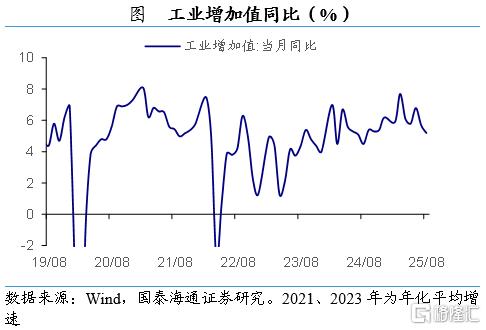
Economic Overview - The domestic economy continued to slow down in August, with a mix of resilience in production and pressure on demand, leading to increased internal differentiation [2][3] - Industrial value-added growth year-on-year was 5.2% in August, down from 5.7% in July, indicating a slight decline but still at a relatively high level [4][6] - The overall economic trend is expected to maintain a slow and stable trajectory with structural optimization, but demand recovery will take time [2][3] Production Sector - The production growth rate showed a slight decline, primarily due to external demand pressures and some upstream industries experiencing production cuts [4][6] - The production-sales rate decreased from 97.1% to 96.6%, indicating a marginal improvement in domestic consumption capacity [4] - Policy-related industries, such as transportation equipment and non-ferrous metals, showed resilience, while export and consumer-related sectors faced significant pressure [6][7] Service Sector - The service sector's production index grew by 5.6% year-on-year in August, down 0.2 percentage points from July, reflecting a slowdown [7] - High-value-added industries like information technology and finance showed growth, while leasing and business services faced challenges due to weak corporate expansion intentions [7] Employment - The urban survey unemployment rate rose slightly to 5.3% in August, primarily due to seasonal pressures from the influx of recent graduates into the labor market [9] Consumption Sector - Retail sales growth year-on-year was 3.4% in August, down 0.3 percentage points from July, indicating a need for stronger consumption recovery [12][15] - Dining consumption showed signs of recovery, while retail sales growth for goods slowed down, reflecting a mixed performance across different categories [14][15] - Essential consumption categories faced declines, while some upgraded consumption categories showed resilience, supported by seasonal demand and policy measures [15] Investment Sector - Fixed asset investment growth was 0.5% year-on-year for January to August, with August showing a significant decline of 7.1% compared to July [16][19] - Investment in manufacturing, infrastructure, and real estate all experienced negative growth, necessitating policy support to break the downward cycle [16][20] - The real estate sector continued to face fundamental pressures, with sales area and sales value both declining significantly year-on-year [20]


北京市组织开展“惠民建材大集”活动,助力居民房屋焕新
Xin Jing Bao· 2025-09-15 02:20
Core Viewpoint - The Beijing Municipal Commission of Housing and Urban-Rural Development, in collaboration with local governments, organized a "Beneficial Building Materials Fair" to address housing damage caused by heavy rainfall during the flood season, aiming to assist residents in home renovation [1][2] Group 1: Event Overview - The event took place on September 14 and was held at the Agricultural Products Trading Market in Longyong Town, Pinggu District [1] - The fair featured over 80 well-known building material companies, including Beijing Construction Engineering, Beijing Urban Construction, Beijing Jinyu, and Beijing New Building Materials, showcasing more than 20 categories of products [1] Group 2: Services Offered - The fair provided a "one-stop" convenient service by organizing quality building material suppliers for on-site exhibitions, promoting direct supply from manufacturers, and centralized procurement [2] - Residents could register their purchasing needs on-site to enjoy discounts for old material removal, and those who ordered windows or cabinets could receive free old material removal services [2] - All purchased products came with a guarantee of the lowest market price, valid until June 30, 2026, along with centralized delivery and installation services [2] Group 3: Future Plans - The Beijing Municipal Commission plans to continue similar beneficial building materials fairs in other districts, such as Miyun and Huairou, to further assist residents in achieving comfortable housing [2]

牛市中的震荡如何演绎?
2025-09-15 01:49
Summary of Conference Call Records Industry Overview - The A-share market is currently experiencing a strong oscillation pattern, with limited upward potential and minimal downward risk, influenced by market sentiment, economic data, and Sino-U.S. relations [1][2][5] - The technology growth sector is performing exceptionally well, particularly companies with strong industrial trends. Cyclical industries and previously underperforming growth companies, such as the telecommunications sector, also present opportunities for low-cost positioning [1][3][12] Core Insights and Arguments - Key factors contributing to market oscillation include: 1. High-level financing leading to cooling risks, with a total inflow of nearly 60 billion since September 5, and financing balances exceeding 2.3 trillion, a historical high [5] 2. Economic data from August indicating a weak recovery, with export growth slowing to approximately 4% year-on-year and a decline in new social financing and RMB loans [5] 3. Increased risk from U.S.-China semiconductor sanctions, although ongoing trade negotiations may mitigate long-term impacts [5][10] - Historical patterns suggest that oscillations in bull markets typically end with significant policy changes or external events that positively influence risk appetite [6][12] - Current indicators for the end of the oscillation phase are not fully met: - The valuation percentile of the Shanghai Composite Index is around 66, above the neutral level of 50% [8] - Trading volume has decreased by a maximum of 37%, not exceeding the 50% threshold [8] - The turnover rate remains high at 72%, indicating insufficient cooling [8] Industry Rotation and Opportunities - Industry rotation is incomplete, with consumer and cyclical sectors not showing significant recovery. In the agriculture, forestry, animal husbandry, and fishery sector, only leading stocks have increased, with an average rise of 8.1%, while non-leading stocks only rose by 1.4% [9][12] - Recommended sectors for investment include: 1. Technology, Media, and Telecommunications (TMT) and non-ferrous metals, which are expected to continue their upward trend [13][14] 2. Telecommunications and innovative pharmaceuticals, which may show signs of recovery and potential for upward movement [13][14] Additional Important Insights - The current market sentiment remains relatively high, which could lead to a decrease in potential gains [5] - The overall liquidity environment is favorable, with policies supporting inflows and a low-risk external environment due to ongoing negotiations with the U.S. [11][12] - The short-term economic outlook remains weak, but there are signs of recovery in corporate earnings data, suggesting a potential for gradual improvement [11][12]
中国建材(03323):业绩成功扭亏,期待新材料中期更大贡献
Changjiang Securities· 2025-09-14 23:30
Investment Rating - The investment rating for the company is "Buy" and is maintained [8]. Core Views - The company reported a successful turnaround in performance, achieving a net profit of 1.36 billion yuan in the first half of 2025, compared to a loss of 2.018 billion yuan in the same period of 2024 [2][5]. - Revenue for the first half of 2025 was 83.28 billion yuan, a slight decrease of 0.2% year-on-year [2][5]. - The new materials segment showed promising growth, with revenue of 26.8 billion yuan, up 13.6% year-on-year, primarily driven by increased sales of fiberglass blades [6]. Summary by Sections Financial Performance - The company achieved a revenue of 83.28 billion yuan in 2025H1, a decrease of 0.2% compared to 2024H1. The net profit was 1.36 billion yuan, marking a significant increase of 167% year-on-year [2][5]. - The cement segment saw a total sales volume of 97.78 million tons, down 14% year-on-year, with an average selling price of 250 yuan per ton, which is an increase of 9 yuan per ton [7]. - The new materials segment reported fiberglass sales of 2.03 million tons, a growth of 1% year-on-year, with an average selling price of 4,547 yuan per ton, up 12.3% [7]. Segment Analysis - The new materials division contributed significantly to the company's performance, with a net profit contribution of 1.98 billion yuan [6]. - The engineering technology services segment generated revenue of 21.3 billion yuan, a year-on-year increase of 3.6%, with a net profit contribution of 700 million yuan [6]. - The basic building materials segment faced challenges, with revenue declining by 8.8% year-on-year, but the gross margin improved to 16.6% due to lower coal prices [10]. Future Outlook - The company expects earnings of 3.7 billion yuan and 4.7 billion yuan for 2025 and 2026, respectively, corresponding to price-to-earnings ratios of 11 and 8 [8]. - The company is undergoing a valuation restructuring, aiming to enhance its growth attributes and improve its profit margins as it optimizes its product structure [10].
衡阳即禧建材有限公司成立 注册资本10万人民币
Sou Hu Cai Jing· 2025-09-14 18:02
Group 1 - The company Hengyang Jixi Building Materials Co., Ltd. has been established with a registered capital of 100,000 RMB [1] - The legal representative of the company is Zhou Guanhua [1] - The business scope includes sales of building materials, wholesale of hardware products, sales of non-metallic minerals and products, sales of metal structures, sales of doors and windows, sales of metal materials, construction of metal doors and windows projects, sales of building decoration materials, and sales of fireproof sealing materials [1]
策略周聚焦:反杠铃配置
Huachuang Securities· 2025-09-14 12:45
Group 1 - The report maintains a positive outlook for the short term, indicating that it is not yet time for high-low switching, while mid-term expectations are for a physical re-inflation bull market [3][10][14] - The report emphasizes the importance of technology innovation, highlighting that the technology sector is expected to continue its growth, particularly in industries with clear growth expectations such as pharmaceuticals (innovative drugs), electronics (PCB), and communications (optical modules) [6][54] - The report notes a shift in market dynamics, with large-cap stocks outperforming small-cap stocks, driven by factors such as superior earnings under inflation, resilience in return on equity (ROE), and the expansion of ETFs favoring large-cap styles [12][34][35] Group 2 - The report discusses the "barbell strategy," which is suitable for low-price environments, indicating that as inflation expectations rise, the demand for the reverse barbell strategy will increase [4][19] - The report highlights the performance of the technology bull market and the return of leading blue-chip stocks, noting that since June 25, there has been a reversal in style within the technology sector, with large-cap stocks gaining significant traction [5][33][36] - The report identifies key industries to focus on in the mid-term, particularly those experiencing supply constraints and price increases due to the ongoing "anti-involution" policies, including industrial metals, small metals, steel, petrochemicals, and construction materials [6][56]
行业比较周跟踪:A股估值及行业中观景气跟踪周报-20250914
Shenwan Hongyuan Securities· 2025-09-14 12:02
Investment Rating - The report does not explicitly provide an overall investment rating for the industry but highlights various sectors' valuations and historical percentiles, indicating potential investment opportunities and areas of caution [1][2]. Core Insights - The report tracks the valuation of A-shares as of September 12, 2025, with the overall market PE at 21.5 times, indicating it is at the 81st percentile historically [2][5]. - Key sectors with PE valuations above the historical 85th percentile include Real Estate, Steel, Building Materials, Electric Equipment (Photovoltaic), National Defense, Automation Equipment, Light Industry Manufacturing, Chemical Pharmaceuticals, and IT Services [2][3]. - The report notes that the photovoltaic industry is experiencing price increases in the supply chain, while the battery materials market shows mixed price movements [2][3]. Valuation Comparison - The report provides a detailed comparison of various indices and sectors, highlighting that the ChiNext Index has a PE of 42.3 times, at the 39th percentile historically, while the STAR 50 Index has a PE of 184.3 times, at the 100th percentile [2][5]. - The report indicates that no industries are currently in the historical 15th percentile or below for both PE and PB valuations [2][3]. Sector-Specific Summaries New Energy - Photovoltaic prices are rising, with upstream polysilicon prices down by 5.5% and downstream battery prices up by 0.3% [2][3]. - The report notes a 7.5% year-on-year increase in domestic retail sales of new energy vehicles in August 2025, although growth is expected to slow in the coming months [2][3]. Real Estate Chain - The report indicates a 1.0% decrease in rebar prices and a 1.2% increase in cement prices, reflecting a mixed outlook for the construction materials sector [2][3]. Consumer Sector - The average price of live pigs decreased by 3.1%, while wholesale pork prices increased by 0.2%, indicating a weak market for pork [2][3]. Technology (TMT) - The semiconductor market saw a 10.4% year-on-year increase in sales in July 2025, although growth is slowing due to inventory adjustments [2][3]. Cyclical Industries - The report highlights a 1.8% increase in Brent crude oil prices, driven by geopolitical tensions, while coal prices show mixed trends [2][3]. Key Industry Valuations - The report lists specific industry valuations, such as Real Estate at a PE of -6.9 and Steel at -1047.8, indicating significant challenges in these sectors [2][8]. Overall Market Trends - The report notes that the overall market is experiencing a mixed sentiment, with some sectors showing resilience while others face headwinds due to economic conditions and policy changes [2][3].
金观平:重点行业产能治理重在“反内卷”
Jing Ji Ri Bao· 2025-09-14 02:04
Group 1 - The central government's commitment to address capacity issues and optimize market competition order is evident, aiming to solidify the foundation for high-quality industrial development [1] - The core of capacity issues lies in supply-demand imbalance, necessitating efforts from both supply and demand sides to improve effective demand and promote supply-demand matching [1] - The "anti-involution" approach through legal and market-based means is crucial for improving supply-demand dynamics and establishing a fair competition order, which will stimulate innovation [1] Group 2 - In the automotive industry, "involutionary" competition has intensified this year, primarily through price wars, leading to reduced reasonable profits for upstream and downstream enterprises and potential quality risks [2] - Traditional industries should focus on enhancing technical standards and strictly controlling new capacity to avoid low-end capacity homogenization, while new industries must prevent blind expansion to mitigate investment waste [2] - A comprehensive approach to address "involutionary" competition requires a combination of effective government action and market mechanisms, promoting fair competition and encouraging enterprises to shift from price competition to value competition [3]
2025年9月上旬流通领域重要生产资料市场价格变动情况
Guo Jia Tong Ji Ju· 2025-09-14 01:30
Core Viewpoint - The monitoring of market prices for 50 important production materials across nine categories shows a mixed trend, with 8 products experiencing price increases, while 40 products saw price declines, and 2 remained stable in early September 2025 compared to late August 2025 [2]. Group 1: Price Changes in Major Categories - In the black metal category, prices for rebar, wire rod, and ordinary plates decreased by 1.3%, 1.6%, and 0.7% respectively, with rebar priced at 3175.0 yuan per ton [4]. - In the non-ferrous metal category, electrolytic copper increased by 1.0% to 80030.0 yuan per ton, while aluminum ingots decreased by 0.3% to 20686.3 yuan per ton [4]. - Chemical products showed varied results, with caustic soda increasing by 1.5% to 909.7 yuan per ton, while pure benzene and styrene saw declines of 2.5% and 3.1% respectively [4]. Group 2: Energy and Coal Prices - In the petroleum and natural gas sector, liquefied petroleum gas (LPG) increased by 1.6% to 4503.7 yuan per ton, while gasoline prices decreased by 0.6% for 95 and 0.7% for 92 grades [4]. - Coal prices also experienced declines, with ordinary mixed coal dropping by 5.5% to 526.6 yuan per ton, and Shanxi premium mixed coal decreasing by 2.0% to 687.5 yuan per ton [4]. Group 3: Agricultural Products and Inputs - In agricultural products, the price of yellow corn decreased by 0.1% to 2299.7 yuan per ton, while cotton prices fell by 0.2% to 14720.2 yuan per ton [5]. - Fertilizer prices showed a decline, with urea dropping by 1.3% to 1736.4 yuan per ton, while pesticide prices increased by 0.7% to 27275.0 yuan per ton [5]. Group 4: Monitoring Methodology - The monitoring of market prices includes data from over 2000 wholesalers, agents, and distributors across more than 300 trading markets in 31 provinces [8]. - The price monitoring methods involve on-site price collection, telephone inquiries, and electronic communications [9].
重点行业产能治理重在“反内卷”
Jing Ji Ri Bao· 2025-09-13 22:10
Group 1 - The central government is determined to address capacity issues and optimize market competition order, which will support high-quality industrial development [1] - The core of capacity issues lies in supply and demand imbalance, necessitating efforts on both supply-side control and demand-side expansion to improve supply-demand matching [1] - "Anti-involution" through legal and market-based means will help improve supply-demand conditions and establish a fair competition order, stimulating innovation [1] Group 2 - In the automotive industry, "involution" competition has intensified this year, leading to reduced reasonable profits for upstream and downstream enterprises and potential quality risks [2] - Traditional industries should focus on improving technical standards and controlling new capacity to avoid low-end capacity homogenization [2] - New industries must prevent blind expansion and investment waste by monitoring technology iteration cycles and adjusting industrial policy guidance [2] Group 3 - Effective governance of "involution" competition requires a combination of proactive government action and effective market mechanisms [3] - The government should regulate price behaviors to avoid vicious price competition and maintain a fair market environment [3] - Addressing "involution" competition is a systematic project crucial for industrial health and high-quality economic development, requiring collaboration between government and market [3]