
传媒

Search documents
中央经济工作会议这些新提法 为A股投资提供最新指引
Di Yi Cai Jing· 2025-12-11 23:56
中央经济工作会议12月10日至11日在北京举行,为明年经济工作指明方向。 相比此前,会议在宏观政策取向、产业发展重点以及资本市场改革方向等方面都有不少新提法,为A股 市场投资提供了最新指引。 业内认为,新旧动能交替仍将是2026年的主要线索,科技板块如AI、半导体、机器人等值得关注,顺 应国家战略、具备真实技术壁垒的科技企业将是明年A股投资的重要主线。在政策红利与产业升级共振 下,A股市场长期稳健运行基础将进一步夯实。 会议在部署"改革攻坚"任务时强调"持续深化资本市场投融资综合改革"。 "2026年是'十五五'规划的开局之年,金融改革创新的重点领域仍在资本市场。"银河证券首席经济学家 章俊认为,新质生产力正成为经济高质量发展的强劲推动力和支撑力,需要加强资本市场改革,更好赋 能新质生产力。 在他看来,继"十五五"规划建议强调"健全投资和融资相协调的资本市场功能"之后,中央经济工作会议 使用"持续深化"这一表述,是对2026年资本市场开展投融资改革重要性的再次深化。 政策预期:积极、宽松 会议明确,继续实施更加积极的财政政策和适度宽松的货币政策,加大逆周期和跨周期调节力度,强调 政策协同性和集成效应。业内认为 ...
中央经济工作会议这些新提法,为A股投资提供最新指引
Di Yi Cai Jing· 2025-12-11 23:33
都有哪些新提法? 中央经济工作会议12月10日至11日在北京举行,为明年经济工作指明方向。 相比此前,会议在宏观政策取向、产业发展重点以及资本市场改革方向等方面都有不少新提法,为A股 市场投资提供了最新指引。 业内认为,新旧动能交替仍将是2026年的主要线索,科技板块如AI、半导体、机器人等值得关注,顺 应国家战略、具备真实技术壁垒的科技企业将是明年A股投资的重要主线。在政策红利与产业升级共振 下,A股市场长期稳健运行基础将进一步夯实。 会议在部署"改革攻坚"任务时强调"持续深化资本市场投融资综合改革"。 "2026年是'十五五'规划的开局之年,金融改革创新的重点领域仍在资本市场。"银河证券首席经济学家 章俊认为,新质生产力正成为经济高质量发展的强劲推动力和支撑力,需要加强资本市场改革,更好赋 能新质生产力。 在他看来,继"十五五"规划建议强调"健全投资和融资相协调的资本市场功能"之后,中央经济工作会议 使用"持续深化"这一表述,是对2026年资本市场开展投融资改革重要性的再次深化。 政策预期:积极、宽松 会议明确,继续实施更加积极的财政政策和适度宽松的货币政策,加大逆周期和跨周期调节力度,强调 政策协同性和 ...
中央经济工作会议如何指引A股?机构研判来了
Sou Hu Cai Jing· 2025-12-11 15:30
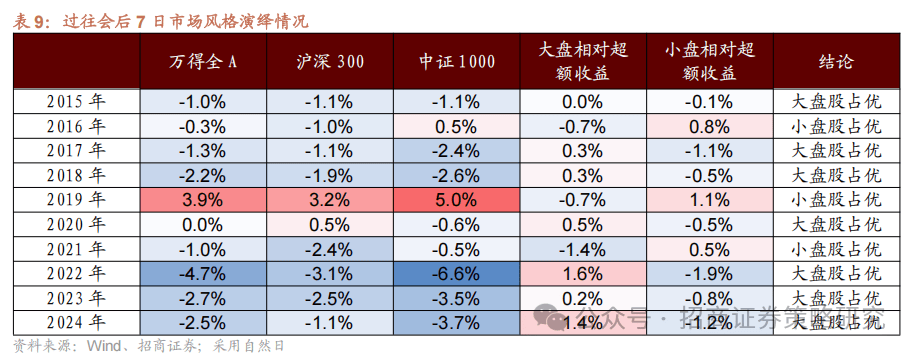
Group 1 - The central economic work conference indicates a relatively positive policy tone for the capital market in 2024, with a fiscal deficit rate potentially maintained at 4% and a focus on promoting economic stability and reasonable price recovery in monetary policy [1][2] - The conference emphasizes the need to address the decline in investment growth, with major projects expected to be a key focus for investment in 2024, particularly as it marks the beginning of the 14th Five-Year Plan [1][2] - The conference highlights the importance of consumer demand, with plans to implement a rural resident income increase plan, although there may be limited expansion in funding support for new policies [1][2] Group 2 - Historical market performance shows that large-cap stocks tend to outperform in the week following the conference, with a consistent trend observed over the past five years [3][4] - Specific industries such as oil and petrochemicals, telecommunications, and electronics have a higher probability of rising in the week after the conference, while sectors like social services, public utilities, coal, and media have shown higher average excess returns over the past five years [6][11] - The focus on key industries mentioned in the conference often translates into increased policy support in the following year, with past examples including the emphasis on low-altitude economy in 2023 leading to significant policy developments in 2024 [11][12]

财信证券袁闯:政策护航提质增效 关注科技成长核心主线
Zhong Zheng Wang· 2025-12-11 14:23
Core Viewpoint - The Central Economic Work Conference emphasizes a continuation of proactive macroeconomic policies, including more active fiscal policies and moderately loose monetary policies, to support economic recovery and stabilize the capital market [1] Market Environment - The overseas economy remains resilient with marginally easing liquidity, alongside rising expectations for interest rate cuts by the Federal Reserve, indicating an improving external environment [1] - Domestically, the "dual easing" policy is expected to continue, leading to a likely weak recovery in the economy, while "anti-involution" policies are set to optimize industry supply and demand dynamics, positively impacting listed company performance [1] Investment Themes - The technology growth sector remains the core focus for the medium to long term, with the AI industry chain expected to shift from hardware to application, particularly in media, computing, and internet sectors [2] - Four specific investment lines are highlighted: 1. High dividend assets are seeing increased accumulation by institutional investors, with sectors like white goods, banking, and telecommunications showing promising dividend strategies [2] 2. The "anti-involution" trend is entering a phase driven by fundamentals, with significant performance improvement expected in coal, steel, and photovoltaic industries [2] 3. Domestic demand expansion focuses on "matching effects," with new consumption areas like health consumption and pet economy, alongside travel and aviation sectors, presenting opportunities [2] 4. In the resource sector, strategic minor metals and industrial metals are anticipated to follow gold in price recovery, benefiting from the upward trend in commodity prices [2] Outlook for 2026 - With policy support, improving internal and external environments, and structural optimization, the A-share market is likely to continue its upward trend, with a focus on technology growth and advantageous niche sectors as the core logic for capturing market opportunities [2]
中央经济工作会议点评:2025年中央经济工作会议如何指引A股?
CMS· 2025-12-11 13:32
证券研究报告 | 策略专题报告 2025 年 12 月 11 日 2025 年中央经济工作会议如何指引 A 股? ——中央经济工作会议点评 中央经济工作会议 12 月 10 日至 11 日在北京举行。会议整体延续政治局会议 相对积极的表态。短期来看,过去 10 年间,会后 7 天大盘风格往往相对占优。 行业表现上,从平均超额收益水平来看,近 5 年,社会服务、公用事业、煤炭、 传媒这五个行业会后 7 天平均超额水平相对更高。中长期来看,建议重点关注 会议"推动投资止跌回稳"下,明年重大项目的安排。 专题报告 相关报告 1、《如何理解 12 月政治局会 议?对资本市场意味着什么? ———政策专题》2025-12-08 2、《今年以来服务消费政策部 署梳理,美政府结束停摆——国 内外产业政策周报(1116)》 2、《黄金税收政策调整,美国 与亚洲多国达成合作——国内 外产业政策周报(1103)》 3、《发布会召开介绍和解读四 中全会精神,有哪些增量信息? — — 国 内 外 产 业 政 策 周 报 (1025)》 4、《整治内卷聚焦价格治理, 特朗普威胁对华大幅加征关税 — — 国 内 外 产 业 政 策 周 报 ...
2026年转债投资策略:稳中求变,顺势而为
Guolian Minsheng Securities· 2025-12-11 11:26
Group 1 - The core view of the report indicates that the convertible bond market is expected to maintain a trend of oscillation and upward movement in 2026, with equity markets experiencing a "slow bull" market, leading to continued activity in equity and balanced convertible bonds [5][8] - The supply-demand situation for convertible bonds in 2026 is projected to be tight, with new bonds being issued to meet corresponding allocation needs after some bonds are redeemed or mature [5][14] - Institutional investors' holdings of convertible bonds have increased, indicating strong demand for allocation in a market characterized by asset scarcity [5][30] Group 2 - The report highlights that the domestic bond interest rates are expected to exhibit an "N" shaped trend in 2026, with a moderate impact on convertible bonds [47][48] - The report suggests that the funding side is likely to become the main driver of the stock market in 2026, with policies aimed at increasing the entry of long-term funds into the market [59][60] - The report recommends focusing on convertible bonds related to emerging pillar industries, future industries, and the construction of a new energy system, in line with the "14th Five-Year Plan" [61][62]
【财闻联播】越南禁止出口稀土矿石!蓝盾光电终止购买星思半导体部分股权
券商中国· 2025-12-11 11:00
Macro Dynamics - The China Association of Automobile Manufacturers reported that in November, China's automobile exports reached 728,000 units, marking a month-on-month increase of 9.3% and a year-on-year increase of 48.5%. The total exports from January to November amounted to 6.343 million units, reflecting a year-on-year growth of 18.7%. It is projected that by 2025, annual automobile exports could reach 7 million units [2]. Trade Relations - Mexico's Senate has passed a new tariff law that will impose tariffs ranging from 5% to 50% on certain products from several Asian countries, including China, starting next year. The Chinese Foreign Ministry expressed hope that Mexico would correct this protectionist approach to maintain healthy bilateral trade relations [3]. Semiconductor Industry - The Ministry of Commerce of China is pushing for representatives from Nexperia Netherlands to visit China to discuss corporate control and supply chain stability following a letter from Wingtech Technology inviting them for negotiations [4][5]. Rare Earth Industry - Vietnam's National Assembly has passed a law restricting the export of refined rare earths and reaffirming a ban on the export of rare earth ores to support its domestic rare earth industry. Despite having significant rare earth reserves, Vietnam's estimated reserves have been drastically reduced from 22 million tons to 3.5 million tons [6]. Financial Institutions - The former head of the policy research office at the Agricultural Development Bank of China, Wu Biao, is under investigation for serious violations of discipline and law [7]. Market Data - The market experienced fluctuations with the ChiNext index dropping over 1%. Nearly 4,400 stocks in the market closed lower, while the total trading volume in the Shanghai and Shenzhen markets reached 1.86 trillion yuan [12]. The financing balance in both markets increased by 3.472 billion yuan, reaching a total of 24.888 trillion yuan [13]. Company Dynamics - Bluetron Optoelectronics announced the termination of its agreement to purchase a stake in Star Semiconductor, with no payment made for the shares as of now [15]. Bilibili denied rumors regarding a full membership system and stated that it would pursue legal action against those spreading false information [16]. Wanhu Chemical has signed an investment agreement to build a 650,000-ton lithium iron phosphate project in Laizhou, which will support the development of new energy industries in Shandong Province [17]. Huawei launched its new generation Harmony PC, the Huawei Qingyun HM740, which boasts the longest battery life among its laptops to date [18]. Vanke's domestic bonds saw a significant decline, with some bonds dropping over 18% [19].

中原传媒:截至2025年11月28日公司登记在册的股东人数为18542户
Zheng Quan Ri Bao Wang· 2025-12-11 10:51
证券日报网讯12月11日,中原传媒(000719)在互动平台回答投资者提问时表示,截至2025年11月28日 公司登记在册的股东人数为18542户。 ...

精彩抢先看 | 价值与投资——蜕变破局 文娱行业新叙事
第一财经· 2025-12-11 10:19
Core Viewpoint - The article emphasizes the importance of rational, value, and long-term investment in the context of China's capital market reforms, particularly focusing on the entertainment industry and its potential for growth and transformation [1]. Group 1: Industry Insights - The entertainment industry in China is experiencing significant changes in content forms, production methods, and industry structure, driven by trends such as intelligence, digitalization, and IP commercialization [1]. - There is a growing demand among Chinese residents for cultural and spiritual experiences, indicating a vast potential and broad prospects for the entertainment sector [1]. Group 2: Event and Discussion - A discussion featuring key industry figures, including the secretaries of Oriental Pearl and Shanghai Film, as well as the chief analyst from CICC, will explore how the entertainment industry can promote "Chinese stories" globally and leverage new technologies and operational models for growth [1]. - The event will be recorded and made available on the Yicai website and app on December 12, 2025, at 15:00 [1].


综合行业资金流出榜:三木集团等6股净流出资金超千万元
Zheng Quan Shi Bao Wang· 2025-12-11 09:25
Core Points - The Shanghai Composite Index fell by 0.70% on December 11, with only one industry, banking, showing a slight increase of 0.17% [1] - The comprehensive and communication industries experienced the largest declines, with drops of 4.31% and 3.14% respectively [1] - Overall, there was a net outflow of 74.467 billion yuan in the main funds across the two markets, with only the banking sector seeing a net inflow of 67.4893 million yuan [1] Industry Summary - The comprehensive industry ranked first in terms of decline, with a drop of 4.31% and a net outflow of 21.5 million yuan in main funds. Out of 15 stocks in this sector, only one rose while 14 fell, including one hitting the daily limit down [1] - The electronic industry had the largest net outflow of main funds, totaling 13.586 billion yuan, followed by the communication industry with a net outflow of 11.340 billion yuan. Other sectors with significant outflows included computer, media, and retail [1] Company Summary - The top three companies with the largest net outflows in the comprehensive industry were: - Sanmu Group (code: 000632) with a decline of 10.01% and a net outflow of 55.2721 million yuan [1] - Dongyangguang (code: 600673) with a decline of 5.47% and a net outflow of 48.4336 million yuan [1] - Nanjing Xinbai (code: 600682) with a decline of 4.86% and a net outflow of 33.6248 million yuan [1]


