有色金属

Search documents
港股异动 | 有色金属股跌幅居前 黄金、白银今早突发跳水 有色市场近期波动加剧
智通财经网· 2026-02-05 03:38
Group 1 - The article highlights a significant decline in the prices of various metal stocks, with Tianqi Lithium Industries (09696) dropping by 12.73% to HKD 43.2, and other companies like Minmetals Resources (01208) and Jiangxi Copper (00358) also experiencing notable losses [1][1][1] - On February 5, the international precious metals market saw a downturn, with spot gold falling below USD 4,800 per ounce and spot silver experiencing a drop of 15%, falling below USD 75 [1][1][1] - The domestic commodity futures market reflected this trend, with lithium carbonate futures hitting a daily limit down and copper futures dropping nearly 4% [1][1][1] Group 2 - According to a report from Guotai Junan Securities, the gold and silver markets are expected to become increasingly volatile, influenced by long-term dollar credit dynamics and shifting asset preferences [1][1][1] - The report suggests that the frequency of global black swan events is leading to a temporary reduction in risk appetite, while rising inflationary pressures in the U.S. are tightening expectations for interest rate cuts [1][1][1] - The potential for a confluence of these factors may lead to significant historical volatility in gold and silver, which could also affect other major asset classes [1][1][1]
中原期货晨会纪要-20260205
Zhong Yuan Qi Huo· 2026-02-05 03:22
Report Industry Investment Rating No information provided. Core Viewpoints of the Report - The A-share market shows a mixed trend, with the spring market still likely to continue, but the market performance may not be smooth. Before the Spring Festival, the market may be volatile, and investors are advised to adopt a more conservative style and focus on high-dividend sectors [27]. - The commodity market has different trends. Precious metals generally rise, while base metals show mixed performance. The energy market is affected by factors such as geopolitical risks and inventory changes, and oil prices rise [10][11][12]. Summary by Relevant Catalogs 1. Macro News - China's President Xi Jinping had a phone call with US President Trump, emphasizing the importance of the Taiwan issue and the need for the US to handle arms sales to Taiwan carefully [7]. - Market rumors that Musk's team visited Chinese photovoltaic companies led to a surge in A-share photovoltaic concept stocks. However, some companies announced that they had not carried out any cooperation with the relevant team, and the China Photovoltaic Industry Association pointed out that space photovoltaic technology is still in the early exploration stage [7]. - Google's parent company Alphabet's Q4 2025 revenue exceeded expectations, and its 2026 capital expenditure is expected to be much higher than investors' expectations [8]. - The A-share market showed a trend of first decline and then rise. The coal and photovoltaic sectors saw a wave of daily limit increases, while the semiconductor, computing hardware, and AI application sectors were sluggish [8]. - The Ministry of Industry and Information Technology emphasized the need to strengthen the technological supply of future industries and promote breakthroughs in fields such as 6G, quantum technology, brain-computer interfaces, and embodied intelligence [8]. - The number of newly opened margin trading accounts in the market in January increased significantly compared with the previous month and the same period last year [9]. - The US dollar index rose, and most non-US currencies fell. The offshore RMB against the US dollar fell [9]. - China's first domestically developed 12-inch silicon carbide ingot thinning equipment and substrate thinning equipment were successfully delivered, marking a new breakthrough in the field of large-size silicon carbide processing [9]. - The Federal Reserve announced that it will not adjust the capital levels of large banks in the 2026 stress test cycle and is considering reforms to improve transparency [9]. - The US stock market closed mixed. The Dow rose, while the S&P 500 and Nasdaq fell. The labor market data showed that the number of private sector employment in the US in January was far lower than expected [10]. - The domestic commodity futures market mostly rose, with precious metals leading the gains. The international precious metals futures market also generally rose [10][11]. - The London base metals market mostly fell [11]. - The European stock market closed mixed. The French stock market rose due to the rebound of the luxury goods sector and the stability of the European Central Bank's interest rate; the British stock market was boosted by the strengthening of the pound; the German stock market fell due to the difficulties in the auto parts industry and geopolitical concerns [11]. - Iran's Foreign Minister clarified the official position on the talks with the US in Oman, and the meeting is scheduled to be held on February 6 [12]. - The yields of treasury bonds in the interbank market showed mixed trends, and the treasury bond futures closed lower. The central bank carried out reverse repurchase operations, and the interbank market liquidity returned to a stable and loose state [12]. - The prices of US and Brent crude oil futures rose due to concerns about the risk of military conflict and the unexpected decrease in US EIA crude oil inventory [12]. 2. Morning Meeting Views on Major Varieties 2.1 Agricultural Products - **Sugar**: The price of the sugar futures main contract continued to rebound. Although the supply pressure remains, the rebound of international sugar prices and the tightening of domestic import policies have alleviated some downward pressure. It is expected to maintain a bottom - shock repair in the short term [14]. - **Corn**: The price of the corn futures main contract fluctuated narrowly, and the pre - holiday selling pressure continued to be realized, putting pressure on the price. It is recommended to wait and see and pay attention to the support at 2250 yuan/ton [14]. - **Peanuts**: The price of the peanut futures main contract fluctuated narrowly, and the supply and demand contradiction is not prominent. It is expected to maintain a bottom - shock pattern in the short term [14]. - **Pigs**: As the Spring Festival approaches, the supply of pigs is abundant, and the downstream demand is limited. The futures market is expected to remain volatile before the festival [14][16]. - **Eggs**: The spot price of eggs dropped significantly, and the futures market reflected the decline in spot prices and the expectation of post - festival decline, maintaining a volatile trend [16]. - **Red Dates**: The price of red dates is expected to remain stable in the short term, and the futures market is looking for support [16]. - **Cotton**: The supply of cotton is expected to decrease, and the demand is resilient. It is recommended to treat it with an interval - shock idea and consider going long at the lower edge of the interval [16]. 2.2 Energy and Chemicals - **Caustic Soda**: The caustic soda market is in a state of high supply and high inventory, and the fundamentals remain in an oversupply pattern [15][16]. - **Coking Coal and Coke**: The supply of coking coal and coke is expected to shrink, and the downstream demand is also weak. It is expected to show a weak - shock trend in the short term [16]. - **Logs**: The price of log futures continued to be strong, but there is a risk of a decline in demand before the festival. It is recommended to wait and see [18]. - **Pulp**: The supply pressure of pulp continues, and the demand support is weak. It is necessary to pay attention to whether the price can stand firm at the spot price level [18]. - **Double - offset Paper**: The supply of double - offset paper is abundant, and the demand is weak. The price may be restricted if there is no substantial improvement in demand [18]. - **Urea**: The domestic urea market price is stable. The daily output is rising, and the inventory is decreasing. The UR2605 contract should pay attention to the support at 1750 - 1760 yuan/ton [18][20]. 2.3 Non - ferrous Metals - **Copper and Aluminum**: The price of copper is boosted by the proposed key mineral strategic reserve plan and the easing of market uncertainties. The supply of aluminum is increasing, and the demand shows signs of stabilization, but the structural contradiction has not been eliminated. Both are expected to continue to run at a high level [22]. - **Alumina**: The alumina market is in an oversupply pattern, waiting for new market drivers [23]. - **Rebar and Hot - rolled Coil**: The spot market of rebar and hot - rolled coil is inactive, and the demand is limited. The steel price is expected to fluctuate and adjust in the short term [23]. - **Ferroalloys**: The supply and demand of ferroalloys changed little this week. The fundamentals of silicon iron and manganese silicon are relatively healthy. The short - term trend is expected to be callback - biased and long, and the impact of the macro environment should be noted [25]. - **Lithium Carbonate**: The price of lithium carbonate futures is under pressure. The supply is expected to shrink in February, and the demand is in the peak season. It is recommended to wait and see before the festival and look for long - buying opportunities after the price stabilizes [25]. 2.4 Options and Finance - **Stock Index Options**: On February 3, the A - share market rose, and the trading volume of stock index options changed. Trend investors can pay attention to the arbitrage opportunities between varieties, and volatility investors can hold short - straddle positions to short volatility [25]. - **Stock Index**: The stock market may be volatile before the Spring Festival. It is recommended to focus on high - dividend sectors and adopt a more conservative investment style. The spring market is still likely to continue in February after short - term adjustment [27].
以均衡方式穿越市场波动,景顺长城均衡增长正式发行
Zhong Guo Ji Jin Bao· 2026-02-05 03:19
Core Viewpoint - The market has experienced significant valuation increases since the second half of 2024, leading to accelerated industry rotation and increased volatility, making a balanced allocation strategy a favorable choice [1] Group 1: Fund Overview - The Invesco Great Wall Balanced Growth Equity Fund (Fund Code: 026462) is currently being issued, managed by the emerging fund manager Wang Kaiduan, who is known for his balanced investment style [1] - Wang Kaiduan has a diverse background, having covered various sectors such as steel, machinery, and media internet, which provides a solid foundation for balanced investment in a rapidly changing market [2] Group 2: Investment Strategy - Wang Kaiduan employs a dynamic investment approach based on the industry lifecycle, categorizing industries into six stages: emergence, acceleration, collapse, clearing, maturity, and recovery, to identify investment opportunities [2] - The investment strategy emphasizes industry diversification and includes a "blacklist" mechanism to avoid companies with governance issues or unclear business models, focusing on firms that can create sustained value across market cycles [2] Group 3: Fund Performance - The Invesco Great Wall Chenglong Leading One-Year Holding Mixed Fund, managed by Wang Kaiduan, demonstrated a balanced allocation with its top ten holdings spread across more than seven different industries, achieving a net value return of 29.87% in 2025, surpassing the benchmark by 11.67 percentage points [3] Group 4: Market Outlook - Wang Kaiduan is optimistic about the manufacturing sector's overseas expansion and inflation-linked assets, driven by global economic growth primarily led by AI investments, which are expected to extend beyond TMT-related hardware to traditional resource sectors [4] - Specific areas of interest include midstream sectors such as power generation and energy, as well as traditional capital goods in emerging markets, where Chinese companies are rapidly gaining market share [4] - The Invesco Great Wall Balanced Growth Equity Fund features a floating management fee structure that aligns the interests of fund managers and investors, enhancing the overall investment experience [4]
金价铜价盘中走低,有色金属ETF基金(516650)跌破6%
Xin Lang Cai Jing· 2026-02-05 03:15
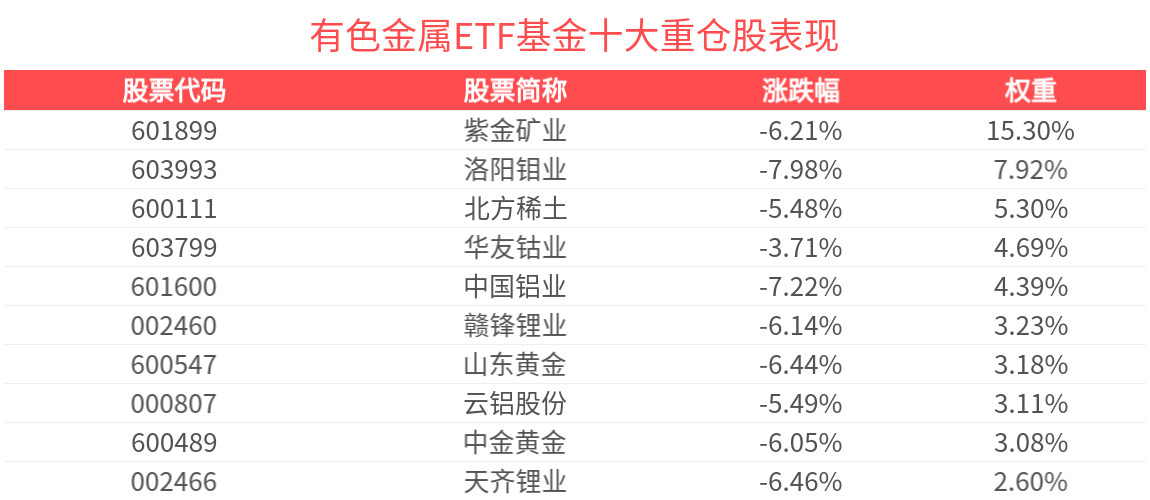
Group 1 - Gold and copper prices have declined, with COMEX gold futures dropping below $4950 and COMEX copper prices falling to $5.82. The non-ferrous metal ETF fund (516650) decreased by 6.07%, with stocks like Silver Holdings and Hunan Gold hitting the daily limit down, while companies such as Luoyang Molybdenum, Northern Copper, and Zhongfu Industrial also saw declines. However, the non-ferrous metal ETF fund has increased by 16.69% over the past month as of February 4, 2026 [1] - The Vice Secretary-General of the China Nonferrous Metals Industry Association, Duan Shaofu, announced the need to improve the copper resource reserve system during a press conference on the economic operation of the non-ferrous metals industry in 2025. Additionally, the U.S. has initiated a $12 billion critical mineral reserve plan ("Project Vault") to mitigate supply chain risks, which includes over 50 critical minerals identified by the U.S. Geological Survey, such as rare earths, lithium, and copper [1] - According to China International Capital Corporation (CICC), inventory replenishment is supporting copper prices, with strong demand for low-priced copper as downstream inventories are low. The upcoming spring peak season, combined with tight supply conditions and low TC/RC levels, is expected to further tighten copper supply and potentially increase copper prices [1] Group 2 - The non-ferrous metal ETF fund closely tracks the CSI segmented non-ferrous metal industry theme index. As of January 30, 2026, the top ten weighted stocks in the CSI segmented non-ferrous metal industry theme index (000811) include Zijin Mining, Luoyang Molybdenum, Northern Rare Earth, China Aluminum, and Huayou Cobalt, with these ten stocks accounting for 51.85% of the total weight [2] Group 3 - The following stocks in the non-ferrous metal ETF fund experienced declines: Zijin Mining (-6.21%, 15.30% weight), Luoyang Molybdenum (-7.98%, 7.92% weight), Northern Rare Earth (-5.48%, 5.30% weight), Huayou Cobalt (-3.71%, 4.69% weight), China Aluminum (-7.22%, 4.39% weight), Ganfeng Lithium (-6.14%, 3.23% weight), Shandong Gold (-6.44%, 3.18% weight), Yun Aluminum (-5.49%, 3.11% weight), Zhongjin Gold (-6.05%, 3.08% weight), and Tianqi Lithium (-6.46%, 2.60% weight) [3]

伦铜价格延续跌势 2月4日LME铜库存增加2525吨
Jin Tou Wang· 2026-02-05 03:08
Core Viewpoint - The LME copper futures prices continue to decline, with the current price at $12,980 per ton, reflecting a decrease of 0.46% from the opening price [1] Group 1: LME Copper Futures Performance - On February 5, LME copper futures opened at $13,123 per ton and reached a high of $13,197.5 per ton and a low of $12,947.5 per ton [1] - On February 4, LME copper futures closed at $13,040 per ton, down 2.76% from the previous day [1] Group 2: Market Data and Trends - The electrolytic copper spot price ratio between Shanghai and London was reported at 0, with an import loss of ¥602.79 per ton, compared to ¥536.38 per ton the previous trading day [1] - As of February 4, the Shanghai Futures Exchange reported copper futures warehouse receipts at 159,772 tons, an increase of 751 tons from the previous trading day [1] - LME registered copper warehouse receipts totaled 155,725 tons, with canceled receipts at 22,925 tons, a decrease of 14,150 tons, and total copper inventory at 178,650 tons, up by 2,525 tons [1]
主力资金监控:紫金矿业净卖出超15亿
Xin Lang Cai Jing· 2026-02-05 03:08
Group 1 - The main point of the article highlights that major funds have net sold over 1.5 billion in Zijin Mining [1] - In the early trading session, major funds saw net inflows in sectors such as food and beverage, pharmaceuticals, and film and television, while experiencing net outflows in the electric new energy, non-ferrous metals, and electronics sectors [1] - The electric new energy sector had a significant net outflow exceeding 15.3 billion [1] Group 2 - Pingtan Development reached the daily limit with a net buy of over 1.1 billion, leading the inflow rankings [1] - Companies like Zhongji Xuchuang, N Beixin-U, and Wangsu Technology also saw significant net inflows from major funds [1] - Zijin Mining faced the largest net sell-off, exceeding 1.5 billion, along with other companies like Tebian Electric, Xinyisheng, and Longi Green Energy experiencing notable net outflows [1]

铜冠金源期货商品日报-20260205
Tong Guan Jin Yuan Qi Huo· 2026-02-05 02:51
1. Report Industry Investment Rating - No specific industry - wide investment rating is provided in the report. 2. Core Views of the Report - Overseas, the US employment market has cooled at the beginning of the year, with a weak ADP employment report in January. The "high - price, weak - employment" pattern in the service sector continues. Global resource - related games are intensifying, and overseas market risk appetite is weak [2]. - Domestically, the A - share market continued to rebound on Wednesday, but the trading volume decreased. The market has entered a stage of rapid style rotation, with short - term shocks likely and a positive long - term outlook due to policy and fundamental support [3]. - For different commodities, their prices are affected by various factors such as macro - economic data, geopolitical situations, and supply - demand fundamentals, and different price trends are expected [2][3]. 3. Summary by Commodity Categories Macro - US 1 - month ADP employment increased by only 22,000, lower than the expected 45,000. The 1 - month ISM service PMI rose to 53.8, but employment was nearly stagnant and prices rebounded. Global resource - related games are intensifying, and overseas market risk appetite is weak [2]. - The A - share market continued to rebound on Wednesday, with the Shanghai Composite Index returning to 4,100. The market entered a stage of rapid style rotation, with short - term shocks likely and a positive long - term outlook [3]. Precious Metals - On Wednesday, international precious metal futures prices rose and then gave back some gains. COMEX gold futures rose 1.04% to $4986.40 per ounce, and COMEX silver futures rose 5.36% to $87.77 per ounce. - Investors are waiting for US employment data. The current precious metal price increase is a technical rebound, and blind chasing of the rise is not recommended [4][5]. Copper - On Wednesday, the main contract of Shanghai copper fell, and LME copper adjusted to around $13,000 for support. The domestic near - month C structure narrowed, and spot market trading improved. - The US 1 - month ADP employment was lower than expected, and the Fed may maintain a moderately loose stance. The Chilean Copper Commission predicts that copper production in 2026 will reach 5.613 million tons, a 3.7% year - on - year increase. Copper prices are expected to be in a short - term, shock - strong trend [6][7]. Aluminum - On Wednesday, the main contract of Shanghai aluminum closed at 23,690 yuan/ton, down 0.92%. LME aluminum closed at $3059/ton, down 1.29%. Aluminum ingot and aluminum rod inventories increased. - The US 1 - month ADP employment data was far lower than expected, and the more authoritative non - farm data is delayed. The consumption off - season continues, and aluminum prices are expected to fluctuate and adjust in the short term [8][9]. Alumina - On Wednesday, the main contract of alumina futures closed at 2727 yuan/ton, down 0.69%. Two previously - overhauled alumina plants in Guangxi plan to resume production on the 7th and 9th. - Overseas alumina prices have rebounded slightly, but the expected pressure of new production capacity in the future is high. Alumina is expected to oscillate at a low level [10]. Cast Aluminum - On Wednesday, the main contract of cast aluminum alloy futures closed at 22,215 yuan/ton, down 0.58%. Cast aluminum prices follow cost fluctuations, and overall cost support has moved up. - Market purchasing sentiment has slightly improved, but pre - festival inventory - building willingness is low. Cast aluminum is expected to maintain an oscillating and consolidating pattern [11]. Zinc - On Wednesday, the main contract of Shanghai zinc oscillated horizontally during the day and weakly at night, and LME zinc oscillated. The US data is mixed, and market risk appetite is dragged down. - The zinc market is in a stage of weak supply and demand. Zinc prices are expected to be under pressure and adjust [12][13]. Lead - On Wednesday, the main contract of Shanghai lead oscillated weakly during the day and horizontally at night, and LME lead oscillated. Downstream battery inventory - building is basically completed, and demand is poor. - However, secondary lead smelters have reduced production due to losses, providing weak support. Lead prices are expected to oscillate weakly and narrowly [14][15]. Tin - On Wednesday, the main contract of Shanghai tin oscillated weakly during the day and at night, and LME tin oscillated. The US dollar rebounded, and the earthquake in Myanmar may affect tin production. - Domestic downstream purchasing is limited, and tin prices are expected to continue to consolidate weakly after stabilizing [16]. Steel (Screw and Coil) - On Wednesday, steel futures oscillated. As the Spring Festival approaches, spot trading has shrunk rapidly. Steel mills' maintenance is increasing, and production has decreased. - The steel market is in a state of weak supply and demand, and prices are expected to oscillate in the short term [17]. Iron Ore - On Wednesday, iron ore futures oscillated and fell. Steel mills' pre - festival inventory - building is coming to an end, and spot prices are weakening. - Supply pressure remains, and iron ore prices are under pressure due to the pattern of strong supply and weak demand [18][19]. Coking Coal and Coke (Double - Coking) - On Wednesday, double - coking futures oscillated and rebounded. Indonesia has suspended coal exports, pushing up supply shortage sentiment. - Due to environmental policies, coking enterprise production is restricted, and supply is tightening. Prices are expected to be strong in the short - term [20]. Soybean Meal and Rapeseed Meal - On Wednesday, the soybean meal 05 contract fell 0.48%, and the rapeseed meal 05 contract fell 0.88%. US soybean prices rose sharply due to policy and trade sentiment. - South American supply is abundant, and pre - festival inventory - building is weakening. Soybean meal is expected to oscillate in the short term [21]. Palm Oil - On Wednesday, the palm oil 05 contract rose 0.42%. Malaysian palm oil inventory is expected to decline in January, and production is expected to decrease. - The US biodiesel policy is positive for US soybean oil, and palm oil is expected to continue to oscillate and adjust in the short term [22][23].
ETF盘中资讯|“小非农”数据不及预期,美联储降息预期升温!有色ETF随市盘整下挫,获资金净申购1500万份!
Sou Hu Cai Jing· 2026-02-05 02:34
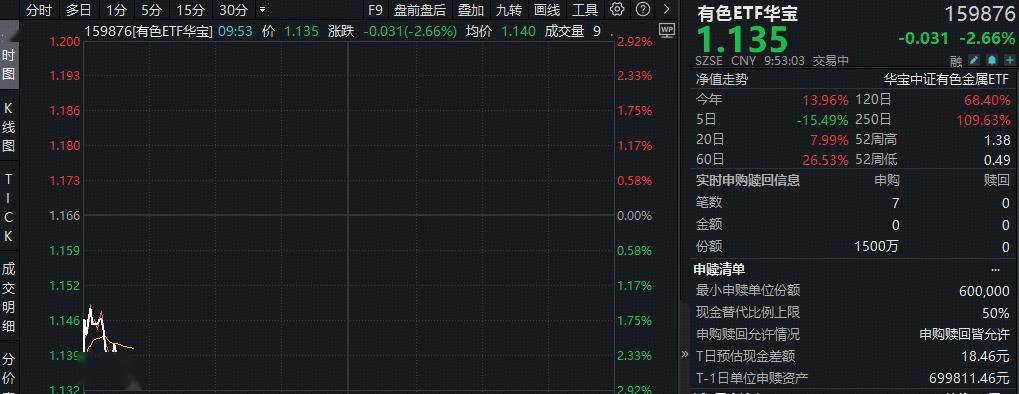
Core Viewpoint - The recent performance of the Huabao Nonferrous Metal ETF (159876) indicates strong investor interest in the nonferrous metal sector, with significant net subscriptions and a positive outlook for future performance despite short-term volatility [1][3]. Group 1: Market Performance - The Huabao Nonferrous Metal ETF experienced a decline of 2.66% in price, with a real-time net subscription of 15 million units and a total of 174.9 million yuan attracted yesterday [1][2]. - Over the past 20 days, the ETF has accumulated over 1.2 billion yuan, reflecting a strong belief in the sector's future performance [1]. Group 2: Sector Dynamics - Macro factors such as a slowdown in the U.S. labor market and expectations of interest rate cuts by the Federal Reserve are influencing investment strategies in the nonferrous metal sector [3]. - Mining companies are actively acquiring assets, with notable transactions including the acquisition of Brazilian gold mines by Luoyang Molybdenum and a significant purchase by Zijin Mining [3]. Group 3: Price Trends and Projections - Prices for gold, copper, aluminum, zinc, tin, and nickel have seen significant increases, positively impacting the earnings forecasts for major mining companies like Luoyang Molybdenum and Zijin Mining [3]. - Analysts predict that the high profitability in the nonferrous metal sector will be sustained for 3-5 years due to supply-demand mismatches, macroeconomic easing, and industrial upgrades [4]. Group 4: Investment Strategy - The Huabao Nonferrous Metal ETF provides comprehensive exposure to various metals, including precious and strategic metals, making it an efficient tool for investors looking to capitalize on the sector's performance [5]. - Recommendations suggest maintaining a 10%-20% allocation to the nonferrous metal sector within investment portfolios to benefit from potential price increases while managing risk [4].
综合晨报-20260205
Guo Tou Qi Huo· 2026-02-05 02:25
gtaxinstitute@essence.com.cn 综合晨报 2026年02月05日 (原油) 夜间交易时段国际油价上涨。伊朗方面此前传出谈判取消的消息,随后伊朗外交部长阿拉格齐澄清 指出,伊朗与美国将于6日上午10时左右在阿曼首都马斯喀特举行会谈。EIA数据显示,受冬季风暴 影响,上周美国原油库存超预期大幅下降,产量亦降至2024年11月以来最低水平。目前美伊谈判前 景仍存在较多不确定性,但整体冲突局势仍属可控,预计对原油价格的影响更多是阶段性与间歇性 的,难以形成趋势性转变。全球石油市场累积的压力依然显著。在多空因素交织的背景下,预计油 价将延续波动加剧的态势。 【责金属】 隔夜贵金属震荡,波动依然较大。美国经济数据喜忧参半,1月ADP就业人数增加2.2万人低于预期 的4.8万人,不过ISM非制造业PM153.8与此前公布的制造业PMI均体现经济韧性,市场关注的非农就 业将推迟到下周发布。短期资金博弈激烈,贵金属进入高位盘整阶段,暂时观望等待波动率下降。 国投期货研究院 【铜】 隔夜铜价高位震荡,沪铜减仓,市场关注潜在储备与春节前后国内供求变动。倾向正向价差强化能 形成天然仓单储备。更关注跨期反套。 ...
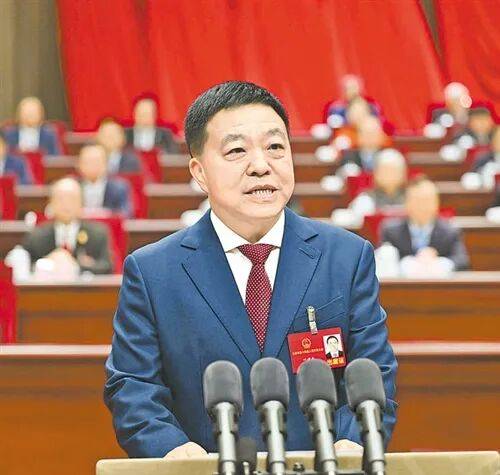
江西省政府工作报告全文发布:推动剩余地方政府融资平台全部退出
Sou Hu Cai Jing· 2026-02-05 02:07
Economic Growth and Targets - The expected economic growth for Jiangxi Province in 2026 is set at 5%-5.5%, with industrial added value growth above 7.3% and fixed asset investment growth around 3.5% [28][29] - The retail sales of consumer goods are projected to grow by over 4.5%, while urban and rural per capita disposable income is expected to increase by approximately 4.5% and 5.5%, respectively [28][29] - The consumer price index (CPI) is anticipated to rise by about 2%, and the urban unemployment rate is targeted to be controlled at 5.5% [28][29] Investment and Infrastructure - The government plans to stabilize investment scale by implementing the "Ten-Hundred-Thousand" project, with 5,296 major projects and an annual investment completion of around 1.1 trillion yuan [29] - Investment direction will focus on new productivity, new urbanization, and comprehensive human development, with a scientific layout for new infrastructure projects like 5G-A and computing power [29] - Efforts will be made to enhance project planning and reserve mechanisms to secure more projects under central budget investment and new policy financing tools [29] Real Estate Market - The government aims to stabilize the real estate market by implementing city-specific policies, linking land supply with the de-stocking cycle of unsold properties, and promoting the construction of "good houses" [29] Financial Risk Management - Continuous efforts will be made to reduce financial risks, improve monitoring and early warning mechanisms, and promote the reform of small and medium-sized financial institutions [30] Social Development and Welfare - The government has committed to fulfilling ten key livelihood projects, with urban employment and entrepreneurial loan issuance exceeding planned targets [12] - Per capita disposable income for urban and rural residents is projected to grow by 4.3% and 5.7%, respectively [12] Environmental Quality - The ecological environment quality indicators for water and air are expected to maintain excellent levels, with carbon emission control meeting national targets [28][29] Innovation and Industry Development - The province is focusing on technological and industrial innovation, with significant achievements in high-tech manufacturing and the establishment of national laboratories [8][9] - The digital transformation of manufacturing is being promoted, with over 14,000 enterprises undergoing upgrades and 34 projects entering the national 5G factory directory [9] Regional Coordination and Urban-Rural Integration - The government is working on a coordinated development strategy for urban and rural areas, with policies to support regional growth and urban renewal projects [11][40] - Agricultural modernization and rural infrastructure improvements are also key focuses, with significant investments in agricultural enterprises and rural housing [11]